Summary
- The Assisted Registry Check is described as an initiative by the RIPE NCC to enhance the traditional audit process that all LIRs are required to take part in, checking the quality of registry data and offering to assist where improvements are needed.
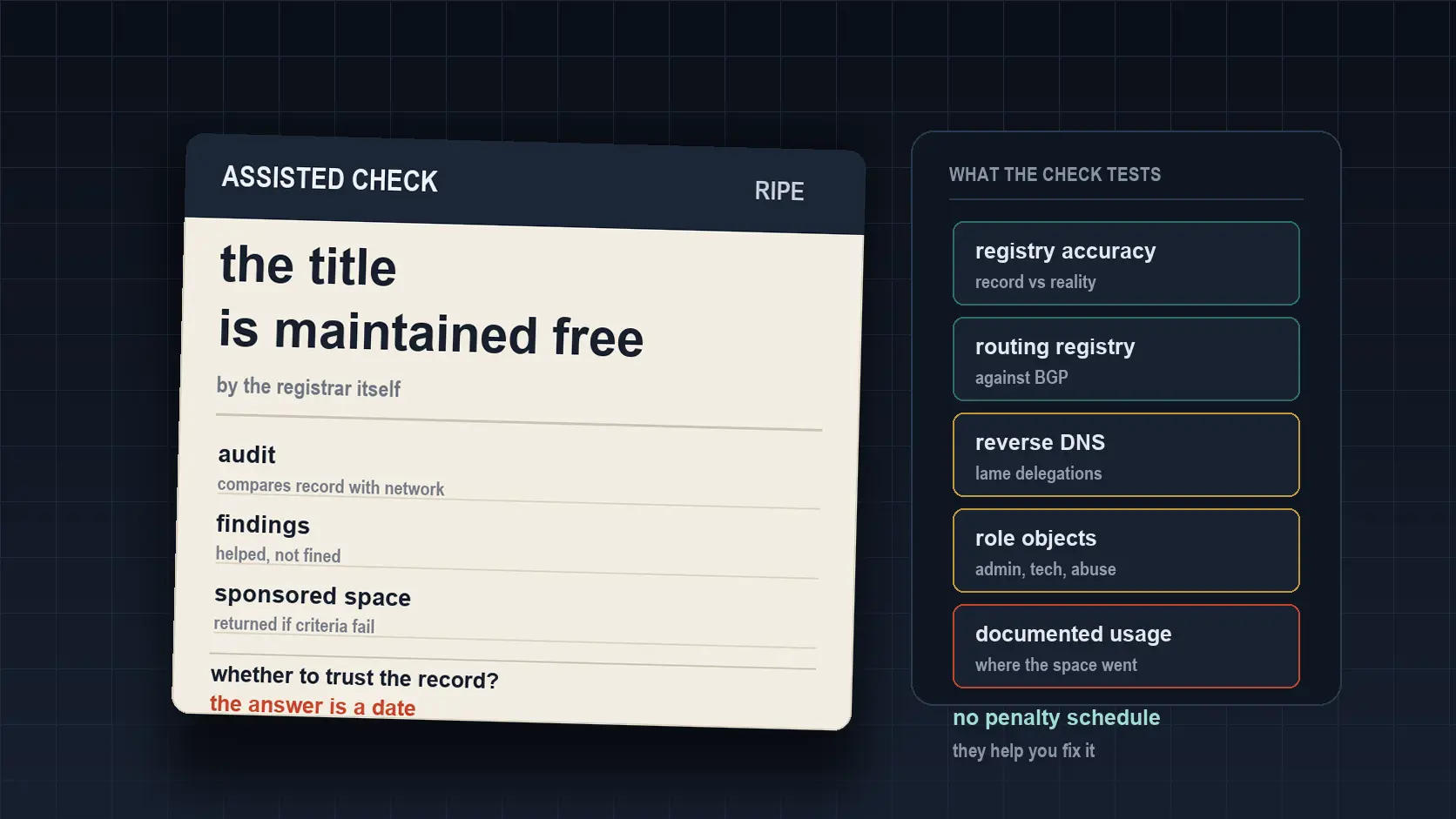
- The review covers registry data accuracy, mismatches between the routing registry and actual BGP announcements, reverse DNS problems including lame delegations, role objects used as admin-c, tech-c and abuse-c contacts, documentation of usage, and the resources an LIR sponsors for end users.
The registry checks the claim against the network
Most registry accuracy work is a form: fill in who holds what. This audit is different in kind. It compares the routing registry to what is actually announced in BGP, and it looks for reverse DNS delegations that do not answer. Those are not filing errors; they are tests of whether the network behaves the way the record says.
That makes the review the closest thing this industry has to a title search with a site visit. A block's value rests on the registry believing a named holder uses it. The audit samples exactly the evidence a dispute would use: an announcement, a working reverse zone, a reachable contact role.
Everything is checked, nothing is fined
Read the whole page and the posture does not change. The registry identifies and resolves inconsistencies, locates and fixes reverse DNS issues, provides "tailored support for creating and updating RIPE Database objects", and offers guidance on policy compliance with recommendations for improving services. The stated benefit is efficiency: a less time-consuming audit for the LIR.
There is no penalty schedule in this document. A registry that wanted to be feared would put one there. This one offers to do the correction with you, which is cheaper for both sides and quietly transfers the definition of correct to the reviewer.
The small rules that decide who is reachable
Two details are structural. Role objects carry the contact details of a team, and the page states they are "the only object type that can be used for the abuse (abuse-c) contact". Documentation of usage is not optional either: to comply with IPv4 and IPv6 policy, LIRs must make sure all networks are properly registered according to the registration requirements for addresses considered in use.
So the audit reads the difference between holding space and being able to show where it went. That difference is the same one a transfer application turns on, and the same one somebody will quote back at you if your record has drifted.
The one clause that takes something away
Sponsored resources get a sentence with teeth. They are issued directly from the RIPE NCC to the end user and remain with them as long as the original criteria for approval are met, and if the end user no longer requires them they must be returned to the RIPE NCC. Everywhere else the tone is assistance; here the continued holding is conditional on criteria that the audit is in a position to observe.
That is the real product of a friendly audit. It creates a regular, documented moment at which the registry can notice that the reasons for a hold no longer exist, without ever having to open a case.
What is not published
The page describes what is reviewed and not how often, not what share of reviews find a BGP mismatch, a lame reverse delegation or a missing role object, and not what happens when a finding is never fixed. Those rates are the only way to tell whether the audit is a cleaning service or a formality, and the document that defines the check does not report them.
Sources
Member Briefing
Read the full trend briefing
Members read the full briefing with the source notes behind every finding.
Strategic Circle
A daily briefing in your language, built from changes we have verified.
Join for USD 20/monthCancel anytime.
Members also get the full research library, a daily briefing on the networks they follow and the private forum.