Summary
- The French State acquired 80% of Alcatel Submarine Networks from Nokia, with the sale completed on 31 December 2024 at an enterprise value of EUR 350 million and Nokia retaining 20% plus board representation until an exit that no document read dates.
- ASN's own 2025 sustainability report puts every repeater and branching unit it builds in Greenwich, not Calais; Calais manufactures the cable, assembles it with the submerged equipment, tests the system on site and loads it onto ships. Those statements rest on search-engine excerpts of the PDF, because the file itself was refused as too large.
- Three documents print three company censuses: 2,400 people on four European sites in the finance ministry's release, 2,000+ people on three plants in ASN's report, and 2,000 people with two factories in the regional business press. The perimeters differ; none is a correction of another.
- In March 2026 ASN committed approximately EUR 100 million over 2026 to 2028 to its Calais and Greenwich plants — the same order of magnitude as the roughly EUR 100 million in cash that third-party reporting attributes to the State's purchase after debt is stripped out.
The paperwork has three dates and they are not interchangeable. Nokia signed a put option agreement with the French State on 27 June 2024, contemplating the sale of ASN at an enterprise value of EUR 350 million, with the State taking 80%, Nokia holding 20% with board representation until a targeted exit, and completion expected at the end of 2024 or the beginning of 2025 subject to employee-representative consultation and regulatory approvals (Nokia, 27 June 2024). Antoine Armand, then the minister, signed the contract acquiring 80% of the shares at Calais on 5 November 2024 (ministry release). The transaction itself completed on 31 December 2024 and was announced on 3 January 2025 (Nokia, 3 January 2025). Nokia's 2024 annual report files the retained fifth where a minority holding belongs, as an investment in an associate, and states the plan that the French State will acquire the remainder at targeted exit (Nokia 2024, Note 6.4).
A signature, a completion and an accounting treatment are three different facts about one asset. The ministry's release adds a fourth: the agreements discussed with Nokia provide, in time, the possibility for the State to acquire 100% of the capital, with Nokia remaining a minority shareholder in a first phase to facilitate the transition.
The correction this article owes
This piece began from a working assumption that the sale handed the West its only scaled repeatered-cable factory, and that the factory was in Calais. The documents refuse both halves of that sentence.
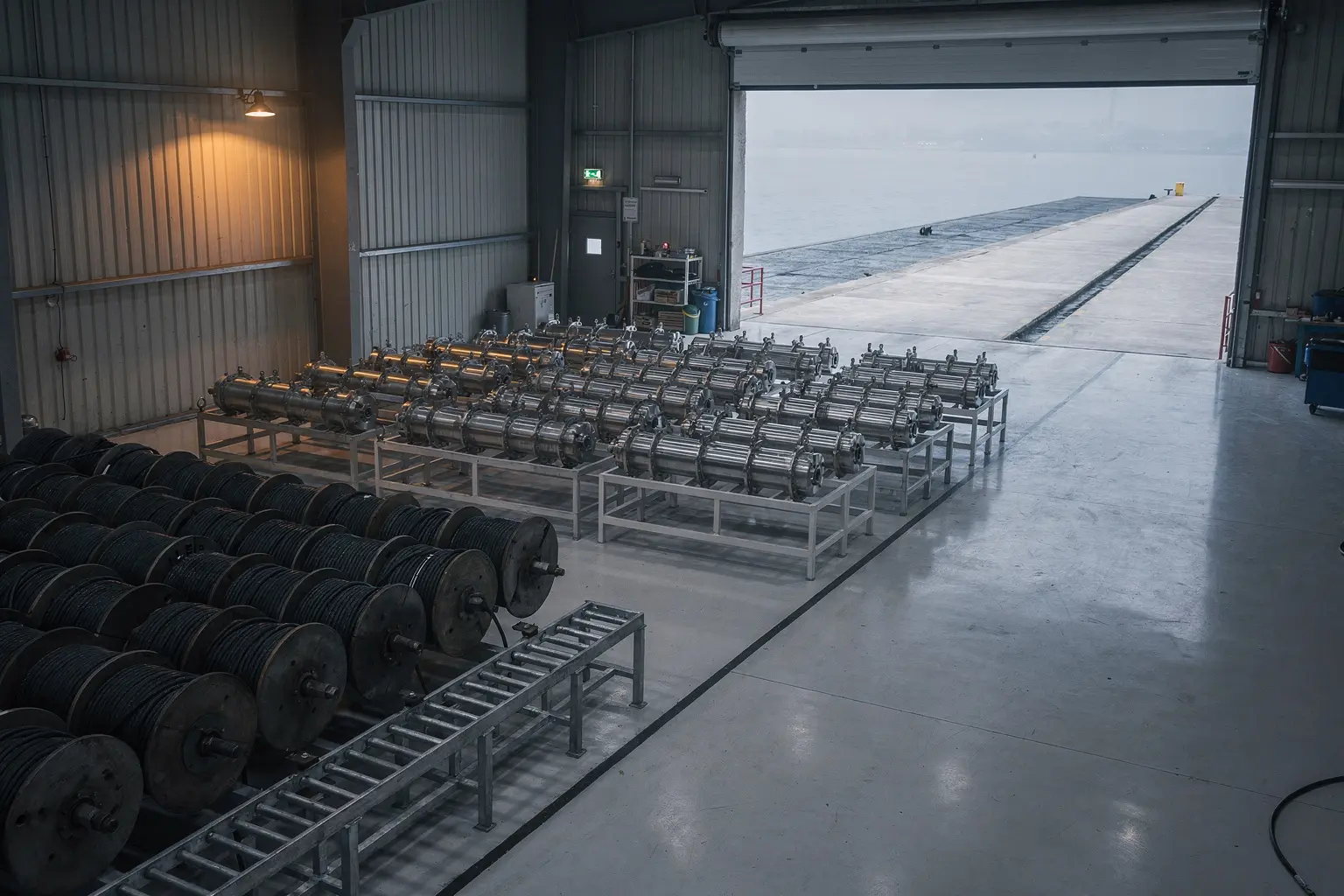
The first half fails on geography. ASN's own account of its industrial footprint puts the submerged equipment — the repeaters and the branching units — in London Greenwich: "Greenwich is responsible for producing all of the submerged equipment, repeaters, and branching units, which will then be shipped to Calais for assembly into the system" (ASN, Sustainability Report 2025). Calais, at 160,000 m² the largest of the three plants, is where "the cable is manufactured and assembled along with other subsea equipment to form systems that are loaded onto ships once tested on-site". The third plant, in Trondheim, "specializes in the assembly of equipment for the energy market: DAS interrogators and PRM stations".
Those three sentences come from search-engine excerpts of the exact PDF, not from the document itself: the retrieval adapter refused the file as too large to fetch, so the report was read in fragments rather than opened. That is a weaker grade of evidence than a page read, and it is stated here because a division of labour between plants is exactly the kind of claim that a summary can flatten.
The second half fails on evidence. No document read for this article says Greenwich is the only repeater plant in the West, or that ASN is the only supplier of repeatered systems, or that anyone has counted the alternatives. ASN's report says Greenwich produces all of the submerged equipment that ASN builds. It says nothing about anyone else's, and an internal totality is not a market census.
What survives is narrower and more useful. The asset the State bought has a division of labour in which the most specialised component sits in one plant in one country, and the assembly, test and load-out of the finished system sits in another. That is a supply-chain structure a reader can check. A claim about being the last of something is not.
Three counts of one company
The census problem starts with the buyer's own announcement. The ministry release prints the company's industrial capability in one sentence: "Les compétences industrielles et technologiques d'ASN sont mises en œuvre par 2 400 collaborateurs sur 4 sites en Europe : Norvège, Royaume-Uni, France (Les Ulis et Calais)." Two thousand four hundred people, four sites, and a list that counts France twice — Les Ulis and Calais — because a head office is a site of employment even when it is not a factory.
ASN's own report counts differently: three production sites, Calais, London Greenwich and Trondheim, and "Number of employees: 2 000+", with the company described as a wholly owned subsidiary of the Nokia Group until 31 December 2024 and the 2025 report prepared voluntarily on a VSME basis because ASN is not yet subject to the CSRD (ASN, Sustainability Report 2025).
The regional business press counts a third way. Le Journal des Entreprises prints the head office at Les Ulis and two factories: "Alcatel Submarine Networks, dont le siège se situe aux Ulis (Île-de-France), possède deux usines : l'une à Calais, dans les Hauts-de-France et l'autre à Greenwich, en Angleterre." The same piece prints revenue above EUR 1 billion, 2,000 employees worldwide, 1,370 in France and about 600 at Calais (Le Journal des Entreprises, 5 November 2024).
Three printings, then: 2,400 people on four European sites; 2,000+ people on three plants; 2,000 people, two factories, 1,370 of them in France. The gap between the largest and smallest headline is 400 people, which is a fifth of the smaller figure. The reader who wants one number has to choose which document to believe. The reader who wants an accurate number has to notice that the documents are not describing the same set.
The reconciliation is mine, not any source's. Four sites equals three plants plus a head office at Les Ulis. Two factories equals two of the three plants, and the plant that disappears from the press count is Trondheim — the one that assembles equipment for the energy market rather than for cables. That is consistent with the state's own communication, which was written around the plants an undersea-cable customer would recognise. It is also the reason no single figure can be adopted: a count of factories and a count of sites are different objects, and a headcount can be restricted to one country without saying so.
None of the three documents presents itself as a revision of the others. They were published on different dates, for different purposes, and not one of them states the date on which its headcount was measured or the perimeter it covers. That shared silence is what makes them a set rather than a disagreement.
The price, and the number nobody printed
EUR 350 million is the enterprise value from the June 2024 announcement, and it is repeated in reporting to this day (telecoms.com). It is not the cash the State found. Third-party reporting attributes to the French business press the figure that, once debt is removed, the State pays around EUR 100 million for its 80% (telecoms.com).
That second number deserves a label rather than a citation. It is a third-party attribution, published in a trade outlet whose article was read only as a search excerpt, and none of the primary documents retrieved for this article prints a debt figure, an equity figure, a completion adjustment or a purchase-price allocation. The ministry's release does not print a price. Nokia's announcement prints an enterprise value. Nokia's annual report prints a retained associate interest without a valuation line in the note read here.
So the gap between EUR 350 million and roughly EUR 100 million is real in the reporting and unverified in the primary record: three documents could close it, and none of them was obtained.
What is verified is the direction and the structure. The State bought 80% and can, in the ministry's own words, "acquérir 100% du capital de l'entreprise" in time, with Nokia staying on as a minority shareholder in a first phase. A purchase with a scheduled path to full ownership is a different instrument from a purchase that leaves a permanent private partner, and the ministry printed which one this is.
A hundred million into two of the three plants
On 12 March 2026 ASN announced an investment of approximately EUR 100 million over three years, 2026 to 2028, in its factories in Calais and Greenwich, under a plan called Ambition 2030: "This plan includes the renovation and expansion of a building at the Calais site as well as the fit-out of a new building at the Greenwich site" (ASN, 12 March 2026). The same release carries the corporate boilerplate that has travelled furthest: more than 165 years of history, 80% ownership by the French State investment agency (APE), three factories in Europe, an exclusive fleet of seven cable-laying vessels and more than 850,000 km of cable deployed.
Two things follow from the sentence about buildings, and neither is a matter of interpretation. The capital goes to two of the three plants. Trondheim is not in the programme. And the two plants that receive it are precisely the two that the state's communication and the regional press count: Calais and Greenwich.
The comparison a reader will want to make is the one between the capital programme and the cash price. Roughly EUR 100 million over three years against roughly EUR 100 million once debt is stripped from the enterprise value: the same order of magnitude, arrived at from two unrelated documents and one third-party attribution. The comparison is mine, not ASN's and not the ministry's, and the two quantities are not the same kind of thing — a three-year building programme is a flow of capital, a purchase consideration is a stock of money paid once. They are comparable in scale and in nothing else.
What the release does not say is what the buildings will do. A renovation and expansion at Calais and a fit-out of a new building at Greenwich are physical works. Whether the new Greenwich space adds repeater output, replaces existing lines, consolidates scattered activities or houses test equipment is not stated. For a company whose most specialised component is manufactured in a single plant, that is the number an outsider would need, and it is the one the announcement does not carry.
The fleet, the plant and the floor that keeps moving
The easiest number to quote about ASN is the length of cable it has deployed, and it is the one that changes the most. The ministry's November 2024 release prints more than 750,000 km (ministry release). ASN's March 2026 release prints more than 850,000 km (ASN, 12 March 2026). Sixteen months, one hundred thousand kilometres.
Both numbers are floors. Neither document says what was measured, over which period, on which basis, or whether the count includes cable manufactured for others. A difference between two floors is not a measurement of anything, and the honest statement is the one the documents support: ASN's printed floor rose by at least 100,000 km between November 2024 and March 2026. It may have risen by more. It cannot have risen by less without one of the two releases being wrong, which nothing read here suggests.
The fleet is the other headline asset, and it is printed more consistently: seven cable-laying vessels, described by ASN as exclusive, in both the ministry release and the company's own boilerplate. Seven ships and three plants are different kinds of constraint. A ship can be repositioned; a repeater line cannot. That asymmetry is the reason the plant census matters more than the fleet count, and the reason both prior and current coverage of this company have tended to quote the ships.
What an operator can and cannot price
If you are the buyer of a new repeatered system, the documents read here give you a supplier's plant map and nothing you can schedule against. There is no statement of repeater output, no unit count, no lead time, no order book, no backlog value, no statement of how many systems Calais can assemble and test in a year, and no statement of how many ships can load out simultaneously. ASN's sustainability report prints plants, functions and a headcount band. Its investment release prints a capital figure and the buildings it buys. Neither is an operating statement.
What you can establish is where the risk sits. The submerged equipment is produced in Greenwich and shipped to Calais for assembly into the system. The system is tested on site at Calais before it is loaded onto a ship. Those two sentences, taken together, mean that one plant in one country produces the component that cannot be substituted from the assembly site, and one plant in another country performs the integration, the test and the load-out. A delay or an interruption at either end is not absorbed by the other. Nothing in the documents says either plant has a second site for the same task, and nothing says it does not.
The supply-chain question that motivated this article — what single-source cable supply costs the operators now ordering systems — does not answer in euros or in months. It answers as a disclosure gap with a specific shape. A buyer can learn who owns the supplier, where the plants are, which plant makes what, how much capital is going into two of them, and how many ships exist. A buyer cannot learn from these documents how much of anything the plants can produce, or how long a system takes. For a market where systems are ordered years ahead of the traffic they carry, that is the relevant absence.
The delta against what BTW has already published
This publication has covered Alcatel Submarine Networks three times, and this article does not re-tell those pieces. One covered the June 2024 agreement, the 80/20 split, the EUR 350 million enterprise value, the EUR 100 million investment plan and the disagreement between seller pages about the transfer date. One covered what remained visible after the State's purchase and found a press release and no readable fleet or order book. One used the company's capacity arithmetic to show that 24 lit pairs of a 28-pair cable produce 624 Tbps and that the remaining four pairs are not stated to be included.
The addition here is the plant. Specifically: the division of labour between Calais, Greenwich and Trondheim as ASN itself describes it, the three-way census that three different documents print for the same company, and the fact that the capital programme announced in March 2026 goes to two of the three plants while the third drops out of both the state's communication and the press count. Read together with the earlier pieces, the picture is of a purchase whose reported price is well documented, whose industrial base is documented in outline, and whose production capacity is not documented at all.
The documents, and how each was read
Eight documents, retrieved on 20 November 2026, carry every factual statement above. Four were read as full page text through the retrieval adapter: the French finance ministry release of 5 November 2024, Nokia's 2024 annual report note on EDGAR, ASN's investment release of 12 March 2026, and Le Journal des Entreprises of 5 November 2024. Three were read only as search-engine excerpts of the exact URL: both Nokia newsroom pages, which returned HTTP 403 to direct retrieval, and ASN's 2025 sustainability report, a PDF the adapter refused as too large.
One, the trade report on the debt-adjusted consideration, was a search excerpt whose page was not opened.
What that means for this article's confidence is uneven and worth stating plainly. The transaction sequence, the 80/20 split, the ministry's census, the SEC treatment of the retained stake, the capital programme and the regional press census all rest on text read in full. The three-plant division of labour, the 2,000+ headcount and the enterprise value rest on excerpts. The division of labour is the most load-bearing excerpt-grade claim in the piece, and it is the one a reader should treat with the most caution.
No ASN financial statements, order book, capacity figure, repeater output figure or customer list was obtained. No interview was conducted and no site was visited. The three headcounts are not stated by their publishers to share a date or a perimeter, and are therefore reported rather than reconciled. The reconciliation of four sites to three plants plus a head office, and of two factories to two of the three plants, is my analysis and is labelled as such. The comparison between roughly EUR 100 million of capital expenditure and roughly EUR 100 million of cash consideration is also mine, and it compares a flow to a stock.
Nothing here concerns the contractual terms, prices or volumes of any named operator, and no document read states why the State bought the company, what it intends to do with the plants beyond the works announced, or whether the remaining 20% will change hands.
Member Briefing
Read the full trend briefing
Members read the full briefing with the source notes behind every finding.
Strategic Circle
A daily briefing in your language, built from changes we have verified.
Join for USD 20/monthCancel anytime.
Members also get the full research library, a daily briefing on the networks they follow and the private forum.