
Summary
- Prospero let users and maintainers create virtual directory views over files and indexes that remained on remote systems; it organized references rather than moving or interpreting the underlying data.
- The 1993–94 record describes links to Archie, Gopher and planned WAIS and Web resources, but a 2005 RFC later says the protocol was not widely implemented.
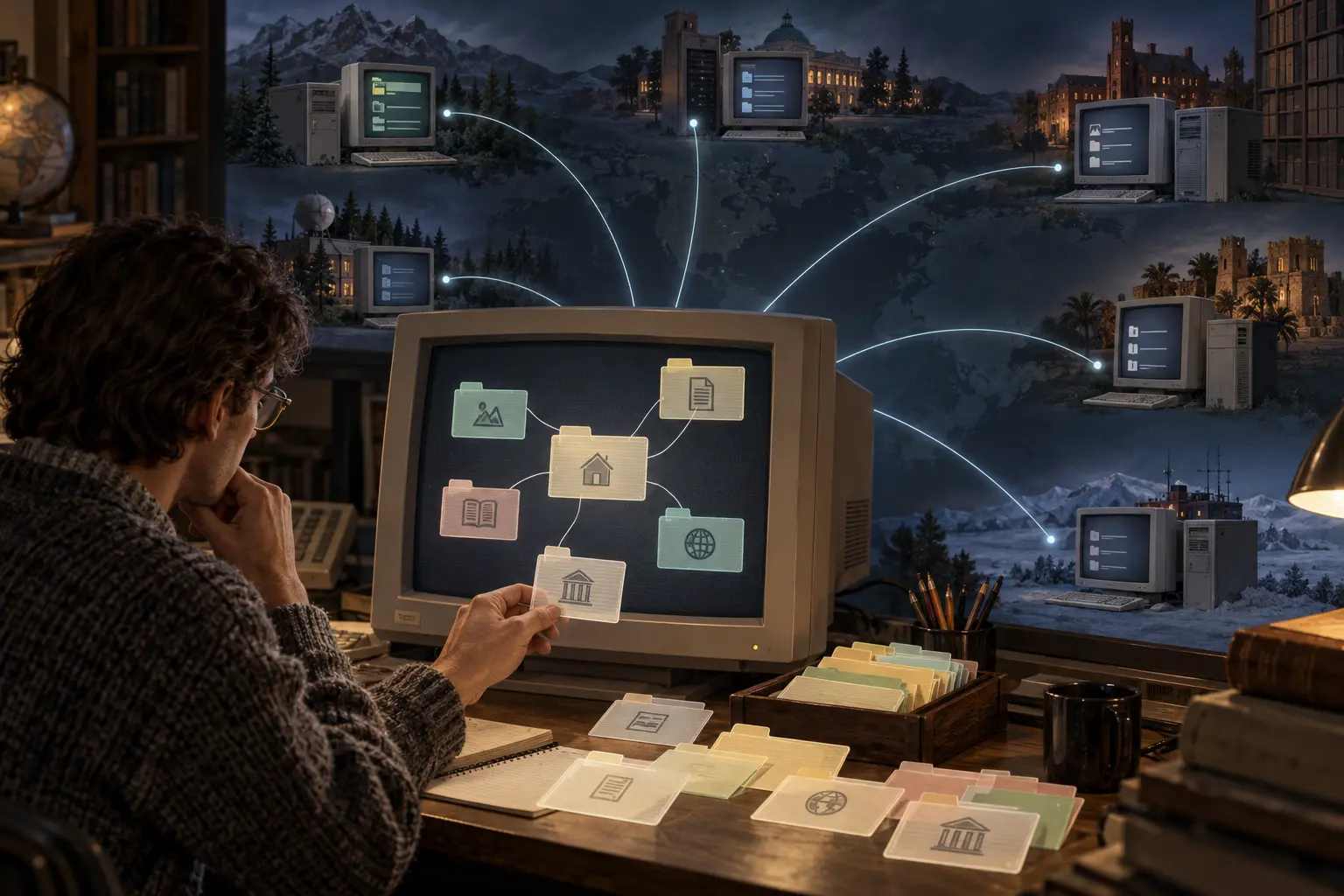
A directory could be a point of view
A file directory usually looks like a property of the machine that stores the files. Prospero proposed a different answer: what if a directory were a view assembled across machines, with the user’s organization kept separate from the resources themselves?
The distinction was practical. By the early 1990s, people could search FTP archives with Archie, browse Gopher menus, query WAIS databases and follow the emerging World Wide Web. Those systems exposed different kinds of information through different interfaces. Finding a useful item did not make it part of a person’s own working map. A researcher might want one directory for a project, with entries drawn from several institutions, without copying the files into a new central repository.
Prospero’s Virtual System Model supplied that organizing layer. A server could publish information about selected parts of its filesystem or expose material from another database. Users and maintainers could also create customized views of the namespace. The directory entry could point toward a resource while the resource remained where its publisher kept it. The network map was personal and distributed at once: one coherent view, assembled from locations that did not have to merge.
The layer between finding and fetching
This was not simply Archie with a different name. Archie built an index of FTP archive filenames and locations so that a query could identify candidates. Prospero could make the Archie database available as one source inside a larger directory view. Nor was it just Gopher: Gopher’s familiar menus organized material for browsing, while Prospero’s server could treat Gopher servers as databases and combine their contents with other sources.
The boundary mattered because Prospero did not claim to understand the data. The 1994 networked-information report says it could provide retrieval mechanisms, but display and use belonged to the user’s application. It had no separate file-transfer protocol of its own: access could proceed through FTP, NFS, AFS or Gopher, with Telnet for login-based services. Prospero could help a client decide where a resource was and how it might be reached; it did not guarantee that the file was current, readable, authorized or useful.
That separation made the design extensible. A directory could gather different services without forcing them into a common storage system or content format. It also left real work at the edges. A pointer could outlive its target, a remote server could refuse access, and a client still needed the right method to fetch and present what it found.
A network map with rules and boundaries
Prospero directory requests ran over UDP with a reliable message-delivery layer described by the project. The design also included access controls on objects, directories and indexes. The 1994 report lists several authentication choices, from client assertion and trusted ports to passwords and Kerberos version 5. Those options show that a virtual directory was not necessarily an open public list: maintainers could decide who could inspect or use particular parts of it.
The prospero URL scheme made the separation visible. A URL named a host-specific object that the Prospero server interpreted. Contacting that server could return an underlying access method, potentially represented by another URL. The string was not itself a promise that the target existed or that a user could retrieve it. Even a slash in the name did not guarantee hierarchical meaning. The server, rather than the punctuation alone, defined the object.
This resembles a map more than a warehouse. The map can connect places and give a reader a route, but it neither owns the places nor ensures the road is open. Reading Heng Lu’s notes on directories and distributed authority as an editorial lens, not as evidence about Prospero’s designers, helps keep that distinction clear: a catalogue of pointers is not control over the resources it describes.
Ambition was easier to document than adoption
In its 1994 status report, the project listed approximately 50 Prospero servers, with the server and client information last updated in November 1993. That is a dated project-reported estimate, not a measure of unique users, active directories or Internet-wide market share. The same report described working links to Archie and Gopher and plans for WAIS indexes and Web documents. Some integrations were available; others remained future work.
A decade later, RFC 4157 retained the URI scheme while moving it into a Historic document and stated directly that the Prospero protocol had not been widely implemented and that almost no servers remained in use. The later judgment does not erase the design experiment. It does change what the history can claim: Prospero demonstrated a way to let people arrange distributed resources, but did not become a broadly deployed directory layer.
That outcome points to more than a technical shortcoming. The value of a personal map depended on maintainers publishing useful views, clients understanding the namespace, integrations staying current and users finding the added layer worth learning. A design could bridge services elegantly while still asking multiple communities to adopt and maintain the bridge.
Prospero’s lasting historical question is therefore not whether it invented a later system. It is whether discovery should produce one authoritative global index or many locally meaningful maps over resources held elsewhere. Prospero made the second option concrete. Its architecture separated organization from storage and naming from retrieval; its modest footprint shows that good separation alone cannot create an ecosystem.
Sources
Member Briefing
Deeper Profile Context
Sign in with the right membership level to unlock the full briefing and source notes.
Only for Strategic Circle
Strategic Circle
Open to all readers. Unlock profile briefings after joining and signing in.
Join Strategic CircleOnly for Leadership Alliance
Leadership Alliance
For qualified IP-asset owners and management; sign in to unlock alliance briefings.
Join Leadership Alliance