
Leaders
Leaders
Leaders people intelligence profiles the leaders, operators, researchers, creators, investors, and policy actors shaping internet infrastructure strategy. The category connects interviews, public profiles, company links, role changes, governance exposure, affiliation context, and related articles so readers can follow decision-makers by operating role rather than by isolated article chronology.

Latest Coverage
Latest from Leaders
1,338 articles

Leaders
Shaila Sharmin Knows What Trust Costs. APNIC’s Abuse Policy Stopped at the Mailbox.
The APNIC Policy SIG Co-Chair works in bank security, where “reachable” is only the first control on the path. The proposal she introduced at APNIC 62 tried to find the person who can actually handle an abuse report; it returned to the mailing list without an agreed test.
Leaders
Bikram Shrestha Called No Consensus. Christopher Hawker Asked Which Objection Still Counted.
At APNIC 62, the Policy SIG Chair presented himself as a neutral facilitator. A disputed decision on smaller IPv6 allocations was declared twice, and the public record still does not show how support, objections and the remote poll produced the result.

Leaders
Oanh Nguyen Chairs a Forum for 15,000 Members. Its Charter Promises a Conversation.
APNIC’s new profile traces Oanh Nguyen from IP hostmaster to NIR SIG Chair. The forum’s public mandate is information sharing and cooperation, so its test is whether the conversation leaves an agenda, an owner and an action.
Leaders
Christian Johnson Has the SOC 2 Audit. The Public Gets the SOC 3 Summary.
ARIN Online has completed its first SOC 2 Type II audit. Christian Johnson announced the result, but the public download is a summary SOC 3 report; the full SOC 2 evidence remains available only through an Ask ARIN request.
Leaders
Alison Wood’s Four-Block Waitlist Fix Uses “Noncontiguous” and “Contiguous” in the Same Policy
ARIN-prop-356 would let four scattered `/24` blocks satisfy one `/22` waitlist request. The problem statement is clear; the policy text then switches back to “contiguous,” while its comment repeats an unrelated 12-month transfer rule.

Leaders
Eric Landgraf Wants ARIN’s IPv6 Reserve to Keep Small Dual-Stack Networks Alive
ARIN-prop-354 would let operators below a `/22` use part of the 4.10 pool for IPv4 service to end devices. Landgraf’s own filing names the trade: a reserve built for IPv6 becomes a limited support line for IPv4.

Leaders
Christian Seitz Kept the IPv6 Chair Seat Without a Challenger. The Room Still Had Harder Problems.
RIPE 93 recorded one continuing candidate for the IPv6 working-group chair. In the same session, ILNP and Windows CLAT showed how much operational change still depends on a small volunteer bench.

Leaders
Hans Petter Holen: an appointing clause, and no end date
RIPE NCC's board minutes print the day Hans Petter Holen became a Managing Director and the day three other Managing Directors stopped being one. They never print the day his own appointment ends.

Leaders
Graciela Martínez counts incidents. The counted thing keeps changing
Nine years of LACNIC CSIRT incident numbers share one property: each arrives in a different unit. The person who signs them is also the credited author of the plan that asks every other organisation to name theirs.
Leaders
Six slots, no duty: what a LACNIC credit block never says
LACNIC's technical reports open with the same four lines: who wrote it, who is credited with coordination and revision, which edition, which department. Between 2017 and 2024 Guillermo Cicileo's name fills six different slots in that architecture — sole author, co-author…

Leaders
Chris Caputo published 18 drop tests and one unmeasured number
Chris Caputo published 18 drop tests and one unmeasured number intelligence summary explains the development, the public evidence available to readers, the organisations involved, the regional context, market exposure, and the infrastructure consequences that may follow. The…

Leaders
The record prints Vyncke's objection. It never prints the answer.
Éric Vyncke files objections that stop documents, and the Datatracker pages print every word of them, alongside the date he takes the stop back. What none of the five records reviewed for this piece prints is the edit that satisfied him. In a review system whose own rulebook…

Leaders
Denis Walker counts the days; the jurisdictions stay round
His abuse framework hands a resource holder a cure period measured in business days. The sentence that justifies the whole design measures nothing at all.

Leaders
RIPE NCC Counts Blocks. The Rule Lives in an Article.
The registry publishes a file of every policy transfer and a glossary of the columns in it. The word that turns those rows into a total — and the boundary that says which transfers never reach the file at all — sit in two bylined analyses by the same hand.

Leaders
Acosta's 34% names its source; the source prints inputs
Alejandro Acosta, LACNIC's R+D coordinator, does what analysts are constantly told to do: he puts a numbered reference beside nearly every IPv6 percentage he prints. His June 2024 ten-year review even defines the counted noun in words a stranger can use — 30% means 30 out of…

Leaders
Philip Smith's routing table: a date, a count, and no clock
The same engineer presented the same table twice in twenty days, and both decks print the day, the count and the noun. Neither prints the clock, the frame, or the sentence that says what the noun means. That absence is the story — and the same family of reports shows exactly what…

Leaders
One article, two Chinas: 76% and 6% from the same pen
The same November 2025 article, signed by Geoff Huston, tells readers that China's IPv6 fragmentation drop rate is "a massive 76%" on potaroo.net and "6%" on the APNIC Blog. Both versions send the reader to the same APNIC Labs map. The map prints its own seven-day window, with a…

Leaders
Six leak types, one role test, one shared byline
Six leak types, one role test, one shared byline intelligence summary explains the development, the public evidence available to readers, the organisations involved, the regional context, market exposure, and the infrastructure consequences that may follow. The Leaders…
Leaders
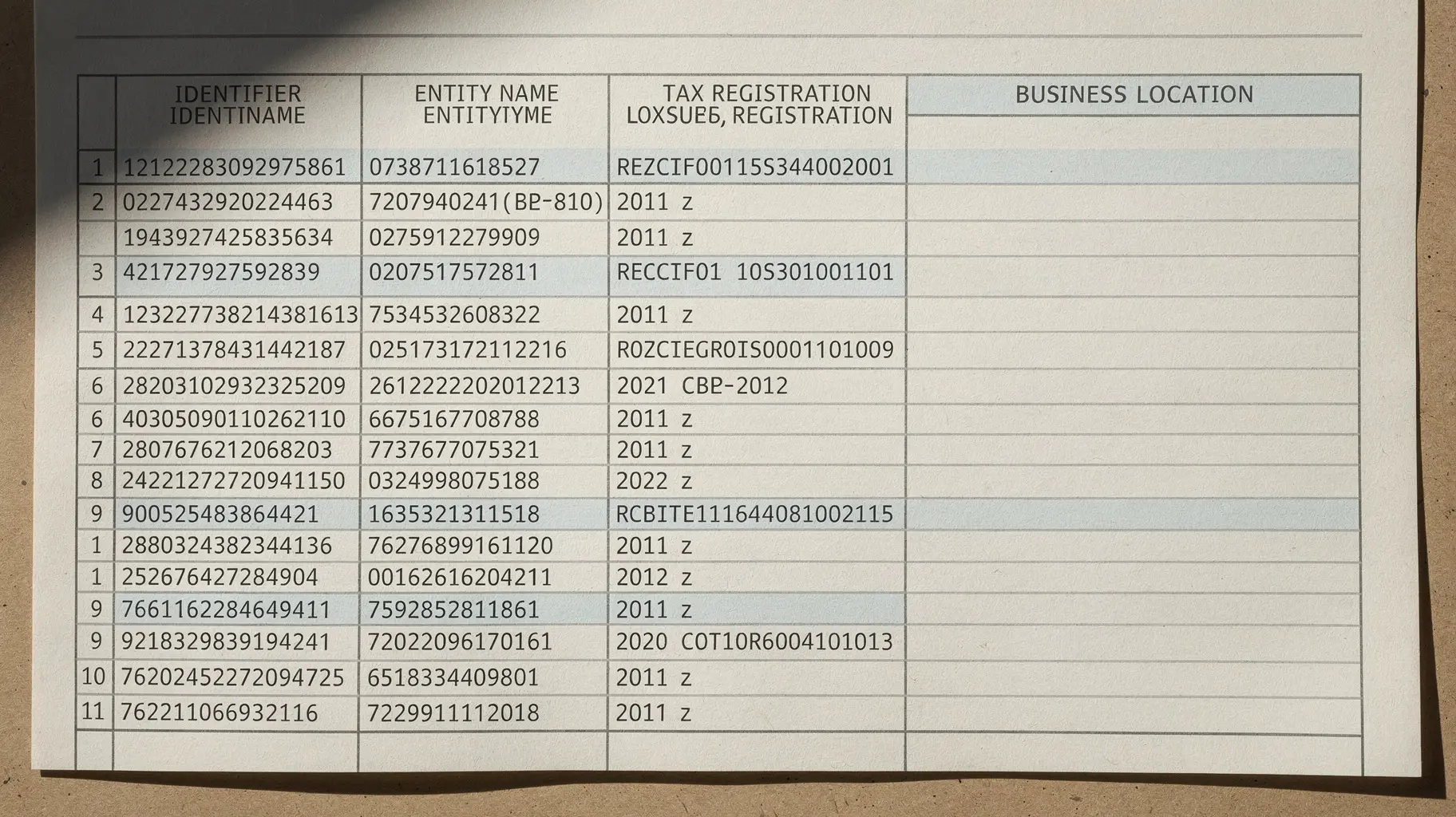
The register names the company. It never names the director.
Four companies behind one operator's Australian connectivity business each print an ABN, an ACN, an entity type and a status date on the Commonwealth's free business register. Not one of those pages prints a human being, and the only page that does put a name to the job was…

Leaders
Curran's signature is on the letter. The numbers are not.
Two consecutive ARIN annual reports open with a message jointly signed by John Curran, President and CEO. Neither message prints the year's billings or the number of organisations ARIN serves. Both quantities exist, set by staff a few pages deeper in the same file. The one…