Summary
- Japan's reportable serious telecom accident is a per-service pair of independent minimums — a duration and a count of affected users — plus a separate limb for satellites, submarine cables and comparable facilities; 30日 is the detailed report's deadline, never part of the definition.
- KDDI's 22 November 2026 snow notice prints areas, brands, emergency-call impact, cause and a roaming workaround, but no affected-user figure, no duration measurement and no service category, and none of the nine pages read prints the arithmetic behind any published user figure.
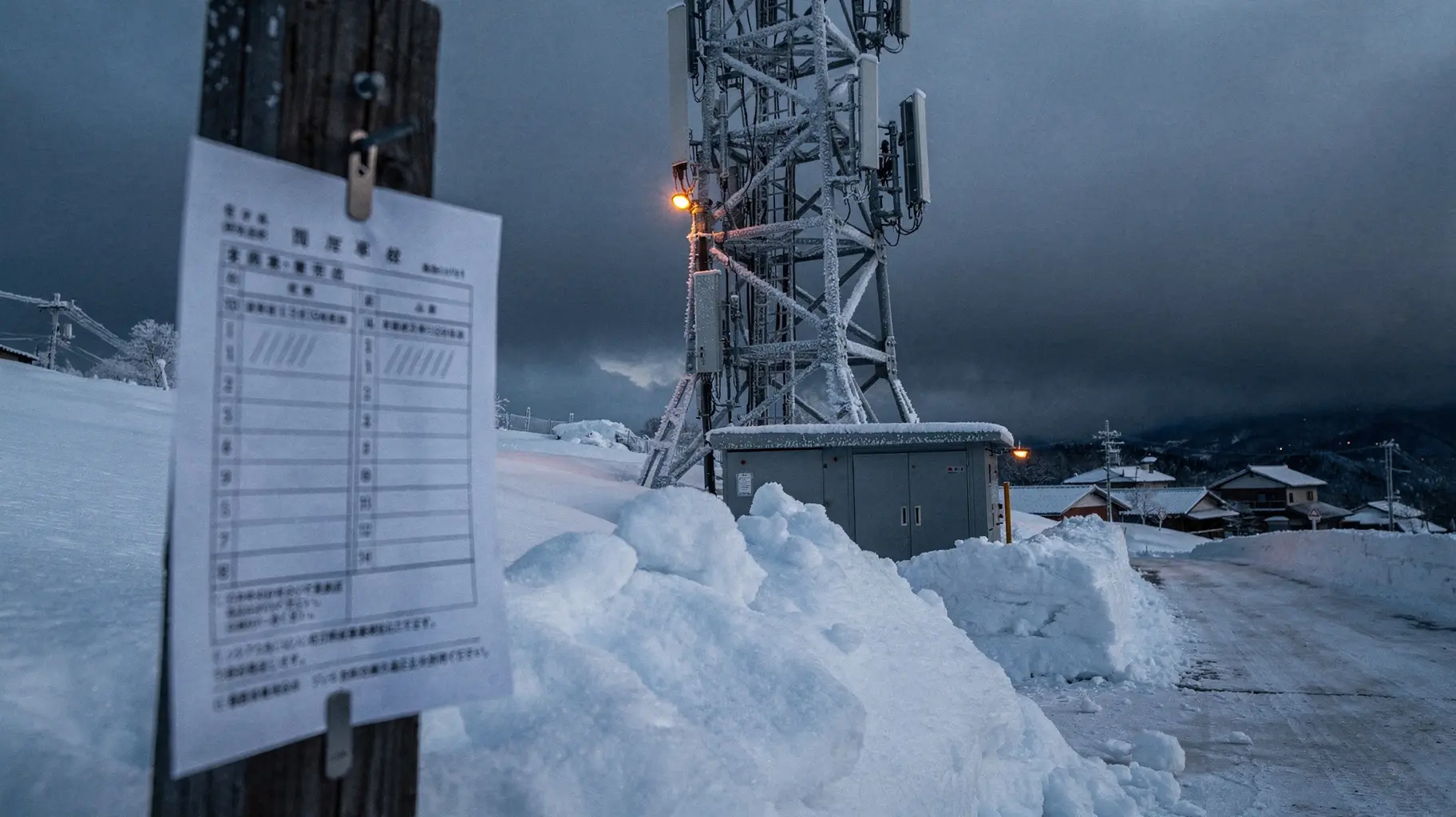
At 17:00 on 22 November 2026, KDDI stamped an update to its disaster notice. From about 23:00 two nights earlier, service had been unavailable or hard to use in parts of Kitashiobara and Inawashiro in Yama County, Fukushima, in Nagano City, and in Takayama and Gujo in Gifu. The notice covers au, UQ mobile, povo and au-line MVNOs, says emergency calls were affected too, attributes the outage to base-station power failures caused by heavy snow and to faults in transmission lines to base stations, prints the recovery outlook as 現地状況を確認中 — site conditions still being assessed — and describes JAPAN Roaming in full-roaming mode as restoring voice including emergency calls, SMS and data at up to 300 kbps where JPN-ROAM appears (KDDI notice, 22 November 2026).
That is a competent notice. It is also silent on both figures the Japanese rule asks for.
The rule first. The 総務省 page that reproduces 電気通信事業法施行規則第58条第2項 sets out services row by row, and each row carries a duration and a number of affected users joined by それぞれ — each, separately (事故の報告/重大な事故). Across the rows printed there, the duration minimums run from one hour to 24 hours and the user minimums from 30,000 to 1,000,000. Emergency-call voice appears at one hour and 30,000; non-emergency voice appears twice, at two hours and 30,000 and at one hour and 100,000. It is a pair of independent conditions. It is not a headcount, and it is not users multiplied by hours.
A separate limb stands beside the table: failure of 衛星、海底ケーブル等の重要通信設備 that cuts all traffic for two hours or more is a 重大事故 regardless of how few users were on it. The 令和7年度検証報告 shows what that door admits. NTT西日本 filed an accident affecting seven lines that ran 22日18時間30分 — 546.5 hours, against a user count a rounding error above zero (令和7年度 電気通信事故検証報告).
Now the number that gets misread. Thirty days does appear in this regime, and it is a deadline, not a threshold: the detailed report is due within 30 days of その重大な事故が発生した日, on 様式第50の3, while the first report under 第57条 is triggered by 速やかに and must carry occurrence date and time, place, outline, cause and measures taken. An accident is classified first. The 30 days then measures how long the operator has to write it up. Nothing in the definition turns on a month.
Two instruments share two numbers and count different things. The annual report under 電気通信事業報告規則第7条の3 applies to accidents with 30,000 affected users or more, or a duration of two hours or more — a disjunctive test, on 様式第27, with quarterly reporting through the fourth quarter of FY2024 and annual reporting from FY2025 (年度報告). The same 30,000 and the same two hours decide a different population under a different clock. A reader who carries one 30,000 away from both pages has the wrong rule.
What the published record does print is generous. The 令和7年度 report records six serious accidents, the same as the year before, and its 表2 gives, per accident, the operator, occurrence date and time, duration, affected users, main failure and applicable service category. kubell 23h44m; NTTドコモ 3h52m with a maximum of 325,564 users; TOKAIコミュニケーションズ 4h46m with 91,064; NTT東日本 1h21m affecting approximately 220,000 lines. The disclosure hub compiles counts by service and report item, counts an accident reported by several operators and an intermittent accident each as one, and published its FY2025 material on 令和8年7月17日 (事故発生状況); the casebook lists the published elements as year, operator, occurrence, duration, affected area, affected users, service category, cause classification, cause detail and recurrence prevention, covering FY2015 to FY2025 (公表事項の事例集).
Then it stops. The detailed report may carry the basis for the affected-user count, but as a permitted attachment rather than a printed element. The guideline says how that count is arrived at: 影響利用者数 counts only users actually affected, so emergency-call voice takes all users under failed equipment where the failure is total and otherwise multiplies by the call-loss rate, while mobile and PHS services where measurement is difficult use either the users present in the failed base-station area or failed base stations divided by all base stations multiplied by all users, under 令和5年総務省告示第408号; 継続時間 runs from the equipment failure until service can be provided again on user request, and temporary alleviation does not stop the clock (ガイドライン). Among the nine pages read for this article on 22 November 2026, none prints the computation behind any individual published figure, and none records a regulator disposition such as an instruction, guidance or sanction attached to a specific accident. The 令和4年度 report, published 2023-08-29, shows the limit in one cell: ten serious accidents against seven the year before, with Microsoft Japan's user figure printed as 3万人以上(詳細非公表) — a floor and a non-disclosure note (令和4年度 検証報告).
There is a version problem on top of that. The definition page prints seven category rows under a 関係法令 label dated 令和5年12月7日現在, while the report published in July 2026 sorts the same population under five 区分. No page read reconciles the two, so which table governed which accident is archaeology the reader has to perform. The consolidated text on e-Gov is the reference instrument, and in the copy read for this article its article body did not render, so no threshold here is quoted from it (電気通信事業法施行規則).
Set the snow notice against that. From about 23:00 on 20 November to the notice's own 17:00 stamp on 22 November is 42 hours, and the longest duration minimum printed in the reproduced table is 24 hours, so on its face the elapsed time already clears that limb. What the notice does not supply is the other limb: no user figure, no applicable row, and no restoration — so the statutory duration cannot be read from it either, because the guideline's clock runs until service can be provided again on user request, and 現地状況を確認中 is not that moment. Nothing on the page says whether the event has been reported as a 重大事故.
Our earlier KDDI reporting read outages as engineering and accountability narratives — the 2022 VoLTE sequence, the 61-hour account, the AS56197 rename, the JPIX port list, the mailbox-governance guidance, the Kumamoto roaming and relief notices, the continuity-cost essay. None read the reporting threshold as a pair of limbs, none separated the first-report clock from the 30-day clock or from the annual-report test, and none asked who computes the affected-user figure. That is the subject here, and KDDI appears in the BTW directory as KDDI.
The fix is a record, not an accusation. Publish, for every serious accident, the duration and the affected-user count beside the category row that fired, and the basis for the count — the attachment the regulator already receives. Label every reproduced table with the ordinance revision and effective date it mirrors, so the seven rows and the five 区分 stop competing in the reader's head. And a notice like this one can close its own gap in a sentence: two numbers, published when they exist, rather than after the report is filed.
Member Briefing
Read the full trend briefing
Members read the full briefing with the source notes behind every finding.
Strategic Circle
A daily briefing in your language, built from changes we have verified.
Join for USD 20/monthCancel anytime.
Members also get the full research library, a daily briefing on the networks they follow and the private forum.