Summary
- Auditor-General Report No. 32 2020–21 prints thirteen numbered cyber recommendations, each followed by the responding entity's stated position: 'Agreed', 'Agreed in principle', 'Noted'.
- The ANAO's implementation audits print 'Entity view of current status of implementation' beside 'ANAO assessment of implementation' — two authors in one row.
- No document among the ten cited in this briefing joins any of those thirteen to a later printed status; completion survives as a status word, never as a date.
Recommendation no. 1 sits at paragraph 2.13 of Auditor-General Report No. 32 2020–21, Cyber Security Strategies of Non-Corporate Commonwealth Entities. Its answer is one line, and the line has a subject: 'Department of the Prime Minister and Cabinet response: Agreed.' The table is spare and honest about authorship. A number, a paragraph reference, the recommendation itself, then the response. The first three belong to the auditor. The fourth belongs to the body under audit, and it is printed in that body's own words, inside the auditor's report, under the auditor's paragraph number.
Not every answer is a yes. Recommendation no. 11 is recorded as 'Agreed in principle' by the Attorney-General's Department. Recommendation no. 13 is recorded as 'Noted' by the Attorney-General's Department, the Australian Signals Directorate and the Department of Home Affairs. Those three answers appear here in their own words; I do not characterise the other ten, because their printed wording is not in front of me.
What the word 'Agreed' buys is set out by the auditor. The ANAO's own page on implementation puts it without ornament: performance audit reports are prepared for presentation to Parliament, and 'agreement to implement a recommendation made in an ANAO report is therefore a commitment to the Parliament.'
The report's transmittal letter is printed 'Canberra ACT 19 March 2021' and presents the report to the Parliament 'Pursuant to Senate Standing Order 166 relating to the presentation of documents when the Senate is not sitting.' The ANAO's page for the report prints 'Published Friday 19 March 2021' and records the portfolio and entity as 'Across Entities'.
The office — the Australian National Audit Office — does not leave the commitment to memory. Auditor-General Report No. 6 2019–20, Implementation of ANAO and Parliamentary Committee Recommendations, printed 'Canberra ACT 5 August 2019' in its own transmittal letter, carries 'Table 3.1: ANAO's categorisation of implementation status' and four defined categories: 'Not implemented', 'Partially implemented', 'Not fully implemented', 'Implemented'. The last carries the standard: 'The action taken met the intent of the recommendation, and sufficient evidence was provided to demonstrate action taken.'
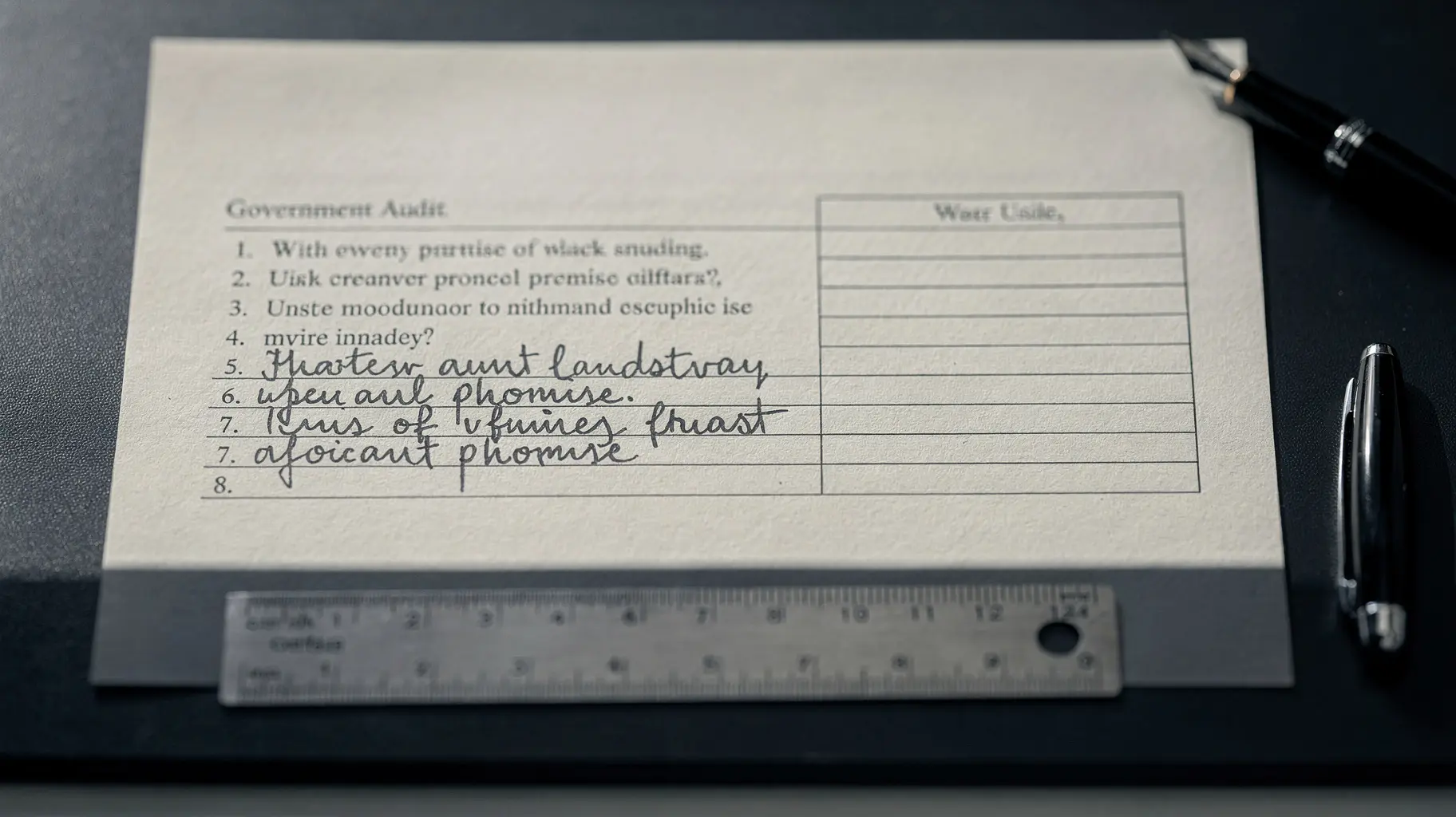
The layout matters more than the words. The report's per-recommendation tables carry four columns: 'Recommendation', 'Entity response', 'Entity view of current status of implementation', 'ANAO assessment of implementation'. The auditee's opinion is not a rumour checked privately later; it is a published field, in the same row as the auditor's finding, in a table anyone can open.
The implementation audit of the Department of Finance prints five categories rather than four and adds one: 'Implementation ongoing', explained as 'There is supporting evidence of ongoing action to implement the recommendation and the entity considers that implementation is in progress or ongoing.' Read the definition twice — the tense belongs to the entity. The table carries a note, 'The ANAO assessed implementation status at November 2023', which dates the assessment and not one single row. And it carries the sharpest sentence in this briefing: 'The closure of four recommendations assessed by Finance as implemented was not supported by adequate evidence.' The same table counts eight implemented, one largely implemented, one partly implemented, two not implemented and six implementation ongoing. That is eighteen rows by my addition; the components are the report's.
The ANAO's annual report for 2025–26 states the limit without decoration: 'Self-reported implementation data is not independently audited at the time of reporting.' It then gives the size of what it can see: 'Across the implementation audits completed to date, 25 per cent of recommendations reported by entities as implemented were assessed by the ANAO as partly implemented or not implemented.' That proportion belongs to the report that prints it and to the moving set of audits completed to that date; it is not a rate for a single year, and it is not a rate for a single recommendation. The monitoring itself is described on the same page: 'We monitor entities' implementation of performance audit recommendations through attendance at audit committees, follow-up audits and annual self-assessments by entities on implementation progress over a two-year period.'
If the annual report were required to close the loop, a blank column would be a compliance failure. It is not. The 2016 amending instrument to the Public Governance, Performance and Accountability Rule 2014 inserts the operative obligation: the annual report must include information on the most significant developments during the period in external scrutiny of the entity, and the entity's response to that scrutiny, including particulars of any report on the operations of the entity given by the Auditor-General. Its Schedule 2A marks that paragraph 'If applicable, Mandatory'. Report No. 6 restates the duty at paragraph 1.9. What the rule requires is a response to scrutiny; it does not require a recommendation-by-recommendation implementation table, and no page read for this briefing suggests otherwise. One correction, since it cost me an afternoon: section 66 of the PGPA Act is the power to authorise a gift of relevant property. The annual-report duty is section 46. A citation can sound official and still be wrong.
Report No. 8 2024–25, 2023–24 Performance Audit Outcomes describes the machinery that produces the response columns: under section 19 of the Auditor-General Act 1997 the ANAO provides the proposed report, including proposed recommendations, to entities before the report is finalised, and entity responses are reproduced in the body of the final report. The same report counts 1,188 recommendations from 2017–18 to 2023–24, with 92 per cent fully agreed. I stop at those two printed figures: 1,188 multiplied by 0.92 is not a whole number, so the pair cannot be closed into a count of agreements.
The shape has not changed with time. The 2025–26 audit of cyber security in the Department of Parliamentary Services makes two numbered recommendations, at paragraphs 2.21 and 2.62, each followed by 'Department of Parliamentary Services response: Agreed', and prints at paragraph 16: 'The proposed audit report was provided to DPS. The summary response to the report is below and the full response is at Appendix 1.'
Now the blank. Among the ten documents cited in this briefing, read on 22 November 2026, none joins any one of Report No. 32's thirteen numbered recommendations to a later printed status. From the report's own printed date of 19 March 2021 to today is 2,074 days by my arithmetic — more than twice the two-year period over which the ANAO says it monitors implementation. The series that could carry such a status exists, and the implementation page lists its completed audits with publication dates of 5 August 2019, 25 June 2020 and 12 April 2021. Six hundred and sixteen days separate the first and last of those entries; that is the distance between neighbouring audits in a series, not a follow-up interval. The titles also show the series is not uniform — one unqualified, one for the Education and Health portfolios, one for the Department of Defence alone — and reading the Defence audit as a cross-entity roll-up would be an error.
A recommendation closes when a page prints a row with a date in it, written by someone other than the body that made the promise. For these thirteen, the document that would do it is the audited entity's own annual report, and no entity annual report was opened for this briefing. That is the stop, and it is exactly where the checking end sits. Until a page prints that date, 'Agreed' remains what the audit office says it is: a commitment to the Parliament, with the clock running and nobody publishing where it stopped.
Member Briefing
Read the full trend briefing
Members read the full briefing with the source notes behind every finding.
Strategic Circle
A daily briefing in your language, built from changes we have verified.
Join for USD 20/monthCancel anytime.
Members also get the full research library, a daily briefing on the networks they follow and the private forum.