Summary
- One cable is printed as a minimum of 10 Terabits/s per fibre pair, up to 20 Terabits/s per country, 40 Terabits/s for the whole system, a "Design Capacity (Tbps): 20" in a table, and 200 Gigabits/s initially installed. The printings reconcile only when one table's wavelengths, per-wavelength rate and pair count are multiplied out, and no reviewed page labels that product.
- The only operative per-megabit figure located for this physically single system is Papua New Guinea's, denominated in Kina, and its endnotes name the Coral Sea Cable System. The Solomon Islands side prints a retail filing duty, a discretionary power to cap, a consultant's January 2020 rate card and no located wholesale determination.
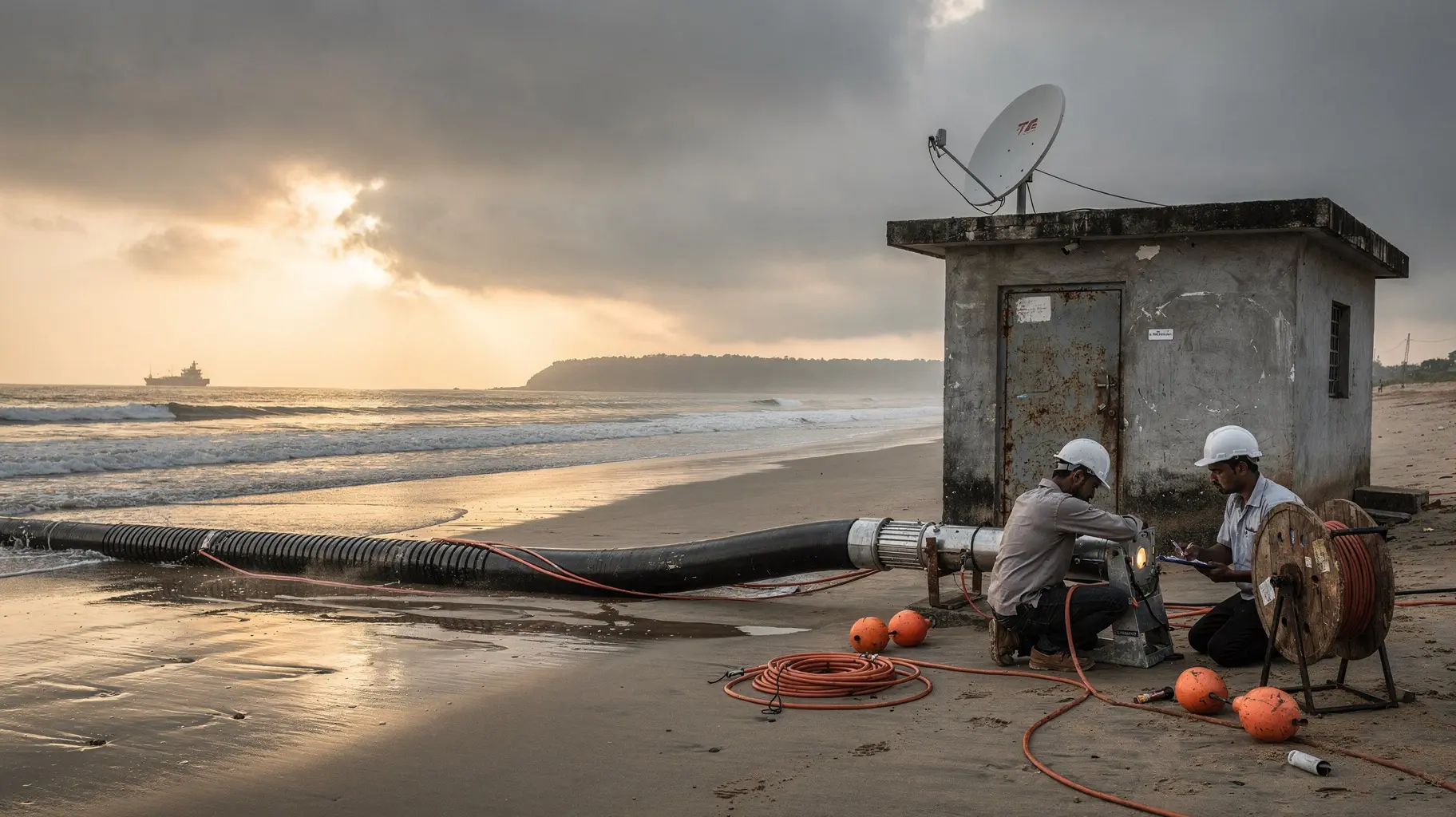
The Coral Sea Cable System was completed on 29 November 2019, which is six years and 358 days before this dateline — my subtraction of two printed dates. It runs from Honiara and Port Moresby to Sydney, and it is owned and operated by Coral Sea Cable Company Pty Limited in Australia, held equally by the Commonwealth of Australia, SISCC and PNG DataCo, with 25-year rights of use over two fibre pairs to each of SISCC and PNG DataCo (SISCC systems).
The seller in Honiara is the Solomon Islands Submarine Cable Company Limited: incorporated in Solomon Islands in August 2016, 51 per cent owned by the Investment Corporation of the Solomon Islands and 49 per cent by the Solomon Islands National Provident Fund, trading as Solomon Submarine Cable, selling international and domestic capacity only to licensed operators (SISCC home). The regulator records commercial operation since 1 February 2020 with four wholesale operators connected (TCSI on the submarine cable).
The same number, printed five ways
Start with the pair. The Solomon Islands regulator describes the system as engineered "to provide a minimum of 10 Terabits/s over a single pair of fibres, so each country has a potential 20 Terabit/s capacity with today's established cable technology" — a sentence that names the pair, names the country and keeps the word potential (TCSI on the submarine cable).
The owner drops the pair and keeps the country: each country uses two fibre pairs from its capital to Sydney, "giving each country up to 20 Terabits/s in capacity" (SISCC systems). The word potential is gone. The unit stays.
A case study published on 30 November 2020 prints three states on one page: "The four fibre-pair system has a total capacity of 40 terabits/sec. Each country will be able to access up to 20 terabits/sec of bandwidth if the cable is expanded to full capacity. The initial installed capacity of the system is 200 gigabits/sec to each country" (Global Infrastructure Hub). Forty for the system, twenty per country on expansion, 200 Gigabits/s actually installed.
A compiled case study table prints the figure beside the cells that produce it: "Design Capacity (Tbps): 20" next to "Fiber Pairs: 4", "Wavelengths per Fiber Pair: 100" and "Capacity per Wavelength (Gbps): 100" (CIPE case study). The table never says whether that 20 counts one country or the system.
And the January 2020 report hosted on the regulator's file server prints "20,000G (2T) is available over CS2 with 200G lit now (half of which is for protection)" (de Ridder report) — a parenthetical that contradicts the 20,000G beside it. A consultancy report in the regulator's library prints "a theoretical capacity of 20Tbps" and 100 Gigabits/s of protected production capacity (Caedus report).
The arithmetic a stranger has to supply
Here is the multiplication the documents leave to the reader, and it is mine. One hundred wavelengths per fibre pair, each carrying 100 Gigabits/s, is 10 Terabits/s per pair. Four pairs is 40 Terabits/s, which reproduces the total the November 2020 case study prints without deriving it. Two pairs per country at 10 Terabits/s per pair is 20 Terabits/s per country.
That closes every printing in the reviewed set except the table. Twenty labelled design capacity, printed beside four pairs, a hundred wavelengths and a hundred gigabits per wavelength, is half the product of its own cells. Read as one country's share it is consistent. Read as the system it is half the system. The table does not choose, and no reviewed page chooses for it.
Then the installed figure. Two hundred Gigabits/s against a potential 20 Terabits/s per country is one per cent — my division. Nothing in the reviewed set states how much of that potential is lit today, how much of the lit capacity is protected rather than working, or how much of either is unsold.
Keep the domestic network out of this. The domestic system is separate, and the regulator gives its amplified Honiara–Noro span "a maximum capacity of 12 × 100GB/s or 1.2 Terabit/s" while the other spans support 10 Terabits/s (TCSI on the submarine cable). That is a domestic span, not a capacity of the international system, and it should never be added to one.
One cable, one cap, one rate card
Papua New Guinea's National Information and Communications Technology Authority publishes the kind of instrument a wholesaler can be billed against. Its Service-specific Pricing Principles (Submarine Cable Services) Determination 2019, in a compilation dated 23 December 2020, sets Schedule 1 maximum average prices in Kina per Mbps per month: K 209 from the commencement date to 31 December 2020, then K 198, K 145 and K 104, each marked indicative, for the three calendar years that follow. Endnote 1 states the maximum average prices are for all international submarine cable systems, "specifically APNG-2, PPC-1, Kumul and Coral Sea Cable System". Endnote 3 states that all maximum average prices are based on an average capacity sale of 1,000 Mbps (NICTA determination).
The compilation contradicts itself, and the contradiction should be printed rather than smoothed: the body states commencement on 1 January 2021 while the first price period ends 31 December 2020. Under the determination's own 1,000 Mbps assumption, K 209 per Mbps per month is K 209,000 per month for a one-gigabit lease — my multiplication of the regulator's cell, and a total the determination never prints. K 198 sits 5.3 per cent below K 209 and K 104 sits 50.2 per cent below, my divisions of printed cells.
The cap is one all-systems column in Kina under Papua New Guinea law. It is not a Coral Sea-only price. It is, however, the only operative per-megabit number located for these fibre pairs.
In Honiara the surface is different in kind. The regulator's price page, last reviewed 4 August 2026, requires service providers to file the standard retail prices of all their services within seven days of setting or changing them, states that the Commission may regulate the prices of selected providers by price caps or a glide path, and notes that the Price Control Act does not apply to telecommunications (TCSI price filings). It prints no wholesale capacity price. The interim licence notice of 2 February 2020 authorises international and domestic leased capacity, IP transit, and internet exchange and peering services to facilities owned and operated by licensed providers, and prints no price, tariff or cap condition at all (TCSI interim licence). The licence instrument itself was not obtained for this reading.
What sits on the file server is the January 2020 report, and inside it a rate card titled SISCC International Pricing 2020. Per Mbps per month it prints 99 for the three bands covering 100 to 1,999 Mbps, then 77, 64, 57, 50, 40 and 30 as commitments rise to 19,999 Mbps, with a second column printing 10.0, 5.1 and 3.0 at the 1G, 5G and 10G breakpoints. The report states its own convention that all dollar amounts are USD unless stated otherwise; the table headers themselves carry no unit (de Ridder report). At 99 per Mbps a one-gigabit lease is US$99,000 per month, and at 30 it is US$30,000 — my multiplication of the consultant's cells.
The same report proposes traffic prices: the international system at US$25,000 per month plus 18 cents per gigabyte with a 45 cents entry level, and the domestic network at US$6,000 per month plus 1.5 cents per gigabyte with a 5 cents entry level. Domestic capacity pricing on the same page runs from 1,000 Mbit/sec at 12,500 monthly, marked "INCLUDED WITH INTERNATIONAL", to 10,000 Mbit/sec at 31,250, with per-megabit rates of 13.00 and 10.00 on one-year and three-year terms at one gigabit, falling to 3.13 and 2.50 at ten.
One number in that report must never be read as Solomon Islands pricing. Section 7.2 attributes an initial US$54 per Mbps, K185, to Papua New Guinea's authority, and compares a planned PNG cut to US$98 with the Solomon Islands level. It is a PNG figure inside a Solomon Islands report.
The report in the regulator's library also records the wholesaler's position: that its pricing would be "unsustainable" if the Commission regulated maximum lease costs on the international and domestic systems, and that a Solomon Islands government participant asked for capacity on a 2 Gbps commitment to be priced below US$100 per Mbps. The working group agreed the wholesaler should negotiate commercially with retail service providers (Caedus report). A recorded objection is not a determination, and the reviewed record shows no regulation being made.
Four printings of what it cost
The Australian foreign minister's release of 19 June 2018 records the award of "the $136.6 million contract to delivery partner Vocus", with Australia delivering and majority-funding and a financial co-contribution from both Papua New Guinea and Solomon Islands (ministerial release). That is a construction contract value, and the dollar sign carries no currency code.
The Department of Foreign Affairs and Trade, on a page last updated 28 September 2018, puts the co-contribution as the two governments "jointly contributing up to one third of project costs" (DFAT). A ceiling on a joint contribution, with no dollar amount and no split between the two states.
The November 2020 case study gives a total project budget of "about AUD200 million (USD131 million in 2019)", two-thirds from Australia and one third jointly from the two governments (Global Infrastructure Hub). The compiled table gives project cost as "K324 million or US$93 million" and "AU$137 million" (CIPE case study) — a row that is internally inconsistent on the Kina conversion.
Those are four different claims about four different perimeters, and they are not averaged here. Nor is a fifth figure a project cost: the owner states its shareholders bought their shares for "a combined value of $29.7M USD" to fund the Solomon Islands co-contribution (SISCC home), while the compiled case study puts the same payment at "AU$29.7 million (K72.6 million)" (CIPE case study). One payment, two currencies, the same numeral.
A second cable is now financed. The Australian Infrastructure Financing Facility for the Pacific announced on 19 November 2025 a grant and loan package of USD72.71 million, approximately AUD104 million, comprising an AUD71.9 million grant and an AUD31.9 million loan, plus AUD1.8 million from a climate financing partnership for off-grid electricity generation and storage, for a 1,015-kilometre cable that will interconnect with Google's Bulikula system and will be delivered by SISCC, with completion scheduled for late 2027 (AIFFP). Trade reporting records that SISCC owns and operates that second system and that the landing-station contract is worth about AU$1.2 million with delivery due April 2027 (Data Center Dynamics). No reviewed document prints a design capacity for it.
What the reviewed set does not print
An absence here is a count over the documents named in this article, read on 22 November 2026.
- No reviewed page states the fibre-pair perimeter that reconciles the capacity figures, so the reconciliation above is a stranger's arithmetic and not a publisher's statement.
- No reviewed page prints a Solomon Islands wholesale capacity determination, price cap, glide path or tariff schedule with a period, a currency and a contracting party.
- The interim licence instrument itself was not obtained; a notice that prints no price condition is not an instrument shown to contain none.
- No reviewed page prints a design, theoretical or installed capacity for the second cable.
- No reviewed page prints the settled dollar contributions of Papua New Guinea and the Solomon Islands under the jointly-contributed up-to-one-third formula, or splits that contribution between them.
- No reviewed page prints the wholesale price the operator charges today, or the price it charged in any year after 2020.
- No reviewed page defines the capacity noun it prints, so whether a figure counts engineered, protected, lit or sellable capacity cannot be settled from the reviewed set.
- The 2020 rate card's table headers carry no explicit unit or period; the US dollar convention comes from the report's prose, not from the table.
- No reviewed page states who other than the operator sets or approves the Solomon Islands wholesale price today, and no reviewed page shows the discretionary cap power being used.
- The January 2020 report, the compiled case study and the library report were not opened as laid-out PDFs in this reading; their text came from a retrieval pass, one page was truncated near its end, and one further government release returned no readable text and is not used at all.
What a buyer can actually hold
A reader deciding whether to buy capacity on this cable needs three quantities and can currently get one and a half.
The perimeter — one country's two pairs or the system's four — is reconstructable only by arithmetic the documents do not perform.
The price is published as a binding cap by one of the two states that buys the same fibre pairs, and as an advisory rate card six years old by the other.
And the capacity actually available for sale is printed nowhere in this set: installed is 200 Gigabits/s per country, potential is 20 Terabits/s, and the distance between those two numbers is the whole commercial question the record leaves open.
That is not a story about a company hiding something. It is a story about a record whose perimeter lives in the head of whoever writes the next sentence, on a cable that two sovereign price regimes already share.
Member Briefing
Read the full trend briefing
Members read the full briefing with the source notes behind every finding.
Strategic Circle
A daily briefing in your language, built from changes we have verified.
Join for USD 20/monthCancel anytime.
Members also get the full research library, a daily briefing on the networks they follow and the private forum.