Summary
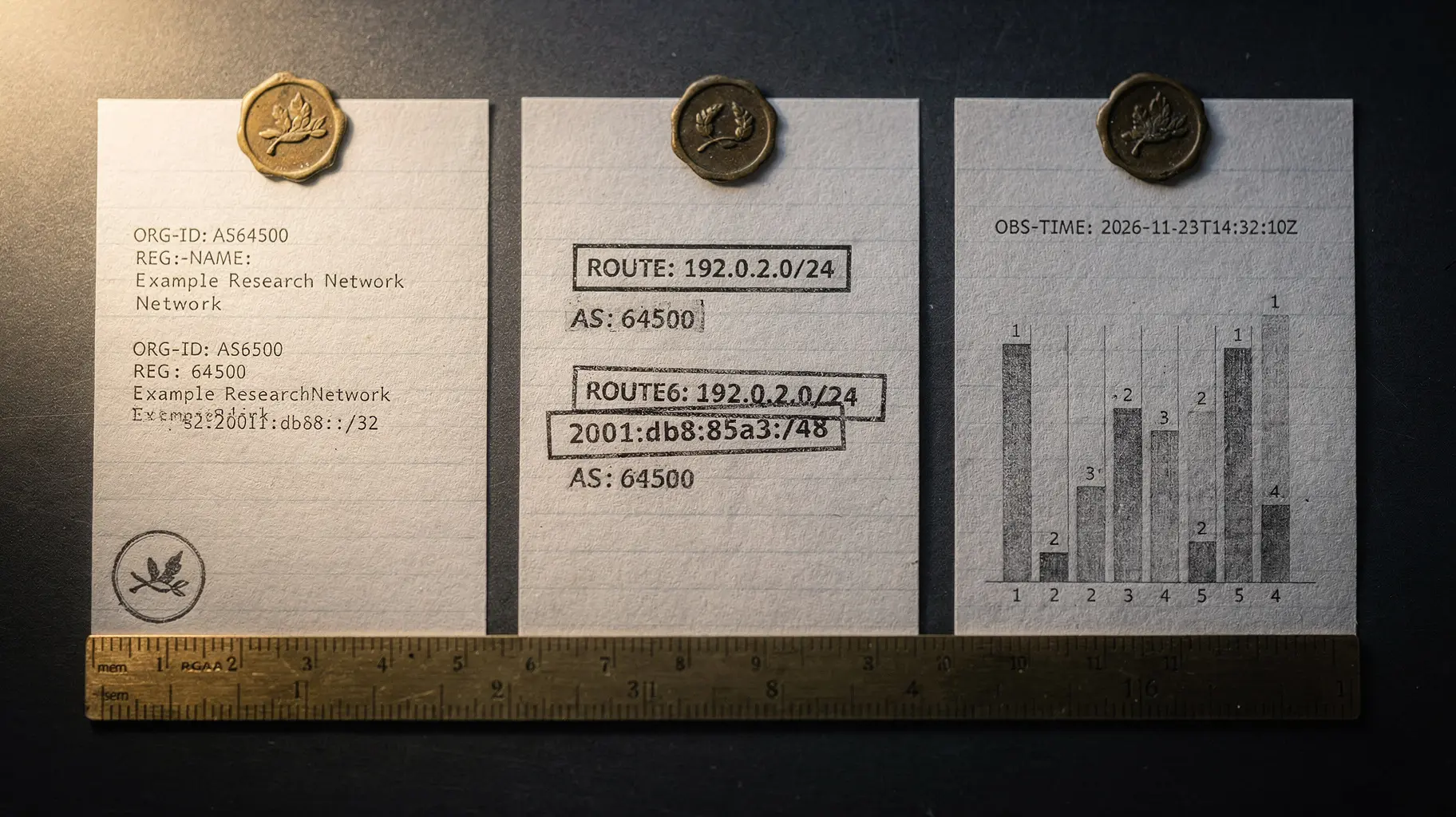
- The registry record establishes a holding: AS140734, 103.152.60.0/23 with 512 addresses under status ASSIGNED PORTABLE, and 2406:2a40::/32 under status ALLOCATED PORTABLE, each with one APNIC-source route object naming that origin.
- A separate measurement ledger shows both prefixes announced and accepted: 100% of 164 IPv4 and 152 IPv6 RIS full peers at 2026-10-23, two observed neighbours. It does not say where the addresses are used, or who operates them.
The entry is one line long. APNIC's public member directory prints a name — Watch Tower Bible and Tract Society of the Philippines — an economy, PH, and a membership category, SMALL. It prints no member-since date, no AS number and no prefix (APNIC member directory). Everything else sits in different objects, and each of those objects carries a date years old.
Four objects, and what each one says
The organisation object is ORG-WTBA1-AP: org-name the same corporate string, org-type LIR, country PH, two address lines reading 186 Roosevelt Avenue and San Francisco del Monte, last modified 2023-09-05T02:18:12Z. The autonomous system is AS140734, as-name WTBATSOTP-AS-AP, description the same corporate name, country PH, maintained by APNIC-HM with mnt-lower and mnt-routes MAINT-WTBATSOTP-PH and an abuse-handling object IRT-WTBATSOTP-PH, last modified 2020-06-16T09:37:50Z (whois transcript, aut-num and organisation).
Two resources hang off that organisation. The IPv4 inetnum runs 103.152.60.0 to 103.152.61.255 — a /23, which RIPEstat prints as 512 addresses — netname WTBATSOTP-PH, status ASSIGNED PORTABLE, last modified 2020-06-17T02:28:28Z (whois transcript, inetnum and route). The IPv6 inet6num is 2406:2a40::/32, same netname and organisation, status ALLOCATED PORTABLE, last modified 2020-06-17T02:34:30Z (whois transcript, inet6num and route6). Two route objects name AS140734 as origin, one per family: the /23's last modified 2020-07-06T12:05:07Z, the /32's 2020-07-06T12:05:28Z.
Org-type LIR is worth reading carefully, because it is the field most often mistaken for a business description. APNIC documents four values — RIR, NIR, LIR and OTHER — and LIR denotes a Local Internet Registry (APNIC organisation-object documentation). It is an object class. It is not a statement that the holder registers addresses for anyone else, and it is not a service catalogue.
Two date layers in one object
A last-modified stamp is not an allocation date, and this record separates the two cleanly. The reproduced APNIC RDAP response for the autonomous system prints a registration event at 2020-06-16T09:37:03Z and a last change at 2020-06-16T09:37:50Z — forty-seven seconds apart, on the same object (reproduced RDAP response for autnum 140734). The organisation object's registration event prints 2020-04-28T12:59:06Z.
On those prints the organisation precedes the AS number by 49 days; the AS number precedes both prefixes by roughly seventeen hours; the prefixes precede their route objects by 19 days; and the route objects precede the first sighting of the IPv6 prefix on the running network by 24 days, on 2020-07-30. Those intervals are my arithmetic on printed timestamps. They describe a sequence of records being created. They do not describe anyone's intention, and no document read here supplies one.
The second ledger: what the network says
IRRd3 lists exactly two APNIC-source route objects for AS140734, one per family (IRRd3 rendering for AS140734). RIPEstat reports both prefixes RPKI VALID and visible to 100% of 164 IPv4 and 100% of 152 IPv6 RIS full peers at 2026-10-23 00:00 (RIPEstat, AS140734), and each prefix page repeats 100% at 2026-10-24 16:00 (103.152.60.0/23, 2406:2a40::/32). Hurricane Electric reports two originated prefixes, 512 IPv4 addresses, two BGP peers in each family, and AS-path counts of 762 for IPv4 and 706 for IPv6 (Hurricane Electric, AS140734). The two neighbours observed in that view are named as AS9299 and AS4775.
Registration, authorisation and announcement are three ledgers. A route object authorises an origin; it does not announce anything. A measurement network observes what is announced; it is not the registry. What the three support together is narrow and firm: the holder of record exists, the resources are portable and current, an origin is authorised in APNIC's routing registry, and the prefixes are accepted across the measurement set on the dates printed.
The identity seam: an address that matches, a record that never joins
APNIC prints the name without "Inc." and prints no corporate registration number. The Philippine Statistics Authority's Solemnizing Officers Information System prints a longer string — WATCH TOWER BIBLE AND TRACT SOCIETY OF THE PHILIPPINES, INC. (JEHOVAH`S WITNESSES) — with SEC Registration 53236 (PSA Solemnizing Officers Information System). An SEC listing of released requests carries 0000053236 against the same name, with a Certificate of No Derogatory Record request evaluated and released on 26 September 2019 (SEC released-requests list). The difference between 53236 and 0000053236 is leading zeros; a released request is a log entry, not a standing certificate.
A 2013 Tagalog page on jw.org prints the same street address as the APNIC organisation object — 186 Roosevelt Avenue, San Francisco del Monte, 1105 Quezon City — under a charitable planning office (jw.org, 2013 issue).
So the address matches across an APNIC object, a 2013 magazine page and a government index entry. No surface cross-references another: APNIC prints no SEC number, the SEC list prints no APNIC handle, and the 2013 page prints neither. The join is an inference from an address. It is a good inference. It is not a printed link, and this piece will not dress it as one.
What the record cannot answer
Where the 512 IPv4 addresses are used, and for what, appears in none of the objects read here. Nor does whether the society operates any network service at all, whether it does so only for its own publishing and meeting infrastructure, or whether the holding serves arrangements beyond the Philippines.
Two fields get misread as answers. LIR is an object class, as above. The member category is a billing band: APNIC describes membership tiers assessed on IPv4 and IPv6 block sizes, with a member holding both families assessed on each and the higher tier applying (APNIC membership tier page). A band prices a membership. It does not describe a network.
The document that would close it
One artefact would move this from inference to record: a dated response from APNIC's own primary query service or its RDAP endpoint for AS140734, 103.152.60.0/23 and 2406:2a40::/32, read at the source rather than through a reproduction. APNIC documents that service and its autonomous-system lookup path (APNIC RDAP documentation). Every object field in this piece comes from third-party reproductions of APNIC output, which is a weaker evidence class than the registry's own served answer, and the difference matters most exactly where the record is thin.
Even that document settles fields and status, not purpose. Purpose needs a second artefact: a society statement, filing or network disclosure naming the operator of AS140734. Nothing of that kind appeared in the material read for this piece, and the APNIC corporate-documents index, where any such instrument would sit if the society had published one, carries no record for this holder (APNIC corporate documents index).
A registry entry is a footprint, not a business model. This one is worth reading because it is checkable, and worth bounding because it checks so little: a name, an economy, a band, an autonomous system, two portable blocks, two origins authorised, and a running network that accepts them — with every question a reader would actually ask left outside the frame. BTW tracks the entity itself here: directory entry.
Member Briefing
Read the full trend briefing
Members read the full briefing with the source notes behind every finding.
Strategic Circle
A daily briefing in your language, built from changes we have verified.
Join for USD 20/monthCancel anytime.
Members also get the full research library, a daily briefing on the networks they follow and the private forum.