
Intelligence
Latest Articles
Latest intelligence on infrastructure operators, policy decisions, market moves, and digital power shifts.

IETF
The watts fell. The proof did not: RFC 9845 and the green-network control loop
A power graph can move down while the network’s carbon cost, workload allocation and service risk remain unknown. RFC 9845 makes visibility useful; it does not let one meter speak for the whole system.

IETF
A Workload Credential Is Not the Workload: Eight Proofs Between Bootstrap and Outcome
The WIMSE practices draft shows how platforms can replace embedded secrets with short-lived workload credentials. Its harder lesson is that every safer credential still sits inside a longer chain of facts that must not be compressed into one green authentication event.

Global Institutional
The ASN Is Not the Control Plane
The ASN Is Not the Control Plane intelligence summary explains the development, the public evidence available to readers, the organisations involved, the regional context, market exposure, and the infrastructure consequences that may follow. The Global Institutional intelligence…

IETF
RFC 9991 Made Failure Detail Conditional, Not Owed
A failed email can be both a diagnostic clue and somebody else's private correspondence. RFC 9991 does not solve that tension by awarding the domain owner every available header and body. It standardizes a request and a report while leaving the receiving operator responsible for…

Number Resource Society
DFINFRA and AS210860: The Evidence Chain Still Stops at the Registry
A public-record investigation can identify where a network-control question begins. It cannot answer that question by treating a registry name as proof of ownership, authority or active service delivery.

Global Cloud Services
DATAMATIX and AS210973: From Network Visibility to a Testable Operating Business
DATAMATIX and AS210973: From Network Visibility to a Testable Operating Business intelligence summary explains the development, the public evidence available to readers, the organisations involved, the regional context, market exposure, and the infrastructure consequences that…

History
The Turnaround Was the Budget: RFC 1986 and ETFTP’s Selective Evidence
On a half-duplex radio path, the expensive event was not merely losing a packet. It was surrendering the channel, synchronizing the other direction, and paying again before useful data could resume. RFC 1986 designed ETFTP around that bill.

IETF
Jim Schaad and the Key ID That Was Only a Hint
Two keys sit in the same verifier under the same short label. The message supplies that label, the first key is tried, and a dashboard turns the result into the name of a device. Jim Schaad’s COSE specification draws a harder boundary: the label is a search hint; identity and…

Leaders
Mohamed Awang Lah and the Institutional Continuity of MyCERT
Malaysia’s MyCERT is best understood not as a personal possession that moved from one job to another, but as an incident-response function that survived changes in institutional placement. Dr. Mohamed Awang Lah can be connected to the security initiatives associated with MyCERT’s…

Story
APNIC’s Electoral-Committee Recusal Safeguard Lives in a Blog Comment
APNIC has a sensible answer to an awkward governance question: Executive Council members who may seek re-election do not help choose the committee that polices the election. The trouble is not the answer. It is where the answer lives—and how little of the annual record shows the…

IETF
RFC 9990 Counted the Receiver’s Claims, Not the Mailstream Itself
A dashboard can show 240,000 messages, three alignment rates and a red segment labelled as a policy override. The numbers may be perfectly formed and genuinely useful. They still do not let the domain owner walk back through 240,000 individual decisions. RFC 9990 standardizes…

Story
LACNIC 46's Attendee List Has Consent. It Still Needs a Retention Clock
LACNIC tells registrants that their names will appear on the event website. That clarity settles the easy argument; the harder one is how a public list shows the scope, duration and outcome of the permission it already has.

IETF
Donald E. Eastlake 3rd and the RBridge Nickname That Could Not Be a Permanent Identity
Two TRILL campuses join, and the same 16-bit nickname suddenly has two claimants. The number has not lied; the inventory that treated it as a permanent device identity has asked it to carry evidence it was never designed to hold.
Europe and Middle East Institutional
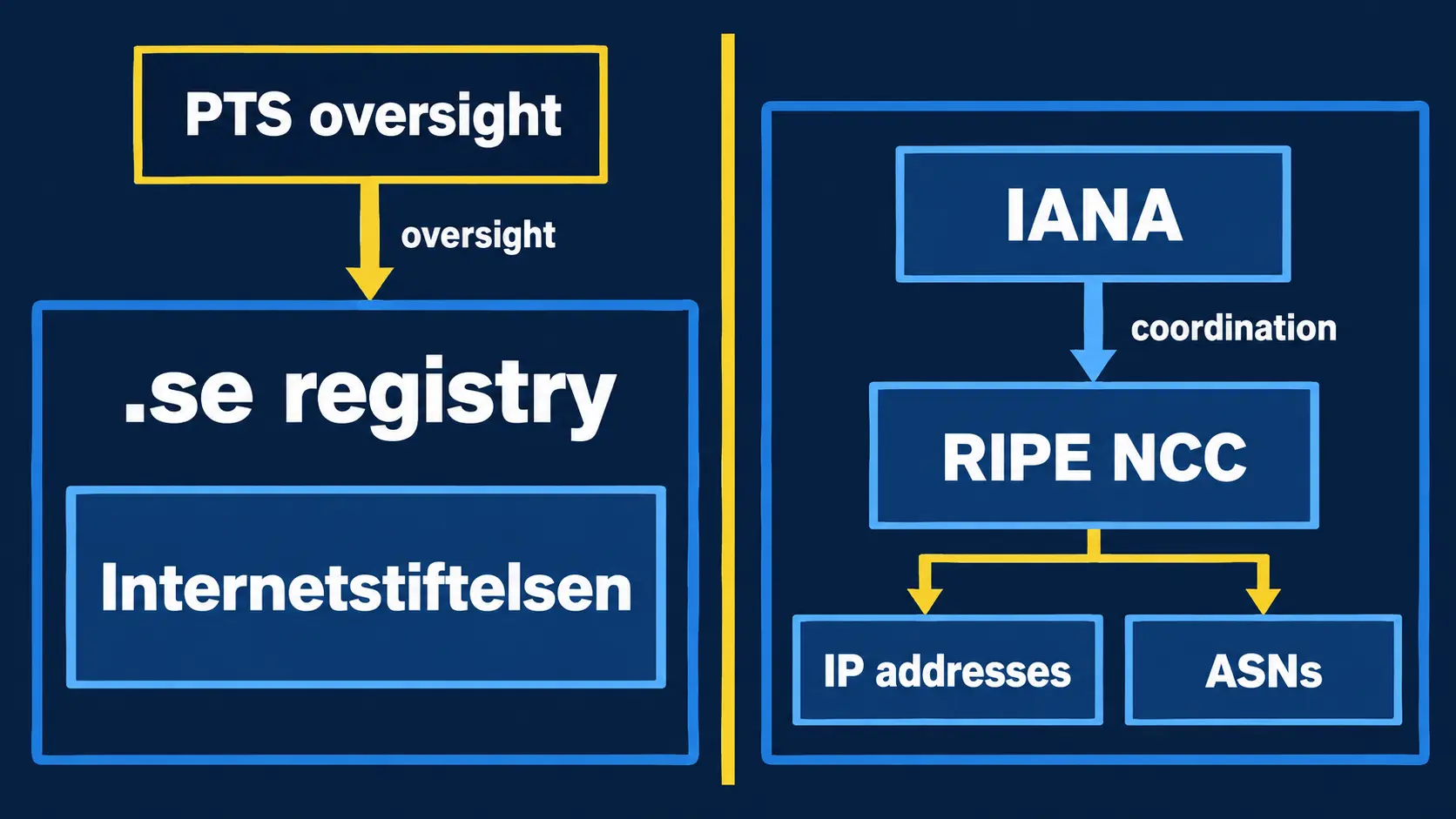
What Internetstiftelsen Controls—and What It Does Not
A sparse directory label points toward Sweden’s .se registry, but the evidence separates domain-name stewardship from the Internet’s IP-address and autonomous-system infrastructure.

IETF
RFC 9996 Registered the Media Type, Not the Schema Version
A label can tell a receiver what kind of parcel arrived without telling it which rulebook gives the contents meaning. RFC 9996 gives Protocol Buffers two proper media types and draws useful boundaries around binary and JSON handling. It does not place the Protobuf schema, its…

Story
AFRINIC Calls Its NS2 Dashboard ‘Real-time.’ All Twelve Linked Measurements Are Stopped One-Offs
A page can refresh on demand without measuring the present. AFRINIC’s public NS2 dashboard illustrates the distinction: it advertises “Real-time Anycast Node Monitoring”, yet every RIPE Atlas measurement wired into the interface is a stopped one-off. The result is useful evidence…

Leaders
From Registry Association to Operational Authority: What AS211867 Records Can—and Cannot—Show
From Registry Association to Operational Authority: What AS211867 Records Can—and Cannot—Show intelligence summary explains the development, the public evidence available to readers, the organisations involved, the regional context, market exposure, and the infrastructure…

IETF
Patrik Fältström and the ENUM Answer That Did Not Complete the Call
The number resolved. A signed DNS answer yielded a URI. The phone still never rang. Patrik Fältström’s work on ENUM is most useful when those three facts remain separate.

IETF
RFC 9997's PEN-Derived SID Range Is Not a Provenance Stamp
A number can be globally unique and still tell the wrong story about its origin. RFC 9997 gives eligible Private Enterprise Number holders a deterministic block of YANG Schema Item iDentifiers, eliminating a central allocation round trip. That is useful coordination. It is not an…

IETF
David Harrington and the SNMP Context That Did Not Identify the Operator
The command named an engine, a context and an entity with precision. None of those fields said which human had chosen the change. David Harrington’s SNMP architecture makes that absence visible rather than filling it with an assumption.