
Summary
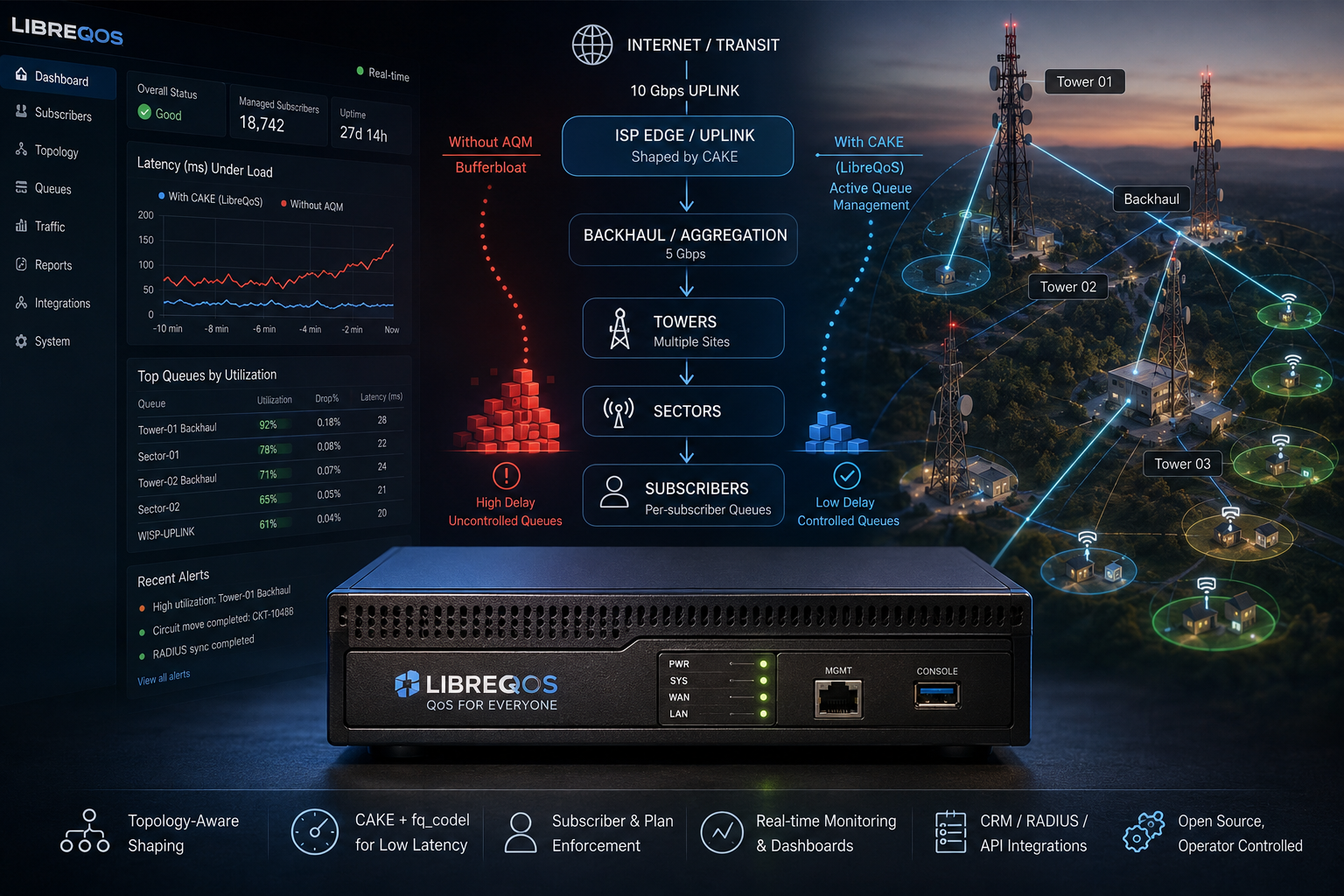
- LibreQoS runs inline and applies CAKE to subscriber and shared bottlenecks, targeting delay that conventional speed and utilisation figures can miss.
- Its hierarchy of circuits, sectors, towers and backhauls turns topology data into live queueing policy, so stale records can directly distort customer experience.
- March 2026 releases expanded the local interface and operational workflow while sharpening the boundary between the GPL core and paid LibreQoE services.
- The system cannot create capacity or control queues outside its path; wrong rates, asymmetric routing, variable radio links and inline failure remain material constraints.
Every packet crosses the shaper, so failure planning comes first
LibreQoS commonly runs as a transparent bridge: traffic enters one network interface, crosses a Linux server and leaves through another. That placement gives the system authority to classify and queue every packet on the path. It also means a software crash, failed network card, bad bridge configuration or overloaded processor can affect the entire link behind it.
The physical position is the first fact an operator must understand. An out-of-band monitoring platform can fail while packets continue. An inline shaper participates directly in forwarding. Bypass hardware, redundant power, kernel updates, recovery images and a tested unshaped path are part of the deployment, not optional work to be considered after the latency graphs look better.
LibreQoS uses that inline position to control where queues form. If Linux sends slightly below the rate of a downstream link, packets wait in a queue the host can manage rather than in an opaque modem, radio or provider device. The system can also represent shared bottlenecks—such as a tower backhaul or wireless sector—and apply parent queues to the subscribers competing beneath them.
The operating model leaves one question: can a small provider turn topology and modern queue management into consistently better customer experience without making an inline server and an imperfect network inventory the new sources of failure?
The answer depends on placement and accuracy. If the provider has a 10-gigabit upstream and configures LibreQoS below that value, the server becomes the bottleneck by design. That can be useful because the queue is now visible and controllable. Set the value too low and capacity is wasted. Set it too high and packets can still accumulate on the uncontrolled link.
Path symmetry matters as well. If only one direction crosses the shaper, LibreQoS controls only what it sees. Routing changes can move traffic around the node. A topology that was correct when installed can become wrong after ordinary network maintenance.
High availability needs a state policy as well as a second server. Failover can change the path, reset counters or remove shaping. A bypass device may preserve connectivity while allowing the old queueing problem to return. The provider has to decide whether the failure state is unshaped service, reduced service or another shaper with current policy.
Commodity hardware keeps the system accessible and does not make performance automatic. CPU, network cards, PCIe bandwidth, interrupt behaviour and non-uniform memory access can all matter. Project guidance cites an approximate 30 per cent virtualisation penalty; the figure is workload-dependent, not a universal constant.
LibreQoS offers inspectable queue control on ordinary Linux systems. The operator must still build appliance-grade reliability around it. Because every customer packet crosses the box, the failure plan is part of the quality-of-experience claim.
Full speed can still arrive with intolerable delay
Broadband performance is usually sold as a rate. A customer buys a plan measured in megabits or gigabits per second, runs a speed test and expects the result to explain the experience. The metric is useful and incomplete. A connection can reach its advertised rate during a test and become painful when an upload, cloud backup or software update fills a queue. Web pages hesitate, calls become choppy and games respond late even though packets continue moving at high throughput.
This condition is associated with bufferbloat: excessive queueing delay under load. Buffers are necessary because traffic arrives in bursts and links have different speeds. A short queue can keep a bottleneck busy. A large standing queue can hold packets for hundreds of milliseconds or more without increasing useful capacity. The user experiences the waiting time, while an operator looking only at average utilisation may see a healthy link.
Large operators can buy specialised traffic-management systems, deploy extensive telemetry and assign teams to tune them. Small and regional providers have the same physics with fewer staff and tighter margins. Wireless internet service providers face an additional complication: capacity can be shared across towers and sectors, and the available rate may change with radio conditions. A flat per-subscriber limiter does not necessarily protect the shared backhaul that all of them use.
LibreQoS grew from this gap. Early versions appeared around 2020 and 2021 through work connecting the bufferbloat community with operational ISP needs. The project offered an inline Linux-based system that could identify subscriber traffic, enforce plans and apply active queue management at the bottleneck. It sought to make methods such as CAKE usable as an operations platform rather than as a set of command-line recipes.
The project is now associated with LibreQoE, LLC, which develops and supports the software and offers paid products around the open core. LibreQoS is a GPL-2.0 codebase and community project. LibreQoE is the commercial steward and service provider. By August 2026, the company’s website reported more than 950 networks using the platform. That figure is useful as a self-reported adoption signal and not an independently audited installed-base census.
LibreQoS makes a narrower promise than “make the internet faster”. LibreQoS does not add fibre, spectrum or backhaul. It decides how existing capacity is shared and how much queue can accumulate. When configured at the true bottleneck, active queue management can preserve responsiveness while a link is busy. When placed at the wrong point or given the wrong rate, the system can shape traffic needlessly or fail to control the queue that matters.
The commercial consequence is clear. A provider may postpone a capacity upgrade if better queue management solves the customer’s immediate problem. It may also discover, through better visibility, that the bottleneck is real and needs investment. LibreQoS should not be presented as a substitute for capacity planning. It is a way to make congestion legible and controlled enough that the operator can distinguish delay caused by queues from demand that exceeds the network.
The project’s story is therefore about operational translation. CAKE and fq_codel are sophisticated kernel mechanisms. A provider needs subscriber imports, topology, dashboards, safe updates, support and a way to recover when the inline system fails. LibreQoS has been turning the algorithms into that larger operating system for access-network quality.
The topology is an executable claim about where congestion lives
A subscriber does not exist alone in an access network. The circuit may connect through a sector, a tower, an aggregation site and a backhaul. Each layer can have a capacity limit. LibreQoS represents this structure as a hierarchy and uses it to build queues. The model determines which traffic competes and where the system enforces an aggregate rate.
This is a substantial improvement over a flat list of IP addresses and plan speeds. Suppose fifty subscribers share a wireless sector with less capacity than the sum of their plans. Individual shapers can keep each subscriber below the purchased rate while allowing the sector queue to fill elsewhere. A parent queue for the sector can control the shared bottleneck and divide service more fairly when demand peaks.
The topology also supports commercial policy. A provider can associate a circuit with a plan, attach it to a site and reflect upstream constraints. The system can import these relationships from CRM, RADIUS or network-management platforms. Automation avoids duplicate data entry and allows service changes to reach the shaper quickly.
The model becomes a source of risk when business data and network reality diverge. A customer may change address. A circuit may be moved to another sector. A backhaul may be upgraded without the configured capacity being updated. Duplicate or stale records can put traffic into the wrong queue. The shaper then enforces a coherent policy on an incorrect world.
Errors can be subtle. A customer placed under the wrong parent may appear slow only during another site’s busy period. An upgraded link can remain artificially constrained. A missing circuit may fall into a default class and escape plan enforcement. A support agent may interpret the dashboard as network evidence when the problem is the import itself.
Data ownership therefore matters. The CRM may be authoritative for plans, RADIUS for active addresses and a network inventory for topology. LibreQoS has to reconcile them. When sources disagree, the operator needs a defined priority and an alert. Silent conflict turns automation into drift.
The hierarchy is also a planning instrument. It can reveal which parent queues spend time near capacity and which subscribers generate demand. These observations can guide backhaul upgrades or plan design. They remain measurements from the shaper’s location. Traffic that bypasses the node or congestion in a remote network is outside the model.
Changing the topology safely is difficult because queue objects hold live traffic and counters. A circuit may move from one parent to another while packets are flowing. Rebuilding the entire hierarchy can create interruption or reset evidence. The 2.1 engineering programme includes transactional moves and safer reload work intended to make these changes less disruptive.
The word “transactional” should be read as an operational goal rather than an assumption that every distributed effect is atomic. Kernel state, classification, monitoring and imported data need coordinated transition. A failed update should leave the old valid structure rather than a partial new one. Tests must cover concurrent traffic and large hierarchies.
LibreQoS’s topology awareness is one of its most important differentiators. It turns an ISP’s physical and commercial structure into queueing policy. It also makes data quality part of packet forwarding. Installing the system also declares that the operator’s inventory is accurate enough to control customer experience.
CAKE controls the queue LibreQoS creates, not every queue on the path
CAKE—the Common Applications Kept Enhanced queueing discipline—combines active queue management, flow isolation and rate shaping in Linux. It builds on work from the bufferbloat community and includes mechanisms associated with fq_codel. LibreQoS uses this kernel capability to keep delay under control and divide capacity among flows and subscribers.
The essential idea is to avoid one large first-in, first-out queue in which a bulk transfer can delay every other packet. Flow queueing separates traffic into smaller queues, allowing sparse traffic such as a game packet or voice frame to be served without waiting behind a large download. Active queue management detects persistent delay and signals congestion before buffers become excessive.
Shaping creates a controlled bottleneck. If Linux sends slightly less than the downstream link can carry, the queue forms in the host where CAKE can manage it. Without shaping, packets may pile up in a modem, radio or provider device whose queue behaviour is unknown. The technique does not eliminate congestion; it moves and disciplines the waiting line.
Capacity accuracy is central. Set the rate too high and the uncontrolled queue can still fill downstream. Set it too low and the provider leaves usable bandwidth idle. Wireless links make this difficult because available capacity changes with modulation, interference and scheduling. A fixed value may be safe at one time and wasteful or ineffective at another.
CAKE’s fairness is also bounded by what it can classify. Network address translation, shared addresses and encrypted transports can complicate identification. LibreQoS uses subscriber mappings and kernel-assisted classification to place traffic into the intended queues. A wrong mapping changes who shares with whom.
The algorithm cannot control remote bottlenecks. If congestion occurs in a transit network, content server or home Wi-Fi link, the inline ISP shaper may observe symptoms without having authority over the queue. A good latency-under-load result at the access bottleneck does not guarantee low end-to-end latency to every destination.
Traffic types respond differently to congestion. TCP adapts its sending rate. Some real-time or custom transports behave differently. Active queue management can protect responsive flows from persistent queues and isolate flows, but it cannot force every application to behave well. Policing and policy may still be needed for abusive traffic.
The user-visible benefit can be striking because interactive delay is sensitive to queues. That makes before-and-after demonstrations persuasive and easy to overgeneralise. Results depend on the original problem, path, plan and workload. A provider whose main issue is insufficient radio capacity may see limited improvement. A provider with oversized buffers can see large gains without adding bandwidth.
LibreQoS’s contribution is to operationalise these mechanisms across an ISP topology. It does not own CAKE or the Linux queueing work behind it. Dave Täht was a major scientific and community contributor to the bufferbloat movement and LibreQoS; his death in April 2025 was a significant loss. Current releases are maintained by a wider team, and the underlying kernel work has many contributors.
The attribution boundary matters because the platform is an integration. Its value comes from combining algorithms, network data and operations. The algorithms remain useful outside LibreQoS; LibreQoS remains dependent on their upstream maintenance.
Variable wireless capacity exposes the limit of a fixed shaping rate
A fibre handoff usually has a capacity that can be measured and configured with reasonable stability. A wireless sector behaves differently. Available throughput changes with signal quality, modulation, interference, weather, scheduling and the mix of clients. The bottleneck can move over minutes or seconds. A static queue rate cannot match every condition.
If LibreQoS is configured to the sector’s best-case capacity, the radio can become the uncontrolled bottleneck when conditions deteriorate. Packets queue in equipment beyond CAKE’s authority, and latency rises. If the rate is set for a conservative worst case, the provider leaves capacity unused whenever the radio performs well.
Dynamic shaping is an appealing answer and depends on trustworthy feedback. The system needs a timely estimate of usable capacity rather than a link-speed field or a vendor’s theoretical rate. Radio telemetry may lag, fluctuate or be unavailable through an open API. Aggressive adjustment can create oscillation: the shaper chases measurements that are themselves affected by the traffic it controls.
Operators can use margins, time-of-day profiles or external telemetry to improve the estimate. Each method adds policy. A margin protects latency and sacrifices peak rate. A profile assumes recurring demand and conditions. A telemetry integration creates another dependency whose failure needs a safe default.
The hierarchy can reduce the problem by controlling stable upstream bottlenecks and subscriber plans even when the radio varies. Flow isolation still prevents one transfer from dominating a queue LibreQoS owns. The system should not be credited with controlling delay that forms inside an opaque radio scheduler.
This boundary matters in customer communication. A provider can show that its controlled queues remain healthy while a sector’s physical rate has degraded. The evidence can support a capacity or maintenance decision. It cannot make the user’s latency disappear.
The hardest engineering question for access QoE is therefore not whether CAKE works at a known bottleneck. It is how to identify a moving bottleneck quickly enough to act without creating instability. LibreQoS’s topology and integrations give it a place to incorporate that evidence. The public record does not support saying that the problem has been solved generally.
The web interface moved queueing evidence into daily operations
A command-line queue hierarchy can be technically effective and inaccessible to the support team that needs to explain a customer complaint. LibreQoS 2.0 and 2.1 moved the project toward a broader operations platform with a stronger local web interface, maps, integrations and runtime views.
Version 2.0 was released on 19 March 2026, followed by 2.1 on 31 March. The short interval reflects an active transition rather than two unrelated generations. The releases updated how operators interact with subscriber, queue and traffic data and clarified the boundary between the open local system and paid services.
An operations interface changes who can use the evidence. A network engineer can inspect queue state and topology. A support agent can see whether a subscriber is mapped, active or constrained. A manager can identify busy sites. The same data no longer lives only in kernel counters and configuration files.
This accessibility is valuable and can create misplaced certainty. A graph is only as accurate as the imports and measurements beneath it. Traffic classification may be sampled or aggregated. A subscriber may appear under an old address. A map can show the configured parent rather than the real path. The interface should make data provenance and freshness visible.
A local web interface keeps core operations under the provider’s control. It can continue to function without a commercial cloud service, depending on the deployment. It also becomes another application to secure. Authentication, access roles, browser exposure and software updates matter because the interface can reveal traffic and change policy.
The UI can reduce configuration errors through validation and context. It can also make powerful changes easier to perform. A safe design needs role separation, confirmation for high-blast-radius actions and an audit trail. The person who views a customer’s experience should not necessarily be able to move an entire site or alter plan rates.
Version 2.1’s operational focus is significant because open-source networking tools often stall between an effective algorithm and a supportable product. LibreQoS is attempting to cross that gap. The engineering extends beyond the visual interface. It includes safer runtime changes, integrations and the foundations for multi-node operation.
LibreQoE’s current claim of more than 950 networks suggests a constituency for this work. The number remains issuer-reported. A fuller picture would separate active production installations, trials and versions. It would also show how many use only the open core and how many subscribe to LibreQoE services.
The interface’s long-term test is upgradeability. A provider may customise views or integrations. If those extensions block future releases, the operator inherits a fork. Stable APIs and plugin boundaries matter more than a polished dashboard at launch.
LibreQoS’s product evolution should therefore be understood as a change in operating audience. The shaper began as a way to apply modern queueing. The current system is becoming a place where technical and customer-facing teams make daily decisions. That increases its value and the consequences of wrong data.
CRM and RADIUS records become inputs to live enforcement
An ISP already has systems that know customers, plans and addresses. Re-entering the same information in a shaper creates delay and inconsistency. LibreQoS integrates with CRM, RADIUS and platforms such as UISP and Sonar so subscriber and topology data can be imported into the queue model.
The efficiency gain is direct. A plan change in the business system can update the configured rate. A new circuit can appear without manual editing. Authentication records can map an active address to a subscriber. Operations teams avoid maintaining parallel spreadsheets.
The trust boundary expands with each integration. A malformed API response or duplicated customer record can alter live enforcement. A CRM field intended for billing may not express the exact physical bottleneck. RADIUS data can be transient. A network platform may use site names that do not match LibreQoS hierarchy.
The operator needs a translation layer with validation. Imported capacity should fall within sensible bounds. Addresses should not be assigned to several active circuits without an explicit shared-service model. A site move should require confirmation if it changes the parent queue. The integration should report rejected records rather than silently placing them in a default.
Timing matters. A customer upgrade should not take hours to reach the shaper, while an accidental plan change should not propagate instantly across the fleet without review. Different fields deserve different deployment policies. The API can automate transport; it cannot decide the organisation’s risk appetite.
Data reconciliation is especially difficult during outages. If the source system is unavailable, should the shaper retain the last known state? Usually yes, because dropping all policy would be disruptive. The system then needs a way to identify stale data and recover without applying a backlog of contradictory changes.
Integrations also create a dependency on commercial systems whose APIs change. A provider may adopt LibreQoS partly to avoid a proprietary appliance and remain tied to one CRM connector. Open formats, documented mappings and exportable state preserve optionality.
Privacy belongs in the design. Subscriber addresses, traffic volumes and plan data are sensitive. A local system reduces external data transfer, while Insight or other commercial services may use additional data paths. The operator should understand which fields leave the network and why.
The integrations are one reason LibreQoS is more useful than a collection of tc commands. They connect queue policy to the business and physical network. They are also the point where a network error can begin in a customer-service workflow. Operational maturity requires treating every connector as production code with tests, versioning and an owner.
Transactional moves aim to change live topology without tearing it down
An ISP network does not stand still. Customers upgrade plans, addresses change, towers are split and backhauls are replaced. LibreQoS needs to change its queue hierarchy while traffic is flowing. Earlier approaches that rebuild large parts of the structure can interrupt packets, reset counters or create a period in which classification and queues disagree.
The 2.1 programme, supported in part through an NLnet project, targets transactional moves and safer reloads. The goal is to move a circuit or update topology without tearing down more state than necessary. This is a less visible feature than a dashboard and one of the clearest signs that the project is confronting production operations.
A safe move has several parts. The new parent and queue need to exist. Classification must begin sending new packets to the correct object. Existing queued packets need defined treatment. Counters may need continuity or a documented reset. If any step fails, the system should return to a valid old state.
Atomicity is difficult because the operation spans user space, kernel queueing and imported data. The kernel may expose primitives that can be changed one at a time. Traffic continues between calls. A transaction manager can order operations and detect errors, but it cannot make every external effect occur at one instant.
The practical objective is bounded inconsistency. The operator should know which transitions are safe, how long they take and what the fallback is. Tests should run under load and include resource exhaustion, duplicate identifiers and concurrent updates. Large topologies expose timing and memory issues absent from a small laboratory.
Counter continuity has operational value. Operators use traffic history for support and capacity planning. A reload that resets every queue can create false drops in a graph or erase evidence around an incident. The system should mark discontinuities so users do not compare incompatible intervals.
The feature also improves automation confidence. A CRM integration is more useful when a site move can be applied without a maintenance window. That convenience raises the importance of validation because bad input can now change policy faster.
External grant support is relevant to the project’s economics. Work on transactional state and scaling is shared infrastructure that may not produce an immediate premium feature. A grant can fund the engineering while results remain available to the surrounding ecosystem. The programme’s stated goals are evidence of direction; released, tested behaviour is the evidence of completion.
LibreQoS’s move toward transactional updates mirrors a wider transition in network software. Configuration is becoming continuous rather than episodic. The safety model must move from “restart and hope” to controlled state change. For an inline system, that is not a refinement. It is the condition for trusting automation.
Multi-node scale trades one throughput ceiling for distributed state
A single server has finite CPU, memory and NIC capacity. Project materials discuss high-rate tiers and deployment on capable hardware, but no universal claim can be made that one node handles a particular rate in every configuration. Packet size, queue count, traffic distribution, telemetry and hardware all matter.
The planned and developing multi-node API is intended to extend LibreQoS beyond one shaper. A larger provider may place nodes at several aggregation points or split a high-capacity path. A central layer can coordinate configuration and visibility across them.
Distribution aligns with topology. Shaping closer to the real bottleneck can be more accurate than sending every packet through one central appliance. It can reduce the blast radius of a node failure. It also creates state-consistency and operational questions.
A subscriber should not be enforced by two nodes unintentionally. A route change can move traffic to another shaper while the control system still believes the old node is authoritative. Counters must be aggregated without double-counting. Capacity shared across nodes needs a model or remains uncontrolled.
The control plane must handle partial failure. One node may be offline while others continue. Configuration should be versioned so the operator knows which state each node runs. A central API outage should not remove local queue policy. Recovery should reconcile rather than overwrite blindly.
Clock and measurement alignment matter for analytics. Two nodes may report intervals differently. Combining latency and volume requires timestamps and identity stable enough to follow a circuit across moves. The user interface must show whether a sudden change reflects traffic or a node transition.
Distributed shaping also changes support. Hardware can vary by site. One node may use a different NIC or kernel version. A performance issue can be local rather than systemic. Standardised deployment profiles and health checks become more important as the fleet grows.
The strategic benefit is that LibreQoS could serve larger regional networks without requiring one enormous appliance. The risk is that a project valued for its approachable inline design becomes a complex distributed platform. The engineering team must decide which coordination belongs in the open core, which in Insight and which remains an operator architecture.
Multi-node work should be evaluated through failure tests and published scale envelopes. A headline aggregate throughput is less useful than evidence showing failover, route changes and consistent policy. The project’s maturity will be measured by whether operators can understand the distributed state; passing packets through several servers is insufficient.
Bypass design decides whether maintenance becomes an outage
An inline server eventually needs a kernel update, a NIC replacement or a LibreQoS upgrade. The maintenance plan cannot begin with stopping the process and discovering what the bridge does next. Operators need a defined path that preserves connectivity while the shaper is unavailable.
A hardware bypass can join the two network ports when power or software fails. The network continues without queue management, and the uncontrolled bottleneck may return. A routed failover can send traffic through another node and must preserve symmetry and capacity assumptions. A maintenance window can accept interruption and needs a customer-impact plan.
Each choice has test cases. A bypass relay should be exercised under load and after power loss. The alternate path should be checked for loops, address learning and maximum rate. Monitoring should distinguish “healthy shaping” from “traffic passing in bypass,” because both can look like reachability.
Upgrades need a rollback image and configuration export. Kernel and driver changes can affect queue behaviour even when LibreQoS itself is unchanged. A provider should test the production topology and representative flow count, not only whether the new version starts.
The maintenance procedure should preserve evidence. Counters may reset, and the dashboard should mark the interval. CRM imports can change while a node is offline; recovery should reconcile versions before applying them. A stale node must not overwrite newer topology.
This work is easy to postpone because the system is introduced to improve service, not to become a new failure domain. The inline position makes it one. Providers that prove bypass and rollback before deployment convert open software into dependable infrastructure. Those that rely on the server never failing have built a single point of optimism.
The open core and paid analytics layer divide control and revenue
LibreQoS’s commercial model is explicit enough to resist two easy descriptions. The core repository is licensed under GPL-2.0 and can be self-hosted. LibreQoE, LLC offers paid Local and Insight services and support around the project. From version 2.0, mapped-circuit ingest above the first 1,000 circuits requires an Insight licence under the stated terms.
In August 2026, the pricing page gave an example at 1,000 subscribers of $150 a month for Local and $282 a month for Insight. Prices and packaging can change. The figures show the shape of the model: an accessible open core, paid operational and data services, and charges that scale with the provider’s subscriber base.
This arrangement provides a revenue path for maintenance and support. Open-source infrastructure needs engineers, test systems, documentation and incident response. A commercial company can fund that work and give operators someone to call. The model is not evidence that every project contribution is company-owned or that community labour is unpaid.
The licence boundary deserves clarity because “free” can mean source availability, zero price, unlimited use or community governance. The LibreQoS core is open source. Some functions and data services have commercial conditions. An operator should evaluate the current licence and service terms for its scale rather than assume the entire platform is costless.
The threshold can create an adoption path. Smaller networks can use the core and learn the system. Larger providers contribute revenue when they need more mapped circuits or advanced services. The risk is that a future boundary moves in a way that makes an operator dependent after significant integration.
GPL licensing preserves access to the covered code and modifications under its terms. It does not guarantee a hosted service, trademark rights, support or access to proprietary analytics. The company can differentiate above the core without closing the repository.
The commercial layer can also improve product discipline. Paying customers demand upgrades, documentation and predictable support. Their requirements can fund features useful to the wider community. They can also skew priorities toward subscribers with contracts. Transparent roadmaps and open review help maintain balance.
Operators should map which functions remain available during a service interruption or subscription change. If the local shaper continues but central analytics disappear, the operational risk differs from a platform that stops enforcing policy. Data export and migration paths determine whether Insight is a useful service or a new lock-in point.
The model’s success should be judged by sustainability and optionality. Can the company support the maintainers? Can users operate the core independently? Can paid customers retrieve their data and move support providers? A clean open-versus-proprietary label answers none of these questions.
Support economics decide whether low latency becomes routine
Deploying a shaper can produce a visible improvement and leave the provider with a new system to maintain. Support teams need to interpret the interface, network engineers need to own topology, and management needs to understand why a heavily utilised link may require attention even when customers still pass speed tests.
The economic benefit can appear in fewer complaints, faster diagnosis and delayed upgrades. None is automatic. A provider may improve latency and continue using scripts that make plan changes unreliable. Support agents may lack access to the right evidence. Savings need to be measured against hardware, subscription and staff time.
LibreQoE’s Local and Insight offerings are one way to professionalise the deployment. Paid support can reduce the cost of learning the system and provide central analytics. The open core gives the operator the option to build internal capability or use another provider. Whether that option is practical depends on documentation and the availability of skilled engineers.
A small WISP may find the current example prices modest beside the cost of one senior engineer. A larger network may pay more with subscriber-based scaling and gain more from fleet-wide visibility. Price alone cannot be compared with a proprietary appliance unless support scope, data retention and failure responsibility are included.
The support desk is also a source of product truth. Complaints reveal topology errors, variable bottlenecks and mappings that dashboards miss. A mature workflow should let support staff attach a case to queue and traffic history without granting them authority to change the network. Feedback should reach engineering as structured evidence rather than anecdote.
Training matters because bufferbloat is counterintuitive. An agent may see a customer receiving full rate and conclude there is no network problem. Understanding latency under load changes the diagnostic conversation. LibreQoS can make the evidence visible; organisations need to teach what the graphs mean and where they do not reach.
Long-term success will depend less on installed servers than on whether providers keep the data accurate six months later. Integrations need owners, firmware and kernels need upgrades, and bypass paths need tests. Commercial support can make this routine. Community documentation can make independent operation credible.
This is the ordinary economics of open infrastructure. The software lowers a barrier and creates a shared maintenance base. The operator still pays for competence. LibreQoS becomes valuable when that competence is embedded in daily operations rather than concentrated in the engineer who completed the first deployment.
A bufferbloat score starts an investigation; it cannot locate the queue
Public latency-under-load tests played an important role in making bufferbloat visible. A user can see that delay rises dramatically while a download or upload runs. LibreQoE announced Bufferbloat Test v2 in March 2026, continuing the project’s connection between measurement and operational action.
The test can reveal a symptom: the path accumulates delay under load. It cannot identify every queue on that path. The bottleneck may be in the home router, Wi-Fi, access network, transit or server. Test traffic may use one route and protocol. Browser and device limits can affect the result.
For an ISP, the test becomes more useful when combined with internal evidence. LibreQoS can show whether the subscriber or parent queue was active, what traffic volumes were present and whether the configured bottleneck was reached. A support agent can distinguish an access queue from a local wireless problem more effectively than from the public score alone.
The test can also create perverse incentives if treated as a ranking. Providers may optimise for the test path without improving broader experience. Users may interpret a single result as proof of provider negligence. Responsible presentation should explain variability and encourage repeated measurements.
Synthetic tests are valuable because they are controlled. Real applications are valuable because they reflect use. A mature quality programme combines both. Voice and gaming respond to latency differently from bulk transfers. Cloud applications may open many connections. Capacity planning uses longer intervals than an interactive test.
LibreQoS’s connection to the bufferbloat community gives the project a strong explanatory foundation. It frames latency as a queue-management problem that can often be fixed through engineering rather than a vague complaint. The loss of Dave Täht removed a prominent advocate and contributor; the continuation of releases shows that the project is not solely dependent on one person.
The measurement story should remain separate from product claims. A good test result after deploying LibreQoS supports that configuration and path. It does not prove every customer benefits equally. A poor result can reveal a problem outside the shaper’s control.
The value of the test is to start a structured investigation. The danger is to stop at the score. LibreQoS is most credible when it connects the public symptom to queue, topology and capacity evidence while preserving the uncertainty between them.
Competing systems price support, control and proof differently
LibreQoS competes with several categories rather than one product. Commercial quality-of-experience platforms such as Preseem target WISPs with managed analytics and traffic management. Larger observability products from vendors such as Kentik or Nokia’s Deepfield focus on network-wide traffic intelligence. Policy appliances from Sandvine or Allot offer deeper commercial control. MikroTik and other router platforms provide built-in queueing. Operators can also build Linux tc scripts directly.
A managed platform reduces integration work and provides a clear support contract. It may offer mature benchmarking and fleet analytics. The operator accepts subscription cost, data transfer and dependence on the provider’s roadmap.
A large policy appliance can combine classification, enforcement and commercial features at high scale. It may be expensive and opaque to a small ISP. Deep application classification also raises privacy and encryption challenges.
Router-native queueing avoids an extra inline server. It may be constrained by hardware, vendor interfaces and the ability to represent topology. A hand-built Linux system offers maximum control and minimum product overhead, while placing all maintenance on the operator.
LibreQoS’s differentiator is the combination of open code, topology-aware CAKE shaping and an operator-facing platform. The paid Insight layer narrows the gap with managed products without removing the self-hosted option. The system is most attractive to providers that value modern queueing and are willing to manage Linux infrastructure.
Price comparisons must include staff and failure risk. A low subscription can be cheaper than one engineer’s time. An open system can be cheaper over several years if it avoids appliance licences and vendor lock-in. The answer depends on fleet size, skill and support needs.
The choice also depends on evidence requirements. A provider may prefer inspectable qdiscs and open counters. Another may need a vendor-certified appliance with one accountable supplier. Openness is a control advantage, not a universal procurement rule.
LibreQoS does not need to replace every alternative to matter. It can raise expectations that latency under load should be managed, that topology should inform shaping and that operators should be able to inspect the policy controlling subscribers. Competitive pressure can spread those practices even where another product is selected.
Queue evidence informs plan design but cannot define fairness
LibreQoS gives a provider data about when subscribers and shared parents are busy. That evidence can reveal a plan tier that regularly reaches its limit or a backhaul whose customers compete during evening peaks. The engineering system does not decide how the provider should translate those observations into products.
A provider may raise capacity, change contention, redesign tiers or communicate a realistic service range. It can also use shaping to enforce a narrowly written plan while leaving the shared network chronically saturated. Both choices can be technically consistent with the configured policy and produce very different customer outcomes.
Fairness has several meanings. CAKE can isolate flows so one transfer does not dominate. Subscriber plans can allocate different rates according to price. A parent queue can divide scarce capacity among circuits. Regulators and customers may care about transparency, minimum performance or equal treatment beyond the algorithm’s scheduling definition.
The data should therefore support, not replace, commercial and public judgement. Management needs to see how often queues constrain service, which groups are affected and whether advertised plans are achievable under ordinary load. Support teams need language that explains congestion without blaming individual users for using the service they bought.
An open platform can make these decisions more auditable because the queue hierarchy and rates are inspectable. The operator still controls them. LibreQoS is a mechanism for distributing scarcity with less avoidable delay; the legitimacy of that distribution depends on policy outside the code.
The most dangerous failure is a wrong model enforced perfectly
LibreQoS brings precision to queueing. It can classify traffic, create hierarchies and apply carefully designed algorithms. The precision of execution does not guarantee the correctness of the policy. An inaccurate topology or capacity value can be enforced with equal efficiency.
This is a general danger in infrastructure automation. Manual systems fail visibly and inconsistently. Automated systems can propagate one wrong assumption across thousands of circuits. The answer is not to avoid automation but to build verification around the model.
Operators should compare imported subscriber counts with active traffic, check for duplicate addresses and alert on unclassified volume. Capacity changes should be reconciled with router and radio data. Parent queues should be tested under controlled load. A configuration diff should be reviewed before it becomes kernel state.
The platform also needs clear defaults. Unknown traffic must go somewhere. If it is unrestricted, customers can escape policy through an unmapped address. If it is heavily constrained, legitimate service can fail after an import error. The choice should be explicit and monitored.
Inline operation magnifies security. The server receives all traffic and may expose management interfaces. Updates to kernel, NIC drivers and the application must be qualified. An attacker who gains administrative control can alter service for many customers. Network segmentation and restricted access are essential.
Privacy is another constraint. Traffic volumes and destinations can reveal behaviour even without payload inspection. Insight and local telemetry need retention and access policy. The project’s open code makes data flows more inspectable; each deployment decides what is collected.
The commercial model introduces continuity questions. Operators should know which functions depend on an active licence or cloud service and how to export data. LibreQoE’s current pricing and thresholds are transparent enough to evaluate, but future terms can change. Avoiding lock-in requires periodic tests of the independent local path.
Contributor sustainability remains an unresolved issue. The project has an active company, community and grant support, yet no audited project-only budget or complete labour census. The loss of a major contributor illustrates why documentation and shared maintainership matter.
LibreQoS’s constraints are not reasons to dismiss the platform. They define the work required to use it responsibly. The project offers a strong mechanism for a problem many providers have ignored. Its success depends on operating the data, hardware and organisation around that mechanism with equal care.
LibreQoS is becoming an open quality-control plane for access networks
By August 2026, LibreQoS 2.1 was the current major release after the 2.0 transition in March. The project had a maintained GPL core, a commercial steward, integrations, a local operations interface and active work on safer state changes and multi-node scale. LibreQoE reported more than 950 networks using the platform, an issuer-supplied adoption figure rather than an independently audited census.
Those facts support the description of a maturing infrastructure platform. They do not support a claim that any commodity server can handle any throughput, that CAKE will fix every customer complaint or that every reported network is an active production deployment.
LibreQoS’s clearest contribution is to treat latency under load as an operating variable alongside bandwidth. It connects queueing policy to the ISP’s topology and subscriber records, giving smaller providers an alternative to proprietary appliances. The 2026 releases expanded the control plane around the shaper through dashboards, maps, imports and safer workflows.
That wider control plane also enlarges the maintenance burden. Business data can now change packet treatment. A software upgrade can affect an inline path. Paid analytics can create a new dependency even while the local core remains open. The value of the architecture depends on clear boundaries between the shaper, the data sources and the commercial service.
The next proof point is an operating record rather than another installation number. A provider should be able to disclose the hardware, traffic mix, topology changes, bypass behaviour, measured latency and capacity decisions over a sustained period. Multi-node deployments will need to show that policy ownership and counters remain understandable during rerouting and partial failure.
LibreQoS cannot manufacture bandwidth. It can keep an avoidable queue from making existing bandwidth feel worse and expose where physical investment is still required. The system becomes durable infrastructure when a provider can improve latency, survive an inline failure and use the same evidence to justify the next capacity upgrade.
Member Briefing
Deeper Profile Context
Sign in with the right membership level to unlock the full briefing and source notes.
Only for Strategic Circle
Strategic Circle
Open to all readers. Unlock profile briefings after joining and signing in.
Join Strategic CircleOnly for Leadership Alliance
Leadership Alliance
For qualified IP-asset owners and management; sign in to unlock alliance briefings.
Join Leadership Alliance