
Summary
- OpenWISP began with public Wi-Fi around Rome and was rebuilt from 2015 as a modular management system for distributed OpenWrt fleets.
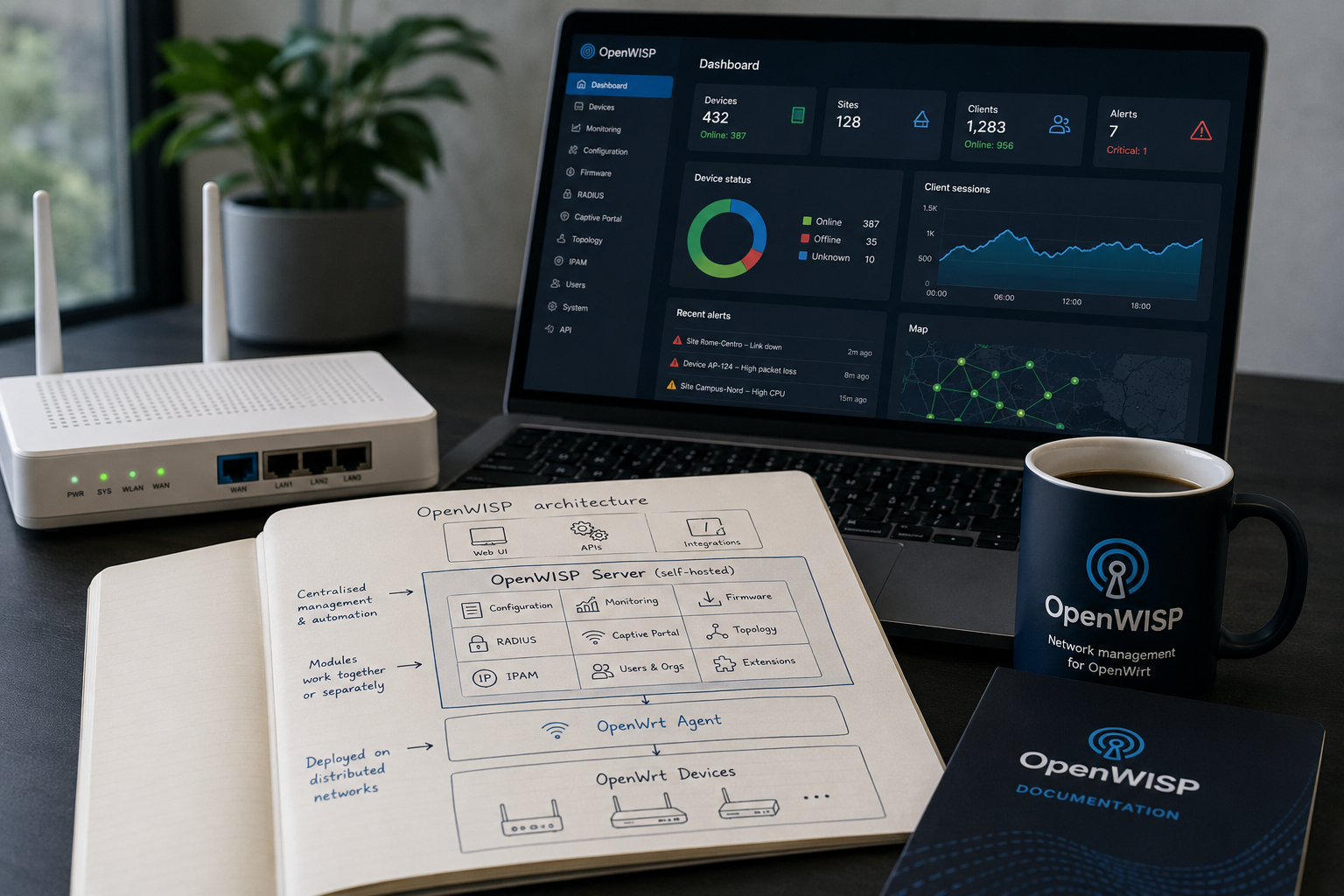
- Configuration, monitoring, firmware, RADIUS, captive portals, topology, address management and APIs can be combined without forcing every operator into one monolithic controller.
- A June 2026 case study describes several hundred routers across multiple instances, useful production evidence that does not establish a universal scale limit.
- Self-hosting preserves control over code and data while transferring availability, backups, credentials, database performance and upgrade responsibility to the operator.
Rome’s public Wi-Fi programme exposed the real cost of cheap access points
By 2012, the FreeItaliaWiFi federation was reported to cover roughly 2,500 access points. The figure grew from WiFi Metropolitano and ProvinciaWiFi around Rome, where public administrations and institutional partners had been using open software to operate connectivity across a dispersed set of municipal sites since 2008. The access points were inexpensive; keeping them configured, authenticated, monitored and secure was not.
A public router needs someone to assign addresses, set radios, rotate credentials, observe outages, apply policy and update firmware. When devices are spread across buildings, squares and community sites, technicians cannot treat each one as a separate appliance. Even a modest network needs a control room, whether that control room comes from a vendor or from software the operator runs itself.
OpenWISP grew from that operating problem. The early system served public hotspot deployments and spread to other Italian municipalities in 2009. Its first users already had constrained budgets, heterogeneous locations and a need to change many devices without logging into each one. Reusable configuration, multi-organisation access, authentication and monitoring followed from field work rather than from a generic product brief.
The project did not remain a municipal hotspot platform. In 2015, it began a substantial redesign around OpenWrt management and a modular server architecture. The change acknowledged that wireless internet service providers, campuses, community networks and enterprises faced the same fleet problem. OpenWrt supplied a widely used device operating system; OpenWISP built an agent, controller and related services around it.
The history leaves a practical question: does self-hosting give a small operator durable control over its network, or does it transfer the same responsibility from a proprietary controller into a stack of servers, databases, keys and custom integrations that the operator must maintain alone?
OpenWISP’s current answer is modular. Configuration, monitoring, firmware, RADIUS, captive portals, topology and IP address management can be combined through Django applications and OpenWrt components. REST and WebSocket interfaces support integration. Different deployments can enable different modules rather than accepting one fixed controller.
The institutional structure is equally distributed. Public bodies, universities, open-source contributors, Google Summer of Code participants and commercial users have all shaped the platform. OpenWISP joined Google Summer of Code in 2017 and by 2020 described itself as a global modular network-management system. No single public record establishes one legal entity as the owner of the whole project.
That absence complicates any attempt to treat OpenWISP as a conventional company and clarifies the real subject. OpenWISP is maintained code, documentation, contributors and support relationships that operators assemble into their own control system. It can reduce dependence on a vendor cloud. It cannot remove the need to run the control room.
The 2015 rebuild separated the controller into services operators could combine
OpenWISP is easiest to misunderstand when it is presented as one controller. The current platform is a set of modules with coordinated releases and separate version numbers. By August 2026, the 25.10 family was the current major line, while individual modules used versions such as 1.2.x and deployment packages retained the 25.10.x scheme. These numbers describe related release tracks, not contradictory products.
The controller sits at the centre. It stores device records, configuration templates and variables, manages credentials and supports remote operations. An operator can define a common configuration once, apply it to groups of devices and override values where needed. That is the basic economy of fleet management: a change should be expressed as policy rather than repeated manually across routers.
Templates are more than a convenience. They become the source from which device state is derived. A provider can define radio settings, interfaces, tunnels, firewall rules or service parameters and reuse them across sites. Variables allow the same template to contain device-specific addresses, names or credentials. The result is closer to configuration management in a server environment than to the traditional practice of treating every router as a separately administered box.
The device side is strongly associated with OpenWrt. An agent can retrieve configuration and report information. The server can also use remote access methods, including SSH, where appropriate. the project’s current strength is not universal multivendor management. It is the ability to manage OpenWrt-based fleets through a coordinated open system.
A modular Django architecture lets organisations extend the server. Django supplies authentication, database models, administration and a mature Python web framework. OpenWISP modules build network-specific functions around those foundations. This design lowers the barrier for teams that already know conventional web development, but it also means the platform inherits the operational needs of a web application: database maintenance, queues, worker processes, caching, certificates and secure deployment.
The release record shows active maintenance. The controller reached version 1.2.3 on 9 April 2026. The Docker deployment repository released 25.10.4 on 4 June. The OpenWrt monitoring agent reached 0.3.1 in May, and the RADIUS module reached 1.2.2 in April. These dates demonstrate continuing work across the stack. They also illustrate the version-alignment problem: an operator must know which combinations are supported rather than assuming every latest module can be upgraded independently.
Modularity gives OpenWISP room to serve different networks. A provider can use configuration and monitoring without a public captive portal. A municipality can combine authentication and login pages with topology. A community network can add custom Django applications. The same freedom complicates support because two installations may share a name while differing in enabled modules, extensions, database scale and deployment method.
The architecture therefore trades a proprietary appliance’s fixed integration for an open platform’s assembly work. That trade is attractive when an organisation wants control or customisation and has the skill to operate the result. It is less attractive when the buyer expects one vendor to own every dependency and service-level agreement.
OpenWISP’s redesign succeeded in making the project broadly reusable. The next question is whether that reuse can remain operationally coherent as the number of modules and protocols grows. A modular stack becomes infrastructure only when its release and migration discipline is as strong as its feature list.
Configuration is useful only when intended state survives an unreliable link
Central configuration sounds straightforward: store the desired settings on a server and push them to devices. Distributed access networks make each part of that sentence unreliable. A router may be behind network address translation, on an intermittent wireless backhaul or powered from an unstable site. A change may affect the very path used to deliver it. A device may be offline while the policy changes several times.
OpenWISP’s controller addresses this environment through templates, agents, remote operations and public-key infrastructure. The operator can define desired state centrally and use a device identity to establish trust. The design avoids dependence on a technician copying commands, but it does not make reachability or change safety automatic.
A dependable workflow needs to distinguish desired state, last reported state and observed behaviour. The server may know what should be configured without knowing whether the device applied it. A successful API call may mean that a job was queued, not that the radio came back online. A router can accept a configuration and then become unreachable because a network parameter was wrong.
Configuration management therefore needs staged deployment. An operator should be able to apply a change to a test group, observe health and expand gradually. Critical values require validation. A syntax checker can catch malformed input but not a policy that points every tunnel to the wrong endpoint. The platform’s APIs make automation possible; the organisation must design the approval and rollback process.
The device identity is another high-value boundary. Certificates and credentials let the server distinguish authorised equipment. If those credentials are stolen, an attacker may impersonate a router or gain access to management. If they are lost, the operator may need physical recovery. Key issuance, rotation and revocation therefore belong to ordinary network operations, not to an installation checklist that can be forgotten after launch.
Templates can also hide context. A variable may change meaning when a device moves to another site. A copied group can carry an old address pool. In a small fleet, an engineer may notice the mistake. At scale, the configuration model needs validation against inventory and topology. The more modules are integrated, the more useful these cross-checks become.
The self-hosted model gives the operator full access to configuration history and automation. It avoids a cloud vendor becoming the sole holder of device state. It also means the operator must preserve backups and audit records. A database failure without tested recovery can erase the management history of the fleet even though the routers continue forwarding.
OpenWISP’s value is clearest when configuration is treated as code: versioned, reviewed, tested and deployed through controlled stages. The platform provides the objects and APIs needed for that discipline. It does not supply organisational judgement. A small provider can gain the same operational pattern used by larger networks, but it must still decide who may change a template and who is awake when the change fails.
Monitoring makes low-cost routers visible, provided the telemetry path holds
A distributed network is difficult to manage because failure is often reported by a user before it appears in an operator’s tools. An access point can remain powered while its uplink is broken. A radio may be associated with clients but delivering poor throughput. A tunnel may flap intermittently. Monitoring must combine device availability, time-series measurements, Wi-Fi sessions and service checks to turn these conditions into actionable signals.
OpenWISP’s monitoring components collect and organise this evidence. The OpenWrt agent reports measurements. Server-side modules store time series, run checks and issue alerts. Device and organisation models let operators view the network by customer, site or administrative boundary rather than as one flat list.
The architecture is useful precisely because low-cost routers often lack a sophisticated proprietary telemetry system. An agent and open API can expose enough information for a small team to see patterns across the fleet. A dashboard can identify a site with rising packet loss or a group of devices that stopped checking in after an update.
Telemetry is not ground truth. A router that cannot reach the monitoring server appears down even if local service continues. A device can report healthy CPU and memory while users experience radio interference. Sampling intervals can miss short failures. The monitoring server itself can lag under load. Alerts therefore describe observations from a particular path and schedule, not the complete state of the network.
Scale depends on the entire data pipeline. More devices create more measurements, database writes, tasks and notifications. Wi-Fi sessions can create high-cardinality data. Retention policies determine storage. An operator that enables every metric without planning capacity can turn the monitoring system into the bottleneck. Case studies and release material show real use; they do not define one maximum fleet size applicable to every configuration.
The June 2026 Stellar Telecommunications case study is the clearest current production reference. It describes several hundred routers managed across multiple OpenWISP instances. The account is useful because it comes from an operator and discusses an extension path rather than a synthetic benchmark. It remains a customer-authored case study. The topology, selected modules, database design and support arrangement may differ from another deployment.
Multiple instances can be a sign of deliberate isolation, geographic design or scaling limits. Without more detail, the number should not be interpreted either as proof that one instance cannot manage the fleet or as proof that any installation can. A responsible comparison would state the workload: configuration frequency, metric volume, RADIUS sessions, topology size and custom code.
Monitoring also creates privacy obligations. Wi-Fi and authentication records can reveal devices, locations and user activity. A self-hosted system keeps the data under the operator’s control, which may simplify sovereignty requirements. It does not decide which data should be collected or how long it should be retained. Access controls and minimisation remain necessary.
The project’s monitoring story is therefore one of accessible capability rather than effortless observability. OpenWISP lets organisations build a network-operations view without purchasing a closed platform. The quality of that view depends on agents, time synchronisation, database health, alert design and the willingness to test the monitoring system as rigorously as the routers it watches.
Firmware automation can repair a fleet or strand it in one move
Configuration changes alter policy inside a running software image. Firmware upgrades replace a larger part of the device. They are necessary for security, hardware support and new functionality, and they carry the greatest fleet-wide risk in a network-management system.
OpenWISP’s Firmware Upgrader coordinates images, device compatibility and deployment workflows. An operator can associate an image with appropriate hardware, stage releases and track outcomes. This is a substantial improvement over manually visiting routers or relying on ad hoc scripts. It also creates a central mechanism whose mistakes can affect many sites quickly.
The first requirement is identity. A firmware image must match the device model, storage layout and boot process. Similar product names may conceal different flash chips or board revisions. An image that boots on a laboratory unit can fail on a field variant. A management system needs reliable hardware inventory and explicit compatibility rather than assumptions based on labels.
The second requirement is integrity. Images should be signed and delivered over authenticated channels. Signing keys need strong custody and a rotation plan. If the server or key is compromised, the same automation that improves maintenance can distribute malicious firmware. Open source makes the update code inspectable but does not protect the operator’s credentials.
The third requirement is recovery. Power can fail during an upgrade. A wireless backhaul can disappear. A new image can boot but lose the management connection. Devices with dual partitions or a known-good fallback offer safer recovery than those that overwrite the only image. The platform can orchestrate a rollback only if the hardware and bootloader support it.
Staging reduces the blast radius. Operators can begin with internal devices, move to a small representative group and expand after observing stability. The representative group must include hardware revisions and network conditions that resemble the fleet. A successful upgrade in a well-connected office does not prove that a solar-powered rural site will recover in the same way.
OpenWISP’s open workflow gives operators an alternative to vendor clouds whose update policy may be opaque. It can extend the useful life of devices when images remain buildable and maintainers are available. It also leaves the operator responsible for deciding when an upstream security fix is ready for production. That decision requires test capacity, not simply access to source.
The project’s coordinated releases and installer updates show that its own server stack also requires upgrades. An organisation must maintain OpenWISP while using it to maintain routers. Database migrations, module compatibility and custom extensions can complicate the server lifecycle. A fleet can become dependent on an old management version because a local plugin has not been ported.
Firmware management is where OpenWISP’s promise and burden are most visible. The platform can turn a small operations team into an effective fleet manager. It can also give that team the power to make a uniform mistake. Safe use depends on approval boundaries, staged rollout, independent recovery and an inventory accurate enough to know what is being changed.
RADIUS and captive portals pull identity and public policy into the controller
Radios are only one part of a public Wi-Fi network. It has users, sessions, access rules and often an obligation to record or account for activity. OpenWISP includes RADIUS integration and Wi-Fi login pages so authentication can be connected to the same organisational model used for devices and monitoring.
RADIUS provides a familiar authentication, authorisation and accounting framework. A network access device sends a request, the server evaluates identity and policy, and the response can accept, reject or challenge the session while returning attributes. Accounting records can describe session starts, stops and usage. In a federated or public environment, these decisions may cross organisational boundaries.
OpenWISP’s RADIUS module and portal components can support captive portals, social login, session management and integration with network inventory. This lets an operator create a coherent workflow rather than assemble unrelated identity and device systems. A municipality can manage sites and users in one framework; a WISP can link access policy to subscriber records.
The integration also enlarges the consequence of a mistake. A configuration error can lock out users across many sites. An identity-store outage can make working access points appear unusable. Accounting gaps can affect billing or compliance. The management platform becomes part of the access path even when packet forwarding does not pass through its server.
Classic RADIUS deployments have well-known security constraints, and captive portals have their own weaknesses. Transport, shared secrets, certificate validation and proxy relationships need careful design. Social-login integrations add external identity providers. OpenWISP supplies software components; the deployment determines the trust model.
Privacy is particularly sensitive. Login records, device identifiers and session history can reveal where and when people used a network. Public authorities and commercial providers face different legal requirements. Self-hosting allows data to remain in an operator-controlled environment, but it also makes the operator the custodian of a valuable dataset.
The RADIUS module’s 1.2.2 release in April 2026 shows active maintenance. It should not be interpreted as evidence that every OpenWISP deployment uses the module or that the project operates a central authentication service. Each organisation runs its own policy and infrastructure.
The identity layer reveals why OpenWISP is more than a router manager. It can become an operations system spanning devices, people and service. That breadth creates value for networks that cannot justify several commercial platforms. It also demands separation of duties. The engineer who edits radio templates should not automatically have access to user identity data or payment systems.
A modular architecture makes that separation possible if roles and APIs are configured carefully. It does not enforce one governance model. The operator must decide how network administration, customer support and privacy oversight intersect. In public connectivity, those decisions are part of infrastructure design rather than an administrative afterthought.
Topology and address data provide context, not a perfect map
Networks fail through relationships. A router may be healthy while its parent backhaul is down. An address conflict can affect several sites. A topology view helps operators understand these dependencies, while IP address management prevents allocations from becoming an undocumented spreadsheet.
OpenWISP includes topology and IPAM functions that connect devices, logical links and address spaces. Maps and APIs can show how components relate. Organisations can separate inventories and allocate resources. WebSocket updates can make changes visible to operators without constant manual refresh.
The model becomes more useful when combined with monitoring. An alert on a parent link can explain several downstream failures. A planned maintenance window can be mapped to affected devices. Address allocation can be checked against configuration templates. The platform can turn separate operational records into one context.
The limits are the same as in any network model: discovery is incomplete, names become stale and logical relationships do not always match physical dependence. A wireless path can change. A device may be moved without the inventory being updated. A tunnel can hide the underlying transport. The map is an assertion assembled from data sources, not the network itself.
Stale topology can be worse than no topology because automation may trust it. A firmware rollout could select the wrong group. Capacity planning could miss a shared bottleneck. Operators therefore need ownership for data quality and a way to compare the model with observed state.
IPAM also carries organisational politics. Address space may be divided by customer, region or service. A central system can reduce conflict and support automation. It can also become a gatekeeper if every workflow depends on one schema or team. Open APIs help other systems consume and update the data, but access controls are essential.
For community networks, a shared topology can support collaboration among independently managed sites. For commercial providers, it can become a source for provisioning and support. The same module serves different governance models because OpenWISP does not require one central operator for every organisation object.
The practical value lies in context, not cartographic perfection. A technician who receives an alert needs to know which site, device, address and upstream relationship are involved. OpenWISP can provide that context in a self-hosted system. It remains the operator’s responsibility to keep the model close enough to reality that it improves decisions.
One platform can serve several networks without erasing separate ownership
Public and community connectivity rarely fits a single-company hierarchy. A municipality may operate sites through several departments. A regional provider can manage networks on behalf of customers. A university may delegate buildings to local administrators while retaining central policy. OpenWISP’s organisation and user models are designed for this kind of separation.
The model allows devices, templates and related records to be assigned to organisations and made visible according to role. A central operator can maintain the platform while giving local teams access to their part of the network. This is more than a user-interface feature. It defines who may see credentials, change configuration and inspect subscriber or monitoring data.
Multi-tenancy creates economies of scale. One OpenWISP installation can host several administrative domains, reducing the need to deploy and maintain a separate server for each small network. Shared monitoring and upgrade infrastructure can be funded collectively. Commercial support providers can operate a platform for several customers while preserving logical boundaries.
The boundaries need testing. A bug in permission checks can expose another organisation’s devices or data. A shared template may be edited by someone who does not understand every tenant. Global administrators can become a concentration of authority. The database and task workers remain shared even when records are logically separate, so one noisy organisation can affect service for others.
Delegation also complicates incident response. A central team may see that a router is down while only a local administrator knows the physical site. A firmware campaign may be approved centrally and need local scheduling. The platform should make ownership and escalation visible rather than merely restrict screens.
Identity integration is part of the design. Local accounts, external authentication and RADIUS-related data can intersect. Roles should be mapped to employment and contract status, and access should be removed promptly when a volunteer, contractor or customer changes. A self-hosted system gives the operator control over this lifecycle and no external vendor to blame when it is neglected.
Audit logs are especially valuable in a shared installation. An operator needs to know who changed a template, which devices received it and whether the action crossed an organisational boundary. Logs should be protected from the administrators whose actions they record and retained long enough to investigate delayed effects.
The multi-tenant model reflects OpenWISP’s public-sector origin. The project learned that networks can share infrastructure without sharing governance. It also gives the platform a route into managed services. The strategic test is whether separation remains strong as custom modules and APIs are added; one extension that ignores organisation boundaries can undo careful controls elsewhere.
Ansible and Docker shorten installation, not production responsibility
OpenWISP offers deployment paths using Ansible and Docker. These tools lower the barrier to creating a repeatable server environment. They can install dependencies, configure services and make a development or initial production setup far more predictable than a handwritten sequence of commands.
Packaging is an important part of open-source adoption. A project can have excellent code and remain unused because installation is fragile. The Docker release line, including 25.10.4 in June 2026, and the Ansible approach show that OpenWISP treats deployment as part of the product experience.
The tools do not own the production environment. An operator still needs domain names, certificates, storage, backups, monitoring and a security boundary. Containers need resource limits and image updates. Databases need maintenance. Task queues and workers need capacity. Logs need retention. A high-availability design requires more than starting a second container.
The distinction between repeatable installation and dependable service is crucial for smaller operators. A successful initial setup can create false confidence. The harder events arrive later: a database migration fails, a certificate expires, disk fills, a custom module blocks an upgrade or a restore procedure proves incomplete.
A self-hosted system also needs an out-of-band plan. If OpenWISP is unavailable, routers may continue forwarding with their existing configuration, but the operator can lose visibility and the ability to make changes. Identity and portal functions may have a more immediate dependency. The organisation should know which services fail closed, which fail open and how long devices can operate without the controller.
Backups are only meaningful when restored. The system’s state spans a relational database, configuration files, cryptographic material, firmware images and perhaps time-series data. Recovery requires matching versions and keys. An operator should test the loss of the server rather than assume container images make it disposable.
Commercial support can fill some of these gaps. The project points users toward paid services around the open core. That does not make OpenWISP proprietary; it recognises that production integration and incident response are labour. Organisations can choose to build internal skill or buy it.
The economic trade is transparent. A managed vendor may bundle hosting, upgrades and support into a subscription. OpenWISP offers control over the stack and avoids dependence on one service, but the operator pays through engineering time and infrastructure. For a network with unusual requirements or sovereignty concerns, that control may be worth more than the apparent convenience of SaaS.
Recovery fails if the controller returns without its keys and device trust
OpenWISP’s server state is not one database dump. Device records and templates may live in PostgreSQL, time-series measurements in another store, firmware images on disk or object storage, and private keys in protected files. Custom modules carry their own migrations and secrets. A recovery plan has to restore a compatible set.
The order matters. A database can be recovered while the certificate authority key is missing, leaving the server unable to authenticate devices. Firmware records can point to files that were not backed up. A new container image can run a schema newer than the restored database. Time-series data can be dispensable for forwarding and essential for an incident investigation.
Operators should define a minimum recoverable control plane. That usually includes organisation and user records, device identity, templates, credentials, configuration history and the ability to contact managed routers. Monitoring history can have a different recovery objective. Separating the tiers reduces cost and prevents an enormous metrics archive from blocking urgent restoration.
A realistic exercise starts with a clean environment. The team should restore backups without relying on undocumented state from the failed server, rotate exposed secrets and reconnect a test group of devices. The exercise should identify which DNS, firewall and identity dependencies sit outside the backup set.
Devices may continue running during a controller outage, which gives the team time and can hide urgency. Configuration drift accumulates, firmware campaigns stop and alerts disappear. RADIUS or portal functions may fail sooner. Recovery priorities should reflect these service differences.
The test is also a governance check. More than one person needs access to backups and the authority to use them, under controls that prevent casual extraction of credentials. A support provider should document how the customer receives state if the contract ends.
Disaster recovery is where self-hosting becomes measurable independence. An operator that can rebuild the platform from its own protected assets controls the system. An operator that possesses source code but depends on one person’s undocumented server does not.
Open code does not distribute operational authority by itself
Community networks are often presented as natural users of open software. They may value local control, volunteer participation and the ability to operate inexpensive equipment. These characteristics make OpenWISP attractive and create an operating environment that differs from a commercial provider with salaried staff and formal on-call rotations.
A community can use templates and central monitoring to reduce the burden on individual node owners. A small technical group can maintain firmware and shared services. Members can see the topology and understand how their links contribute. Open APIs allow locally developed tools and public-interest projects to connect to the platform.
The social organisation determines whether this control is genuinely shared. Root access to the server may still sit with one volunteer. Credentials can be stored in a private account. A custom module may be understood by its author alone. The code is open while the practical capacity to operate it remains concentrated.
Succession is therefore a technical requirement. Documentation should cover installation, backups, certificates, upgrade history and emergency recovery. More than one person should be able to restore the platform. The organisation needs a process for transferring domain names, repositories and signing keys. These tasks feel administrative until the only maintainer becomes unavailable.
Funding is another difference. A community network may not pay enterprise licence fees and still needs hardware, hosting and skilled labour. Grants and donations can finance development, while long-term maintenance has less novelty and can be harder to fund. OpenWISP reduces duplicated software work; it does not make the shared server or operator time free.
Transparency can be a strength. Members can inspect configuration models and discuss data collection. A commercial platform may define telemetry by contract; a community can decide collectively which metrics are necessary. This governance takes time and can produce better legitimacy.
OpenWISP’s organisation model can support federated ownership if roles reflect the community. The platform cannot decide whether a central team is accountable or whether node owners have meaningful voice. Software permissions are not democratic governance by themselves.
The same lesson applies to municipalities. A public administration can self-host and still outsource every operational decision to one contractor. The procurement may require open source and remain dependent on proprietary integration knowledge. Genuine portability requires documentation, data export and the ability to change support providers.
OpenWISP is valuable in these settings because it gives social organisations a technical asset they can own. Ownership remains an active practice: maintaining people, keys, knowledge and process around the code.
Extensions preserve local control until they become an unmaintainable fork
Django modules and APIs make OpenWISP adaptable. An operator can add a billing integration, device model, dashboard or workflow without waiting for the upstream project. This is one of the platform’s clearest advantages over a fixed appliance and one of its main lifecycle risks.
A clean extension uses documented interfaces and remains separate from the core. It can be tested against supported versions and upgraded independently. A modification that patches internal models or templates may work quickly and become inseparable from one release. The next coordinated upgrade then requires a costly rebase.
The difference is often organisational rather than technical. A customer deadline encourages a support provider to patch the running system. Upstream contribution takes review, documentation and generalisation. The private patch solves the immediate problem; the operator inherits the maintenance obligation unless it is returned to the project.
Stable plugin boundaries reduce this pressure. Versioned APIs, migration guidance and extension examples let local developers work without relying on internals. The project’s modular architecture is a strong foundation, and the growing number of components creates more interfaces whose stability must be managed.
Custom code also changes security. It may access device credentials, identity records and topology. The upstream project’s review and tests do not cover it. Operators should maintain an inventory of extensions, dependency scanning and an owner for vulnerability response. A commercial support contract should state whether custom modules are included in upgrades.
Testing needs a representative environment. A module can pass unit tests and fail when thousands of devices generate tasks. It can assume one organisation and leak data in a multi-tenant deployment. It can block a database migration or slow every page. Performance and permission checks belong in the extension’s contract.
Upstreaming is not always appropriate. A local regulatory requirement or proprietary system may have no broad audience. The operator should still keep the integration at arm’s length and preserve exportable state. The goal is not to eliminate private code but to stop it from taking control of the whole platform.
Commercial providers can create reusable extensions and support them across customers. This builds an ecosystem around OpenWISP and can concentrate knowledge in a few firms. Public interfaces and more than one provider keep competition credible.
The project’s long-term health will be visible in upgrade stories. If operators can move from one release family to the next while carrying extensions through documented changes, modularity is working. If most large deployments remain pinned to old forks, the open platform will have reproduced the proprietary lifecycle problem in local code.
OpenWISP competes with a support contract as much as with another controller
OpenWISP has no single direct competitor because operators assemble network management in several ways. A vendor may sell an appliance or cloud controller tightly integrated with its hardware. A managed Wi-Fi platform may combine configuration and analytics. A WISP may use billing software with device integrations. An engineering team may build automation around Ansible, Prometheus and custom scripts.
A proprietary controller offers a clear support boundary. The vendor can qualify hardware, host the service and provide one contract. The cost is dependence on its device roadmap, pricing and data model. Migration may require replacing equipment or rebuilding workflows.
A cloud-native SaaS product reduces infrastructure work. It can update quickly and aggregate experience across customers. It also places device credentials, telemetry and operational continuity in an external service. An outage, price change or acquisition can affect the network even when the routers remain in place.
An internal stack gives maximum flexibility but can become a collection of scripts known to one engineer. OpenWISP’s value is that it provides maintained common modules instead of requiring every operator to invent configuration, monitoring, firmware and identity integration independently.
The choice is shaped by organisational capacity. A small provider with no software staff may be better served by a managed platform. A community network with volunteer developers may prefer open source and local control. A larger operator may use OpenWISP as a component while retaining commercial support. There is no universal economic answer.
Hardware compatibility can outweigh software philosophy. If a vendor controller exposes essential radio diagnostics unavailable through OpenWrt, the operator may accept lock-in. OpenWISP must make its device support and operational evidence strong enough that openness does not require sacrificing the functions needed to run the network.
The project can also coexist with other systems. RADIUS may be external. Metrics can be exported. A billing platform can call APIs. This composability lowers the pressure for OpenWISP to become an all-in-one product. It increases integration work and the need for stable interfaces.
The competitive argument should therefore avoid the claim that open source is always cheaper. OpenWISP changes who owns the system and where costs appear. It can reduce licence dependence and increase internal engineering. It can make data portable and increase the burden of database operations. The relevant advantage is control under the operator’s chosen support model.
The 2030 roadmap is most useful as a record of what remains unfinished
Open-source roadmaps are often read as product commitments. OpenWISP’s roadmap through 2030 is better treated as a map of ambition and current gaps. It discusses usability, installation, security, asynchronous scaling, broader device support and protocols such as NETCONF/YANG, TR-069 and TR-369. These are directions, not present-tense capabilities unless a release record confirms them.
The emphasis on protocols beyond OpenWrt reflects a strategic challenge. A management system centred on one device operating system can serve a meaningful market and still face a ceiling. Operators frequently have mixed fleets. Carrier gateways may use USP or TR-069. Enterprise devices may expose NETCONF. Broader support would make OpenWISP relevant to more networks.
Adding protocols is not the same as adding devices. NETCONF and YANG describe structured configuration, but vendors implement different models and behaviours. TR-369 provides an architecture for user-services platforms, yet integration still depends on data models and agents. OpenWISP would need capability matrices, adapters and test programmes rather than a generic checkbox.
The roadmap’s attention to user experience is equally important. Powerful open platforms often assume operators can navigate complex configuration and deployment. A small team needs safe defaults, clear errors and workflows that reduce specialist knowledge. Improving the interface can be infrastructure work when it prevents misconfiguration.
Asynchronous scaling addresses another limit. Monitoring and configuration tasks can generate bursts of work. Worker queues, database contention and external services need to be designed for larger fleets. Architectural changes may be required; adding servers does not automatically remove a bottleneck in shared state.
Security goals should be read as evidence of seriousness and incompleteness. A roadmap that includes stronger controls acknowledges that the project’s expanding management surface creates risk. Delivery should be assessed through releases, audits and documented hardening rather than by assuming the goal has been met.
The long horizon carries governance risk. Contributors and sponsors can change before 2030. Features that require sustained work may slip. A public roadmap allows users to align contributions and avoid misunderstanding, but it does not create the labour needed to complete everything.
The most credible way to discuss OpenWISP’s future is therefore conditional. Broader protocol support could turn it into a general open NMS for mixed fleets. The project could instead deepen its strength around OpenWrt and remain a specialist platform. Either outcome can be valuable. What would be misleading is to describe planned breadth as if the current system already manages every network device.
The code is public; most operating responsibility remains private
OpenWISP publishes code, documentation and release histories. Users can inspect the modules, run the server and build extensions. This is a substantial form of openness compared with a controller that exposes only a web interface. It does not make deployments transparent.
Operators choose their own topology, credentials, custom modules and retention policies. Commercial support arrangements are private. No consolidated project finances or global deployment census is public. A provider can use OpenWISP without reporting it. A company can build a commercial service around the project without becoming the owner of the ecosystem.
This distributed operating model makes influence difficult to measure. Commit histories show code contribution but not user support, deployment testing or funding. Google Summer of Code brings new developers, while long-term maintenance may remain concentrated. A module can have many users and few reviewers.
The lack of one corporate balance sheet is neither a flaw nor a guarantee of community health. It means sustainability must be assessed through active releases, response to issues, contributor diversity, documentation and the availability of support. The 2026 release activity is positive evidence. It does not answer succession or funding questions.
The same boundary appears in security. The project can fix a vulnerability in its code. It cannot force every operator to upgrade. A custom extension may introduce a flaw. A deployment may expose the administration interface. Open source allows responsibility to be shared; it does not make it disappear.
Governance is practical rather than highly formalised in the public evidence. Maintainers review repositories, coordinate releases and guide contributors. The project history and roadmap provide continuity. More public detail about release authority and stewardship would help large operators assess institutional risk.
OpenWISP’s strongest defence against abandonment is usefulness across independent users. If several networks depend on the platform and can hire support from more than one provider, the code has a constituency. If one company becomes the only party capable of maintaining the integrated stack, openness may remain legal while practical control concentrates.
The project’s public identity should therefore stay separate from any support provider. This protects attribution and helps users understand where obligations lie. The project maintains common software. A provider supplies contracted deployment and support. The operator remains responsible for its network and data.
The evidence supports a capable specialist, not a universal controller
By August 2026, OpenWISP had an active 25.10 release family, maintained modules and a current operator case study. Its functional range included configuration, monitoring, firmware, RADIUS, captive portals, topology, IP address management and APIs. The platform had moved far beyond its municipal Wi-Fi origin without leaving behind the field problem that created it.
The evidence supports production use and continuing maintenance. It does not establish a maximum device count, global installed base or market share. The June 2026 Stellar Telecommunications case study offers one concrete scale point—several hundred routers across multiple instances—but its topology, enabled modules, database design and custom code cannot be generalised into a universal ceiling.
OpenWISP’s clearest position is among networks that value self-hosting, OpenWrt support and extensibility: wireless providers, municipalities, community networks, campuses and other organisations with distributed equipment. Some may be larger than the phrase “small network” suggests. The common requirement is control without a closed carrier platform.
The constraint sits at the deployment level. OpenWISP can supply code and documented installation methods. The operator must turn them into a resilient service, align module versions, protect credentials, maintain custom code and test recovery. Flexibility makes this possible and also makes it easy to build a unique installation that becomes difficult to upgrade.
Broader protocol support, improved installation and more published failure cases could expand confidence. Those ambitions belong to the roadmap until releases and operating evidence establish them. The decisive test is more prosaic: can a team upgrade the controller, lose a server, restore its keys and state, roll back a failed device image and keep managing the fleet without one maintainer’s undocumented knowledge?
OpenWISP’s value is not “enterprise management for free”. It is the option to own the code, data and operating choices behind a distributed network. That option becomes infrastructure only when the organisation can recover it, transfer it and continue it after the people who first assembled the stack have moved on.
Member Briefing
Deeper Profile Context
Sign in with the right membership level to unlock the full briefing and source notes.
Only for Strategic Circle
Strategic Circle
Open to all readers. Unlock profile briefings after joining and signing in.
Join Strategic CircleOnly for Leadership Alliance
Leadership Alliance
For qualified IP-asset owners and management; sign in to unlock alliance briefings.
Join Leadership Alliance