
Summary
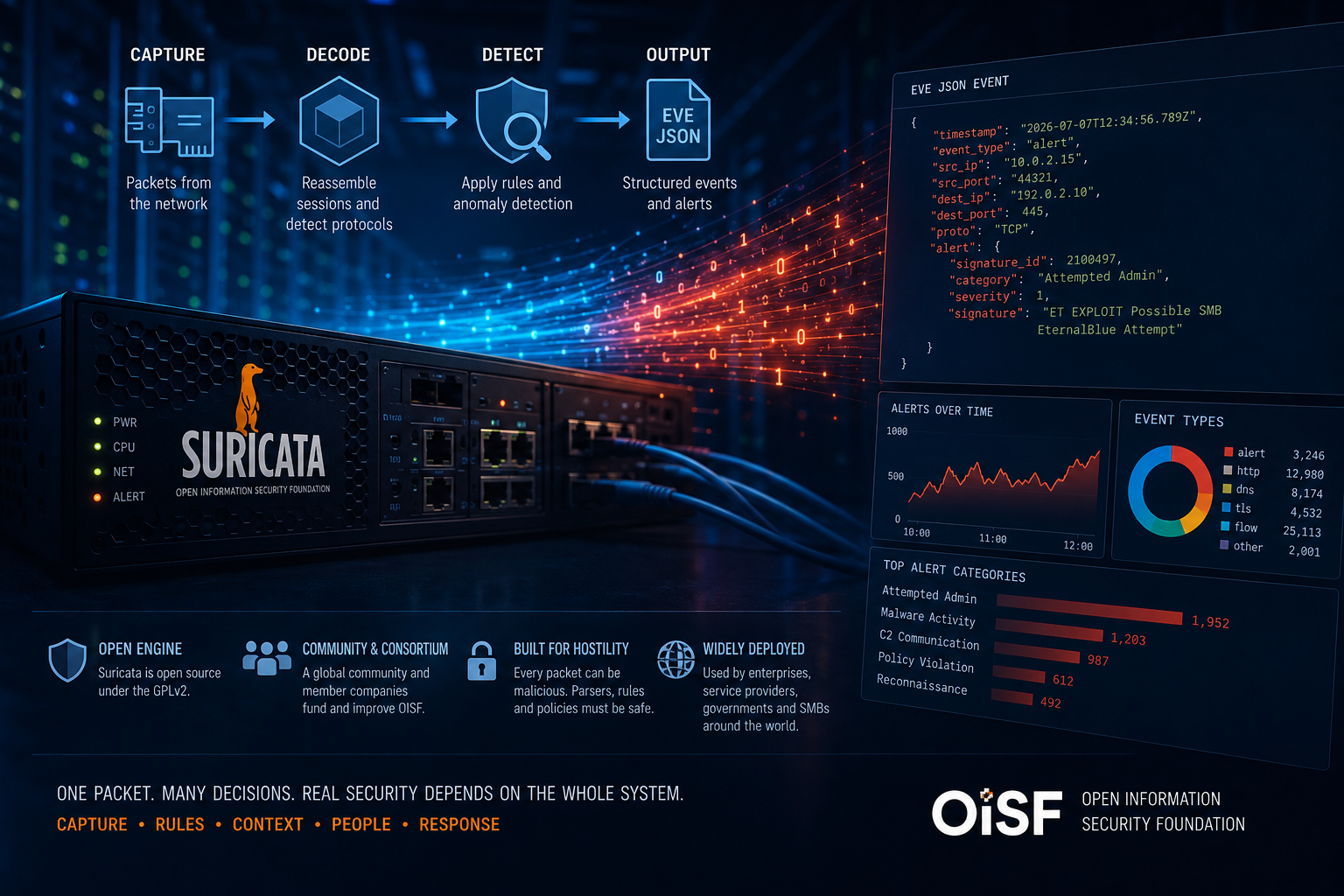
- Suricata is the open packet-analysis engine; OISF is the US nonprofit that employs staff, governs development and publishes releases.
- Capture, flow reconstruction, protocol parsers, rules and EVE JSON form one detection pipeline, so identical binaries can produce different operational outcomes.
- July 2026 releases fixed multiple security issues and retired Suricata 7; the higher report volume was linked partly to AI-assisted analysis, not proven quality decline.
- OISF reported about $2.06 million in FY2025 revenue, a small institutional base beside the commercial products and networks that depend on the engine.
A July security release exposed the burden behind an invisible engine
On 7 July 2026, the Open Information Security Foundation published Suricata 8.0.6 and the final 7.0.17 release. The updates addressed multiple security issues in an engine built to parse hostile network traffic. Two days later, OISF announced the releases and directed users away from the retired Suricata 7 branch. The episode captured the institution’s burden: maintaining a large packet-inspection surface that may sit inline on high-speed links and inside products whose customers never see the Suricata name.
A security operator may run Suricata directly against an interface or packet-capture file. Another may use a commercial network-detection product whose dashboard, rule feed and capture hardware conceal the engine underneath. A firewall distribution may use it inline. A research team may treat EVE JSON as structured telemetry. These systems share code while differing in capture, rules, configuration and response.
Suricata is the open-source intrusion-detection, intrusion-prevention and network-security-monitoring engine under the GNU General Public License version 2. OISF is the US nonprofit that employs staff, governs development, publishes releases and coordinates commercial and community participation. The names describe different things and should not be used as interchangeable legal identities.
Victor Julien began the codebase in late 2007. OISF was organised during the following period to give the project an institutional home and funding model. The first public release arrived in July 2010. From the start, the design emphasised multi-core processing, application-aware analysis and an open engine independent of one commercial IDS roadmap.
The engine’s value comes from maintaining context. It captures or reads packets, groups them into flows, reconstructs TCP byte streams, identifies protocols, parses transactions, inspects files and applies rules. It can emit alerts, DNS records, TLS metadata, HTTP transactions, flow events and statistics through EVE JSON.
That breadth leaves a difficult question: can a relatively small nonprofit keep capture paths, stream logic, protocol parsers, rules interfaces and telemetry trustworthy while every input may be malformed, adversarial or simply unlike the traffic used in testing?
The financial scale sharpens the question. IRS-derived records for fiscal 2025 show OISF revenue of $2,060,506, expenses of $1,680,971 and year-end net assets of $2,090,693. Contributions accounted for $1,833,800, while programme-service revenue was $214,028. These figures describe the nonprofit, not the downstream value of commercial products or the full operating cost of deployments.
“Suricata detected” therefore compresses several authorities into one phrase. The engine version, capture quality, parser, rule source, thresholds, variables and local policy all shape the result. Vendors remain responsible for their integration and support promises. Operators remain responsible for placement, tuning and response. OISF maintains the common engine whose behaviour those layers build upon.
Packet capture sets the ceiling on everything Suricata can know
Every detection pipeline begins with packets. If the sensor misses traffic, later parsers and rules cannot recover it. Suricata supports several capture paths and operating modes, including passive monitoring, inline inspection and offline analysis of pcap files. Backends can include AF_PACKET, NFQUEUE, libpcap, DPDK, AF_XDP, netmap and vendor or hardware integrations.
The presence of code for a backend does not mean OISF supports every path equally. Current documentation publishes support tiers that distinguish strongly maintained and tested options from community, vendor or unmaintained paths. This is a more useful signal than a long feature list because it tells operators where quality assurance and response are concentrated.
Capture design has to match the link. A high-speed interface may expose multiple receive queues. CPU affinity and flow distribution affect whether both directions of a conversation reach the same worker. Packet size, bursts and interrupt behaviour influence loss. A NIC’s nominal line rate does not mean the engine can inspect every packet with an arbitrary ruleset.
Packet loss is a security event because it creates blind spots. Operators should measure capture drops separately from rule processing and export statistics. A sensor can report no alerts because the traffic was benign or because the relevant packets never reached the parser. Dashboards that display alert counts without loss metrics can make overload look like safety.
Hardware offload can change visibility. Checksum, segmentation and aggregation features alter what software sees. A network tap, switch mirror or virtual switch can drop or reorder traffic before it reaches Suricata. The engine may receive one direction only, weakening stream reconstruction.
Inline mode adds availability consequences. In passive mode, an engine failure can remove visibility while traffic continues. Inline, the sensor participates in forwarding and can block packets. Operators must choose fail-open or fail-closed behaviour, bypass hardware and maintenance procedures. A security control that fails closed can become an outage source; one that fails open can become an unobserved gap.
Offline pcap analysis avoids live packet loss after the capture is complete and inherits whatever the capture omitted. It is valuable for forensics, regression testing and rule development. Replaying a pcap is not identical to live timing and flow pressure, so performance and timeout behaviour can differ.
Capture is also the boundary between Suricata and the surrounding product. A vendor appliance may supply accelerated capture or load balancing. The engine should receive correct flow affinity and metadata. When an integration fails, responsibility may be split between OISF, NIC drivers, the operating system and the vendor.
The most disciplined deployments treat capture as a measured subsystem. They benchmark with the intended rules, monitor drops, validate bidirectional flow and document the support tier. Suricata cannot detect what it never received, however sophisticated its parsers become.
Flow tracking turns packets into a security narrative
Many malicious actions cannot be recognised in one packet. A command can be split across TCP segments. Packets can arrive out of order or be retransmitted. An attacker can exploit differences between how a sensor and an endpoint reconstruct a stream. Suricata’s flow and stream engines create the state needed to analyse conversations rather than isolated frames.
Flow tracking groups packets by endpoints, ports and protocol and maintains lifecycle information. TCP reassembly orders bytes, handles retransmissions and supplies a coherent stream to application parsers. Rules can then inspect an HTTP request, TLS handshake or SMB transaction across packet boundaries.
Correctness is security-critical. If Suricata accepts an overlapping segment differently from the protected endpoint, an attacker may make the sensor see benign bytes while the server sees malicious ones. The engine needs target-aware policies, regression tests and conservative handling of ambiguity.
State consumes memory. An attacker can create many incomplete connections or unusual sequence patterns. Operators set memcaps, timeouts and exception policies. When resources are exhausted, the engine has to decide whether to drop state, bypass traffic, stop analysis or block. Each choice changes security and availability.
Asymmetric traffic is a persistent limitation. If the sensor sees only one direction, it may miss handshakes, acknowledgements and server responses. Some parsing can continue, while confidence and transaction completeness decline. Network design should aim for symmetric visibility or explicitly account for the gap.
Encrypted traffic does not remove the need for flow state. Suricata can observe metadata such as addresses, timing, TLS properties and certificate information where available. It cannot inspect encrypted application payload without decryption performed elsewhere. A product that integrates TLS termination may expose plaintext to Suricata; the engine alone does not break encryption.
Flow state also supports output beyond alerts. EVE JSON can record start and end times, bytes, packets and application protocol. This becomes useful for hunting and forensics. The volume can be substantial, and privacy policy should reflect that network metadata can reveal behaviour.
Timeout tuning is workload-specific. Short values reduce memory and can split long-lived sessions. Long values preserve context and increase state pressure. Industrial and IoT protocols may have different patterns from web traffic. Defaults are a baseline, not a universal optimisation.
The stream engine illustrates why an IDS is not simply a search tool. It implements a model of endpoint behaviour under adversarial input. Every parser and rule depends on that model. OISF’s maintenance burden begins before the detection engine evaluates a single signature.
Protocol parsers create meaning and a large hostile attack surface
Raw payload matching can find fixed patterns and has limited understanding of protocol structure. Suricata’s application-layer parsers identify protocols independently of standard ports and expose fields such as HTTP methods, DNS names, TLS properties, SMB operations, QUIC metadata and industrial-protocol transactions.
Protocol awareness improves precision. A rule can inspect a DNS query name rather than search every byte for a string. It can distinguish an HTTP header from a response body. Multi-buffer matching lets rule writers target the semantic location of data.
The parser must handle legitimate variety and malicious edge cases. Protocol specifications allow optional fields, fragmentation and extensions. Real implementations violate standards. Attackers send truncated, nested or contradictory input to consume resources and find discrepancies.
Suricata uses both C and Rust. Rust has been introduced progressively for many parsers and can eliminate classes of memory-safety bugs when used correctly. It does not make parsing safe by declaration. Logic errors, resource exhaustion, unsafe interfaces and C components remain. The engine still needs fuzzing, review and security response.
Protocol evolution is continuous. HTTP/3 and QUIC shift more transport behaviour into encrypted and multiplexed layers. Cloud protocols and vendor extensions appear. Parsers need maintenance to preserve meaning. A parser that merely recognises a protocol may expose fewer fields than an operator assumes.
Port-independent detection can also be evaded or create false identification. Traffic can resemble a protocol during early bytes. Encrypted tunnels hide the application. An endpoint can switch protocols after negotiation. The engine reports its best classification under the available evidence.
File extraction and inspection add another layer. Reassembled application data may contain documents, executables or compressed content. Limits are essential because nested or oversized objects can exhaust memory and storage. Downstream antivirus or sandbox tools introduce their own queues and trust boundaries.
Parser output feeds EVE JSON and rules. A schema change can affect dashboards and detections. Operators upgrading the engine should test downstream consumers, not only whether the process starts. A richer parser can increase event volume and storage unexpectedly.
The July 2026 security releases are relevant because Suricata parses hostile traffic at high speed. Vulnerabilities in parsers can affect availability and, in serious cases, create code-execution risk. The existence of advisories reflects both attack surface and a functioning discovery process.
Application parsing is the reason Suricata can act as a network-security-monitoring engine rather than a packet filter. It is also the reason OISF must sustain expertise across many protocols whose owners and implementations lie outside the foundation.
The July releases tested both parser security and the response process
OISF’s 9 July announcement confirmed that the releases addressed multiple security issues and made 7.0.17 the final maintenance release for Suricata 7. Users were directed towards version 8.
Security releases in a packet-analysis engine deserve close attention because untrusted traffic reaches complex code. A flaw can crash a sensor, impair visibility or, in the most serious cases, permit remote code execution. Inline deployments add availability consequences.
The announcement linked the increased volume of reports partly to AI-assisted code analysis and thanked contributors and programmes involved in discovery. This is evidence of a changing audit method, not proof that the code suddenly became less secure. More findings can reflect deeper examination of a large existing attack surface.
Trend interpretation requires a denominator: code volume, parser coverage, audit intensity, severity and exploitability over time. One release with many advisories cannot establish a worsening or improving security trajectory. For operators, the immediate conclusion is simpler: operators needed to update and migrate off the retired branch.
End-of-life transitions create a downstream problem. Commercial products may embed Suricata 7 with private patches or extended support. Customers need the vendor’s policy and should not assume upstream OISF will fix the old branch. A version string inside an appliance may be difficult to obtain.
Rule and configuration compatibility can slow migration. Suricata 8 introduced changes that require testing. Output consumers and capture integrations need validation. The safest response is not an emergency untested upgrade on every sensor; it is a staged migration programme with compensating controls and clear deadlines.
Disclosure quality is part of institutional trust. Advisories should identify affected versions, severity, mitigations and credit. OISF’s publication and release process demonstrates that the nonprofit can coordinate response. The record does not reveal undiscovered issues.
AI-assisted analysis creates governance questions. Automated tools can increase false reports and find subtle defects. Maintainers need triage capacity and secure ways to reproduce findings. Funders may need to support review rather than only code scanning.
The episode is a reminder that security software is software exposed to adversaries. Its reputation cannot rest on the idea that defenders are inherently safer than the systems they inspect. Maturity is shown by finding, fixing and communicating flaws while preserving operational continuity.
Rules are a separate intelligence and policy supply chain
Suricata provides a rule language and detection engine. It does not write every rule used in production. Operators combine community, commercial and local content, apply variables and thresholds, enable or disable categories and modify policy. The same engine can therefore behave like several different security products.
A rule can match packet fields, flow state, application buffers, datasets, reputation and other context. It may generate an alert, set state or drop traffic in inline mode. Its quality depends on the threat model and the precision of the condition.
False positives have operational cost. A noisy rule consumes analyst time and can hide important alerts. Inline, a false positive can block legitimate service. False negatives are less visible. A rule can miss a variant, encrypted payload or traffic the sensor did not receive.
Rule provenance should travel with every alert. The source, revision, signature identifier and local modification explain why the sensor acted. A statement that “Suricata detected malware” without this information collapses engine and intelligence into one claim.
Third-party rule providers have their own licences and update channels. A commercial feed may deliver timely research and create subscription dependence. Community feeds can be open and require more local tuning. Operators often write rules for their own environment.
Thresholds and exceptions are part of policy. An operator may suppress repeated events, ignore a known scanner or restrict a rule to certain networks. These changes can make a deployment usable and create blind spots. Configuration review should treat suppressions as code with owners and expiry.
Datasets and reputation lists extend detection beyond static signatures. They can identify known domains, addresses or hashes. Their freshness, false-positive rate and source need evaluation. An old blocklist can disrupt reassigned infrastructure.
The detection engine must process the chosen rules within available resources. More rules and buffers increase work. Performance testing with a default sample set does not establish throughput with a production feed and full protocol logging.
Rules also create organisational separation. Threat researchers produce content. Platform engineers maintain sensors. Analysts respond. Network teams own inline risk. A mature Suricata programme coordinates them and does not assume installing the engine creates detection capability by itself.
Suricata-Update makes rule delivery repeatable, not equivalent
Managing several rule sources by hand is error-prone. Files need to be downloaded, enabled, modified and kept compatible with the engine. Suricata-Update provides a utility and source index for retrieving and assembling rules. The July 2026 release announcement identified version 1.3.8.
The tool improves reproducibility. An operator can define sources and local modifications, run an update and generate a consolidated rule set. Automation can distribute the result across sensors. Version information can be captured for incident review.
Automation also accelerates mistakes. A bad rule from a feed can reach every sensor. A syntax error can prevent loading. A newly enabled drop rule can interrupt traffic. Updates should be staged and tested against representative pcap and live traffic.
Feed licences remain external. Suricata-Update can retrieve content and does not grant rights beyond each source. Commercial redistribution and managed-service use need legal review. Local rules may contain sensitive information about internal systems.
Rule compatibility is tied to engine version and features. A feed may use keywords unsupported by an older branch. Suricata 7 reached end of life in July 2026, making migration to Suricata 8 a security and content issue. Vendors that provide extended support need to state how rules are qualified.
Local modifications create merge problems. An operator may disable a noisy signature or change a threshold. A later feed update can alter the rule. The update process should preserve intentional policy and reveal conflicts rather than silently overwriting them.
Testing needs realistic benign traffic as well as attacks. A rule can match a proof-of-concept and disrupt a common application. Historical pcaps help regression testing, while privacy and data retention limit what can be stored.
Suricata-Update is a small component with large operational leverage. It turns rule management from a manual file task into a pipeline. The security quality still depends on sources, review and rollout. The tool makes the supply chain manageable; it does not make the content interchangeable.
EVE JSON can produce more downstream data than the sensor can comfortably hold
EVE JSON is one of Suricata’s most important interfaces. It provides structured events for alerts, flows, DNS, TLS, HTTP, files, statistics and other protocol records. Security information and event management systems, data lakes and network-detection platforms can consume the stream.
This output changed the engine’s role. Suricata can support hunting and network-security monitoring even when no rule fires. An analyst can search DNS queries, compare TLS metadata or reconstruct a sequence of transactions. The sensor becomes a source of network evidence rather than only an alarm generator.
Structured data improves integration and creates schema dependency. A downstream parser expects field names and types. New engine versions can add or alter events. Products embedding Suricata may normalise the data into proprietary schemas. An operator should preserve the original event where possible so transformations can be audited.
Volume can be enormous. Logging every flow and transaction on a busy link can generate more data than alerts by orders of magnitude. Storage, indexing and retention become part of the architecture. A sensor that successfully analyses traffic can still overload its output pipeline and drop events.
Backpressure needs a defined policy. If the log writer or destination is slow, should Suricata buffer, drop telemetry or affect packet processing? Inline deployments must keep observability failure from becoming uncontrolled network failure. Separate queues and monitoring help.
EVE data is sensitive. DNS names, addresses, URLs and file metadata can reveal user activity. Even without payload, the event stream can be valuable to attackers and regulated under privacy rules. Access should be limited and retention justified.
Time quality matters for correlation. Sensors need synchronised clocks and consistent time zones. A few seconds of error can confuse a multi-system incident timeline. The output schema can record timestamps; the deployment must make them reliable.
EVE also creates commercial value. Vendors can build dashboards, detections and managed services around a common open event format. They may extend or transform it. The value of the downstream product should not be attributed entirely to OISF, and the common schema lowers the cost of integrating the engine.
The interface is a form of portability. An operator can change analytics backends while retaining the sensor format. Portability weakens when pipelines rely on vendor-specific enrichments. Keeping a documented raw EVE archive preserves options.
Reproducibility requires more than the JSON record itself. A consequential event should remain connected to the sensor identity, Suricata version, active rule revision, variables and capture context that produced it. Two sensors can emit similarly shaped EVE records while applying different thresholds, exception lists or protocol settings. When a downstream platform strips that provenance, an analyst may be able to search the alert but not explain or recreate it. The practical safeguard is a versioned detection package and a retention policy that keeps enough original context for high-impact findings.
That turns EVE from a convenient interchange format into auditable evidence without pretending that every event deserves permanent storage.
Inline mode turns uncertain detection into a production decision
Passive alerts allow an analyst to investigate after the event. Inline IPS mode lets a rule drop traffic immediately. This can prevent harm and raises the standard required for capture, rule quality and failure handling.
A drop rule needs higher confidence than an informational alert. The cost of a false positive may be an application outage or blocked customer. Operators often begin with alerting, measure prevalence and move selected signatures into enforcement after review.
The engine can run inline through supported mechanisms such as NFQUEUE or AF_PACKET configurations, depending on platform and design. Each path has performance and failover characteristics. Hardware bypass and redundant paths may be needed on critical links.
Fail-open and fail-closed are not moral categories. A hospital or industrial control network may prioritise availability for some traffic. A protected administrative segment may prefer blocking during sensor failure. The policy should be explicit by service and tested.
Rule order, flow state and exceptions affect enforcement. An allow policy can override later content. A drop may occur after enough bytes have already passed to cause an effect. Encryption limits payload inspection. Inline deployment is not a guarantee that attacks cannot cross.
Maintenance creates a planned failure condition. Upgrading from Suricata 7 to 8 may require restart, rule qualification and output changes. A bypass or redundant sensor can preserve service. Running an end-of-life branch to avoid change accumulates security risk.
Performance testing must include the production rules and traffic. A sensor can forward line rate with minimal rules and fall behind when application parsing, file handling and logging are enabled. Packet loss in inline mode may manifest as traffic loss or bypass depending on architecture.
The governance of enforcement should separate threat content from network availability decisions. Rule providers can recommend drops; the operator owns the consequence. Change approval, emergency disable and post-incident review are needed.
Suricata’s ability to operate as IDS and IPS is a strength. It lets organisations use one engine across monitoring and enforcement. It also makes the project responsible for documenting modes whose operational risk is very different. The acronym should never substitute for a design review.
Support tiers show where OISF’s maintenance responsibility ends
Suricata supports many operating systems, capture methods and integrations. OISF’s support-status documentation distinguishes tiers and responsibility. Some paths receive strong continuous integration and quality assurance from the project. Others are community- or vendor-maintained, and some may be unmaintained.
This classification protects users from assuming that every feature in the source tree carries the same promise. A backend can compile and receive limited testing. A vendor can maintain an integration outside OISF. A distribution may ship a combination the upstream project does not qualify.
Operators should include support tier in architecture decisions. A Tier 1 path may offer stronger upstream response and test coverage. A lower-tier path may be appropriate when a vendor contract supplies support or when a specialised feature is necessary. The risk needs an owner.
The same principle applies to protocols and plugins. A feature’s maturity depends on maintainers, tests and current use. Documentation should identify experimental or specialised components. A checklist that records only “supported by Suricata” hides the real obligation.
Support tiers also direct scarce foundation resources. OISF cannot maintain every operating system and acceleration framework equally with a small team. Publishing priorities is more credible than promising universal support.
Vendor participation can expand coverage. A NIC company may maintain an accelerated path and provide hardware for testing. The relationship should remain clear: OISF coordinates the engine, while the vendor owns its driver and hardware behaviour. When the vendor withdraws, support can decline.
Downstream products may freeze on a supported configuration and backport fixes. This can be reasonable and makes version comparison difficult. An operator needs the vendor’s patch record, not only the upstream release number.
The support matrix is therefore an institutional map. It shows where the nonprofit’s authority ends and where community or commercial responsibility begins. In open infrastructure, that boundary is as important as the licence.
Quality assurance needs hostile traffic without leaking the networks that supplied it
A packet engine cannot be validated through unit tests alone. Suricata needs examples of fragmented streams, malformed protocol fields, retransmissions, encryption handshakes and ordinary applications whose behaviour should not trigger alerts. The best regression material often comes from real incidents and production traffic, which can contain confidential data.
OISF and contributors therefore need several kinds of test corpus. Small synthetic pcaps isolate one parser rule. Fuzzing generates malformed inputs and explores code paths. Sanitised production captures reveal combinations designers did not anticipate. Performance traffic tests worker, memory and output behaviour at scale.
Sanitisation is difficult. Removing payload can destroy the feature that triggered a bug. Addresses and names can identify organisations. A security vulnerability may require restricted handling until a fix is available. The project needs controlled access and a way to turn private reports into public regression tests when safe.
Reproducibility matters for downstream vendors. A vendor that reports a crash should provide the smallest pcap and configuration that trigger it. OISF can add the case to continuous integration. The fix then protects users beyond the original product and reduces the chance of recurrence.
Rules need their own regression suite. A parser change can alter which buffer a signature sees. A rule update can produce new false positives. Testing engine and content separately misses their interaction. Representative rule bundles and expected EVE records can detect changes before release.
Hardware and capture paths complicate QA. A pcap replay exercises parsing and not live receive queues or offload. CI cannot cover every NIC and platform. Support tiers are one way to align promises with available labs. Consortium members can contribute hardware and test capacity without receiving exclusive control over results.
AI-assisted analysis adds another source of cases. Automated tools can propose defects or generate inputs, while maintainers must confirm reachability and severity. A larger corpus can improve confidence and increase storage and triage demands.
This testing infrastructure is easy for downstream users to overlook because it does not appear in an alert. It is one of the most valuable functions the nonprofit supplies. The engine becomes dependable when yesterday’s failure is preserved as tomorrow’s automated check, under controls that respect the networks from which the evidence came.
Performance claims mean little unless the inspection workload is fixed
Suricata is often evaluated in packets per second or gigabits per second. These figures matter because a sensor that cannot keep up creates blind spots. They are unusually sensitive to what the engine is asked to do.
A ruleset of a few simple packet signatures has a different cost from thousands of application-aware rules. TLS and DNS metadata logging adds work. File extraction, decompression and Lua can add more. Small packets create more per-packet overhead than large transfers at the same bit rate. Traffic with many short flows stresses state differently from a few long sessions.
Capture architecture changes the envelope. AF_PACKET, DPDK, AF_XDP and vendor paths use different queueing and memory models. CPU generation, cache, NUMA placement, NIC queues and worker affinity affect results. A benchmark belongs to that system, not to the word Suricata alone.
Detection quality should not be traded invisibly for throughput. Disabling parsers or logging can make a graph improve while the sensor sees less. Dropping packets after capture is another way to preserve apparent engine speed and lose evidence. Reports should include capture loss, rule count, enabled protocols and output configuration.
Latency matters in inline mode. A system can sustain an average rate and add variable delay during bursts. Tail latency and bypass behaviour are relevant to production services. A passive sensor may prioritise loss over forwarding delay; an IPS must balance both.
Repeatable tests should use representative traffic and malicious cases. Synthetic streams exercise capacity and may lack protocol diversity. Recorded production pcaps reflect real distributions and carry privacy and replay limitations. Combining both gives a more useful envelope.
Vendor appliances may outperform a generic host through tuned capture and hardware. That result credits the integrated product. Upstream OISF documentation and support tiers help users understand which parts are common. Comparisons should avoid using one vendor’s acceleration to claim a universal engine rate.
The disciplined conclusion is not that Suricata is fast or slow. It is that performance is a configured property of a capture, analysis and output pipeline. Operators must test the pipeline they intend to deploy and monitor whether it remains inside the tested envelope as rules and traffic change.
Encryption shifts value towards metadata, correlation and sensor placement
More network traffic is encrypted, limiting payload inspection. TLS, QUIC and application-level encryption protect users and reduce the visibility of passive sensors. Suricata can parse handshake metadata, certificates and unencrypted protocol fields where available. It cannot inspect content it cannot decrypt.
This changes rule design. Indicators may use server names, certificate properties, IP reputation, flow behaviour or protocol anomalies. These signals can be useful and less definitive than a payload match. Encrypted client hello and privacy features can reduce metadata further.
Organisations can place sensors after decryption at proxies or load balancers. This provides visibility and concentrates sensitive plaintext. It may not cover end-to-end encrypted or direct traffic. The architecture should reflect privacy and security policy.
Endpoint telemetry becomes more important. A network sensor can identify a suspicious connection while the endpoint explains which process initiated it. Correlation across EVE JSON, DNS, identity and endpoint events can improve confidence. It also increases data integration and retention.
Encrypted traffic can still expose protocol implementation risks to Suricata. Parsers handle handshake structures and transport metadata. Malformed input can attack the sensor even when application content remains hidden.
The project’s value therefore does not disappear with encryption. It moves toward flow state, protocol metadata and network-wide context. Claims need adjustment. A sensor with no decryption should not be marketed as seeing complete application activity.
The strategic question is where visibility should exist. Ubiquitous decryption can undermine privacy and create key concentration. Metadata-based detection may miss content. Suricata supplies tools for several positions in the architecture; policy belongs to the operator.
Specialised protocols increase both public value and the cost of error
Suricata’s protocol portfolio extends beyond ordinary web and DNS traffic. Industrial, file-sharing and infrastructure protocols can be parsed and exposed to rules and EVE. This gives operators an open way to observe networks where proprietary monitoring is expensive or limited.
Specialised environments have different failure consequences. An industrial control message may be rare and safety-critical. A false positive in passive mode can distract an operator; an inline block can interrupt a process. Protocol semantics and local engineering context are essential.
Legacy implementations often deviate from specifications. Devices may remain in service for decades and cannot be patched easily. Parsers need to accept expected quirks without accepting ambiguous input that enables evasion. Test data are harder to obtain because production captures can reveal sensitive operations.
Encrypted and proprietary variants limit visibility. A parser may identify the outer protocol and not understand vendor extensions. The absence of an alert should not be interpreted as protocol compliance or safety.
Community and vendor maintainers are especially important in these domains. OISF’s core team cannot possess operational expertise for every industrial protocol. A company contributing a parser should supply tests and maintenance, while upstream review protects the common engine.
Support status needs to be explicit. A parser present in documentation may have different maturity and fuzzing coverage. Operators should know whether the path is actively maintained and whether the rule ecosystem has meaningful content.
The public benefit can be substantial. An open parser allows researchers, asset owners and security companies to share improvements. It avoids making one appliance vendor the sole interpreter of critical traffic. The shared code can concentrate a defect across deployments, making coordinated disclosure vital.
Specialised protocols illustrate the project’s basic bargain. Suricata expands inspectable security capability across sectors. Every new decoder increases the institution’s obligation to test hostile inputs and state precisely what the engine understands.
Analyst capacity is a detection dependency the engine cannot automate away
A sensor can produce more accurate alerts than an organisation can investigate. The result is not stronger security. Queues grow, analysts suppress noisy signatures and important events become one line among thousands. Suricata’s output must be designed around a response capacity, not only around what the engine can log.
Alert volume is shaped by rules and local context. A signature useful on an internet edge may be noisy inside a vulnerability lab. A known scanner can generate repeated events. Thresholds, suppression and asset criticality turn generic content into an operational signal.
Tuning has risks. An analyst may disable a rule after several false positives and remove the only detection for a real attack. Exceptions should have owners, reasons and review dates. A temporary suppression during maintenance should not become permanent policy through neglect.
EVE JSON supports enrichment. Asset inventory, identity and endpoint data can tell analysts whether a destination is critical or whether a process created the connection. Enrichment can increase confidence and introduce errors from stale sources. The original Suricata event should remain available.
Automation can close known low-risk cases or block high-confidence indicators. It can also propagate a false interpretation at machine speed. Automated response needs narrower evidence thresholds than notification and a rollback path. The rule source and engine state should be recorded with the action.
Staffing is part of total cost. The engine is open source, while 24-hour monitoring, threat research and incident response are not. Managed services and commercial products sell this layer. Their value should be judged by response outcomes and transparency, not by the number of alerts they ingest.
Training connects packet evidence to applications. Analysts need enough protocol knowledge to understand parser fields and enough operational context to know whether behaviour is expected. Rule authors need feedback from incidents. Platform engineers need to see when output delay or packet loss affects investigations.
OISF can improve schemas, documentation and training. It cannot supply an analyst to every deployment. Any claim that the engine “detects threats” must preserve the human and organisational system that turns a match into a defended network.
Commercial embedding broadens reach and obscures the version in use
Vendors embed Suricata because building a high-performance packet parser and rule engine from scratch is expensive. The open engine gives them a mature foundation. They can add capture hardware, rules, analytics, orchestration and support.
The customer may not know the upstream version or local patches. A product name can persist while the underlying engine changes. Security advisories create a supply-chain question: is the embedded version affected, and when will the vendor ship a fix?
GPL obligations influence integration architecture and distribution. The precise legal analysis depends on how code is combined and conveyed. OISF’s open licence does not make downstream proprietary layers part of the foundation. Vendors need their own compliance process.
A product can improve Suricata through production testing and upstream patches. It can also maintain a private fork that diverges. Divergence may be necessary for hardware or features and makes future upgrades costly. Customers should ask which changes are upstream and how long the vendor supports its branch.
Rule provenance becomes opaque in appliances. A vendor may supply proprietary content and use third-party feeds. An alert should identify the rule source even if the interface brands everything as the product’s detection. This matters for tuning and liability.
Capture architecture can make performance incomparable with upstream references. A vendor may load-balance flows across sensors or use accelerator cards. A strong result demonstrates the product, not Suricata alone. Conversely, a poor integration should not be treated as an engine limit.
Embedding expands the project’s influence and complicates a deployment census. OISF does not publish a complete list of products or installations. Vendor claims and public case studies are selective. The safe description is that Suricata is used directly and inside commercial systems.
The relationship is strategically valuable when downstream companies contribute fixes, fund OISF and preserve transparency about versions. It becomes extractive when the common engine carries risk while all operational knowledge and revenue remain private.
Products that embed Suricata owe customers version transparency
A customer cannot respond to an upstream advisory if the appliance does not disclose which Suricata branch and patches it runs. A product may expose its own version while hiding the engine. That packaging choice transfers information advantage to the vendor and delays independent risk assessment.
A useful software bill of materials identifies the upstream base, local commits, capture integration and rule sources. It should be available to the customer under appropriate confidentiality and updated with each release. The vendor should state whether OISF advisories apply and when fixes will ship.
Private backports can make an older version safe against a named issue, but the version string alone will look vulnerable. The vendor needs a public or customer-facing security record. Conversely, changing the string without applying every fix creates false reassurance.
Contractual support beyond Suricata 7’s upstream end of life may be legitimate. It places the patch and test burden on the vendor. Customers should not assume OISF will review the private branch or that new rules and parsers will remain compatible.
Version transparency also helps OISF understand the ecosystem without owning it. Downstream reports can identify which branches need migration guidance. The foundation supplies upstream releases; vendors owe customers a clear account of how those releases enter the product.
A small nonprofit funds the common engine beneath larger commercial businesses
OISF’s FY2025 figures show an organisation with about $2.06 million in revenue and $1.68 million in expenses. Contributions supplied most of the revenue. Programme-service revenue was smaller. The foundation ended the year with about $2.09 million in net assets.
The figures suggest a stable operating base and should not be mistaken for the value of Suricata as an ecosystem. Security vendors can sell appliances, subscriptions, managed detection and rule feeds that depend on the engine. Operators pay for hardware, storage and analysts. Those amounts sit outside OISF’s filings.
The consortium model lets companies support shared code. Members can fund engineering and gain a voice in an ecosystem important to their products. The foundation employs staff, runs quality assurance, organises training and SuriCon and coordinates releases.
This arrangement addresses a common open-source problem: companies benefit from a public component while the maintenance burden falls on volunteers. Contributions can turn part of downstream value into upstream capacity. The amount and conditions of member support matter, and public records do not provide a complete dues or concentration analysis.
Commercial influence is not inherently capture. Vendors have production evidence and engineers. Their priorities can improve performance and protocols. Governance needs to prevent one company from converting upstream into a private roadmap or receiving preferential security information without legitimate process.
OISF’s 501(c)(3) status and EIN 26-3316567 establish the legal institution. The nonprofit structure does not remove commercial incentives. It creates a vehicle for aligning them around a common engine.
Financial sustainability must match attack surface. More protocols, capture paths and plugins create maintenance work. Security audits can increase findings faster than staff can triage. Training and conferences compete with engineering for resources. The foundation needs to allocate funds transparently enough that contributors and members trust the balance.
A small budget can have outsized leverage because vendors and users contribute in kind. It can also create key-person and burnout risk. Current team records identify Victor Julien and Kelley Misata in executive roles, with technical leaders including Jason Ish and Peter Manev. The institution needs succession across both engineering and operations.
OISF’s clearest economic argument is not that Suricata is free. It is that many organisations can share the cost of one inspectable engine while competing above it. The model works when enough of the value returns to security response and common maintenance.
Snort, Zeek and commercial NDR products solve adjacent problems
Suricata is often compared with Snort because both can use signature-oriented IDS and IPS workflows. Snort has its own architecture, rule ecosystem and commercial lineage. Compatibility is not complete, and performance or detection claims depend on versions and configurations.
Zeek takes a different approach, emphasising rich network analysis and scripting around events and protocol semantics. It is commonly used for network-security monitoring and hunting rather than as a direct signature-equivalent replacement. Organisations often deploy Zeek and Suricata together: one produces detailed behavioural logs, the other applies rules and can enforce inline.
Commercial network-detection and response platforms add machine learning, entity context, storage and case management. Some may embed Suricata; others use proprietary engines. They provide an integrated service at a price and can reduce operator assembly work.
Firewall and endpoint products see different layers. A firewall can enforce identity and application policy at a choke point. Endpoint detection sees process and file activity invisible on encrypted networks. Suricata provides a network perspective and cannot replace host context.
Security Onion and SELKS package Suricata with other tools. Their releases, configurations and support are separate. A user running one of these distributions depends on the integration project as well as OISF.
The choice should follow the detection model. An organisation needing inline signature enforcement may prioritise Suricata. A hunting team may want complementary telemetry. A small operator may choose a supported distribution. A vendor may embed the engine to avoid duplicating protocol work.
Benchmark comparisons are fragile. Traffic mix, packet size, enabled parsers, rules, output and capture path determine throughput. A one-number ranking can reward a configuration that does less inspection. Detection quality cannot be inferred from packets per second.
Suricata’s competitive strength is inspectable, extensible infrastructure with a broad rule and integration ecosystem. Its weakness is that the operator must assemble capture, content, storage and response unless a distribution or vendor does so. The nonprofit governs the engine, not the complete security programme.
Maturity lies in published limits, fixes and support boundaries
By August 2026, Suricata 8.0.6 was the current stable release, while Suricata 7 had reached end of life. The project had a documented architecture, support matrix, rule-update utility, EVE schema, security policy and nonprofit institution. Those are markers of maturity because they make limits and responsibilities visible.
They do not establish a complete installation count, equal support across backends or the absence of undiscovered vulnerabilities. The July security releases show why continuing maintenance matters. A packet-analysis engine keeps expanding through new protocols, capture paths, rules and downstream integrations, each of which adds value and a new trust boundary.
The organisational centre is OISF, with a real but modest budget beside the ecosystem using the engine. Contributions and commercial relationships fund common work. Vendors, rule providers and operators add products and labour outside the foundation’s accounts. The health of the shared engine depends on enough of that downstream value returning to parser security, quality assurance, release engineering and documentation.
Suricata is not a complete detection programme by itself. It needs reliable capture, current and appropriate rules, storage, tuning and analysts. An alert records that a configured rule matched the engine’s interpretation of observed traffic. It does not by itself prove compromise.
The most useful future evidence would include workload-equivalent performance tests, studies of detection error, transparent embedded versions and a clearer view of contributor concentration. The most immediate institutional test would be a serious remotely triggerable issue: rapid disclosure, supported fixes, visible downstream adoption and no confusion over which party owns the response.
The open engine gives buyers leverage because a vendor is not the only party able to explain what the parser or rule did. That leverage survives only when products preserve version information, rule provenance and raw event context. Suricata’s maturity lies in making those boundaries inspectable, not in claiming the engine is finished.
Member Briefing
Deeper Profile Context
Sign in with the right membership level to unlock the full briefing and source notes.
Only for Strategic Circle
Strategic Circle
Open to all readers. Unlock profile briefings after joining and signing in.
Join Strategic CircleOnly for Leadership Alliance
Leadership Alliance
For qualified IP-asset owners and management; sign in to unlock alliance briefings.
Join Leadership Alliance