
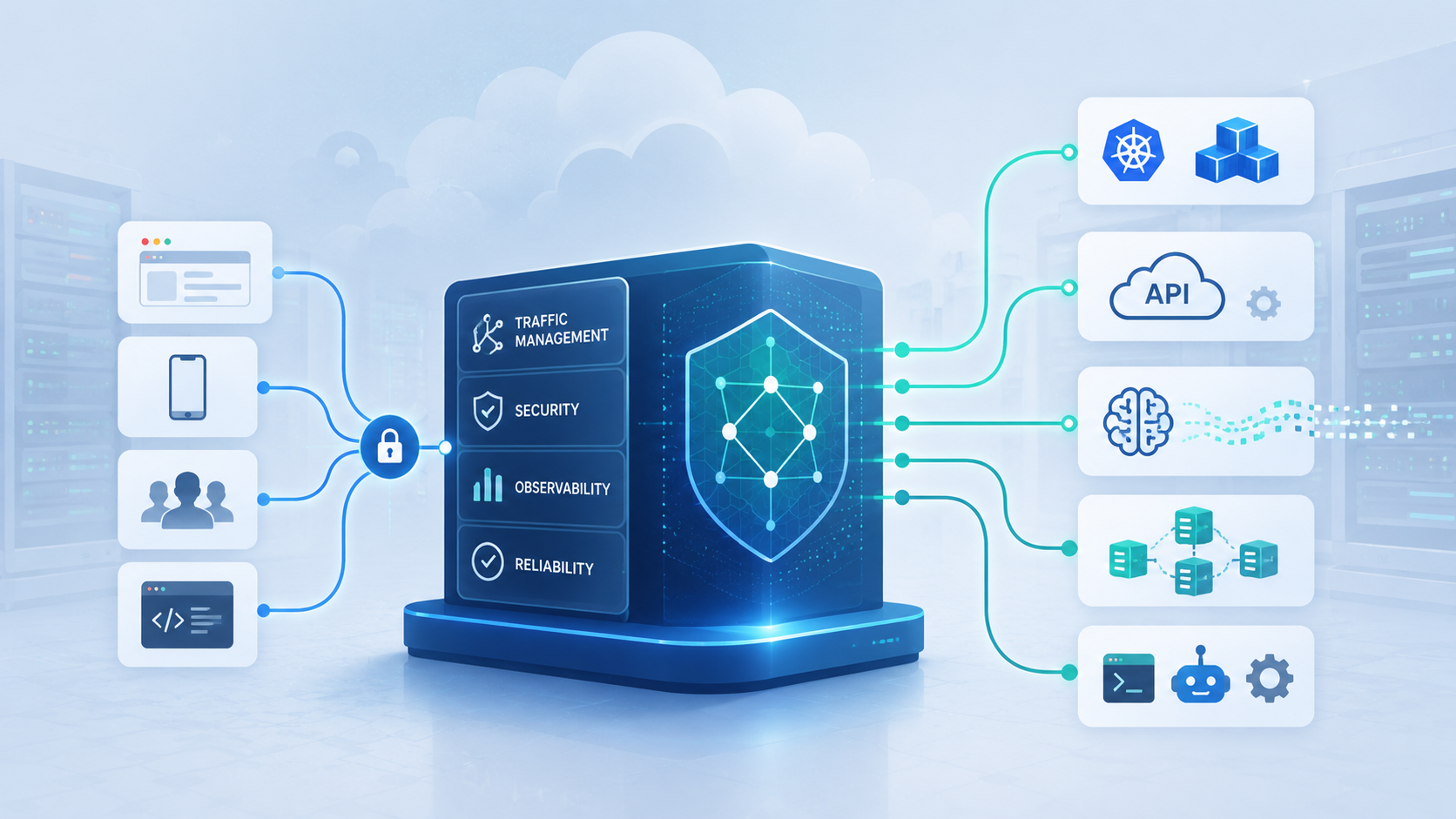
Summary
- Traefik Labs is a private open-core company centred on Traefik Proxy, an open-source reverse proxy and ingress controller for which Emile Vauge wrote the initial code in 2015. The company was founded in 2016 as Containous and renamed Traefik Labs in 2020.
- Traefik’s technical hallmark is provider-driven dynamic configuration. It watches infrastructure sources such as Docker, Kubernetes, and files, converting service metadata into routers, services, and middleware, reducing the need to rewrite static proxy configs on every change.
- The commercial scope extends beyond ingress. Traefik Hub offers API gateway, discovery, policy, and management features, while AI Gateway and MCP Gateway apply the same gateway logic to model providers, prompts, agent connections, servers, and tools.
- Adoption figures are large but require strict interpretation. In July 2026 Traefik reported 1,000 contributors and 3.5 billion pulls of the official Docker image—neither equates to unique production deployments, customer count, or user count.
- The strategic opportunity is to become a shared policy layer for application and agent-driven traffic. The corresponding risk is concentration: a gateway that handles TLS termination, authentication, header rewriting, backend selection, and tool authorisation can become a broad single point of failure for security and availability.
Not a network operator, but a gateway company
Traefik Labs occupies a digital-infrastructure position that is operationally straightforward yet commercially easy to miscategorise. It owns no global CDN, provides no cloud compute, operates no autonomous system, and sells no access circuits. Typically its software runs on infrastructure the customer chooses and controls. Even so, Traefik sits directly in front of production traffic: it receives connections before applications do, terminates encryption, selects a destination backend, and can perform authentication, header modification, rate limiting, and operational-signal logging.
This position carries importance beyond the apparent size of a proxy binary. A gateway is a decision point between external demand and internal services. When it decides correctly, application teams can deploy quickly and infrastructure teams can standardise reusable controls. When it decides incorrectly, a syntactically valid route can expose a management endpoint, a policy chain can trust a forged identity, a certificate failure can break multiple applications, and a single configuration change can misdirect traffic across large estates.
For that reason this article’s entity is not Traefik Proxy alone but Traefik Labs, the private software company. Traefik Proxy has open-source repositories, contributors, releases, issues, licence terms, and security advisories. Traefik Labs employs the lead maintainers, runs the commercial products, sells support and enterprise features, and uses the broad goodwill towards the proxy as an open-core distribution channel. The two are tightly coupled but not legally or institutionally identical.
Observable operating structures include Traefik Labs SAS in France and, for some non-European business, Traefik Labs, Inc. Current legal filings identify the French entity at 132 rue Bossuet, Lyon, SIREN 818103475. Public information does not yield consolidated audited financials, a complete capitalisation table, a current valuation, product-level revenue, or a verified customer count. We can describe how the company creates value without guessing how much of that value it captures as revenue.
The problem Traefik set out to solve in the container era
Traditional reverse-proxy operations assumed an environment where backend services changed relatively slowly. Administrators could configure server lists and virtual hosts, validate a file, and reload the proxy. That worked in stable environments, but containers and orchestrators changed both the frequency and the actors of change. Services are created, rescheduled, scaled down, replaced, and deleted while applications remain running. A service identity represented by orchestration metadata became more durable than any one backend address.
In that environment every manual configuration step introduces delay and opportunity for failure. Even when a deployment system spins up a new service in seconds, the traffic layer will not reach external users until it learns the service exists. A human ticket queue can become the slowest element in an otherwise automated platform. Rewriting and reloading files on each event also creates races: referencing dead endpoints, overlooking ready ones, or leaving stale state written by a different automation.
Traefik’s answer was to let the proxy itself watch infrastructure sources that already know the desired state. Docker labels, Kubernetes resources, files, and other provider interfaces become input; Traefik interprets them and adjusts runtime routing entities. The technical advantage is not merely that configuration is generated automatically—it is that application-deployment metadata and network behaviour can change inside the same operational loop.
The design ambition was sometimes phrased as “make the network boring.” Boring here does not mean unimportant; it means predictable enough that developers do not have to raise tickets with specialists for every route or certificate. A service appears with the necessary metadata, the gateway discovers it, a route becomes active, and certificate automation handles the repetitive work. Organisations can direct scarce network expertise towards platform design, security boundaries, and exceptional failures rather than day-to-day publication tasks.
The trade-off is equally important: metadata becomes executable network policy. Labels, annotations, and custom resources are not merely descriptive; they determine who can reach a service and which controls apply en route. The operational question shifts from “who can edit the proxy file?” to “which identities can publish metadata the proxy trusts, across which namespaces and resources?” Automation reduces handover but does not eliminate authority; it moves it into the orchestration and policy systems.
From Emile Vauge’s code to Containous
Emile Vauge wrote the first Traefik code in 2015. The project’s origin and the company’s origin are separate facts worth separating. Traefik began as software answering a practical container-networking problem; the commercial entity formed in 2016 under the name Containous. Thus 2015 marks the code start, 2016 the company formation, and the one-year gap helps avoid confusion about founding dates.
The early project had a clear, demonstrable use-case. Developers could run Traefik alongside Docker and define routing through service labels. As Kubernetes adoption grew, ingress became a natural deployment point. Automatic certificate acquisition through ACME removed another repetitive task. The ability to experience value before a purchase is one of the strongest distribution advantages open-source infrastructure software can have.
Containous provided a structure for commercial support and product development. It could hire engineers, maintain documentation, build enterprise features, and assist customers whose requirements went beyond community adoption. It could also invest in the integrations that make the proxy useful across multiple infrastructure providers. The commercial challenge was turning a tool whose free adoption was itself a selling point into ongoing revenue.
Between 2016 and 2019 Traefik became known for its coupling with Docker and Kubernetes ingress. That was an advantage—it placed the project inside a fast-growing software-infrastructure segment—but also a constraint. If the company were seen solely as an ingress-controller company, it would be treated as a replaceable cluster component rather than an enterprise policy foundation. Much of the later strategy can be understood as widening the commercial category around the original dynamic-discovery advantage while preserving it.
There was also a naming dissonance. Developers recognised Traefik, while investors, employees, and customers dealt with Containous. As the project became the engine of adoption and the product set broadened, it made more sense to align the company brand with the project. The 2020 rename was therefore not cosmetic; it acknowledged that the open-source name had the strongest market recognition and tied community trust directly to the company’s commercial identity.
Architecture: entry points, providers, routers, services, middleware
Traefik’s operating model can be understood through a small set of concepts that separate network exposure, discovery, matching, delivery, and policy. An entry point typically binds a port and protocol and defines where traffic enters. A provider supplies configuration from an infrastructure source. A router decides whether a request matches a rule. A service represents the backend that will handle the request. Middleware transforms, restricts, or authorises requests or responses between matching and delivery.
Entry points are the boundary where the gateway starts accepting traffic; they can represent HTTP, encrypted HTTPS, or other supported protocols. Because they determine listeners, addresses, and basic transport behaviour, they belong to the deployment’s static shape. Platform teams can separate public traffic, internal traffic, management interfaces, and protocol families, though the strength of that separation depends on surrounding network and deployment design.
Providers connect Traefik to a changing infrastructure. The Docker provider inspects labels and container state; the Kubernetes provider can watch Ingress resources, Traefik-specific custom resources, and Gateway API resources. The file provider reads dynamic entities from a configuration file. Other integrations supply service information through supported interfaces. A provider is not merely an adapter; its authority defines what Traefik can observe, and the observed scope derives routing authority.
Routers express the matching logic; they can evaluate host, path, header, method, and protocol-specific conditions. When a request arrives at an entry point, matching and priority rules select a router, which in turn references middleware and a service. This abstraction makes common deployments easy to reason about, but overlapping rules can produce results that are priority-correct yet different from what the operator intended.
Services represent the delivery side, specifying backend servers or other destinations and distributing requests. Health checks, sticky sessions, and transport settings shape the delivery. Dynamic discovery keeps the service membership aligned with the orchestrator, but a backend that returns a formally healthy response is not necessarily operationally correct; application-level health and business observation remain separate responsibilities.
Middleware provides reusable policy. Redirects, header removal or addition, authentication, rate limiting, and path rewrites can be chained together. The price of composability is that ordering becomes part of the security model: a request transformed before authentication can behave differently from one transformed after. Reusable pieces reduce duplication only when teams understand the path through the chain.
The architecture’s appeal is that the concepts map to organisational work. Platform teams define entry points, providers, and guardrails; application teams publish routing intent; security teams specify authentication and header policies; operations teams maintain availability and updates. It is possible to combine self-service and central control, but that separation of roles is an organisational design, not something the software enforces automatically.
Static configuration, dynamic configuration, and the reconciliation loop
Traefik separates static configuration from dynamic configuration. Static configuration defines the process-level environment—entry points, enabled providers, and other startup parameters. Changes in this layer typically require a restart or redeployment. Dynamic configuration includes routers, services, and middleware and can be updated while the gateway is running. This distinction is the basis of the mechanism that turns infrastructure events into live routing behaviour.
The separation prevents every metadata source from altering every aspect of the gateway. A Kubernetes entity may define a route, but it should not carry the authority to open a new process listener or enable a provider. Static configuration creates the outer operational scope inside which dynamic entities move. It is a built-in governance boundary, but one that must be configured deliberately by operators.
Inside the reconciliation loop, providers watch their sources, detect changes in the desired state, translate those changes into Traefik entities, and update the runtime configuration. There is no need for a human to generate a complete proxy file on each event; the infrastructure source’s description is continuously reconciled with the state that should apply. It is the pattern, common in cloud-native systems, of turning declarative intent into an executive state, as Kubernetes controllers do.
This arrangement reduces configuration lag but creates new failure modes. Event streams can be delayed; providers can lose permission or connectivity; the gateway can reject entities the orchestrator accepted; multiple controllers can interpret related resources differently; status can lag real traffic. Operators need observability into both the source entities and Traefik’s interpretation—one side alone is limited public evidence.
The static/dynamic distinction also affects incident response. A routing fix may be applied immediately through a dynamic resource, while changes to provider scope, listeners, or trusted-network boundaries may require a controlled restart. Understanding which type a proposed corrective belongs to before a failure is necessary; the assumption that everything is equally dynamic creates false expectations about recovery time and rollback.
Mature deployments test the reconciliation path itself: whether an authorised application can publish a route, whether a forbidden namespace cannot, whether removal revokes exposure, whether invalid configuration produces observable status, and whether a provider outage behaves predictably. Operational quality resides not only in the final route but in the whole chain from application intent to reconciled network state.
Service discovery turns metadata into network policy
Service discovery allowed Traefik to behave as part of the container infrastructure rather than something bolted on afterwards. Orchestrators already hold services, endpoints, labels, namespaces, and desired replica counts. Traefik consumes some of that rather than creating a separate ledger, reducing duplication and letting routes follow workloads as they reschedule.
It is efficient because a service name becomes more important than a single server address. When a backend instance disappears and another takes its place, the route can remain stable. The provider updates the service membership, and new requests are sent to the current set. For platform teams, the gateway aligns with the same control plane they use for deployment and scaling.
From a security perspective, the discovery scope is also an authority scope. A provider with cluster-wide read access can see resources belonging to many teams. Allowing cross-namespace references or trusting tenant-boundary metadata can create situations where one workload tries to affect another’s exposure or policy. The correct answer differs by deployment, but least privilege, namespace boundaries, and explicit reference policies are essential.
Admission control can block dangerous entities before they enter the orchestration. Organisations can require approved entry points, host-name formats, certificate issuers, middleware references, and namespace relationships, and can detect duplicate routes or forbidden annotations through static analysis. Since the final interpretation lies with the controller and data plane, input-side controls must be complemented by runtime validation.
Metadata also creates a perception gap in change management. To a developer, a routing label looks like part of a manifest; to a security team it looks like a decision to publish externally. Both are correct. An internal path change may be low risk, while adding a public host, bypassing authentication, or referencing a shared middleware may require stronger approval. Review rules need to be proportional to effect.
Cloud-native networking does not eliminate configuration; it distributes it and makes it event-driven. The proxy file may disappear from daily life, but the routing intent lives across labels, annotations, custom resources, Helm values, Git repositories, admission policies, and provider permissions. Traefik’s convenience is real, but it depends on governance that can trace wherever the configuration has moved.
Routing, priority, health, and the limits of automation
A gateway must turn many potentially overlapping declarations into a single decision per request. Traefik routers can match on host, path, header, method, and more, giving application teams considerable expressiveness. But two routes that are individually valid can become ambiguous when combined; priority rules determine the winner, not unspoken intent.
Testing only the success path is limited public evidence. Besides confirming that requests reach the expected application, teams should test that management paths, unexpected hosts, malicious headers, and alternative methods are rejected or handled safely. Negative testing reveals policy gaps invisible to normal health checks, and it becomes especially important when multiple teams generate routes from different repositories.
Load balancing also has boundaries. Traefik distributes requests across discovered backends and can remove failed endpoints through health checks, with support for sticky sessions and transport settings. But it does not guarantee that a backend returns correct business results. An HTTP success can still deliver stale data, refuse writes, or be dependent on a downstream failure.
The gateway sees only part of a transaction. It may know connection latency, status, and chosen backend, but it does not know whether the application correctly authorised a business action. External policies can be enforced, but they do not replace validation inside the application. Central authentication and rate limits reduce duplication, but passing through the gateway does not make a dangerous endpoint safe by itself.
Automation scales good decisions and bad ones equally. It can reproduce a correct route across environments and reduce manual drift, but a faulty template can expose internal services in every environment. A well-designed middleware chain standardises identity handling, yet a defect in that chain propagates to every application. The value of a shared gateway depends on testing and change control that keep pace with the scale of reuse.
Safe operation is often incremental: lint new configuration, evaluate it in a test environment, deploy to a limited gateway instance, observe, and then expand. Critical services can be separated from lower-trust workloads. Redundant instances reduce process failures, but they do not protect if the same incorrect configuration is pushed to all replicas.
Middleware chains and identity boundaries
Middleware moves Traefik from traffic direction to governance. Redirects, path rewrites, authentication, header manipulation, and rate controls can be composed into chains and attached to routers. Platform teams can offer approved controls as reusable pieces instead of having each application re‑implement the same external behaviour.
Identity handling is one of the highest-risk uses. When the gateway authenticates a user with an external auth service and passes identity information downstream in headers, the backend assumes that the gateway has stripped any attacker-supplied header of the same name and inserted a trusted value. The boundary is not just the header name but the full trusted‑proxy chain: normalisation, stripping, insertion, network reachability, and an application that rejects direct untrusted traffic.
A Traefik advisory from July 2026 illustrated the sensitivity of this boundary. In affected authentication middleware configurations, header-name processing with underscore variants could leave an untrusted identity header in place that a downstream application might trust, enabling spoofing. Operators needed to upgrade to a patched version and validate their configuration. The conclusion is neither that Traefik auth was permanently dangerous nor that the patch eliminated structural risk, but that header canonicalisation and trust assumptions are implementation details that determine safety.
Middleware ordering creates problems even without a software vulnerability. A rewrite can alter the path an authorisation component sees; a header addition can overwrite or preserve an unexpected value; rate-limit aggregation changes depending on whether it runs before or after identity resolution; a redirect can send traffic to a host with a different control. Reusable chains require explicit semantics, versioning, and testing.
Ownership is as important as syntax. If application teams can attach arbitrary middleware they can bypass central controls, but if only a central team defines and references middleware, self-service slows. A realistic design separates creation from attachment: a security or platform team maintains approved components, and application teams select permitted policies within namespace and host constraints.
A strong identity boundary also requires that direct reachability to backends is controlled. If an attacker can bypass Traefik and reach a backend that trusts gateway headers, the external authentication policy becomes meaningless. Network policy, service exposure, and mTLS should conspire to ensure that trusted identity signals arrive only from the authorised path.
TLS automation concentrates convenience and risk
Automatic certificate management made Traefik attractive to developers. Through ACME and configured certificate sources, it can obtain and renew certificates, terminate encrypted sessions, and centralise protocol policy. It removes manual renewal and makes it practical to publish services securely by default.
Centralisation also concentrates key material and dependencies. When the gateway holds certificates for many applications, its account credentials, certificate storage, and renewal state become high-value assets. Storage corruption, permission mistakes, or migration failures can cascade across services. A compromised gateway could expose private keys and terminate traffic under an attacker’s control.
ACME carries external dependencies and operational limits. DNS challenges require DNS provider credentials; HTTP challenges depend on routing and reachability; certificate authorities impose rate limits. Clock errors, renewal failures, and account-state mistakes can turn automation into an availability incident. Organisations need pre‑expiry alerting, tested backup and restore, and clarity on whether certificate state is local, shared, or externally managed.
TLS termination also defines visibility. The gateway can observe request metadata and, depending on configuration, decrypted content. That visibility enables policy, logging, and threat detection but creates privacy and data-governance obligations. The ability to see does not mean secrets should land in logs; access to traces and dashboards should be treated as access to production data.
Some organisations terminate TLS at a different point or use passthrough for selected services. The right design varies with the threat model and ownership, and Traefik’s ability to do it does not mandate concentrating every certificate in one deployment. Critical domains can be isolated, and a separate CA or secret-management system can impose different controls.
Commercially, certificate automation increases the switching cost after many services depend on the gateway. Migration involves not only routes but account state, certificate storage, renewal responsibilities, and trust policy. A gateway that promises ease of adoption should also make exit and state transfer intelligible. Operational continuity depends on being able to recover and migrate the identity layer, not just keep a single proxy process alive.
Kubernetes Ingress, CRDs, and the Gateway API
Kubernetes gave Traefik’s provider model a natural environment. The traditional Ingress resource became a standard way to publish HTTP services, with annotations filling implementation-specific gaps. Traefik’s custom resource definitions added richer entities and middleware relationships. The newer Kubernetes Gateway API tries to define expressive resources while clarifying the roles of infrastructure providers, gateway operators, and application teams.
Supporting all three broadens compatibility: keep existing Ingress resources, use Traefik-specific features where needed, and migrate to Gateway API as it matures. However, feature sets, status reporting, reference rules, and conformance differ by release and resource type, which also increases implementation and migration complexity.
The Gateway API is strategically important because it expresses the organisational boundaries that cloud-native infrastructure requires. Infrastructure teams manage GatewayClasses and Gateways, and application teams attach routes within permitted scope. ReferenceGrants and namespace controls can make cross-team authority more explicit than annotation-centric legacy patterns. Implementing this model positions Traefik inside a broader Kubernetes standard, not just its own resources.
Conformance should be verified, not assumed: even products that support Gateway API may not implement every optional feature; resources accepted by the Kubernetes API server may have unresolved status or unsupported fields. Route attachment, certificate references, filters, protocol behaviour, and cross-namespace behaviour need testing by release.
Migration also requires semantic comparison. An Ingress annotation does not always map directly to a Gateway API filter, and a Traefik CRD chain has a different expression from a standard route. Mechanically rewriting manifests can cause silent changes in the traffic path. Behavioural tests and staged coexistence are safer.
The competitive environment is shifting too. Organisations are revisiting their ingress-controller strategy after project changes, end-of-life events, and consolidation. Traefik benefits if it can demonstrate a trusted migration path and a strong Gateway API implementation. It is disadvantaged if supporting multiple configuration models makes the product harder to understand, or if cloud-managed alternatives meet needs with less operational burden.
The open-source project and the commercial company
Traefik Proxy is Traefik Labs’ adoption engine. Developers can download it, run the official image, inspect the code, contribute changes, and build internal knowledge before ever buying a commercial platform. That lowers the cost of evaluation and creates a large user base familiar with the project’s concepts, while also exposing it to broad testing and security research.
Traefik Labs converts some of that adoption into commercial demand. Enterprises may need central management, policy governance, support, hardened packaging, analytics, or features not included in the community edition. Traefik Hub and the other products address those needs. The company can sell to organisations already using the Proxy, reducing the educational cost of pitching a data plane from scratch.
The boundary must be clear. The company controls the commercial roadmap and employs the lead maintainers, but external contributors also participate in the open repositories. Contributions do not create equity or equivalent corporate governance rights. Conversely, the private company’s investor relations do not automatically dictate every project decision. The observable governance mechanisms are code review, maintainership, issue handling, release practice, and licensing.
Open-core businesses face a recurring tension. If too little is available free, adoption and community trust weaken; if too much enterprise value stays in the free product, conversion to paid is limited. Packaging changes can blur what is a stable community commitment and what is a commercial differentiator. A company that shares its brand with the project must handle this tension publicly and consistently.
Security is also a shared boundary. A vulnerability in Traefik Proxy affects users regardless of their subscription. The company funds maintainers and coordinated disclosure; the community can provide reporting and review. Enterprise support may improve response for paying customers, but the public patch line is essential to the project’s reputation.
Scale also creates maintenance obligations that a download metric does not measure. One thousand contributors signals breadth of participation, yet critical review may depend on a much smaller group of maintainers. Project health is measured by review capacity, release discipline, documentation, and succession, not by the tallied headcount in its history.
The 2020 funding and the rename to Traefik Labs
Containous announced a US$10 million Series A on 15 January 2020, led by Balderton Capital with participation from Elaia and 360 Capital. The round provided resources for enterprise product development, commercial expansion, and international growth just as Kubernetes and cloud-native networking were moving from specialist domains into mainstream infrastructure planning.
The confirmed round is important but should not be inflated into a complete funding history. Current company materials also list Kima Ventures and OSS Capital as investors. Each investor’s stake, the current board voting arrangement, the total raised across all instruments, and the current valuation are not public. A list of investors is not a cap table.
In September 2020 Containous became Traefik Labs. The company reported that Traefik had surpassed 2 billion downloads and at that time described a broader networking portfolio including Proxy, Mesh, Enterprise, and Pilot. Those are historical product names and cannot be assumed equivalent to the current product set; by the 2026 cutoff the clear focus was Proxy, Hub, AI Gateway, and MCP Gateway.
The rename aligned the corporate identity with the project users already recognised, while also making commercial success more tightly dependent on project health. A reputational problem with the open-source proxy would affect enterprise sales, and the company’s packaging decisions would affect the community’s willingness to recommend. Brand unification amplifies both marketing efficiency and governance sensitivity.
The funding and rename marked a transition from a company that supports a popular tool to one that aspires to a broader platform category. The original promise was automatic routing to changing services. The commercial question became whether the same operational relationship could underpin API management, security policy, and enterprise control. The later expansion into AI and MCP follows the same logic across a wider scope.
Traefik Hub and the move from ingress to API governance
Ingress answers the fundamental question of how external traffic reaches an application. API management adds the layers of who can call an interface, under what policy, rate, version, documentation, observability, and organisational ownership. Traefik Hub is the attempt to move from a routing component to a commercial API gateway and management platform.
The product builds on the proxy runtime and adds discovery, policy, management, and enterprise visibility. The data plane handles traffic close to the applications; a control or management plane defines, distributes, and observes policy across gateways and APIs. Customers need to understand which functions continue locally during a management-plane outage and which changes can no longer propagate.
Central API discovery helps an organisation find interfaces that would otherwise hide inside individual clusters or teams. Common policies reduce ad-hoc authentication and rate control, while a management layer can provide an inventory of routes, certificates, and gateway health. The value grows as the number of services increases faster than a central platform team can manually review.
However, API management is not merely adding a large dashboard to a reverse proxy. Enterprises may expect developer portals, lifecycle governance, version management, analytics, monetisation, complex identity integrations, and policy workflow. Established API platforms such as Kong compete there, and cloud providers offer managed gateways integrated with their own identity and billing.
Traefik’s advantage is the developer experience and data-plane continuity that many teams already know. An organisation using the Proxy may want to add governance without changing the runtime. The disadvantage is that broad enterprise expectations can pull the product away from the simplicity that drove adoption. Traefik Labs must extend control without turning into an opaque platform whose behaviour application teams can no longer reason about.
Commercial packaging matters. Features and pricing vary by edition and contract. Buyers should not assume every Hub feature is included in every deployment; they should confirm the exact functions they need. The strategic test is whether Hub creates policy consistency and operational leverage without locking customers into a management layer they cannot recover, observe, or migrate.
AI Gateway: model traffic is not normal API traffic
AI applications call external and internal model providers over HTTP-based interfaces, so it is tempting to treat model traffic as just another API category. But the operational semantics differ: requests consume cost by the token, responses may stream for a long time, model names and limits differ per provider, prompts may contain sensitive data, and failure may require a policy choice about whether to permit an alternative provider.
Traefik AI Gateway applies gateway functions to this traffic. It can provide authentication, provider routing, quotas, observability, and model-access policy. A central layer can keep provider credentials away from every application, apply consistent limits, and record which teams or services consume model capacity.
Routing between providers is more complex than ordinary load balancing. Two models do not necessarily produce the same output. A failover that preserves availability may alter quality, safety behaviour, data residency, cost, and contractual terms. The gateway needs AI-aware policy, not simply round-robin under a different name, and operators must decide when they permit an alternative and how they notify the application.
Token economics also change rate control. A small request can produce a large response, and one call can be much more expensive than another. Requests per second alone does not represent the resource surface. Controls need to account for tokens, model class, tenant budget, concurrency, and streaming duration, and their accuracy depends on provider metadata and the gateway’s ability to interpret it.
Data governance is a central concern. The gateway can observe prompts and outputs, and the logging that is helpful for debugging can capture personal, proprietary, or regulated information. Redaction, retention, encryption, access control, and residency must be designed before broad deployment. A central AI gateway improves governance only if it does not become an uncontrolled copying point for sensitive content.
At the research cutoff independent evidence of large-scale AI Gateway adoption was limited. A safe conclusion is that it is a current commercial offering aligned with a real infrastructure need, not that it has already become a dominant AI control plane. Its strategic value will be determined by production references, provider breadth, policy depth, and the ability to keep pace with rapidly changing model interfaces.
MCP Gateway: governing tools, not just requests
The Model Context Protocol creates a connection layer for AI hosts and agents to discover and use servers that expose tools and resources. From a gateway perspective there is a familiar need for routing, authentication, inventory, and policy, but the outcome of a request is profoundly different: a tool call may read a document, query a database, modify a ticket, execute code, or trigger an external action.
Traefik MCP Gateway extends the company’s policy position to these connections. It can identify clients and servers, route sessions, show an inventory, and enforce access control. It helps avoid a situation where every agent and tool provider connects directly, unmanaged.
The security boundary must be finer-grained than server-level reachability. An agent permitted to list documentation is not necessarily permitted to delete a record. Even on the same MCP server, some tools may be usable by one set of users and others not. To move beyond a simple connection broker the gateway requires tool-level authorisation, tenant isolation, origin control, and audit.
Prompt injection complicates the model because an agent can be influenced by untrusted content before it selects a tool. The gateway cannot determine the safety of every semantic decision merely by authenticating the connection. It can limit the available tools, require stronger approval for dangerous actions, log calls, and contain network reach, but it does not make an agent or server safe simply by being present.
MCP also creates discovery and lifecycle problems. Servers and tools change quickly, schemas evolve, and credentials need rotation. An experimental tool that never enters traditional API governance can still become business-critical. A gateway inventory can make relationships visible, but it must be coupled to ownership and risk classification.
As with the AI Gateway, independent adoption evidence at the cutoff was still limited. The offering represents a consistent strategic extension: dynamic endpoints and policy are Traefik’s original problem, and MCP creates a new class of dynamic endpoints. The uncertainty is whether the company can add agent-specific security semantics fast enough without diluting the credibility of the core proxy and API products.
The open-core business model
Traefik Labs uses open source as both a product and a distribution system. Traefik Proxy can be adopted by individual developers, platform teams, and enterprises without a sales contract. That adoption generates awareness, integrations, documentation demand, and a large installed footprint that can lead to commercial opportunities.
Paid value concentrates on requirements that become important at organisational scale: central management, policy consistency, enterprise support, hardened packaging, governance, analytics, and specialised gateway features. Traefik Hub, AI Gateway, MCP Gateway, and support offerings convert technical adoption into commercial relationships.
Because users already understand the core concepts, customer acquisition cost can be lower and technical validation shorter. Some customers use the Proxy for years before evaluating Hub, and community use supplies feedback from a diversity of environments that a closed product would struggle to reproduce.
The economics are not public. There is no confirmed audited group revenue, profit, annual recurring revenue, paid-customer count, or open-source-to-paid conversion rate. Docker pulls are not a substitute measure: automated builds, repeated updates, CI pipelines, and mirrors generate many pulls from the same environment; a pull is a distribution event, not a company, a person, or an installation.
Open-core packaging creates strategic tension. Enterprise customers want long-term support and differentiation; community users want a capable, trustworthy open product; investors want growth; maintainers want quality and manageable review loads. If commercial features are seen to weaken the community edition, the distribution engine suffers; if differentiation is too thin, the company may not fund the expected maintenance and enterprise development.
The strongest models align interests: commercial revenue funds security, maintenance, and documentation, benefiting the project; a transparent open project and broad adoption benefit the company. Boundaries are explained clearly, and users can choose without feeling that features they previously relied upon were withdrawn. The weakest model treats the project as a marketing funnel while keeping strategic control opaque, leaving the community to bear risk.
Leadership after the founder-CEO transition
Traefik Labs changed executive leadership on 1 February 2024. Sudeep Goswami became CEO, and founder Emile Vauge moved from CEO to CTO. The structure separates commercial scale and organisational leadership from the founder’s technical and community role.
Current public leadership lists Gerald Croes as vice president of engineering and Sebastien Francois as head of finance. This suggests a company building specialist management around product engineering and financial operations, though the full board, voting rights, and internal reporting structure are not public.
This transition addresses a common open-source-company problem. The founder who created the core technology is essential for technical credibility but may not want—or may not be best placed—to lead every phase of enterprise sales, international expansion, and organisational design. A professional CEO can focus on go-to-market execution while the founder preserves architectural continuity.
On the other hand, it can create two centres of influence. The CEO is accountable for commercial performance and investor expectations; the CTO and maintainers carry a more informal accountability for technical quality and project trust. When priorities align, the company can scale without losing its engineering identity; when they diverge, packaging, roadmap, and release decisions can become governance disputes.
The open-source community contributes code and pulls images but is not a formal corporate constituency with voting rights. Still, the company depends on the community’s willingness to use, report, review, and recommend. Leadership must manage this relationship, which is economically important even though it is not the same as shareholder control.
The founder’s continuing public role is a stability signal but not a guarantee. Long-term resilience requires maintainership succession beyond a single person, documented processes, and review capacity. Equally, executive leadership must be able to protect project and customer continuity through personnel change.
Adoption metrics are not a mythology
In July 2026 Emile Vauge reported that the Traefik project had reached 1,000 contributors and 3.5 billion pulls of the official Docker image. These are large signals of visibility and activity, indicating broad participation and that the image is being consumed repeatedly in development and deployment workflows.
They do not represent 3.5 billion unique installations. A single cluster can pull many times; a CI system may pull on every build; mirrors and automated updates add further events. One organisation can account for many pulls while representing a much smaller number of distinct users. The number should therefore be kept accurate as reported official image pulls.
Contributor counts also have limits. A person who once fixed documentation and a person who maintains a critical subsystem for years each count as one. The milestone shows breadth but not equal impact, current activity, or maintainer capacity; it defines no formal membership body. Project health depends on the distribution of review, issue response, and release work behind the headline.
The company reported over 2 billion downloads at the 2020 rebrand, but historical and current metrics may be defined differently and cannot be mechanically compounded into a growth rate without a consistent methodology. The direction of adoption is clear, but the exact population of active deployments is not.
Commercial adoption is even less visible. No verified enterprise customer census or product-level revenue is public. Product pages indicate availability and positioning, not numbers of production users. Case studies, renewal rates, and paid conversion rates, if released, would be stronger measures of enterprise traction.
Strict interpretation is not just caution but strategy. Overstated adoption claims create unrealistic support expectations and can hide version fragmentation. For security, active release distribution matters more than cumulative pulls. A mature company should track measures that reflect maintained versions, upgrade behaviour, and production patterns while protecting customer confidentiality.
Security scrutiny and the 2026 advisory record
Security is intrinsic because a reverse proxy handles attacker-controlled traffic at a privileged boundary. Traefik parses complex protocols, terminates TLS, calls authentication services, manipulates headers, and selects internal destinations. Every feature creates code paths and configuration assumptions that require review.
The project published and updated multiple security advisories during 2026, describing the year as a record period for vulnerability reporting. Two interpretations should be held simultaneously: a high count can indicate a heavily scrutinised attack surface, and it can also indicate that researchers are looking and that maintainers are disclosing and fixing defects rather than hiding them.
The identity-header spoofing advisory from 1 July 2026 is a concrete example. Underscore-handling variants could leave an attacker-supplied identity header that a downstream application might trust; affected configurations required a patched version. The operational response required more than reading a severity label: version inventory, identification of the relevant middleware pattern, upgrade, testing, and verification of the trusted-proxy chain.
Vulnerability counts alone do not measure security quality. A project with few advisories may be simple, under-used, under-researched, or have weak disclosure. A project with many may be complex, popular, transparent, or genuinely weak. Severity, exploitability, response time, patch availability, regression risk, and the adoption of the fixed release are what matter.
Configuration is a separate risk surface. Even a fully patched gateway can have over-broad routes, incorrect namespace trust, secret logging, or direct backend access. Guidance should address both software defects and deployment policy. Hardened packaging such as Distro Zero can reduce the attack surface of images and dependencies but does not eliminate route, middleware-order, or credential errors.
Portfolio expansion increases the security burden. An API gateway handles identity and policy; an AI gateway observes sensitive prompts and provider keys; an MCP gateway mediates tools that execute actions. The company must scale threat modelling, testing, and incident response at the same speed as its features.
Operations: upgrades, inventory, and controlling blast radius
Traefik Proxy v3.7.10 was released on 31 July 2026, confirming an active release and patch cadence at the research cutoff. Frequent releases are valuable only when operators can identify the running version, assess impact, and update safely. An old pinned image inside a cluster is not automatically protected by an upstream fix.
Asset inventory is the first requirement: know every Traefik deployment, version, configuration model, enabled provider, exposed entry point, and attached middleware. Shadow gateways created by individual teams can escape central patching. Official image pulls say nothing about whether a vulnerable instance remains in production.
Upgrade testing should cover behaviour, not just process health. The gateway may start but routing priority, middleware semantics, or Gateway API status could change. Regression test critical hosts, negative access cases, certificate renewal, authentication headers, timeouts, retries, and backend selection. Use canary deployments to expose a new version to limited traffic first.
Blast radius must be designed intentionally. A single gateway shared across many teams reduces operational duplication but increases failure impact. Separate deployments by tenant, environment, or critical domain increase the entity count. The right boundary is determined by trust, traffic volume, and recovery requirements.
High availability protects against instance failure but not shared-state failure. Two replicas using the same faulty dynamic configuration will reproduce the same outage. Redundancy needs independent validation paths, configuration rollback, and, for critical services, the ability to bypass the gateway or return to a last-known-good state.
Observability must join infrastructure layers. Be able to trace a request from entry point through routers, middleware, and services, identify the configuration source that produced that path, and correlate it with application health. Metrics without configuration provenance show failure but do not explain the declaration that caused it.
Operational continuity also requires an exit plan. Customers should understand how to export or recreate routes, certificates, policies, and management-plane state. The ability to migrate to another gateway is not an argument against Traefik; it is evidence that the organisation governs it as infrastructure, not as a permanent dependency without a recovery route.
Competitors exist across multiple markets, not one
Traefik’s competitors change depending on the problem a buyer is trying to solve. In open-source reverse proxy and ingress, NGINX, NGINX Ingress, and HAProxy have long operational track records. Envoy-based systems provide a programmable data plane used in service meshes and gateways. Kubernetes-native controllers compete on simplicity, conformance, and ecosystem integration.
In enterprise API management, Kong, Tyk, Gravitee, Apache APISIX, and others compete on policy, portals, analytics, lifecycle features, and commercial support. Cloud providers offer managed ingress and API gateways that reduce operational burden within a single ecosystem; they appeal to customers who value that lightness even though provider dependence and multi-cloud policy inconsistency increase.
Service-mesh gateways overlap where organisations want workload identity and east-west policy combined with north-south ingress. An organisation might use Traefik at one boundary and a different data plane inside, or might select a single Envoy-based stack. Correct comparison depends on architecture, not a generic feature checklist.
AI gateway startups and established API vendors are adding model-specific features rapidly and may innovate faster on token accounting, provider observability, and guardrails. Traefik has an established proxy and cloud-native user base, but it must demonstrate that AI semantics are more than an API product under a different name.
MCP governance is even earlier-stage; specialised agent-security products, platform-native controls, and direct server management are the competing alternatives. Announcing a gateway while the protocol and operational practices are still evolving does not permit a claim of market leadership.
Traefik’s differentiation lies in the combination of developer familiarity, provider-driven configuration, and a coherent path from an open-source proxy to commercial governance. The constraints are the opacity of private finance, the complexity of supporting multiple markets simultaneously, and competition from vendors with older, deeper API portfolios or managed cloud distribution.
Standards also shape competition. Strong Kubernetes Gateway API conformance lowers switching costs and expands the addressable deployment base. Proprietary policy differentiates but also creates lock-in. The company must choose where interoperability grows distribution and where specialised capability justifies commercial control.
Why Traefik matters for digital infrastructure
Traefik matters because application infrastructure depends on software-defined boundaries. A data centre or cloud region may hold enormous compute capacity, but without correctly routed, authenticated, and governed traffic, applications remain unreachable or unsafe. The gateway is a small software layer, yet it has the leverage to determine the usefulness of the system behind it.
For platform engineering, Traefik turns application metadata into network behaviour. Developers request exposure through declarative resources; infrastructure teams maintain shared entry points and controls. This reduces deployment friction and makes standard policy reuse easier.
For security teams, it provides a place to enforce TLS, authentication, header policy, and rate control before requests reach application code. Central policy improves consistency but also creates a high-value target and a broad failure domain. The benefit depends on least privilege, isolation, patching, and making the gateway non-bypassable.
For API teams, Hub can offer discovery and governance across independently managed services; for AI teams, centralising model credentials, quotas, and provider policy; for agent-platform teams, MCP Gateway can provide visibility and control over tool relationships. The constituencies differ, yet all depend on the gateway translating organisational intent into runtime traffic decisions.
The company’s infrastructure influence is direct but bounded. It does not own the applications, networks, or model providers it sits in front of; it cannot guarantee application authorisation, data quality, or tool safety; it is not a CDN that automatically delivers traffic worldwide. Its value lies not in replacing every layer on both sides, but in operating at the intersection, which makes governance critical.
A route represents a publication decision; an authentication chain, a trust decision; a model-provider rule, a cost and data decision; an MCP tool permission, an action decision. As scope expands, Traefik becomes the place where infrastructure and organisational policy meet.
The opportunity of a universal gateway and the choke-point risk
Traefik Labs’ expansion thesis is consistent. The original proxy discovered dynamic application endpoints and routed traffic. APIs are managed application endpoints with lifecycle and policy. Model providers are endpoints with cost, data, and failover semantics. MCP servers expose dynamic tools and resources to agents. In every case a gateway can discover, route, authenticate, observe, and govern.
If successful, Traefik Hub could become a common enterprise control plane across application routes, APIs, AI providers, and MCP tools. Rather than deploying a separate gateway category for each workload, organisations could reuse identity, policy, observability, and operational practice. The open-source proxy provides a familiar data plane; the commercial products add enterprise coordination.
That same convergence creates concentration. A single platform must excel at HTTP routing, Kubernetes integration, API governance, AI-provider semantics, prompt data handling, and tool-level authorisation. A software defect, management-plane compromise, or policy mistake can affect multiple workload classes at once. A company that promises simplification can build a dependency whose internal complexity is hidden from users.
The scope also affects organisational focus. Maintaining a widely deployed open-source proxy is already a major task; competitive API management requires product and sales depth; AI and MCP shift fast and carry specialised security expectations. Investing in new categories can strengthen the company or divert resources from core reliability.
The decisive question is not whether the products can all be named under one brand, but whether the architecture preserves clear boundaries. The data plane must operate safely when management functions are unavailable; policy must be portable and inspectable; critical workloads must be isolatable; AI logs must not contaminate ordinary API data; MCP permissions must be finer-grained than route access; security response must be fast across all editions.
The opportunity and the risk are two sides of the same leverage. Traefik became popular by making a complex operational task feel simple. The next phase asks whether it can keep that simplicity under a far broader responsibility surface.
What we know, what we don’t, and what the evidence supports
Evidence clearly supports Traefik’s origin and technical design. Emile Vauge wrote the initial code in 2015; the company was formed as Containous in 2016; it raised a confirmed US$10 million Series A in January 2020 and renamed to Traefik Labs that September. Sudeep Goswami became CEO in February 2024 with Vauge becoming CTO. The current portfolio includes Proxy, Hub, AI Gateway, and MCP Gateway; Proxy v3.7.10 was released on 31 July 2026.
The provider-router-service-middleware architecture, the static–dynamic configuration distinction, Docker and Kubernetes discovery, TLS automation, and the extension to API and agentic traffic are also supported by evidence. The July 2026 adoption metrics and security advisory record are documented as company and project statements and primary repository activity.
Some commercially important facts remain unknown. There is no public consolidated audited revenue or profit, no verified current valuation, no complete ownership percentages, no product-level revenue, no paid-customer count, and no independent production-installation census. The US$10 million Series A cannot be called total funding without additional evidence.
The maturity of the AI Gateway and MCP Gateway also requires limitation. Product availability is confirmable, but broad independent deployment is not. A safe statement is that Traefik Labs has entered the category and built products, not that it dominates the market.
Historical product names need date-bound qualifiers. Traefik Mesh, Enterprise, and Pilot appeared in 2020 materials but are not part of current strategy; they should not be left as an unchanged catalogue. Similarly, 3.5 billion pulls cannot be converted to unique users, and contributor counts cannot be converted to formal governance rights.
These limits do not weaken the core thesis; they bound it. Traefik Labs is an important open-core gateway company with a large project footprint and an expanding scope. What remains open is how much of that footprint it can convert into durable enterprise economics and governance while preserving its original simplicity, openness, and trust.
The gateway layer for cloud-native applications
Traefik’s history starts with a narrow operational insight: on a dynamic platform, the traffic layer should track service state rather than wait for a human to rewrite files. That idea fitted the container era and made Traefik Proxy a familiar ingress and reverse-proxy choice.
The company built around the project widened what a gateway means. Containous became Traefik Labs; a US$10 million Series A supported commercial scale; Traefik Hub took it into API discovery, policy, and management; AI Gateway and MCP Gateway applied the same routing and governance logic to model providers, prompts, agents, servers, and tools.
The expansion is credible because the underlying mechanism is consistent. Dynamic endpoints need discovery; requests need matching; backends need selection; identity and rate need policy; operators need visibility. Each product is not inventing an unrelated business; it is extending a single traffic-control position to new workload categories.
The risks are equally consistent. The more decisions the gateway makes, the more governance matters. Metadata publishes services; middleware defines identity; certificate storage concentrates keys; AI logs capture sensitive prompts; MCP permissions enable real-world actions. A shared gateway reduces duplication while increasing blast radius.
Long-term importance is measured beyond pull counts or product breadth. It is measured by whether operators can understand the policy path, patch quickly, isolate failures, verify standard support, retain application-level responsibility, and migrate when necessary. The gateway should make infrastructure adaptable without becoming an institution that users cannot safely question or replace.
The best Traefik is a thin, programmable coordination layer between application intent and live traffic. The strategic challenge is keeping that layer comprehensible and recoverable as its responsibility for higher-order digital infrastructure grows.
Member Briefing
Deeper Profile Context
Sign in with the right membership level to unlock the full briefing and source notes.
Only for Strategic Circle
Strategic Circle
Open to all readers. Unlock profile briefings after joining and signing in.
Join Strategic CircleOnly for Leadership Alliance
Leadership Alliance
For qualified IP-asset owners and management; sign in to unlock alliance briefings.
Join Leadership Alliance