
Summary
- ARIN associates Granite Telecommunications LLC with AS16504, and a RIPEstat snapshot on 5 August 2026 showed the autonomous system announced with 212 observed prefix entries. These records establish a visible network identity, not proof that every customer site, carrier circuit or application was available.
- Granite describes a managed layer that combines network monitoring, proactive tickets, carrier-portal integration, remote device control and field dispatch. Its own service terms also show where control changes hands: customers confirm policies, underlying providers may own the failed circuit, people may need physical access, and replacement or repair can take additional time.
Granite Telecommunications is a business communications and managed-network provider. AS16504 is an autonomous system number associated with Granite in public internet records. An autonomous system number, usually shortened to ASN, is a label used by a network that exchanges routing information with other networks. It is closer to a name on the internet’s road map than to a guarantee that every road is open.
That distinction matters because Granite’s value proposition is not simply one physical network. The company describes services that can bring many access methods, managed devices, carrier relationships, tickets and field technicians into a more unified operating model. A customer may see one account team, one support interface and one consolidated process even when several companies and physical systems sit underneath. This can reduce administrative work and shorten some handoffs. It does not erase the handoffs.
The people affected are not only network engineers. A broken connection can stop card payments, telephone calls, appointment systems, cloud applications, warehouse scanners, security cameras or remote work. A manager therefore needs answers to five plain questions. What is the full service chain? Why could it fail now? Who can act at each layer? What changes when the normal path is unavailable? What evidence should be watched after service returns?
The practical change is to treat managed connectivity as a chain of evidence and authority. A registry record identifies a network. Routing observations show that paths were visible from measurement systems. A monitoring platform can detect or organize an incident. A remote device can restart equipment. A carrier can repair its circuit. A field technician can enter a site and replace hardware. A customer can confirm that applications, security policies and business processes work again. Continuity depends on these controls cooperating in the right order.
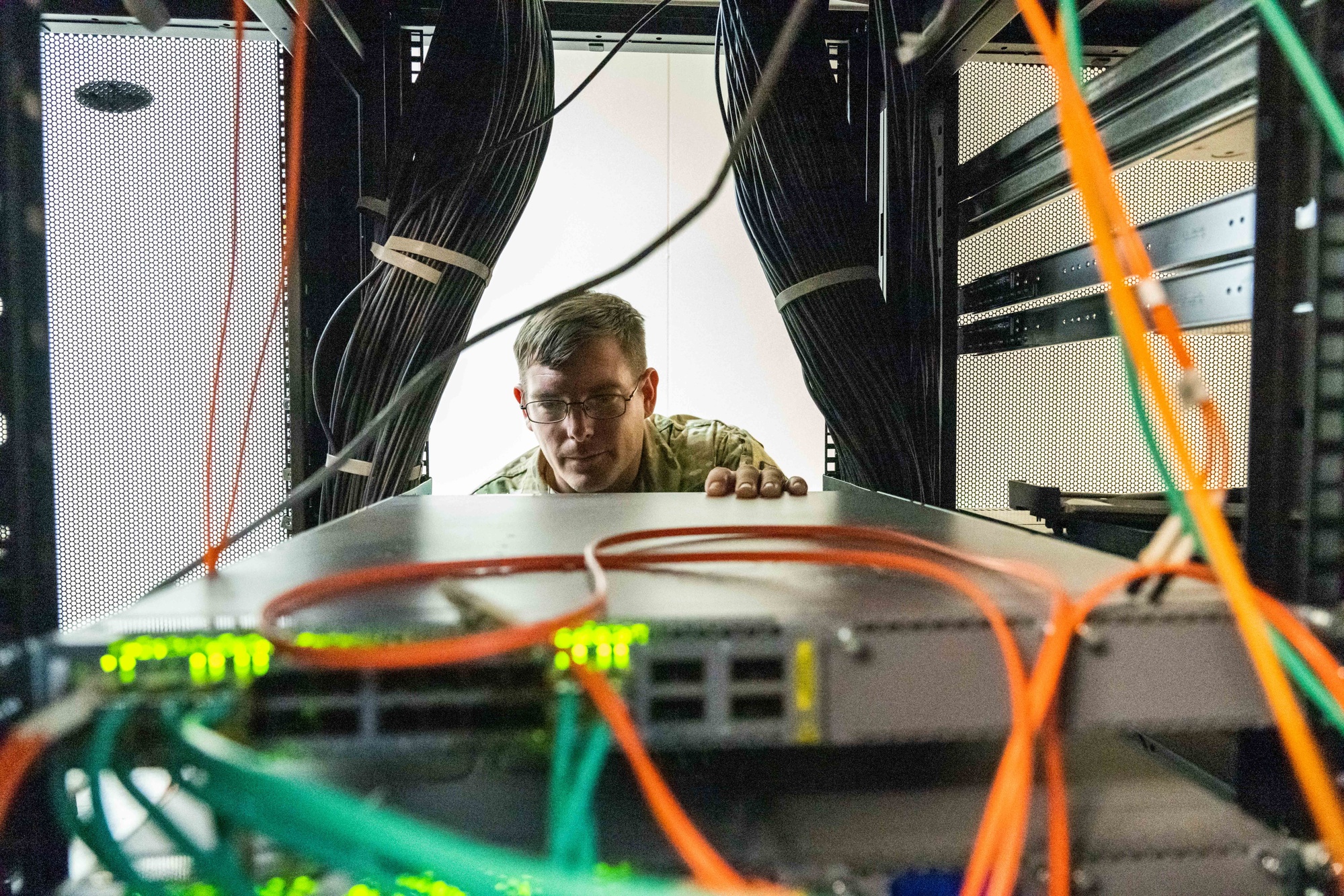
A real public-domain DVIDS photograph used with this article shows a Defense Information Systems Agency server inspection at Fort Huachuca in September 2024. It provides general context for hands-on infrastructure work. It does not show Granite Telecommunications personnel, facilities, equipment, customers, performance or endorsement. Photo by David Abizaid.
What the public record actually establishes
The company in this assessment is Granite Telecommunications LLC, the published BTW directory entity associated with AS16504. A separate draft directory row with a similar name exists, but it is not the object used here. The published company row is the identity boundary for this article, and no earlier BTW article was linked to it at the time of the freshness check.
The American Registry for Internet Numbers, or ARIN, publishes an RDAP record for AS16504. RDAP means Registration Data Access Protocol. It is a structured way to retrieve registry information. The captured record names the autonomous system GRANITE, marks it active and identifies Granite Telecommunications LLC as the registrant. It also carries a Granite website reference.
That is useful evidence of registration identity. It does not say that Granite owns every address ever observed behind AS16504. It does not list every customer, router, carrier, building or application. It does not prove current route security, physical diversity, latency or uptime. A registry is a ledger. Its job is to preserve a unique resource record and enough current information for coordination. It is not the running network and it is not a service-quality tribunal.
RIPEstat adds a time-bounded operational view. Although the name refers to the RIPE community, the service observes internet routing far beyond Europe. Its AS overview associated resource 16504 with Granite Telecommunications LLC and marked it announced in a snapshot dated 5 August 2026. In everyday language, route collectors could see the autonomous system participating in the global routing system at that time.
The announced-prefix response covered a stated window from 22 July to 5 August 2026. It contained 212 prefix entries: 199 IPv4 entries and 13 IPv6 entries. A prefix is a compact notation for a block of internet addresses. IPv4 is the older, smaller address system. IPv6 is its much larger successor. The observation therefore shows a mixed address-family routing surface during that window.
The number 212 is not a customer total. It is not a count of circuits, offices or successful sessions. It is not proof that the addresses were reachable from every location for the entire period. Route collectors have particular vantage points, and routing changes over time. A prefix visible in this dataset could be connected with a customer or another operational arrangement; visibility alone does not decide legal ownership or commercial responsibility.
PeeringDB provides a third kind of record. Its operator-maintained profile names Granite Telecommunications and AS16504, reports a selective general policy, says multiple locations are preferred and lists 13 facilities. The captured profile shows no listed exchange connections and leaves several traffic and scope fields undisclosed. It was last generally updated in 2022, while its RIR-status field shows a 2024 update.
Those dates and empty fields matter. The profile also reports zero declared IPv4 and IPv6 prefixes and an IPv6 information flag of false, while the newer RIPEstat snapshot observed both IPv4 and IPv6 prefix entries. That is not proof that either service is defective. PeeringDB fields are voluntarily maintained operational metadata, and zero can mean unreported, incomplete or stale. RIPEstat reports what route collectors observed in a defined window. The responsible conclusion is that the two sources answer different questions and that operator-maintained records require periodic reconciliation with running evidence.
For non-specialists, the evidence can be summarized in three layers. ARIN says who is recorded against the ASN. RIPEstat says what routing observers saw at a particular time. PeeringDB says what the operator chose to publish about interconnection. The records should be compared, but one should never be silently promoted into another.
Why a managed-network provider is an integration business
Granite’s homepage describes a broad business communications portfolio covering voice, access, mobility, cloud services and managed field services. It also publishes scale figures of 1.75 million voice and data lines, 700,000 serviced locations and more than 85 Fortune 100 customers, together with a 24-hour US-based customer service centre. These are issuer statements. They are useful for understanding the intended scale of the operating model, but they are not independent audits of active lines, customer outcomes or performance at each site.
The operating problem behind those numbers is integration. A large organization may have hundreds or thousands of sites. One branch may use cable broadband, another dedicated Ethernet, another fixed wireless and another a legacy circuit. The sites may contain different routers, firewalls, Wi-Fi systems, power arrangements and building-access rules. The underlying carriers may expose different portals, ticket formats, maintenance calendars and escalation paths.
Without a coordinating layer, the customer’s internal team has to maintain all of those inventories and relationships. Staff must know which carrier owns a circuit, which device sits at the edge, whether an alarm is real, how to open a ticket, who may enter the building and what test proves recovery. Billing and contract records can drift away from the physical estate. A closed shop can continue generating charges. A replacement device can arrive without the correct configuration. A circuit can appear healthy while the application behind it remains unusable.
Granite’s Network as a Service page describes monitoring, solution management, dispatch and professional services such as design, complex configuration, engineering and ticket integration. Its managed-network page describes 24-hour monitoring, alerts and automatic ticket creation. NOCExpress is described as a dashboard and ticket interface integrated with carrier portals. Edgeboot is described as an out-of-band device that can use a private cellular path to cycle power or open a console session when the primary connection is unavailable.
These functions form a control layer. They can improve visibility and make some responses repeatable. If an access device stops responding, an alarm can be correlated with the circuit inventory. A ticket can be opened. A remote power cycle can be attempted. A carrier case can be created. A field visit can be requested. The customer can receive a common status instead of calling several parties separately.
But a control layer is not the same thing as complete physical control. The underlying access circuit may still belong to another carrier. A local electric utility controls commercial power. A landlord may control access to a telecommunications room. A customer may own the application, firewall policy or local switch. A third-party hardware vendor may control replacement stock or software support. A cellular backup may use a tower affected by the same storm or power loss.
The useful business question is therefore not whether Granite “manages the network” in a broad marketing sense. It is which objects Granite can observe, which actions it can execute, which parties it can coordinate and which outcomes require somebody else. Clear boundaries make a managed service stronger because they turn a vague promise into an actionable responsibility map.
Detection, diagnosis, authority, repair and verification are different jobs
Network incidents are often discussed as if they have only two states: up and down. In practice, there are at least five stages.
Detection is noticing that something changed. A monitor may stop receiving a response from a customer-premises device, or CPE. CPE means equipment installed at or near the customer site, such as a router, firewall or modem. Granite’s product pages describe monitoring and proactive ticketing, while its general managed-services terms refer to 24x7x365 up/down monitoring for specified managed devices and interfaces.
Diagnosis is deciding what failed. A silent CPE could mean the device crashed, the access circuit failed, power was lost, a monitoring path broke, a firewall rule changed or an address changed. A dashboard can narrow the possibilities, but it may not see the building’s internal wiring or the business application. Multiple independent observations usually improve diagnosis.
Authority is permission to act. A support team may be able to restart a managed device but not change the customer’s security policy without approval. A carrier may need to dispatch to its own plant. A landlord may need to open a room. The customer may need to authorize an emergency change. A technically obvious action can still wait if authority is unclear.
Repair is the physical or logical work that removes the fault. A reboot can recover a stalled device. A new configuration can correct a policy error. A carrier technician can repair a circuit. A field technician can replace equipment or wiring. A utility can restore power. These are not interchangeable responses.
Verification is proving that the business function works again. A green circuit light is not enough if payment terminals still cannot reach their processor. A successful ping is not enough if voice calls fail. A router may be online while an application route, name service or security rule remains wrong. The customer and managed provider need agreed recovery tests that reflect actual use.
Separating the stages prevents a common reporting error. A ticket can be opened quickly while repair remains slow. A device can be rebooted while the underlying circuit is still unstable. A carrier can mark its service restored while the customer’s application remains unavailable. Metrics should therefore distinguish time to detect, time to acknowledge, time to diagnose, time to obtain authority, time to repair and time to verify.
What Granite’s own terms reveal about control boundaries
Marketing pages describe intended capabilities. Contract terms are useful because they expose conditions and responsibility. The captured Granite managed-services terms are dated 2 April 2019 and are general, not a statement about any particular customer’s signed order. A current order, statement of work and service-level agreement may differ. Even with that limit, the document makes the operating model more concrete.
For managed SD-WAN, the terms describe initial configuration, active/active WAN options, 24x7x365 monitoring of customer-premises equipment and WAN interfaces, analytics, incident management, proactive tickets and email notifications. SD-WAN means software-defined wide area networking. It uses software policies to steer traffic across one or more access links instead of treating a single circuit as the only possible path.
The terms also say that a customer provides current configuration information and remains responsible for confirming that network policies reflect its preferences before and after activation. This is a crucial boundary. A provider can implement submitted policy, but the customer still owns the business meaning of that policy. Only the customer can decide whether a payment system may use a backup path, whether a branch may reach a sensitive database or whether a security exception is acceptable.
For specified services, the terms say the network operations centre serves as the primary contact for problems, ticket updates and escalation. They describe an automatic notification when CPE has been down for fifteen minutes. This is a detection threshold, not a promise that every interruption is discovered instantly or repaired within fifteen minutes. Brief or partial failures may need different telemetry. An application can fail while CPE remains reachable. A customer’s recovery objective may be shorter than the monitoring threshold.
The terms describe coordination with a physical onsite presence during troubleshooting. That sentence is easy to overlook, but it captures the reality layer. Remote visibility cannot open a locked room, reseat a cable that monitoring cannot see, test a local power outlet or identify water damage. A managed service needs a path from digital evidence to physical action.
The same terms describe commercially reasonable efforts to ship replacement hardware when a managed device is defective and the problem is not caused by another component, misuse, misconfiguration or environmental damage. This is not the same as an instantaneous replacement guarantee. Stock location, shipping, site access, device configuration and the availability of a technician all affect recovery time.
The security section is equally instructive. It says the managed security service is one part of the customer’s overall security programme and does not guarantee uninterrupted, error-free or completely secure operation. That is not an admission of poor service. It is recognition that networks contain shared responsibilities, evolving threats and dependencies outside one product’s control.
For buyers, the lesson is simple: read the operating verbs in the contract. “Monitor,” “notify,” “coordinate,” “configure,” “ship,” “repair” and “replace” describe different commitments. Ask what starts the clock, which evidence closes the ticket, what exceptions apply and who owns the next action when the fault is outside the managed device.
Why AS16504 still matters to the managed-service story
It would be a mistake to treat AS16504 as a score for Granite’s entire service portfolio. It would also be a mistake to ignore it. An ASN is part of the public identity through which routes and operational contacts can be coordinated. If the registration, routing and operator-maintained records drift apart, diagnosis becomes harder at exactly the time a clear identity is most valuable.
Suppose a prefix expected behind AS16504 suddenly appears under another origin. That could be an authorized transition, a customer arrangement, a data lag, a configuration error or a security incident. A responsible operator needs an expected-state inventory and an escalation process. The alert is not a verdict; it is a prompt to reconcile the ledger with the running network.
The same discipline applies to contacts and policy metadata. If ARIN records point to a stale role account, a routing incident can lose time. If an interconnection directory retains old facilities or omits new information, peers may contact the wrong team. If an address block moves under a legitimate agreement but records are not updated, abuse reports and troubleshooting requests may be misdirected.
Running evidence deserves priority for a running question. If the question is whether a route was visible on 5 August 2026, the RIPEstat snapshot is more relevant than a PeeringDB field last updated in 2022. But running evidence is not a legal ledger. It cannot determine ownership or contractual authority by itself. The strong control is reconciliation: compare resource records, route observations, authorization metadata, operator directories and internal inventory, then investigate differences.
This article does not publish a full Route Origin Authorization assessment for the 212 observed prefixes. A Route Origin Authorization, or ROA, is a cryptographically verifiable statement in the Resource Public Key Infrastructure, known as RPKI, about which ASN may originate a prefix. The frozen evidence packet does not contain a complete, independently reviewed route-origin inventory, so no coverage percentage or security grade is claimed.
That restraint is important. A visible ASN, a large prefix list or an RPKI result can answer a narrow question. None alone proves application availability, path diversity, incident response or customer experience. Good supervision preserves the boundary around every piece of evidence.
Monitoring is valuable because it shortens uncertainty
Granite describes monitoring, proactive alerts and automated ticket creation across its managed-service pages. NOCExpress is presented as a way to see ticket trends, outages and network data, with integration into underlying carrier systems. The strongest potential benefit is not a promise that failure disappears. It is a reduction in the time spent asking basic questions.
Which site is affected? Which device stopped responding? Which carrier owns the circuit? Is there an open maintenance notice? Has a similar alert occurred at nearby sites? Has a ticket already been assigned? Who has escalation authority? A normalized inventory and ticket interface can make those questions answerable without searching separate spreadsheets and portals.
The integration itself needs supervision. Carrier identifiers must map to the correct customer site. Device serial numbers must map to the current circuit and policy. Ticket statuses must translate correctly across systems. Maintenance notices need accurate time zones. Closed and moved locations must leave the monitoring estate. A wrong mapping can create confident but false answers.
Data freshness is therefore a reliability control. An old circuit identifier may send a ticket to the wrong carrier. A device replaced during a project may continue generating alerts under the old asset. A branch relocation can leave the support team looking at a circuit that no longer serves the building. Reconciliation should be continuous, not a one-time onboarding exercise.
Monitoring coverage also needs to be defined. An ICMP response, commonly called a ping, can show that a device answers a simple network probe. It does not prove that every application, interface or route works. Device telemetry can show temperature, memory, link state or packet loss, but only for objects that expose those measurements. Logs may reveal errors but can also be delayed or incomplete.
The right dashboard is therefore one that makes blind spots visible. It should distinguish “no alarm,” “no telemetry,” “monitor suppressed,” “device reachable,” “circuit reachable” and “business transaction successful.” Those are very different states. A non-specialist manager does not need protocol detail, but does need to know which statement the dashboard actually supports.
Out-of-band control can recover a device, not an entire dependency chain
Granite’s edgeboot page describes a managed power distribution device with cellular out-of-band access. “Out of band” means the recovery path does not depend on the primary connection being healthy. If a router or modem is unresponsive, an authorized operator may be able to cycle power or open a console session over a separate cellular connection.
This is valuable because many site incidents are expensive to diagnose remotely. Without an independent path, the support team may know only that the branch has gone silent. A cellular management channel can reveal whether the edge device has power, allow a restart or expose console information. That can avoid a truck roll for a simple device hang.
The control still has prerequisites. The edgeboot device needs power. Its cellular modem needs coverage and an active service. The controlled equipment needs to be connected correctly. Scripts need safeguards so repeated restarts do not make a hardware fault worse. Access credentials and audit logs need protection. The remote action needs an owner and an approval policy.
It also has physical limits. A remote restart cannot splice a cut fibre, repair a damaged cable modem, replace a failed power supply or enter a locked room. If the same local power failure disables the modem, router, cellular device and switch, the independent path may not be independent enough. If a storm affects both the wired carrier and nearby mobile infrastructure, failover can disappear at the same time it is needed.
The business value of out-of-band control therefore depends on testing. A buyer should not merely ask whether the device is installed. Test whether it is reachable during a simulated primary outage, whether the correct outlet is mapped, whether an authorized person can use it, whether the restart sequence is safe and whether business traffic actually returns afterward.
Carrier-portal integration does not remove carrier boundaries
NOCExpress is described as integrating with carrier portals for ticket assignments, updates, dispatches and resolution. In a multi-carrier estate, that can be a meaningful control. It can reduce duplicate data entry and make a common support team aware of developments without repeated phone calls.
Yet an integration is only as strong as the data and process behind it. A carrier may expose a generic outage code that hides the physical cause. A portal may mark a ticket resolved when a circuit passes the carrier’s test, even though the customer application remains unavailable. An application programming interface, or API, may delay an update or reject an attachment. A ticket can move between carrier teams while the managed provider still owns customer communication.
The integration map should identify every state transition. When Granite opens a carrier case, what customer ticket status appears? When the carrier requests access, who contacts the site? When the carrier reports repair, what independent test is run? If the customer disputes closure, which evidence reopens the case? These are not software details; they determine how long people wait without a useful next action.
Consolidation can create a single throat to choke, but it can also create a single queue that hides parallel work. A strong operating model shows the underlying owner and next action without forcing the customer to manage that owner directly. It preserves the benefit of one interface while keeping the real responsibility chain visible.
Field service is where digital plans meet buildings
Granite’s same-day-equipment page describes 24-hour response, integrated ticketing, hardware replacement, a large warehouse and a claimed network of 12,000 field technicians in North America. These are issuer descriptions of capacity, not guarantees that a particular technician or part will arrive within a fixed time at every location.
Field work has its own dependencies. The right replacement part must be in stock. It must be configured for the site. A technician must have the required skills and travel access. The building must be open. A local contact may need to escort the technician. A carrier-owned demarcation point may require separate authorization. A repair can be delayed even when everyone is working promptly.
Standardization can reduce those delays. A clean site record should include floor and room information, access hours, local contacts, circuit identifiers, device models, photographs, cable labels, power details and a known recovery test. Preconfigured spares can reduce time onsite. Consistent installation guides can make outcomes less dependent on individual memory.
But standardization should not erase site differences. A clinic, warehouse, retail shop and office have different critical functions. One may need voice and emergency calling, another payment connectivity, another scanning and inventory, and another remote access. The recovery test must reflect the site’s actual business role.
The photograph accompanying this article illustrates the physical reality. A technician is inspecting a server rack at a US government test facility. The image is not Granite-specific. Its relevance is that cables, power, ports and components still matter even when network management is delivered through cloud dashboards. Someone eventually has to inspect or replace physical equipment.
A responsibility map for ordinary failures
Consider a branch that suddenly loses access to cloud applications. The monitoring platform reports that the managed router is unreachable. Several causes remain possible.
If commercial power failed, the customer or landlord may need to confirm the outage and the endurance of local backup power. Granite can report what its managed equipment shows, but it cannot restore the utility grid.
If the router froze while power and the access circuit remain healthy, an out-of-band restart may recover service. Granite can control the managed device if the product, credentials and cellular path are working. The customer should still verify applications after the restart.
If the carrier circuit failed, Granite can open and coordinate a carrier case. The carrier may own the physical repair. Site access may be required. The customer needs status and a fallback plan while the carrier works.
If an SD-WAN policy steered traffic incorrectly, Granite may be able to change the managed configuration, but the customer remains responsible for confirming that the intended security and application policy is correct. Emergency changes should be recorded and reviewed afterward.
If a building cable or local switch failed outside the managed scope, a field technician or customer team may need to act. The incident should not be allowed to bounce indefinitely between “network” and “local IT.” The responsibility map should specify the boundary test and escalation owner.
If the cloud application failed, both primary and backup connectivity may be healthy. The connectivity provider can show successful network tests, but the application owner must restore the service. Closing the network ticket should not close the broader business incident until the user function is verified.
This map shows why continuity cannot be purchased as a single object. It is an agreement among systems and people. The managed provider may be the coordinator and may operate important controls, but coordination is successful only when every handoff has a named owner, evidence and deadline.
How failure becomes business cost
The cost of a network interruption is rarely limited to the monthly price of a circuit. A retail site can lose card sales. A clinic can lose access to scheduling or records. A warehouse can stop scanning goods. A call centre can miss customers. Remote employees can become idle while managers organize workarounds.
Coordination delay is a separate cost. Ten people can spend an hour exchanging screenshots, account numbers and ticket references even when the technical fault is simple. A consolidated inventory and ticket process may reduce that labour. It can also reduce the risk that nobody calls the correct underlying carrier.
Poor diagnosis creates duplicate cost. A company may dispatch a technician to a site when the carrier already knows about a regional outage. It may replace a router when the building lost power. It may buy an additional connection that shares the same physical route as the primary service and therefore does not create true diversity.
False recovery creates another cost. If a ticket is closed after a device responds but the payment application still fails, staff may discover the problem only when a customer tries to pay. Recovery tests should include the transactions that matter, not only technical indicators.
Compliance and safety can raise the stakes. Voice services may support emergency calls. Security systems may depend on connectivity. Regulated organizations may need audit records showing what changed and who approved it. The article does not claim a specific Granite failure or compliance outcome. These are foreseeable categories that any buyer should include in a continuity assessment.
A practical financial model starts with the business function. Estimate revenue or service value per hour, staff affected, contractual penalties, emergency logistics, customer harm and recovery labour. Then compare that exposure with the cost of independent access, longer backup power, monitored devices, tested failover, local spares and scheduled exercises.
The least expensive design is not always the one with the lowest monthly bill. It is the one that keeps the expected total cost of failure and control within the organization’s tolerance. A managed provider can supply useful controls, but management must decide which risks deserve additional investment.
Questions a buyer should ask before relying on the control layer
Start with inventory. Which circuits, devices, interfaces, applications and sites are in scope? Which records are authoritative? How quickly are changes reflected in monitoring and billing? Who removes a closed site or retired device?
Ask what “monitored” means. Is the check a ping, device telemetry, interface status, log analysis, synthetic application test or carrier alarm? What is the polling interval? How many consecutive failures create a ticket? What failures remain invisible?
Ask how tickets cross organizational boundaries. Does the platform open a carrier case automatically? Which carrier fields are synchronized? Can the customer see the underlying carrier reference? Who handles a request for site access? What happens when the carrier closes a case but the customer still sees failure?
Ask about authority. Which changes can Granite make without customer approval? Which require emergency authorization? How are policy changes reviewed? Who can use out-of-band controls? Are actions logged and protected with strong authentication?
Ask about physical recovery. Where are replacement devices stored? Are they preconfigured? What arrival targets apply to the exact location and service order? Who provides an escort? What if the carrier, landlord and field technician each need access to different equipment?
Ask about independence. Does the backup link use a different carrier, physical entrance, power source and wireless infrastructure? Has failover been tested under load? Does the backup path support critical security policies, voice quality and cloud routes?
Ask about evidence. Which report proves that a route, circuit, device and application recovered? How are false positives and recurring incidents tracked? Does management see both technical time and business impact?
Finally, ask how public and internal records are reconciled. Who reviews ARIN contacts, expected prefixes, route-authorisation data and operator directory entries? How quickly are legitimate changes documented? Who investigates an unexpected origin or stale contact?
These questions do not assume that Granite lacks the controls. They turn broad service descriptions into verifiable operating expectations. A strong provider should benefit from that clarity because it reduces disputes and accelerates escalation.
What to watch after the contract is signed
Watch inventory accuracy. The number of monitored circuits and devices should match the live estate, not only the invoice. Moved and closed locations should disappear from active monitoring on schedule.
Watch alarm quality. Too many false alarms teach teams to ignore the system. Missing alarms delay detection. Review which incidents were discovered by users before monitoring and why.
Watch ticket handoffs. Measure time spent waiting for the next owner, not only total closure time. Identify repeated loops between Granite, an underlying carrier, a field technician and the customer.
Watch change quality. Track emergency configuration changes, failed maintenance and rollbacks. Confirm that customer policy remains aligned with business needs after upgrades.
Watch failover tests. A backup connection that has never carried a real critical transaction is an assumption. Schedule tests that include power, routing, security and application verification.
Watch public network identity. Compare intended AS16504 routes and contacts with current observations and relevant authorization records. Treat differences as investigation triggers, not instant proof of wrongdoing.
Watch recovery language. “Device online,” “circuit restored” and “business service verified” are different closure states. Reports should say which one has been achieved.
The practical conclusion
The public evidence supports a bounded conclusion. Granite Telecommunications LLC has a visible network identity associated with AS16504. The 5 August 2026 RIPEstat snapshot showed the autonomous system announced and returned 212 observed prefix entries. Granite describes a managed operating layer that includes monitoring, ticketing, carrier integration, remote device control and field service.
Those facts do not prove end-to-end continuity at a customer site. The company’s own general terms make the boundaries visible: customers confirm policies, underlying services can be separate causes, onsite presence may be required and security or uninterrupted operation is not guaranteed by one managed component.
This is not a reason to dismiss managed services. It is the reason to evaluate them correctly. The value lies in reducing uncertainty, standardizing evidence and coordinating action across a fragmented estate. The control is strongest when it preserves rather than hides the real owner of each dependency.
For a non-specialist decision-maker, the rule is straightforward. Treat the registry as the identity ledger, observed routes as time-bounded running evidence, monitoring as a detection tool, tickets as coordination records, remote controls as limited recovery mechanisms and field service as the path to physical repair. Then require a final test of the business function.
That is the reality layer. Continuity is not a slogan and it is not one green dashboard. It is the result of accurate records, observable systems, clear authority, tested alternatives, physical access and recovery evidence that matches what people can actually use.
Sources
- https://rdap.arin.net/registry/autnum/16504
- https://stat.ripe.net/data/as-overview/data.json?resource=AS16504
- https://stat.ripe.net/data/announced-prefixes/data.json?resource=AS16504
- https://www.peeringdb.com/api/net?asn=16504
- https://www.granitenet.com/
- https://www.granitenet.com/solutions/cloud-services/network-as-a-service/
- https://www.granitenet.com/solutions/cloud-services/managed-network-services/
- https://www.granitenet.com/solutions/granite360/nocexpress/
- https://www.granitenet.com/solutions/granite-labs/edgeboot/
- https://www.granitenet.com/solutions/managed-field-services/same-day-equipment-replacement/
- https://www.granitenet.com/Content/pdfs/Granite%20Website%20-%20Managed%20Services%20Terms%20of%20Service.pdf
- https://www.dvidshub.net/image/8665132/jitc-server-inspection
Image attribution
U.S. Army Staff Sgt. Jason Boyd inspects components in a server rack at Fort Huachuca, Arizona, on 3 September 2024. Photo ID 8665132, VIRIN 240904-D-OR787-3780. Photo by David Abizaid for the Defense Information Systems Agency, published by DVIDS and marked PUBLIC DOMAIN subject to the restrictions linked from the DVIDS copyright page. The image is general infrastructure-inspection context only. It does not depict Granite Telecommunications staff, facilities, equipment, customers, service performance or endorsement.
Member Briefing
Deeper Profile Context
Sign in with the right membership level to unlock the full briefing and source notes.
Only for Strategic Circle
Strategic Circle
Open to all readers. Unlock profile briefings after joining and signing in.
Join Strategic CircleOnly for Leadership Alliance
Leadership Alliance
For qualified IP-asset owners and management; sign in to unlock alliance briefings.
Join Leadership Alliance