
Intelligence
Latest Articles
Latest intelligence on infrastructure operators, policy decisions, market moves, and digital power shifts.

History
The Line Was Complete. The Command Had Not Run: RFC 1116 and Telnet Linemode
In character-at-a-time Telnet, a typist could wait for the network to see each key return. Linemode made the nearby terminal feel immediate: editing and echo could happen before the line crossed the path. That improvement also created a durable evidentiary trap. The completed…

IETF
Martin Thomson and the Key Log That Could Decrypt a Session but Not Prove It
The incident package looked decisive: a packet capture, a small text file and a screenshot of readable TLS traffic. The decryption had worked. Yet the file did not say who enabled logging, which endpoint produced the secret, when it was collected or whether the alleged session…

CASE FILE
The Cursor Continued the List. It Did Not Continue the Right: RFC 9865
RFC 9865 gives SCIM a cleaner way to traverse a long result set. It does not convert a continuation value into a portable permission, a complete inventory, or a decision already made.

SANOG
SANOG’s Six-NOG Committee Does Not Cover Its Eight-Country Map
SANOG describes a region of eight countries. Its published future governance strategy, however, routes local-NOG representation through six named forums. That leaves Afghanistan and Maldives without the same visible institutional path into the Core Committee.

Story
AFRINIC Says It Added JSContact. Its RDAP Guide Does Not Say Which One.
AFRINIC’s public record contains a useful sentence and an unfinished question. The current release entry for WHOIS 2.10.7 says that an RDAP feature called JSContact was added. The current RDAP guide tells a reader where the service is, which resources may be queried, which…

CASE FILE
W3C’s Profiles Draft Can Inherit Conformance. The Proof Layer Is Still Unsettled
A machine can follow two RDF links and produce a third: a resource conforms to a profile; that profile is a profile of a specification; therefore the resource conforms to the specification. The W3C’s new Profiles Vocabulary draft makes that inference explicit. It also exposes why…

History
It Worked at NASA. That Did Not Make It Safe for the Internet: RFC 1106 and RFC 1110
June 1989 produced an unusually honest sentence in protocol history: two experimental TCP extensions had been implemented and shown to work using NASA resources. Two months later, another RFC explained why one of them still could not be adopted for the general Internet. The test…

CASE FILE
The Color Reached PCEP. It Did Not Reach the Service: RFC 9863
RFC 9863 lets PCEP carry a color for a TE path. That is useful coordination data. It is not a guarantee that a service was mapped, a latency objective was met, or a customer received a result.

ICANN
ICANN’s DNS-Abuse Debate Turns One Blocklist Count Into a Floor and a Ceiling
Interisle looked at names created in 2025, found 8.5 million that entered selected blocklists and called the result a floor. ICANN answered that reported-abuse statistics are, at best, an upper limit on confirmed abuse. Both descriptions can be logically coherent, but only if the…

CASE FILE
DNS Received the Hint. The Parent Still Had to Decide: RFC 9859’s Delegation Boundary
RFC 9859 can make delegation maintenance faster. It cannot make a notification into a parent-side decision, or turn a received response into proof that DNSSEC or delegation state has changed.

History
Changing the Route Was Not the Same as Filtering the Packet: RFC 1104
In June 1989, RFC 1104 divided “policy routing” into mechanisms that were already easy to confuse. A network could change which reachability it disclosed, inspect a particular packet, assign scarce bandwidth or buffers, and record usage for later accounting. Each act could be…

History
A SHUT State Was Not an Off Node: RFC 1289 Kept the Existing Links
The word “shutdown” invites a clean story: an operator chooses a state, a node stops, and the work is over. RFC 1289 preserves a more demanding chronology. Its DECnet Phase IV MIB did not treat every admission restriction as an OFF node. `SHUT` allowed no new logical links, but…

IETF
Todd Herr and the DMARC Pass That Did Not Make the Message Safe
The green word `pass` can be perfectly correct and dangerously misunderstood. In DMARC it certifies a narrow relationship between domains. It does not certify the person in the display name, the proposition in the message, the attachment behind the button or the wisdom of putting…

CASE FILE
The Router Repaired the Path. It Did Not Restore the Service: RFC 9855 and TI-LFA’s Local Boundary
A router can react to a directly attached failure in milliseconds and still know nothing about whether a customer service has recovered. RFC 9855 gives Segment Routing deployments a disciplined way to precompute and activate a loop-free repair path at the Point of Local Repair.…
NPNOG
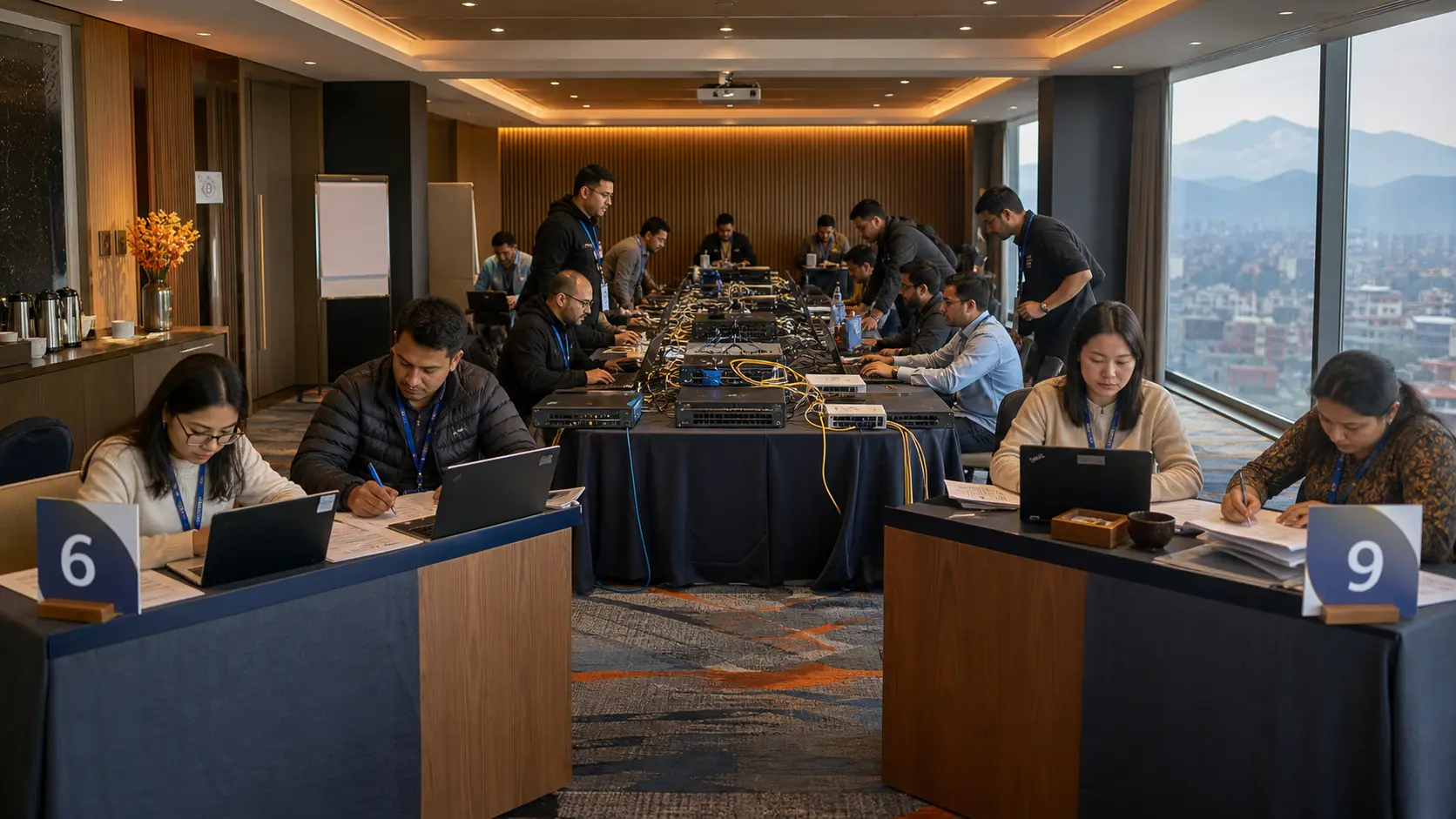
One Week, Two Institutions—and Two Edition Numbers: Untangling npNOG and SANOG-38
In July 2022, operators arriving at the Kathmandu Marriott encountered one technical week: four workshop days followed by a conference. The surviving institutional record is less unified. npNOG calls the event NPNOG-6 with SANOG-38. SANOG's contemporaneous pages called the same…

History
The Memo Called It a Standard. The Record Did Not: RFC 1097
On 1 April 1989, a three-page RFC proposed a Telnet option for flashing messages too quickly for a user to notice. Its joke is easy to recognize. Its more durable lesson is quieter: the memo could call itself a standard, but it could not confer that standing on itself; a Telnet…

Story
The RIR Governance Draft Would Freeze Its Own Amendment Path During an Emergency
The newly public Version 3.4 RIR Governance Document does not merely describe how a registry crisis might be handled. It also proposes a small constitutional restraint: while the crisis machinery is active, the machinery's own rules cannot be amended.

CASE FILE
The Resource Named Its Authorization Server. It Did Not Grant a Right: RFC 9728’s Discovery Boundary
A resource can accurately publish where a client should look next and still have made no decision to let that client do anything. RFC 9728 gives protected resources a disciplined way to publish OAuth metadata. Its value is coordination: it narrows a discovery problem. It is not…

CASE FILE
The Authorization Conversation Was Still Pending. It Was Not an API Right: GNAP’s Continuation Boundary
A client can be entitled to continue an authorization conversation without being entitled to call the API it asked about. RFC 9635 makes the distinction unusually explicit: a continuation credential advances one grant request at the authorization server; a resource right appears…

CASE FILE
Internet Society Added ‘Obedience’ to Its Policy Opening. The Duty Runs to Mission, Not Management
One word can make a governance document look more authoritarian just as the underlying rule becomes easier to read. Internet Society’s Board added the duty of obedience to the opening paragraph of its Trustee fiduciary policy in July 2026. Yet the Board’s own resolution says the…