
Intelligence
Latest Articles
Latest intelligence on infrastructure operators, policy decisions, market moves, and digital power shifts.

IETF
Todd Herr and the DMARC Pass That Did Not Make the Message Safe
The green word `pass` can be perfectly correct and dangerously misunderstood. In DMARC it certifies a narrow relationship between domains. It does not certify the person in the display name, the proposition in the message, the attachment behind the button or the wisdom of putting…

CASE FILE
The Router Repaired the Path. It Did Not Restore the Service: RFC 9855 and TI-LFA’s Local Boundary
A router can react to a directly attached failure in milliseconds and still know nothing about whether a customer service has recovered. RFC 9855 gives Segment Routing deployments a disciplined way to precompute and activate a loop-free repair path at the Point of Local Repair.…
NPNOG
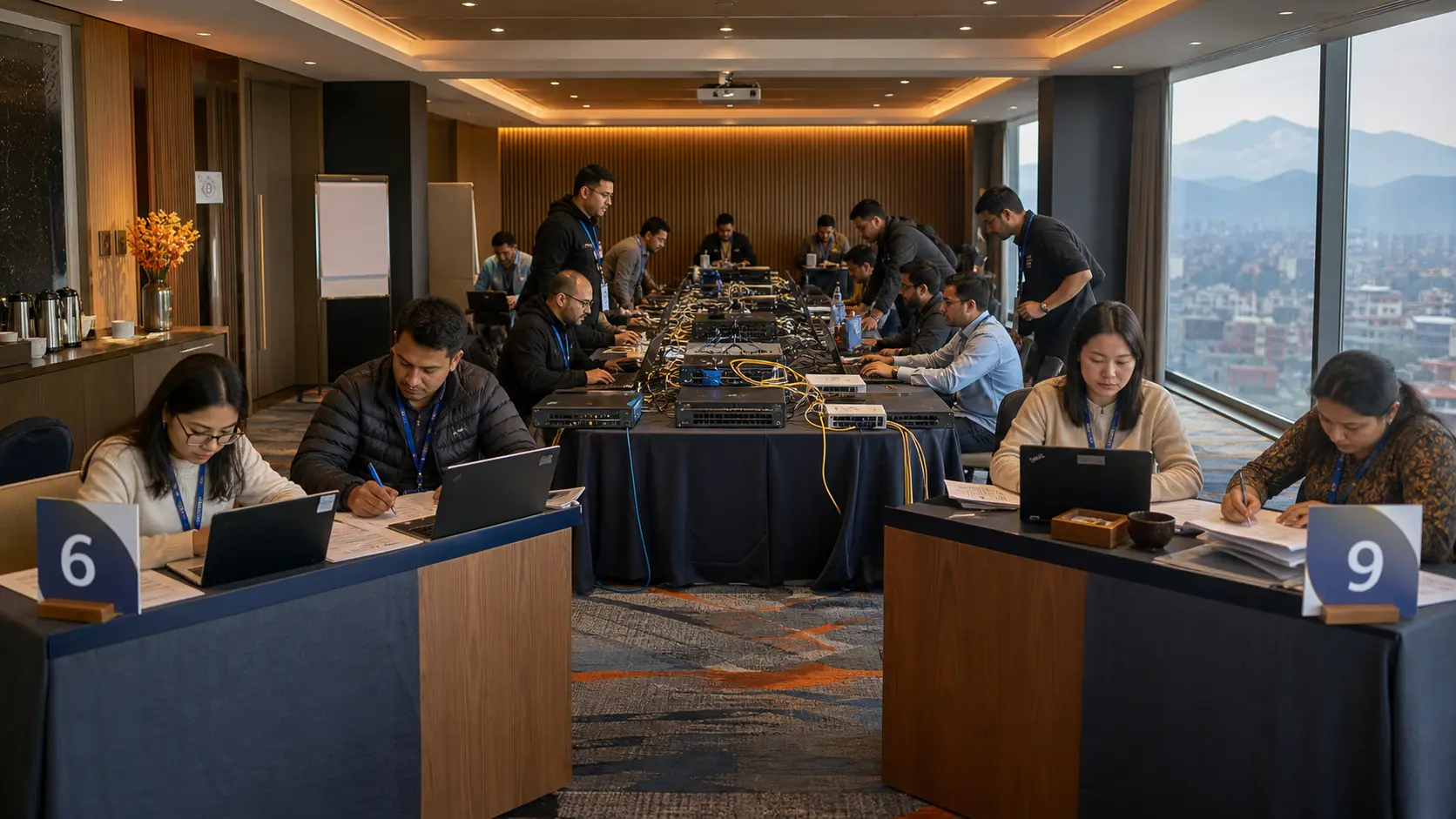
One Week, Two Institutions—and Two Edition Numbers: Untangling npNOG and SANOG-38
In July 2022, operators arriving at the Kathmandu Marriott encountered one technical week: four workshop days followed by a conference. The surviving institutional record is less unified. npNOG calls the event NPNOG-6 with SANOG-38. SANOG's contemporaneous pages called the same…

History
The Memo Called It a Standard. The Record Did Not: RFC 1097
On 1 April 1989, a three-page RFC proposed a Telnet option for flashing messages too quickly for a user to notice. Its joke is easy to recognize. Its more durable lesson is quieter: the memo could call itself a standard, but it could not confer that standing on itself; a Telnet…

Story
The RIR Governance Draft Would Freeze Its Own Amendment Path During an Emergency
The newly public Version 3.4 RIR Governance Document does not merely describe how a registry crisis might be handled. It also proposes a small constitutional restraint: while the crisis machinery is active, the machinery's own rules cannot be amended.

CASE FILE
The Resource Named Its Authorization Server. It Did Not Grant a Right: RFC 9728’s Discovery Boundary
A resource can accurately publish where a client should look next and still have made no decision to let that client do anything. RFC 9728 gives protected resources a disciplined way to publish OAuth metadata. Its value is coordination: it narrows a discovery problem. It is not…

CASE FILE
The Authorization Conversation Was Still Pending. It Was Not an API Right: GNAP’s Continuation Boundary
A client can be entitled to continue an authorization conversation without being entitled to call the API it asked about. RFC 9635 makes the distinction unusually explicit: a continuation credential advances one grant request at the authorization server; a resource right appears…

CASE FILE
Internet Society Added ‘Obedience’ to Its Policy Opening. The Duty Runs to Mission, Not Management
One word can make a governance document look more authoritarian just as the underlying rule becomes easier to read. Internet Society’s Board added the duty of obedience to the opening paragraph of its Trustee fiduciary policy in July 2026. Yet the Board’s own resolution says the…

IETF
Adrian Farrel and the Implementation Receipt That Disappeared Before Publication
One of the most useful sections in an Internet-Draft is written with an expiry condition. It can name the code, version, coverage, licence, test contact and interoperability evidence that made a proposal real. Then, if the proposal becomes an RFC, the section is supposed to…

Story
AFRINIC Named Its Next CEO. He Takes Office on 1 January
The appointment is public. The decision date is not. And the authority of the office does not follow from the title “CEO Designate” before the announced start date.

History
A Bridge Port Was Not Necessarily an Interface. Its Counters Did Not Describe the Whole Line: RFC 1286
A network operator can be handed three reassuringly familiar facts: a port number, an interface index and a counter. RFC 1286, the 1991 Bridge MIB, is valuable because it refused to let those facts collapse into one picture. A bridge port could correspond to an interface without…

History
The Display Location Crossed Telnet. Access Still Belonged to X: RFC 1096
In March 1989, a small Telnet option solved an awkward problem of divided context. A person logged in to a remote host could start an X application there, yet that host did not know where the person's screen was. RFC 1096 let the Telnet client supply a display locator. The…

History
An Optional Attribute Could Extend a Class. A Mandatory One Had to Start Another: RFC 1274
An early directory needed a common vocabulary without turning every local requirement into a universal decree. RFC 1274’s answer for COSINE and Internet X.500 pilots was neither a frozen list nor permission for every site to reuse the same name privately. It made a more careful…

Story
RIPE Rebuilt LatencyMON. A Chart Still Needs Its Own Interpretation Receipt.
RIPE NCC has rebuilt LatencyMON, the RIPE Atlas view used to compare latency trends across probes. The update makes a great deal more of the measurement surface visible: more test types, a choice of grouping logic, an option to reach beyond the aggregated time range and a…

History
Two Protocols Were “Recommended.” Only the Profile Said What Could Interoperate: RFC 1095 and CMOT
In April 1989, the Internet did not have one official answer to network management. CMOT and SNMP carried the same Draft Standard and Recommended labels, and both were meant to describe the same Internet MIB. Yet a shared catalogue of entities was not a shared system. RFC 1095…

Story
RIPE NCC Fixed a Cross-Service Vulnerability. The Remediation Needs a Chain Receipt.
“Fixed” is a useful word only when a reader can tell what changed its meaning. RIPE NCC’s June account of a multi-service vulnerability disclosure makes that distinction unusually visible. It describes several issue categories across more than one service, and it also says that…

IETF
Qin Wu and the Registry Rule That Had to Catch Up With Practice
The same YANG module name appears three times in IANA’s register, attached to three dates and one XML namespace. That is not a uniqueness failure. It is the evidence needed to distinguish a stable identity from the revisions that change inside it.

History
The Measurement Needed Permission Before It Became a Result: RFC 1262
In 1991, the Internet Activities Board gave researchers a deliberately unromantic answer to a worthy ambition. Measuring the network was critical to its development, evolution and deployment planning; it could also disturb the very operation it hoped to understand. RFC 1262 kept…

Story
LACNIC and the economics of rough consensus
Consensus is not the absence of conflict. In a regional Internet registry, it is the work of turning conflict about scarce, shared infrastructure into rules that operators can recognize as legitimate.

IETF
IETF Declined the AUDIT BoF. Its New List Is a Venue, Not a Working Group
On 31 August, the IETF opened a mailing list for a possible effort to make AI-agent actions auditable. That was a useful institutional step. It was not approval of the effort that proponents had requested: the public BoF record remains Declined, the list is explicitly non-WG, and…