
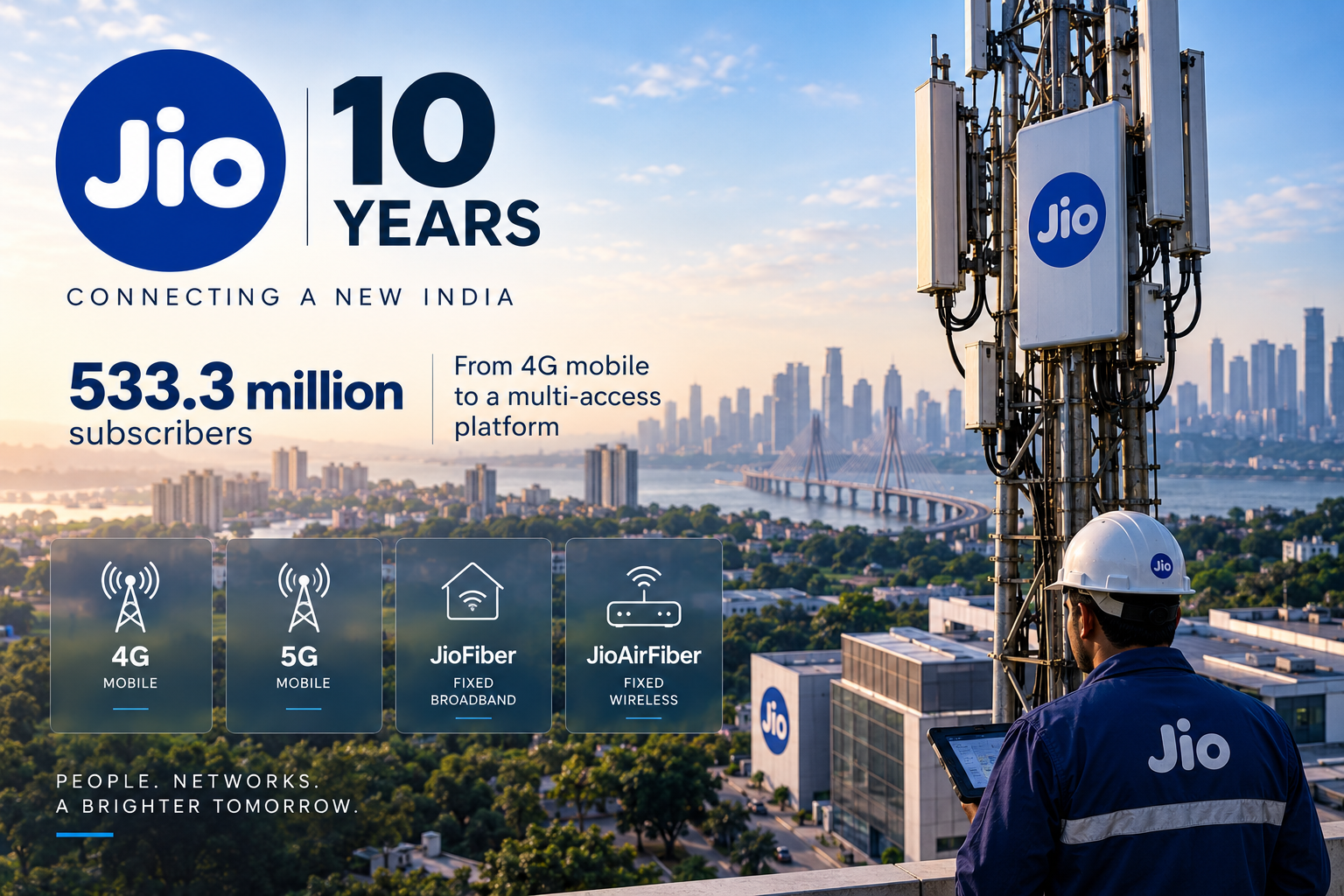
- Jio has grown from a 4G mobile launch into an operator offering 5G, JioFiber, and JioAirFiber alongside its original mobile service
- With 533.3 million subscribers, the next measure is how much growth comes from fixed, enterprise and other services rather than mobile additions alone
The fact
Reliance Jio marked ten years since its commercial launch on 5 September. TelecomTalk's anniversary review put the operator's subscriber base at 533.3 million. Jio entered the Indian market as a 4G mobile operator. Over the following decade, it added 5G alongside fixed services including JioFiber and JioAirFiber, taking the business beyond the mobile network on which it was launched.
Financial reporting around the anniversary describes Jio as entering a period in which making more money from its existing scale is becoming more important than the rapid subscriber acquisition that defined its early years. The anniversary is not a new network launch, but it provides a clear point at which to compare Jio's original 4G business with the mix of mobile, fibre and fixed-wireless services it operates today.
The assessment
Jio's first decade was largely measured by how quickly it could add mobile users. With 533.3 million subscribers and fixed services now sitting alongside 4G and 5G, that number tells less of the story on its own. The different access products also require different network work. JioFiber needs fibre to reach a premises, while JioAirFiber reaches customers over a wireless connection. Mobile services have their own radio capacity requirements. Jio therefore does not build or support every new connection in the same way.
For BTW readers, Jio's 533.3 million subscribers are now only part of the picture. Mobile, fibre and fixed wireless customers place different demands on the network and require different levels of investment. Following where new customers are added, and what Jio spends to support them, will show how the company is using the network it has built.
What to watch
Watch Jio's reporting on JioFiber and JioAirFiber additions, 5G usage, and enterprise growth alongside network capital spending. The useful comparison will be whether fixed services take a larger share of growth and how much investment is required to support them, rather than another increase in the headline subscriber total.
Member Briefing
Deeper Profile Context
Sign in with the right membership level to unlock the full briefing and source notes.
Only for Strategic Circle
Strategic Circle
Open to all readers. Unlock profile briefings after joining and signing in.
Join Strategic CircleOnly for Leadership Alliance
Leadership Alliance
For qualified IP-asset owners and management; sign in to unlock alliance briefings.
Join Leadership Alliance