Summary
- IUMA accepted a cassette or CD, artwork and an introduction, then prepared the package for Internet distribution.
- Its December 1993 notice also offered an incoming directory for musicians able to compress their own audio; donors received priority in the human queue.
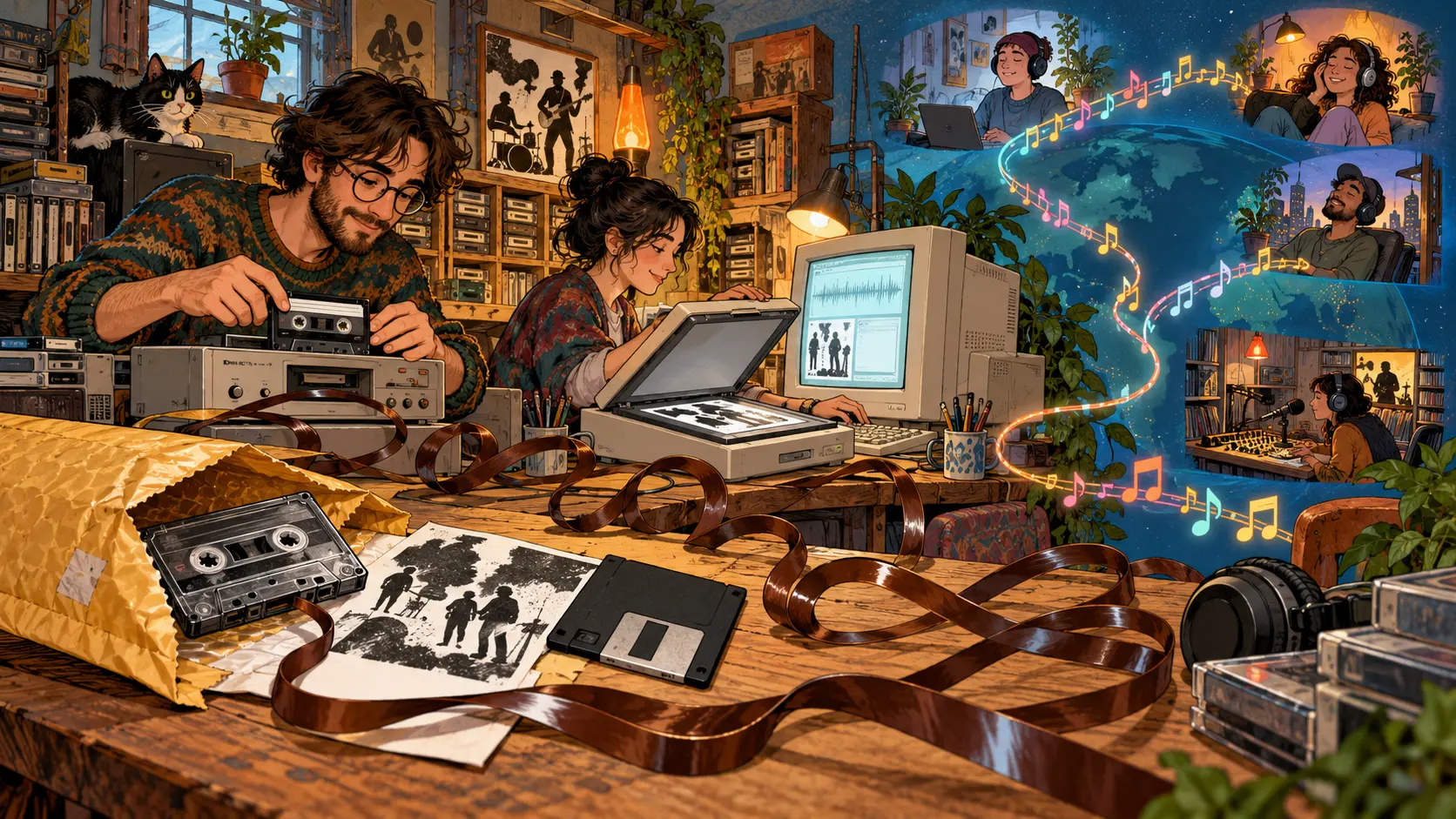
To put your band on the Internet in late 1993, one available method involved finding an envelope. The Internet Underground Music Archive, or IUMA, would accept a cassette or compact disc, a piece of artwork and a short introduction. The band supplied the music. Somebody at the other end supplied the afternoon.
IUMA's submission notice dated 14 December 1993, reposted by Robert Daniel Lord the following January, makes that division of labour wonderfully visible. Signed by Robert Lord and Jeff Patterson, it described a service distributing MPEG-compressed music since November. Listeners could reach its collection through FTP or Gopher at SunSITE, hosted at the University of North Carolina.
Please identify the song
The specification allowed five minutes of audio and asked for one chosen recording. A band sending a tape with several tracks had to say which one to digitize. It could give recording instructions, including mono playback or noise reduction, and ask to be emailed when the song was online.
Artwork had its own physical limit: one US letter-sized sheet. High contrast would help the scanner; black and white would produce a smaller file. A PC-compatible disk carrying an image was another option. The cover had to survive both a scanner and somebody else's connection.
The written introduction could occupy two sides of letter paper. It was supposed to help a stranger decide whether to fetch the music, offer contact details and perhaps advertise a full demo tape. Contributors could save the archive some typing by sending text on disk. Those using handwriting were asked to make it legible. The future of music distribution had acquired a small proofreading department.
These were practical instructions for turning an existing band package into network material. The archive would digitize and compress the recording, scan the image and type the words. Its notice estimated about an hour to process, upload and archive a song with its accompanying artwork and text.
Two ways into the collection
The postal route sat beside a more direct one. Musicians already able to convert their audio could send it to an incoming directory. IUMA required MPEG compression first and encouraged the same submission format. One route gave the preparation work to the archive; the other let the contributor do it.
Payment was not required under the December notice, but donations were welcome. Donors received first priority, and the project suggested US$20 against its estimated hour of work. A free submission service still had a queue, people to do the conversion and a published rule for who moved ahead.
By 15 September 1994, partner Jon Luini reported music from more than 220 indie or unsigned bands online. He named three partners—Rob Lord, Jeff Patterson and himself—and about seven volunteers working daily. That is a dated account of the people keeping the service running, alongside the files it offered.
The December instructions also covered the journey home. Anyone wanting submitted material returned had to enclose a prepaid protective envelope. A musician could even send a blank tape to receive the digitized song back on cassette. IUMA was carrying recordings across the boundary in both directions. The tape deck had work left to do.
Member Briefing
Deeper Profile Context
Sign in with the right membership level to unlock the full briefing and source notes.
Only for Strategic Circle
Strategic Circle
Open to all readers. Unlock profile briefings after joining and signing in.
Join Strategic CircleOnly for Leadership Alliance
Leadership Alliance
For qualified IP-asset owners and management; sign in to unlock alliance briefings.
Join Leadership Alliance