
Summary
- ICRC opened a family-contact website on 19 May 1999, with computers and staff assistance in offices serving people displaced by the Balkans crisis.
- Its May 2001 guide assigned destination offices the work of checking, printing and delivering electronic family messages. Active searches for relatives required a separate tracing request.
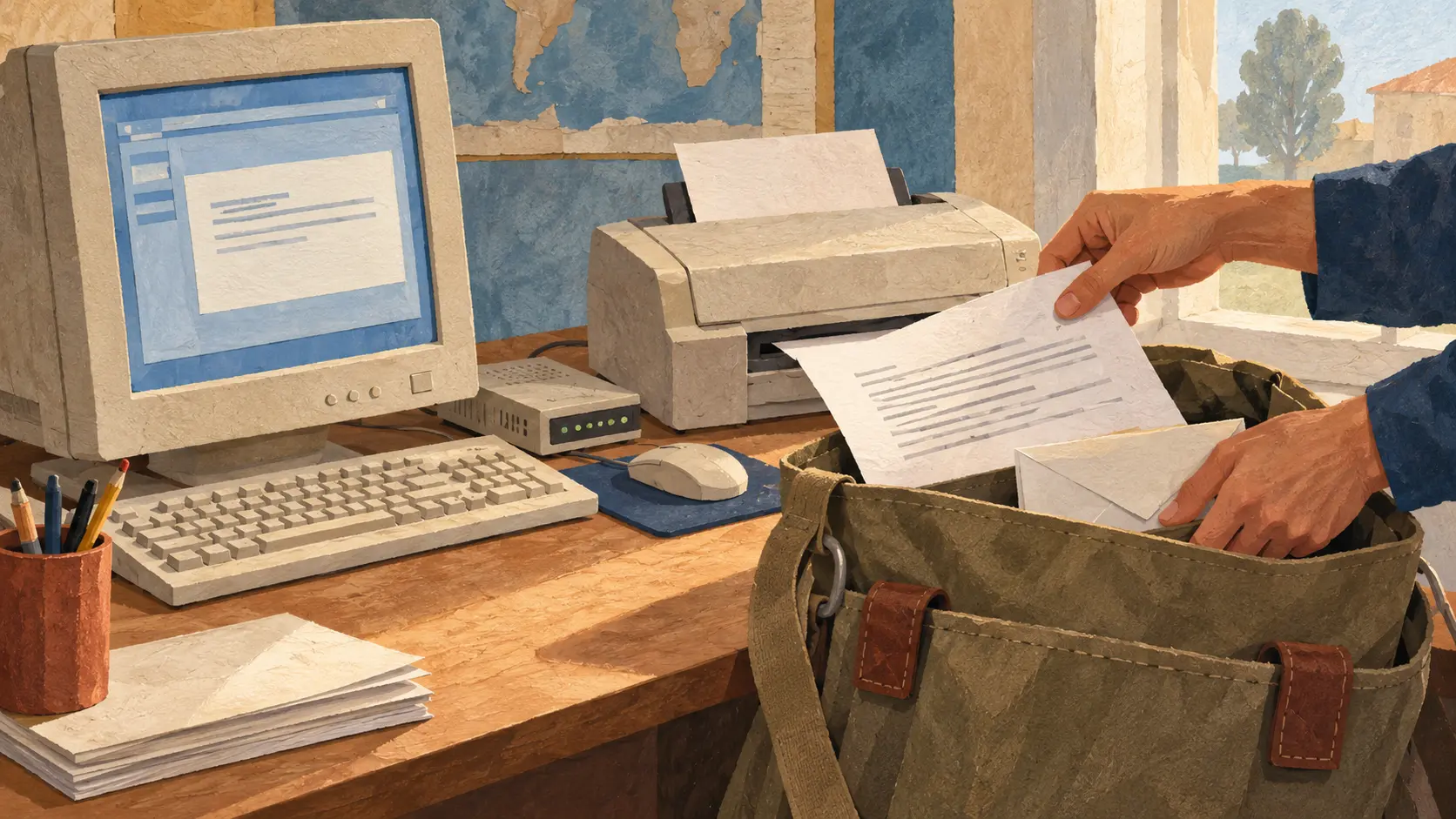
For an electronic family message, reaching a computer could be the easy part. The person waiting for news might be somewhere else entirely. ICRC's instructions gave the receiving office three plain jobs: check the contents, print the message and distribute it. The paperless future had found a use for paper.
The route began with a much more urgent problem than office modernisation. Families separated by the Balkans crisis needed a way to find one another. On 19 May 1999, a joint Red Cross and Red Crescent report announced that ICRC was opening a special website for restoring contact. Anyone with an internet-connected computer could reach it. For people who lacked one, the organisation had installed computers and modems in its offices in Albania, Macedonia, the Federal Republic of Yugoslavia and Bosnia-Herzegovina. Staff would help people use them. National Society offices in countries receiving refugees also offered the service.
That arrangement made an important accommodation: access could begin at a desk shared with someone who knew how the system worked. Owning a computer was unnecessary. Nor did both relatives have to arrive at the same office, in the same country, or at the same time. A person could leave a name and contact details for another person to find later.
Publishing names already had a history. In an account published in 2013, ICRC staff Olivier Dubois, Katharine Marshall and Siobhan Sparkes McNamara traced online missing-person lists to 1996. They described the 1999 addition of self-registration: people could enter details of relatives they sought or register themselves as safe and well. The visitor had gained a way to contribute information, as well as consult it.
The May 2001 guide for National Societies shows the choices this opened. Users could look through names, register their current whereabouts, or leave their own address in the hope that the relative they were seeking would come looking. They could also submit an electronic family message even if its recipient had no entry on the website. That last option mattered: the service could carry news towards someone who had never registered online.
Here the journey changed transport. Under the 2001 instructions, the destination National Society or office checked that the message contained family news and excluded political, military or discriminatory material. A direct web submission gave the office in the sender's country no opportunity to perform that check. Responsibility therefore travelled with the message to the receiving side, which was also told to print and distribute it. Published registration details were visible on the website; the electronic messages themselves could not be read there.
The guide's preparations were correspondingly mundane: computers, a dedicated email address for the tracing service, staff training and publicity so people would know where to go. These were the working parts of an international service. A web address without an attended inbox at the other end would have left the family message with nowhere useful to land.
ICRC's January 2003 account described the same passage from the website to an office that checked and delivered the message. It also named the obstacles to reaching people: logistics, insecurity, restrictions by authorities and populations repeatedly moving out of danger. Those problems belonged to the delivery route, however quickly the electronic part travelled.
The launch report kept older routes open too. People unable to use the electronic service could still turn to Red Cross messages or radio broadcasts. And a family wanting an active investigation had a separate step to take: submit a tracing request. Self-registration supplied a place where relatives could find information for themselves.
This was a web service designed around people who might never meet online. It let one end of a family conversation enter through a browser and the other receive a delivered message. The ambitious part was joining those ends together. The printer had a perfectly respectable place in that ambition.
Member Briefing
Deeper Profile Context
Sign in with the right membership level to unlock the full briefing and source notes.
Only for Strategic Circle
Strategic Circle
Open to all readers. Unlock profile briefings after joining and signing in.
Join Strategic CircleOnly for Leadership Alliance
Leadership Alliance
For qualified IP-asset owners and management; sign in to unlock alliance briefings.
Join Leadership Alliance