
Policy continuity, legitimacy, and accountability signals across internet governance institutions.
Governance
Governance
Internet governance intelligence tracks institutions, policy processes, standards activity, registry operations, accountability disputes, and implementation signals that affect internet infrastructure. BTW.
RIR WatchdogCase FileNumber Resource SocietyICANNIETFHistory of InternetNOGs

RIR Watchdog, Case File, NRS, ICANN, IETF, History of Internet, and NOG sessions.
Coverage prioritizes implementation evidence and institutional behavior over declarative positions.
Latest Coverage
Latest from Governance
7,444 articles

History
One Registry, Three Desks: APNIC’s Distributed Operations, 1993–94
APNIC’s early regional service was built across national network centres. Contemporary records show its address, information and DNS work being divided among JPNIC, KRNIC and AUNIC while a wider group coordinated remotely.

CASE FILE
CRTC sets three mobile-coverage levels, but the public map stays coarser
The CRTC has given mobile providers three common signal thresholds, while keeping two different levels of detail in the pipeline: submissions at 50 metres or finer and public maps at 250-metre road segments. The first reporting round is also staged, starting with Level 1 in early…

History
Two Links to the US, No Local Route: Chile’s Internet Split, 1992–93
In 1992, Chile had two international Internet links but no local interconnection between their networks. A contemporaneous account shows how disagreement over control and cost-sharing reached all the way into the path a Santiago packet took.

History
A Data Link, Not a Voice Call: NCS and Ghana’s 1995–96 Internet Gateway
In a September 1995 memo, Network Computer Systems said its Internet service carried data rather than voice and therefore incurred no fees payable to Ghana Telecom. The claim sat beside a practical limit: NCS’s satellite path reached a provider in London, while local access…

History
BARRNet's OSPF Routes Took an Extra Hop Before the Protocol Changed
A 1991 field report traced two OSPFv2 features to one regional network’s practical limits: its imported routes needed a better next hop, while some routers lacked room for every external route.

Story
RIPE NCC’s new risk register starts with the whole organisation
A top-down view of high-impact risks changes where the discussion begins; the September Board minutes tie some treatments to the right budget.

History
A 64-Kilobit Link Was Not the Whole Network: Turkey’s TR-NET to TURNET, 1992–96
Turkey’s Internet history is often compressed into one date: 12 April 1993, when a 64 kbps leased line connected Middle East Technical University (ODTÜ/METU) to NSFNET in Washington. That line mattered. It was not, by itself, a national access system. The harder story is how…

History
At the Router, Membership Became a Route: CIX's 1994 Filter
In 1994, a shared router made it easy for CIX members to exchange traffic without a per-byte bill. Then the association tied route advertisement at that router to a US$7,500 annual membership—and pointed providers toward private links that could carry the exchange elsewhere.
History
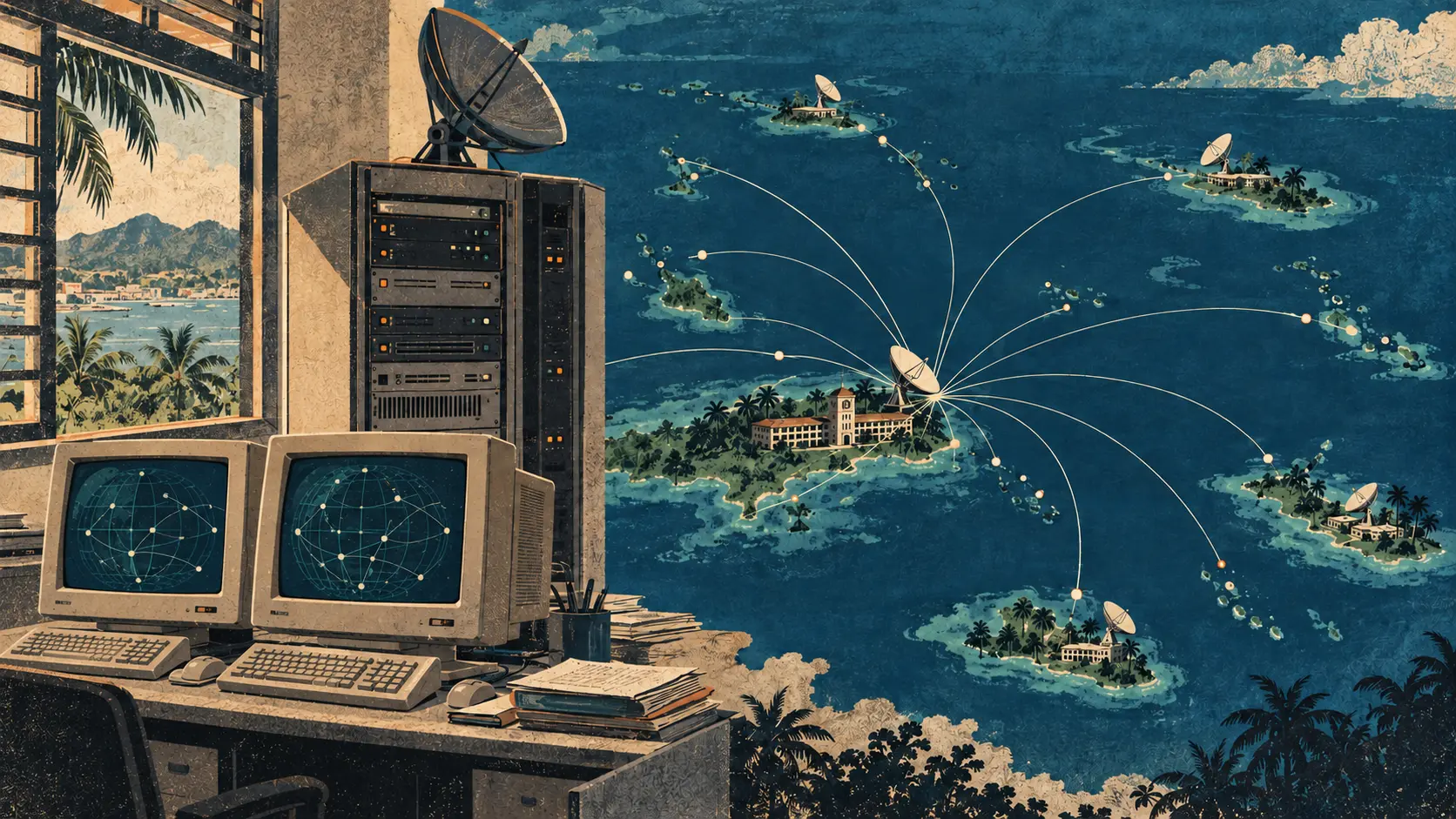
One Gateway in Suva, Many Permissions Across the Pacific: USPNet’s 1995 Internet Plan
The University of the South Pacific had reached the internet over a 2.4 kbps leased line by November 1994. A year later, its upgrade proposal imagined a faster Suva gateway for campuses scattered across the Pacific, but the local stations and permissions that would make that hub…

History
The Dish Had a Lender; the Circuit Had a Sponsor: Mongolia’s Internet Bargain, 1996
Mongolia’s first permanent Internet route was built with two different kinds of money: a local revolving loan for the satellite equipment and a proposed outside subsidy for the monthly circuit. The distinction explains both how the gateway became possible and why a working…

Story
WorldLink’s APNIC /32 Scaled; DHCPv6 Still Held the Session
WorldLink’s account of more than one million IPv6-enabled IPoE subscribers includes an outage loop in which DHCPv6 lease recovery and a broadband gateway’s binding behavior could affect the shared session. The figures describe different things; none is an independent…

CASE FILE
BEREC Draft Maps Uneven Oversight of State-Funded Fibre Access
A BEREC consultation maps how national regulators review wholesale products, prices and reference offers for publicly supported fibre networks. A separate GBER proposal keeps fair-access language but could remove detailed price benchmarks from the Regulation, leaving the…

History
The Message Was Online by Schedule: Nepal’s Early Internet, 1993–95
Nepal exchanged scientific email through a scheduled cross-border relay before commercial providers established a continuously online international IP link. The dates and early upstream paths do not line up in every account.

History
Uganda’s First Full IP Link Was a Kampala Gateway
Uganda’s 1995 Internet milestone began with an international satellite route, but the first full-IP service still entered users through a Kampala provider. The distinction matters: a new path to the global network was not yet a national access network.

History
The Research Network That Became an ISP: Singapore’s TechNet Handoff, 1995
Singapore’s Internet did not move from campus experiment to household service in one launch. TechNet first connected research institutions; SingNet opened a public-facing commercial service in 1994. A year later, TechNet itself crossed into private operation, carrying an…

Story
CEDIA’s FIRST Talk Leaves Critical CSIRT Decisions With People
At the LACNIC 46 co-located symposium, a 21 October session will describe DALIA’s AI-assisted triage and correlation while reserving critical decisions and containment for people. The abstract does not say how that boundary is enforced.

History
The 32 Kbps Link That Challenged Kenya’s Telecom Monopoly
Kenyan organisations had exchanged email for years, but those services were not yet the full Internet connection later histories describe. In October 1995, the African Regional Centre for Computing put a 32 Kbps leased link to the United Kingdom into service. The connection…

History
Two Links to Stockholm, One Missing at Home: Estonia’s 1992 Internet
A 64 kbps satellite link brought TCP/IP from Tallinn to Stockholm in 1992. A second link served Tartu. The striking part of the story is what did not yet connect the two Estonian cities.
History
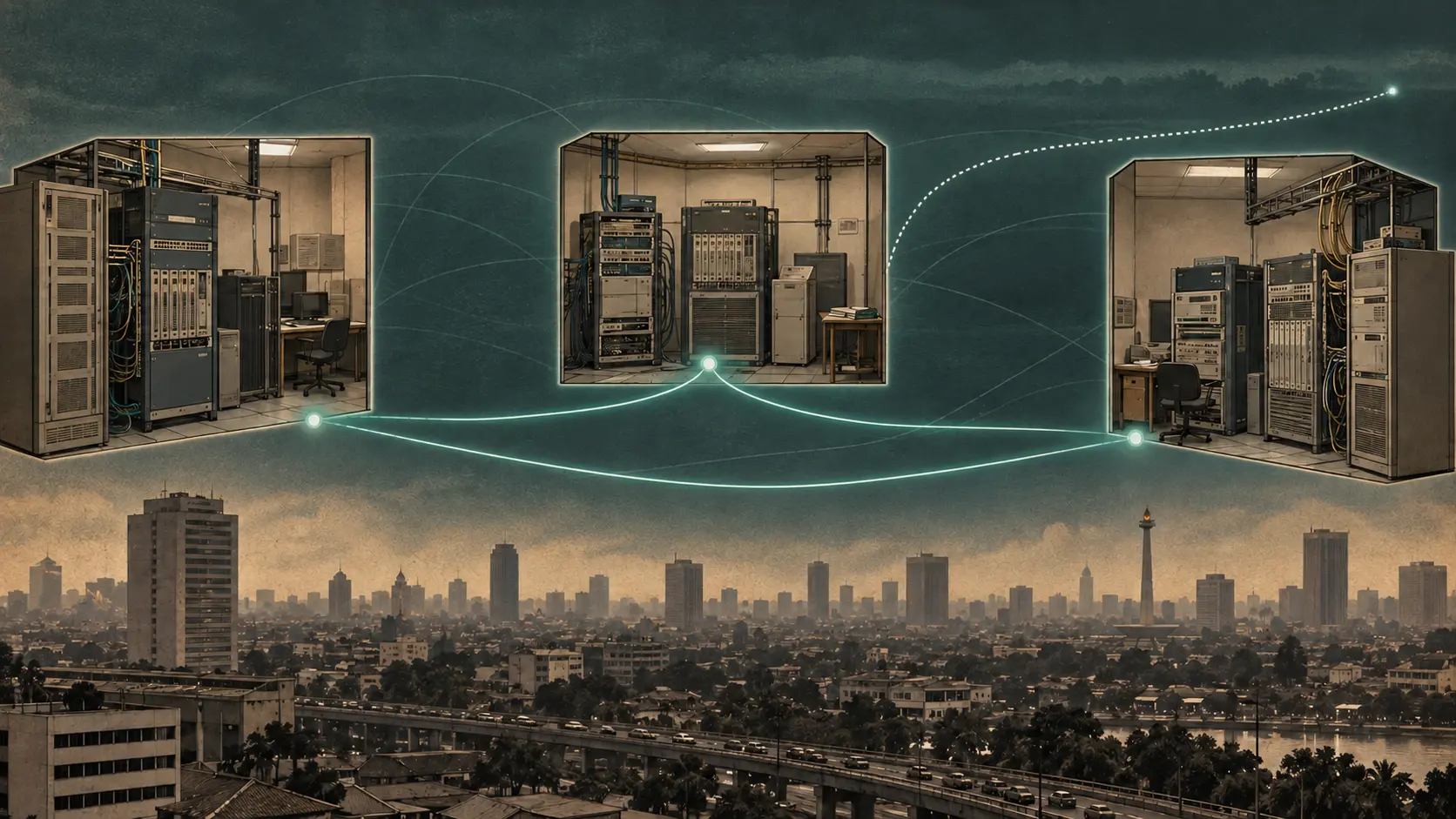
Local Traffic Had to Cross Borders: Indonesia’s 1997 Internet Exchange
In 1997, Indonesian network operators faced an odd routing fact: a message between two users in the same country could depend on international links. APJII’s answer was not one national backbone, but a federation of three carrier-hosted exchange sites where providers could meet…

History
35 of 124 Municipalities: Buenos Aires Rebuilt Government Links with TCP/IP
A provincial decree made one satellite message service the official route for government communications. The project team’s later account shows how narrow that route was, and how a new IP network grew over the carrier links already in place.
Session Map
Governance Branch
RIR Watchdog
Five regional sessions tracking allocation policy, board legitimacy, and institutional continuity.
Open RIR WatchdogCase File
Long-cycle governance dossiers with legal, election, and institutional stress analysis.
Open Case FileNumber Resource Society
Membership, charter, and resource-governance intelligence from the NRS ecosystem.
Open NRS SessionICANN
DNS coordination, accountability frameworks, and global multi-stakeholder process dynamics.
Open ICANN SessionIETF
Protocol standardization trajectory and interoperability risk under fragmented policy conditions.
Open IETF SessionHistory of Internet
Long-cycle infrastructure history used for governance interpretation and structural forecasting.
Open History SessionNOGs
Operator-level implementation intelligence from APRICOT plus regional and national NOG ecosystems.
Open NOGs Session