
Summary
- USP’s 1995 proposal was an upgrade and regional extension, not the university’s first internet connection: ITU dates a direct 2.4 kbps link to November 1994.
- The five-year path to 1997 concerned approval for earth stations in every member country; it should not be mistaken for a five-year delay to the Suva internet gateway.
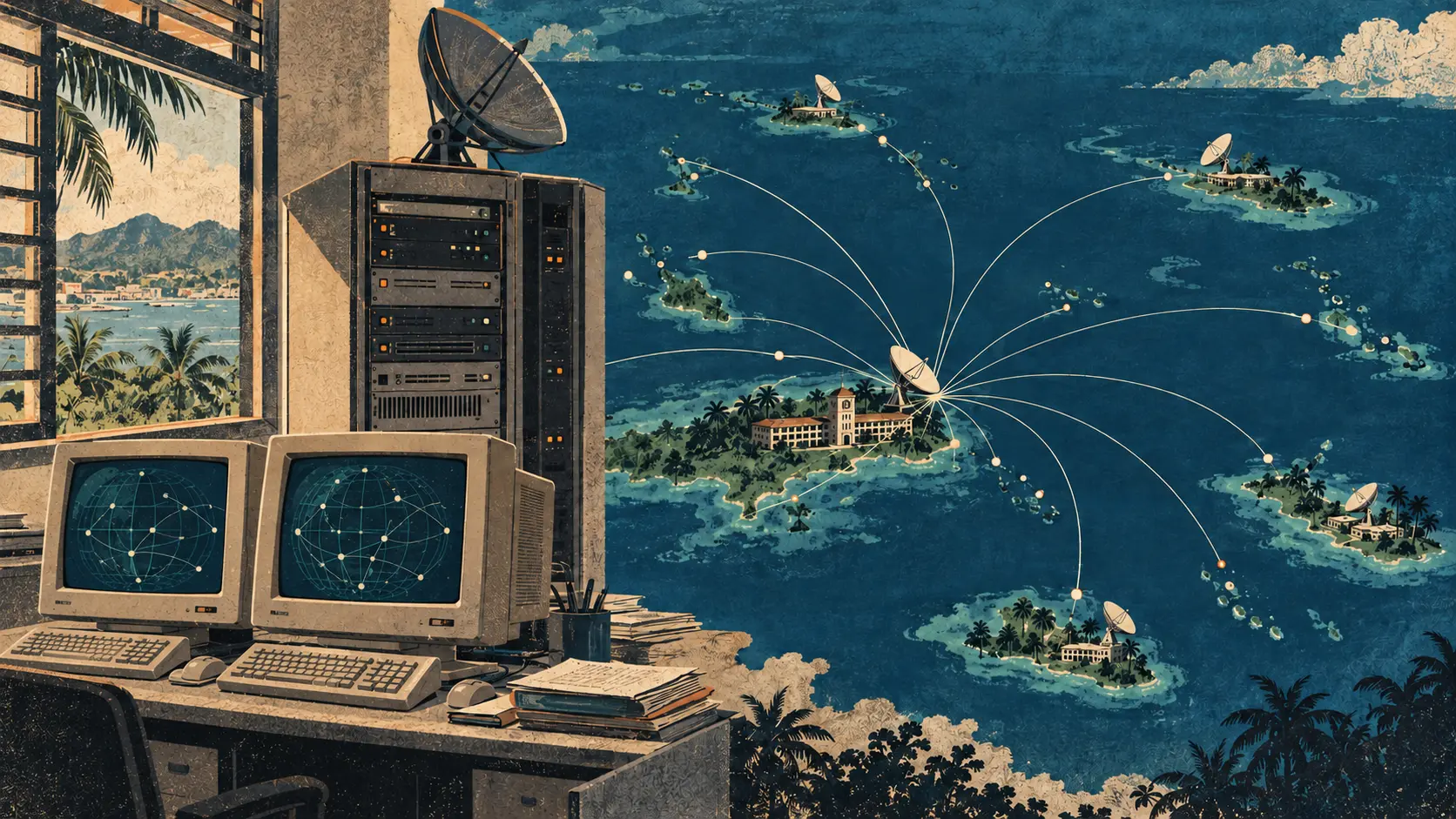
The map of USPNet in 1995 had two different centres of gravity. Internet traffic could be gathered at the University of the South Pacific’s main campus in Suva. The permissions and equipment needed to reach its other campuses could not. That distinction is the useful history in USP’s 1995 upgrade proposal: one gateway could centralise an international connection, but it could not make a regional network jurisdictionally central.
USPNet had begun in 1973 as a distance-education system for students who could not afford the cost of travelling to Suva. NASA’s experimental PEACESAT satellite carried teaching broadcasts, with terminals in member countries. When PEACESAT went off course in 1985, the university shifted to INTELSAT space in 1986. Cable and Wireless Public Ltd in Hong Kong later covered satellite-space costs in successive two-year periods, through 1994, while USP was expected to build a more self-reliant arrangement. The network’s first constraint was not a lack of purpose; it was the recurring cost and ownership of the communications path.
By the early 1990s, links were a patchwork. The ADB’s later case study says national telecom agencies supplied earth-station routes in five of USP’s eleven other member countries. Kiribati was disconnected after talks with its telecommunications authority failed to reduce high charges. Authorities described some access as subsidised, but licenses restricted facilities to educational use and regulators were wary of a university network operating beyond their jurisdiction, partly because it might compete with national monopolies. This was a network built across sovereign operating boundaries, even when its users belonged to one university.
The chronology also resists a single “first internet” date. The International Telecommunication Union’s 2004 Fiji case study dates USP’s first direct internet connection to November 1994: a satellite connection over a 2,400-bps leased line to Australia. That was already internet connectivity, but at a capacity that should not be confused with a high-speed campus network. USP’s June 1995 proposal sought something broader. It proposed earth stations and private-branch-exchange connections at each university centre so staff could call across the member countries at local rates.
For internet access, it proposed a faster central connection at the main Suva campus, serving all sites. Satellite, internet and telephony permissions were all required.
Those were separate legal and technical surfaces. A national authority could control whether a satellite terminal operated within its territory, what traffic it carried and how its local telephone network was interconnected. The university could design a common system and negotiate educational rates, but it did not hold all the permissions in one place. A Suva gateway might simplify upstream capacity; it could not grant the remote earth-station licenses on its own.
One earlier proposal shows the difference between approval in principle and deployment across countries. In 1992, the USP Council approved a network of satellite earth stations in every member country and instructed the university to seek permission from the appropriate authority in each. The ADB study says this proposal took five years, until 1997, to take effect. That interval is evidence of a distributed licensing path for earth stations. It is not evidence that USP waited five years to connect to the internet, nor does the case study say that permits alone caused the delay.
The 1995 upgrade proposal itself produced no decision. The ADB account says the proposal was overtaken by improved video transmission and falling bandwidth costs. In July 1997, Fiji asked Japan to help build a standalone private VSAT system. That design prioritised video teaching from Suva, Port Vila and Apia, with other centres receiving video and using two-way voice and data. It was a different response to the same geography: instead of extending only an internet gateway, build a university communications system around satellite links and teaching requirements.
Fiji’s public internet service was developing alongside USPNet, but accounts describe different circuits and milestones. ITU lists a Telecom Fiji 64-kbps satellite trial to New Zealand in November 1995 and commercial service in May 1996. A JICA-hosted report describes the Pacific Forum Secretariat using a free 64-kbps circuit via New Zealand Telecom to demonstrate faster internet at a Suva conference in 1995. Telecom Fiji engineer Ilaitia Tuisawau later recalled a six-month commercial pilot around December 1995 using a 64-kbps link through Waikato University.
These may describe connected experiments in the same small market, but the available accounts do not establish that they were one circuit or one launch event.
The Suva-centred idea did not disappear. The ADB study records that a 2005 enhancement proposal was accepted for an IP platform at a Suva hub with eleven other centres. That later plan suggests the hub remained an attractive way to pool capacity. It does not prove the 1995 proposal was implemented unchanged.
The record leaves basic measures open: it does not provide the 1995 proposal itself, country-by-country license files, usage levels, complete operating costs, circuit logs or service commitments. What it does show is the control problem. A central gateway can concentrate traffic management and international bandwidth, while permissions, local links, power, maintenance and recurrent costs remain dispersed. Calling the arrangement simply “a network” hides who could authorize each connection and who had to keep it running.
Sources
Member Briefing
Deeper Profile Context
Sign in with the right membership level to unlock the full briefing and source notes.
Only for Strategic Circle
Strategic Circle
Open to all readers. Unlock profile briefings after joining and signing in.
Join Strategic CircleOnly for Leadership Alliance
Leadership Alliance
For qualified IP-asset owners and management; sign in to unlock alliance briefings.
Join Leadership Alliance