
Policy continuity, legitimacy, and accountability signals across internet governance institutions.
Governance
Governance
Internet governance intelligence tracks institutions, policy processes, standards activity, registry operations, accountability disputes, and implementation signals that affect internet infrastructure. BTW.
RIR WatchdogCase FileNumber Resource SocietyICANNIETFHistory of InternetNOGs

RIR Watchdog, Case File, NRS, ICANN, IETF, History of Internet, and NOG sessions.
Coverage prioritizes implementation evidence and institutional behavior over declarative positions.
Latest Coverage
Latest from Governance
7,436 articles

History
The Pacific Circuit Was Only One Leg: TransPAC’s 1998 Link to Asia
The first TransPAC connection did not turn a Pacific cable into a ready-made Internet for every university on either shore. It joined several separately operated layers: an Asia-Pacific research network, carrier infrastructure, a Chicago exchange point and the U.S. research…

History
A Global Voice by Unanimity: The RIRs’ 2003 NRO Compact
Four regional registries created a way to act together without merging their operations. The 2003 NRO memorandum made shared representation depend on delegated authority and unanimous commitments; in 2004, a separate agreement placed the NRO inside ICANN’s address-policy process…

NANOG
Packets Reached CERN; Many Questions Did Not: NANOG 1 and the MBONE, 1994
In June 1994, organizers planned to multicast NANOG’s Ann Arbor meeting over the MBONE. The archive preserves three different kinds of evidence: one person could not find the session, another asked for a steadier view of the screen, and a listener at CERN reported no packet loss…

CASE FILE
A weather-data test belongs inside St Brandon’s universal-service deal
Mauritius’s two-year, USF-funded internet contract for Raphael Island is presented as a connectivity project. Its harder public test is whether the service helps restore a usable weather-observation chain and whether the regulator reports how it measures that result.

History
A Mailbox, a Route and a Country Code: Kazakhstan’s Internet, 1991–96
Kazakhstan’s early network story has several dates that are each defensible when attached to the right layer. A mail node, a persistent Internet route, a root-zone delegation and a commercial service did not arrive at the same moment.

History
The Backbone Had a Closing Date, Not a Single Switch: NSFNET, 1995
NSFNET’s backbone service ended on a date fixed in advance. The network’s own termination notice shows why that date should not be mistaken for a single nationwide cutover: many users already relied on another network for their primary path.

History
Beyond the Islands, Still Through the Hub: ALOHA’s 1971–74 Satellite Experiment
ALOHAnet began as an answer to a local problem: how could terminals scattered across Hawaiian islands reach computing resources without giving every terminal a permanent circuit? By 1974, the project was testing a second answer. A NASA satellite could carry bursts between distant…

Story
RIPE’s first-ASN draft defers the route-policy record until use
RIPE’s first-ASN draft defers the route-policy record until use intelligence summary explains the development, the public evidence available to readers, the organisations involved, the regional context, market exposure, and the infrastructure consequences that may follow. The…

Story
AFRINIC’s Dashboard Draft Needs a Versioned Policy-to-Test Map
The 25 September revision treats automated checks as possible indicators and requires staff to verify what a test found. That boundary matters only if members and reviewers can trace each alert to the exact policy version, input record and test that produced it.

History
The Registry Could Draft a Filter; Operators Still Had to Apply It: RIPE, 1993–95
In 1993, RIPE proposed making routing policy legible to databases and tools. A tiny pilot could turn records into access lists; the records still did not show what a network had put into operation.

History
From Crawl to Public Search: How the Internet Archive Opened the Wayback Machine
The Internet Archive began its first web crawls in October 1996. Five years later, it opened the Wayback Machine as a public service for searching dated versions of the larger collection. Between those milestones, selected project pages were already online; what changed in 2001…

History
Who Could Add a Name? Britain’s Manual .uk Registry, 1985–96
Before Nominet, adding a British domain name depended on a volunteer-run naming process. The 1996 handover put the growing register, its operating rules and its member structure into a dedicated institution.

Story
The LACNIC Board ballot is set for November. Its English call says October.
LACNIC’s election index and dated timelines put the 2026 Board vote on 3–10 November. One English field in the detailed call instead says voting opens a month earlier; the Spanish call gives the November date.

History
KIXP Went Local, Then Closed: Kenya’s Internet Exchange, 2000–02
Kenya’s first Internet exchange began carrying local traffic in November 2000, then was ordered shut a month later. Its 2002 return shows how a simple peering function depended on permission and access to the incumbent’s underlying lines.

Story
RIPE Atlas Said Authentication Was Back; It Closed the Incident the Next Morning
On 29 September 2026, RIPE NCC Status said that both RIPE Access and API-key authentication for RIPE Atlas were failing. Nine minutes later, it reported a rollback and apparent recovery; the incident was not marked resolved until the next morning. Those are two different clocks…
History
Before the Famous Three-Network Test, TCP Crossed Two Networks
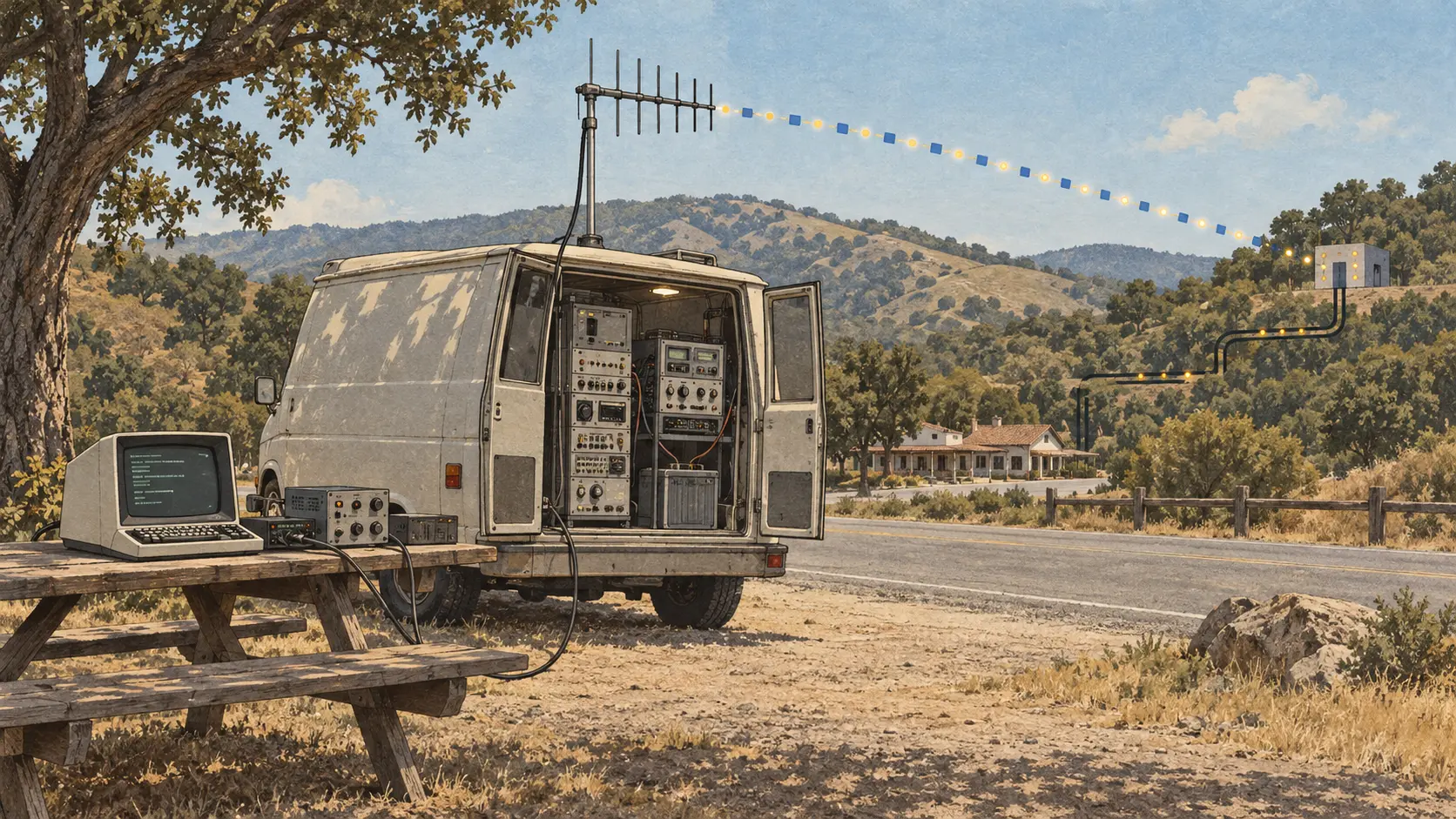
In August 1976, an SRI packet-radio van linked a radio network to the wired ARPANET. It was a bounded field test, a year before the celebrated transcontinental demonstration involving three dissimilar networks—and a different milestone from the later adoption of Internet…

History
When Internet Access Stopped Requiring Membership: NLnet’s 1993 Change
In July 1993, NLnet stopped requiring its subscribers to belong to the Dutch Unix users’ association. Six months later, membership returned as a discount. The annual reports show how that small change sat inside a service scaling faster than its original community could…

History
From FidoNet to SprintLink: Ethiopia’s First Internet Gateway, 1996–97
Ethiopia’s first visible route to a telecom host, the operator’s 256 kb/s gateway description, and the public-service announcement arrived on three different dates. Treating them as one “launch” hides the change from community email networks to a centrally operated full-IP…

Story
ARIN’s space-address draft still needs a global allocator
ARIN has a draft for allocating addresses to networks beyond Earth orbit, but the document leaves a prior question open: who would supply the address block, and who would be authorized to distribute it? The answer sits across IETF, IANA, the RIRs and ARIN’s own board, not in one…

History
The First .com Came Four Years Before the Web
The first .com entered the naming system in 1985, four years before Tim Berners-Lee’s first Web proposal. The dates mark separate layers: domain administration and hypertext.
Session Map
Governance Branch
RIR Watchdog
Five regional sessions tracking allocation policy, board legitimacy, and institutional continuity.
Open RIR WatchdogCase File
Long-cycle governance dossiers with legal, election, and institutional stress analysis.
Open Case FileNumber Resource Society
Membership, charter, and resource-governance intelligence from the NRS ecosystem.
Open NRS SessionICANN
DNS coordination, accountability frameworks, and global multi-stakeholder process dynamics.
Open ICANN SessionIETF
Protocol standardization trajectory and interoperability risk under fragmented policy conditions.
Open IETF SessionHistory of Internet
Long-cycle infrastructure history used for governance interpretation and structural forecasting.
Open History SessionNOGs
Operator-level implementation intelligence from APRICOT plus regional and national NOG ecosystems.
Open NOGs Session