
Summary
- The May agenda for NANOG 1 said the June 2–3 meeting in Ann Arbor was planned for MBONE broadcast.
- June mailing-list posts record different experiences: a missing session at one site, a request to keep the camera on the presentation screen, and a CERN report of clean packet reception but inaudible questions.
- Those messages show why multicast delivery, finding a session and hearing the room must be treated as separate parts of a live media service; they do not establish overall attendance or an event-wide success rate.
A broadcast plan became an operating question
The first NANOG meeting was set for June 2 and 3, 1994, in Ann Arbor, Michigan. A May 26 agenda on the NANOG list said the organizers were planning to broadcast it over the MBONE. That same agenda put network operations at the centre of the programme: participants were to discuss attaching to network access points (NAPs), the services and operations of those exchange points, routing at an ATM testbed, route-server management, the PRDB and routing registries.
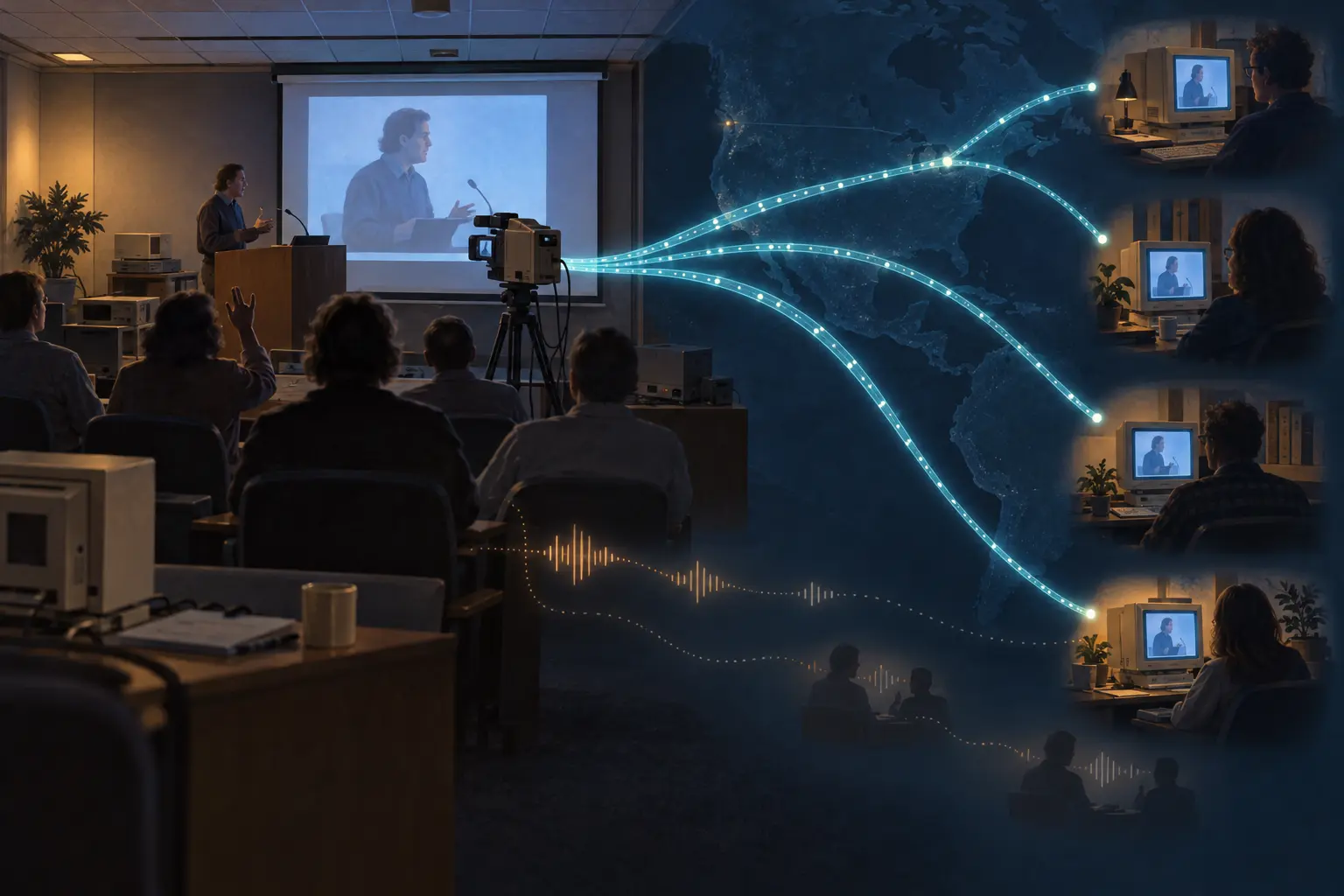
The contrast is useful. The meeting was about how provider networks connected and operated. Its broadcast had to cross those networks too. The stream was not merely a record of the gathering; it was another service path whose reach depended on session information, multicast forwarding and media captured in the room.
The June archive does not tell one continuous story of the stream. It preserves separate reports. On June 2, Dave Sincoskie asked whether the meeting was being sent over MBONE. He wrote that he had expected to attend but could not see a session being transmitted. In another June 2 post, Hans-Werner asked the camera operator to point at the screen instead of the speaker and keep the shot steady. The next day, Olivier Martin reported from CERN that no packet had been lost there, but many questions could not be heard.
These are not three measurements of the same receiver or one diagnosed fault. Sincoskie’s note records difficulty finding a session; Hans-Werner’s records a viewer’s request about framing; Martin’s distinguishes packet reception from the intelligibility of questions. The archive does not identify the exact application, the room’s microphone arrangement or the cause of any of these experiences.
Multicast moved one stream to a group, conditionally
The technical attraction of IP multicast was that a sender could address a host group instead of opening a separate copy of a stream for every listener. RFC 1112, published in 1989, describes host-group membership as dynamic and places inter-network forwarding with multicast routers. It also defines delivery as best effort: datagrams are not guaranteed to arrive intact or in the same order. “Multicast” therefore does not mean that every Internet-connected host automatically receives a programme.
That limitation mattered in 1994. RFC 1633, published in June of that year, describes audio and video multicasts of IETF meetings as large-scale Internet experiments. It says IP multicast was not generally available in commercial routers and that the temporary MBONE multicast backbone was providing it. The same document identifies variable queueing delay and congestion loss as problems for real-time applications. It is a contemporaneous account of the environment, not a postmortem of NANOG’s particular feed.
A receiver also needed to know which session to join and to have a local path that could receive the group traffic. Sincoskie’s message does not reveal whether the obstacle was a missing announcement, a local configuration, multicast reachability or another issue. It only establishes that, from his vantage point, he could not find the session he expected.
The media path did not end at the router
A meeting broadcast had a second chain after packets left the room: camera position, screen visibility, microphone pickup, any mixing or encoding, and the receiver’s ability to render the result. The request to show the screen rather than the speaker points to a practical choice about what remote viewers could see. Martin’s note from CERN points to another distinction: packet reception could be clean while questions from the room remained difficult to hear.
The messages do not prove that the broadcast was designed for two-way participation. The May agenda promises a broadcast, not a remote microphone, a question queue or a right to intervene. Nor do the posts establish whether questions were asked off-mic, whether the camera view changed, or whether anyone later corrected the mix. They are useful precisely because they preserve bounded observations without supplying a complete production log.
Analysis
NANOG’s original January 1994 charter described a forum for technical information exchange and implementation issues that required cooperation among network service providers. The first meeting’s agenda fits that scope: NAP attachment and operations, testbed routing and route-server management were concrete coordination problems. The MBONE stream added a related operational test. To make the meeting remotely usable, a path had to work from an announced session, through multicast-capable networks, to a receiver and a media feed that included more than the presenter’s image.
The evidence supports a narrow conclusion. One contemporaneous listener at CERN reported successful packet reception and incomplete audio of questions; another could not find a session; a third asked for a different camera frame. Those observations make the broadcast neither a universal failure nor proof of complete remote access. They expose separate control surfaces that a packet counter alone could not describe.
The record also cannot be turned into a claim about who attended, who was represented, what the room decided, or whether any absent network operator authorized a position. A reachable stream is evidence of a path, not a proxy for the authority of a meeting or the experience of every intended viewer.
Sources
- NANOG, “1994 Charter” (original text attributed to Mark Knopper and Elise Gerich, January 1994) — technical scope and provider coordination. The separately dated 2000 addendum is not used as 1994 evidence.
- NANOG, “NANOG 1” — June 2–3, 1994, Ann Arbor.
- NANOG mailing-list archive, June 1994 — quoted May agenda and June messages from Sincoskie, Hans-Werner and Martin.
- RFC 1112, “Host Extensions for IP Multicasting” — host-group multicast, router forwarding and best-effort delivery.
- RFC 1633, “Integrated Services Architecture” — contemporary MBONE and real-time media context.
Member Briefing
Deeper Profile Context
Sign in with the right membership level to unlock the full briefing and source notes.
Only for Strategic Circle
Strategic Circle
Open to all readers. Unlock profile briefings after joining and signing in.
Join Strategic CircleOnly for Leadership Alliance
Leadership Alliance
For qualified IP-asset owners and management; sign in to unlock alliance briefings.
Join Leadership Alliance