
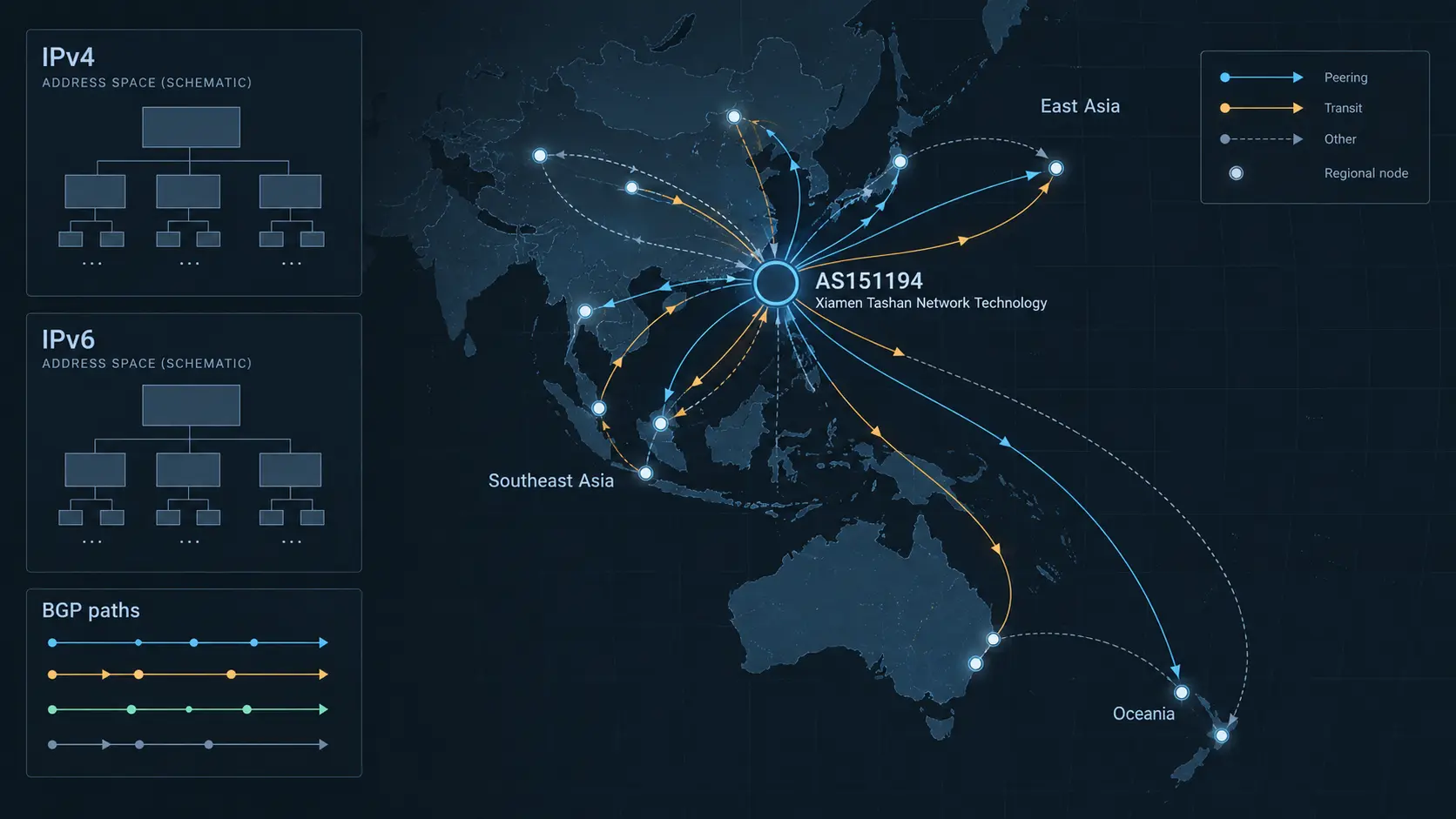
Summary
- The available research establishes a documented investigation into APNIC, RIPE NCC, BGPView, bgp.tools and PeeringDB records, but it does not verify the current contents of those endpoints.
- An ASN assignment, if confirmed in a registry record, would identify an administrative resource and recorded holder; it would not by itself prove route origination, customer dependence, transit relationships or commercial operation.
The most defensible conclusion about Xiamen Tashan Network Technology is therefore narrower than either a company profile or a routing claim. Public evidence points to a research question around AS151194, but the available endpoint responses do not permit a current conclusion about who controls the ASN, whether it originates prefixes, which networks it may exchange routes with, or whether it has a PeeringDB record.
That distinction matters because internet identifiers are often treated as operating facts. They are not interchangeable. A registry record is an administrative statement. A BGP observation is a routing statement. A PeeringDB record is a self-described or community-maintained coordination statement. Each can support a different part of an infrastructure assessment, and none should silently substitute for the others.
The investigation starts with a provisional association
The subject of this investigation is Xiamen Tashan Network Technology, a frozen Directory entity that has previously appeared in a generic profile as a network infrastructure operator. That earlier coverage did not establish a source-backed operating model, a routing footprint or corroborated company detail. The new question is deliberately more limited and more technical: what can public evidence establish about the provisional association between the company and AS151194, and what additional observation would be needed before treating that association as operationally meaningful?
The research produced runtime source artifacts for an APNIC RDAP autonomous-system record, APNIC Whois searches for AS151194 and the company name, RIPE NCC ASN overview, announced-prefix and neighbour endpoints, BGPView ASN, prefix and peer endpoints, bgp.tools, and PeeringDB. The source list is preserved in the research record, including the APNIC RDAP endpoint at rdap.apnic.net/autnum/151194, the RIPE NCC overview at stat.ripe.net ASN overview, and the APNIC search for the company name at APNIC Whois search.
But the refreshed research receipt explicitly says that no web-search or HTTP-fetch capability was available for endpoint retrieval. The source artifacts preserve the attempted URLs and the provenance of the research request; they do not establish the response bodies. That is not a minor qualification. It means that current holder names, registry status, dates, announced prefixes, observed neighbours, peers and PeeringDB records remain unverified in this run.
Administrative identity is not route origination
An autonomous system number is a routing identifier, but the existence of an ASN record does not demonstrate that routes are being originated from it at the time of publication. A registry can record an allocation, assignment, delegation or holder while the resource is unused, transferred, reserved, operated through another arrangement, or simply not visible in the particular routing data being examined.
The administrative side of the question should be tested first. APNIC’s RDAP service is the relevant primary registry source for an APNIC-managed autonomous system: APNIC RDAP for AS151194. APNIC Whois provides a separate search surface for the number and the organization name: APNIC Whois for AS151194 and APNIC Whois for Xiamen Tashan Network Technology. If retrieved and mutually consistent, those records could support a bounded statement about the recorded resource and holder. They still would not show that the ASN currently originates routes.
Third-party metadata can help compare labels and timing, but it does not turn an unverified registry response into a verified fact. The RIPE NCC ASN overview is a distinct observation surface: RIPEstat ASN overview. BGPView’s ASN endpoint is another: BGPView ASN record. Differences among these services can arise from update timing, data provenance, normalization or an actual change in the underlying resource. The correct response to a difference is to preserve it and retrieve the primary record, not to choose the most convenient label.
The same discipline applies to dates. A date associated with an ASN may describe allocation, registration, an update or a database observation. Without the actual field name and response context, it should not be rewritten as the company’s founding date, launch date or start of network operation.
Routing evidence requires a second layer
To establish live or historical route origination, the investigation needs routing observations that include the ASN, the prefixes associated with it and an observation time. The relevant research surfaces include RIPE NCC’s announced-prefix endpoint at RIPEstat announced prefixes, BGPView’s prefix endpoint at BGPView prefixes, and the bgp.tools ASN page at bgp.tools AS151194.
A retrieved prefix list would answer a different question from a registry record. It could show that a monitoring system observed one or more IPv4 or IPv6 prefixes associated with AS151194 at a particular time. It could support analysis of visibility, origin changes, route duration and possible overlap with other origin ASNs. It would not automatically establish that Xiamen Tashan Network Technology owns the underlying address space, sells connectivity, operates the physical network or controls every route attributed to the ASN.
Conversely, the absence of a verified prefix response in this investigation does not establish that AS151194 announces no prefixes. The research receipt reports that the endpoint-specific values were not retrieved. That is a bounded non-observation, not a negative routing result. A source that was not successfully retrieved cannot be used to say that a company is inactive, that an ASN has no routes, or that it has no customers.
The distinction is especially important for smaller operators and infrastructure projects. A network may use an ASN for limited, intermittent, private or experimental purposes. It may announce through an upstream or have a route footprint that changes by time window. A monitoring service may also have incomplete coverage. These possibilities do not prove operation, but they explain why a missing observation cannot carry more meaning than the evidence supports.
Neighbours show relationships, not a business model
The next layer is topology. RIPE NCC’s ASN-neighbours endpoint at RIPEstat ASN neighbours and BGPView’s peer endpoint at BGPView peers can provide evidence about observed adjacent ASNs or route relationships. Those observations can help identify potential upstreams, downstreams, peers or changes in the network’s visible position.
They still require interpretation. A neighbour relationship in a routing dataset is not necessarily a commercial peering agreement. It may reflect a transit path, a route server, a customer-provider relationship, a temporary announcement or a measurement artifact. A list of neighbours also does not establish who pays whom, where traffic flows, or who has authority over an organization’s infrastructure.
No current neighbour or peer values were verified here. The responsible conclusion is therefore not that AS151194 has no peers, but that this investigation cannot presently report its observed neighbours or peers. That wording preserves the difference between an empty response, an unavailable response and a response that was never successfully fetched.
PeeringDB is useful, but not dispositive
PeeringDB provides another type of evidence. Its network endpoint for AS151194 is PeeringDB network lookup. A record could provide self-described information about a network’s points of presence, facilities, internet exchanges, contacts or peering policy. It could make a small operator more legible to potential partners, or reveal that the ASN participates in an established coordination ecosystem.
But PeeringDB is not a registry of legal ownership or a definitive test of operational reality. A network can be active without a public PeeringDB record, and a record can remain after operating conditions change. A missing or unverified PeeringDB response therefore cannot prove that the subject lacks a network presence, peering relationships or commercial activity.
This is one reason the investigation should not convert the earlier generic profile into a more confident company description. The available evidence does not establish what Xiamen Tashan Network Technology sells, which customers depend on it, what facilities it operates, or what revenue model might sit behind the provisional ASN association. The article can explain the evidence problem; it cannot fill the commercial gaps with inference.
What is established, and what is not
The evidence supports several modest claims. The research run generated source artifacts corresponding to the APNIC, RIPE NCC, BGPView, bgp.tools and PeeringDB URLs listed above. The refreshed research result recorded the status as not retrieved and expressly stated that endpoint-specific values must not be inferred. Prior coverage is generic and does not provide a corroborated operating model or routing footprint.
The evidence does not support claims that Xiamen Tashan Network Technology is the confirmed holder of AS151194, that AS151194 is currently active, that it originates no routes, that it originates routes, that it has no neighbours or peers, that it has no PeeringDB entry, or that the company operates a customer-facing network. Each of those statements would require a corresponding retrieved record and a carefully scoped interpretation.
That boundary is the article’s information gain. It replaces a thin label—“network infrastructure operator”—with a testable framework. The next useful research step is not another paraphrase of the Directory entry. It is retrieval of the primary records, preservation of response timestamps and field names, and comparison across administrative and routing sources.
A practical verification sequence
A future verification should proceed in layers.
First, retrieve the APNIC RDAP and Whois records and preserve the raw response, HTTP status, retrieval time and relevant fields. Compare the recorded holder, status, remarks and dates. Search both the ASN and the exact organization name so that a name match is not mistaken for a resource match.
Second, retrieve the RIPE NCC overview and compare its organization and status fields with APNIC’s primary record. Any difference should be reported as a difference in source observations until resolved.
Third, retrieve the RIPEstat, BGPView and bgp.tools prefix observations with their observation windows. Record IPv4 and IPv6 prefixes, origin counts, first- and last-seen values where available, and whether the same prefix appears under more than one origin. This would establish an observable routing footprint, not a complete operating model.
Fourth, retrieve neighbour and peer data from more than one source. Record the observation date and distinguish route adjacency from commercial peering. If the lists disagree, preserve the disagreement and investigate coverage and timing.
Fifth, retrieve PeeringDB and compare network name, ASN, contacts, facilities and exchange information with the registry evidence. Treat self-described fields as a separate evidence class.
Finally, seek corroborating company records before making claims about customers, facilities, products or business model. A routing identifier can be a lead; it is not a substitute for company evidence.
Why the uncertainty matters
For public readers, the uncertainty prevents an unsupported conclusion about whether a little-documented company operates a live autonomous system. For network operators and investors, it identifies the records that would distinguish an administrative association from an operating asset. For security and resilience teams, it prevents a nonexistent route footprint from being treated as evidence of safety—or an unverified association from being treated as evidence of control.
The practical risk is not only analytical error. If the holder, operator and route origin are conflated, a change in any one of them can be missed. A route may move between origins; an organization name may change; an ASN may remain visible after a business relationship ends; a provider may carry traffic for an entity that does not appear as the visible origin. These are different control surfaces and should be monitored separately.
The current record therefore warrants attention, not a verdict. The provisional association with AS151194 is a lead for verification. It is not yet evidence that Xiamen Tashan Network Technology operates the ASN, originates routes through it, or exercises control over a public network.
Member Briefing
Deeper Profile Context
Sign in with the right membership level to unlock the full briefing and source notes.
Only for Strategic Circle
Strategic Circle
Open to all readers. Unlock profile briefings after joining and signing in.
Join Strategic CircleOnly for Leadership Alliance
Leadership Alliance
For qualified IP-asset owners and management; sign in to unlock alliance briefings.
Join Leadership Alliance