Summary
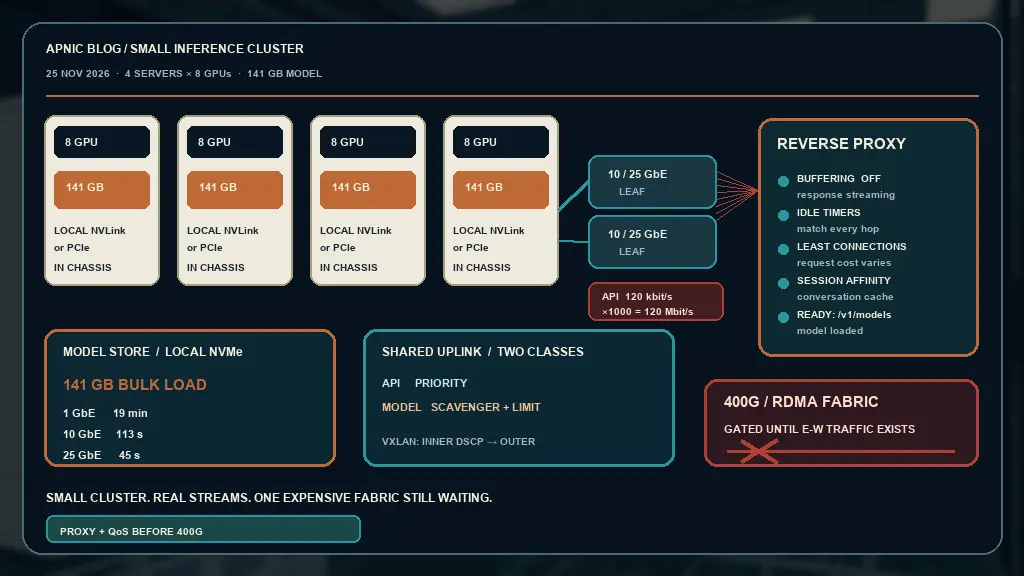
- Sabina Anja’s APNIC Blog post uses four eight-GPU servers and a 141 GB Llama 3.3 70B model as an illustrative small inference cluster. Each server holds the whole model, so GPU traffic stays on NVLink or PCIe.
- At 300 bytes per message and 50 messages per second, a front-end stream is 120 kbit/s. One thousand streams reach 120 Mbit/s, while each open conversation keeps 1–10 GB of GPU memory.
- The design keeps an existing 10 or 25 GbE leaf fabric, adds reverse proxies and separates API traffic from 141 GB model transfers with QoS. 400G, RDMA and RoCEv2 arrive when the model spans servers or fine-tuning crosses chassis.
The expensive network is behind the glass
The cluster is deliberately small: four servers, eight GPUs each, an internal application and a model that fits in every chassis. A server answers without asking another host to calculate part of the token.
Tensor parallelism exchanges partial results at every layer and token; NVLink handles that. Pipeline parallelism moves whole layer blocks only at handoffs and works over PCIe. The post recommends pipeline parallelism for GPUs without NVLink, naming L40S. Either path stays local.
What crosses the NIC is different. A chat response sends a few hundred bytes at a time for minutes. One conversation uses 120 kbit/s; one thousand use 120 Mbit/s. A future cluster coordinating every token would move far more. This one does not.
The first hard limit is GPU memory. Each open stream holds 1–10 GB. After loading the model, a server has a few hundred GB left for tens to a few hundred conversations depending on length. Proxy, firewall state and idle timeouts must be sized to that live stream count.
One huge transfer among small packets
The model is 141 GB. At line rate with no protocol or storage overhead, the post calculates 19 minutes on 1 GbE, 113 seconds on 10 GbE and 45 seconds on 25 GbE. The transfer is rare, but uses the same leaf uplinks and spine ports as the API.
The design fetches weights into a local model store, keeps an NVMe copy on every server and rolls a version one server at a time. The network sees 141 GB at installation and model changes; a process restart reads local disk.
Without QoS, the transfer fills the shared uplink and streaming responses wait. An interface can show 120 Mbit/s while users watch text stall. The design marks DSCP at ingress, gives the API a protected queue and limits model transfers in a scavenger class. On VXLAN, the inner DSCP must survive encapsulation or spines see every packet as default traffic.
That is ordinary DiffServ on a lossy fabric. The 400G, RDMA, PFC and ECN stack solves the opposite case: many servers exchanging GPU state continuously. Buying it before the model crosses a host creates optics and RoCEv2 operations for little traffic.
The proxy returns because a connection is not a request
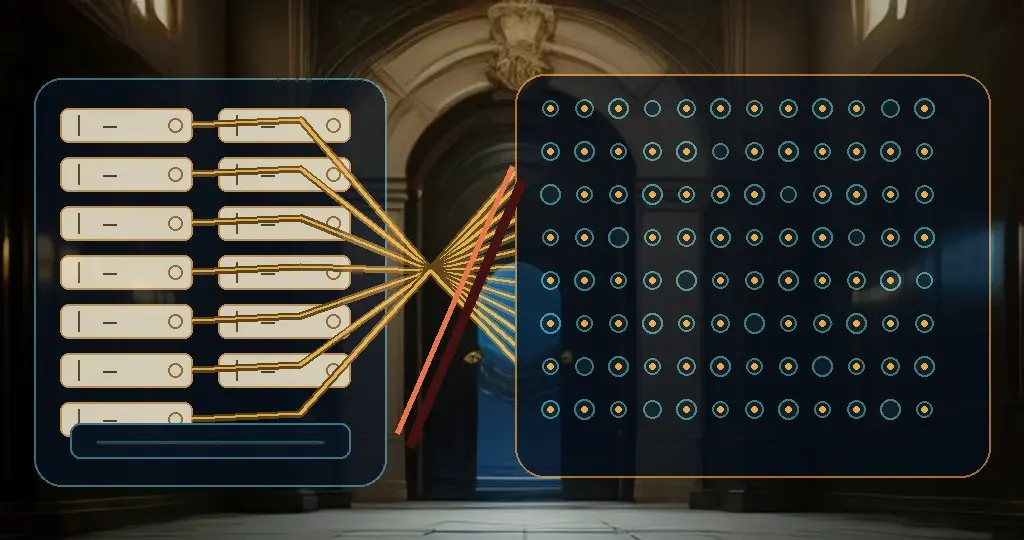
ECMP or a layer-4 load balancer alone cannot steer this work. One request may cost a hundred times the next, and several share one long-lived HTTP/2 connection. The proxy must see request boundaries and choose least connections rather than round robin.
The post names the settings: turn response buffering off, align idle timers down the path, pin a conversation to one instance with a consistent session hash and test /v1/models after the model loads. /health in the cited llm-d documentation is a process check.
The proxy becomes the admission, affinity and readiness control. Network teams can own queues and uplinks; visible latency also depends on knowing that a model, not just a listening port, is ready.
Where this stops working
Everything depends on the model fitting one server. When it does not, vLLM spreads work between hosts and the backend fabric enters. Fine-tuning across servers triggers the same change. An experimental split-request mode moves cached GPU state over the network.
For some infrastructures that expansion may still be three to five years away, according to the post’s assessment. The useful decision today is to measure sessions, transfer windows and uplink contention before buying the future fabric.
The APNIC publication is an illustrative architecture. It gives model size, stream arithmetic, transfer times and controls, but no deployed-traffic sample, latency, session census or failover receipt. Any one of those would turn the sketch into an operating baseline.
Source: APNIC Blog design note.
Member Briefing
Read the full trend briefing
Members read the full briefing with the source notes behind every finding.
Strategic Circle
A daily briefing in your language, built from changes we have verified.
Join for USD 20/monthCancel anytime.
Members also get the full research library, a daily briefing on the networks they follow and the private forum.