Summary
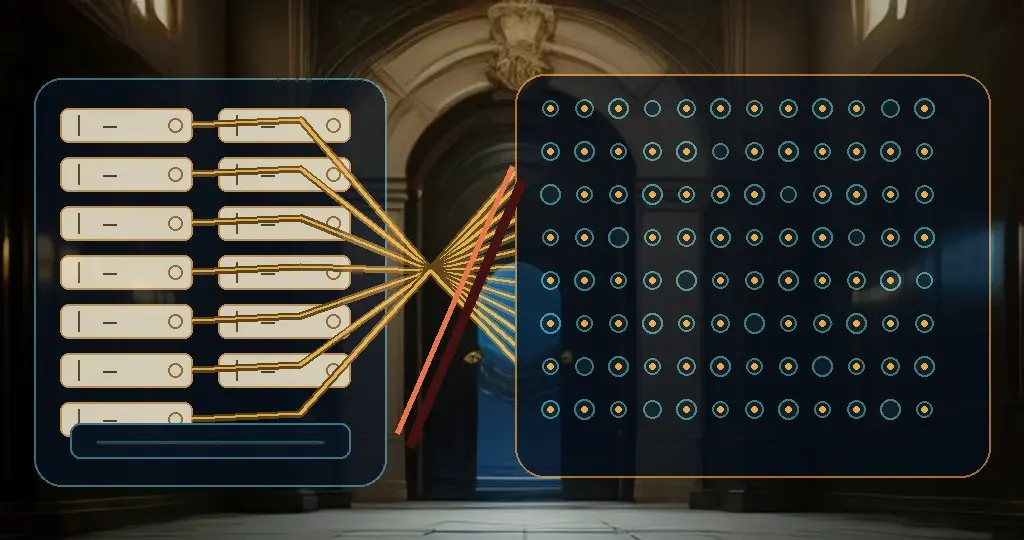
- AFRINIC’s 24 November archive shows the new ASNs, three IPv4 /23s and the IPv6 /48 as available or not present. The 25 November file fills seven rows: AS329850, AS329851 and AS329852; 102.200.136.0/23, 102.200.168.0/23 and 102.200.138.0/23; and 2001:43fc:b800::/48.
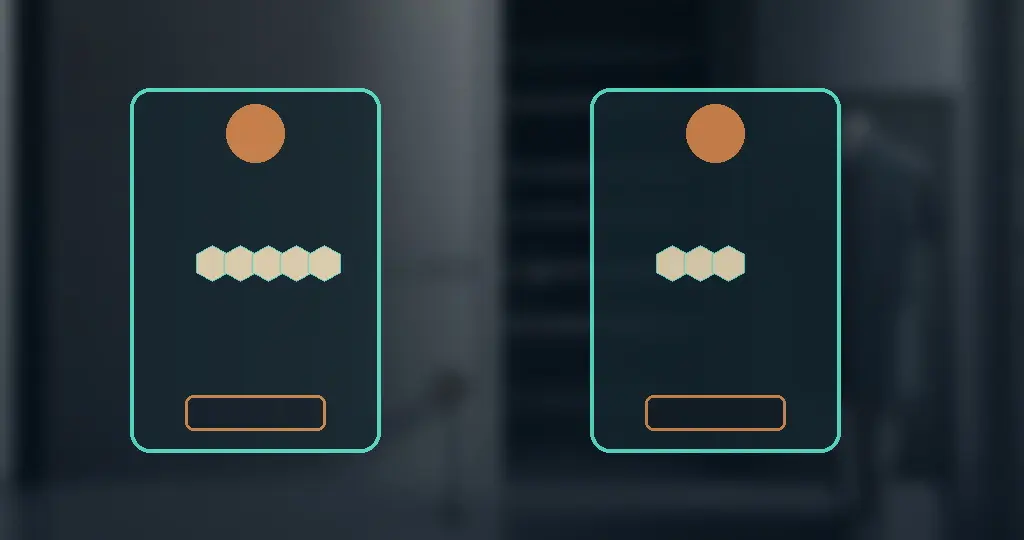
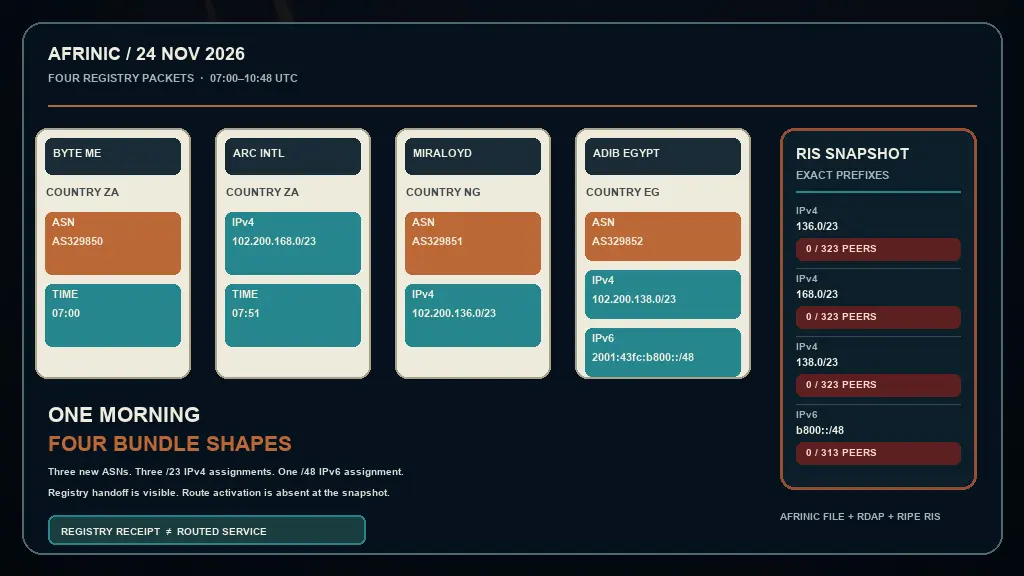
- RDAP gives four different packet shapes. Byte Me Connect has AS329850 alone. ARC International Telecoms receives a /23 under its existing AS329113 identity. Miraloyd Global Consult receives an ASN and a /23. Abu Dhabi Islamic Bank-Egypt receives an ASN, a /23 and a /48.
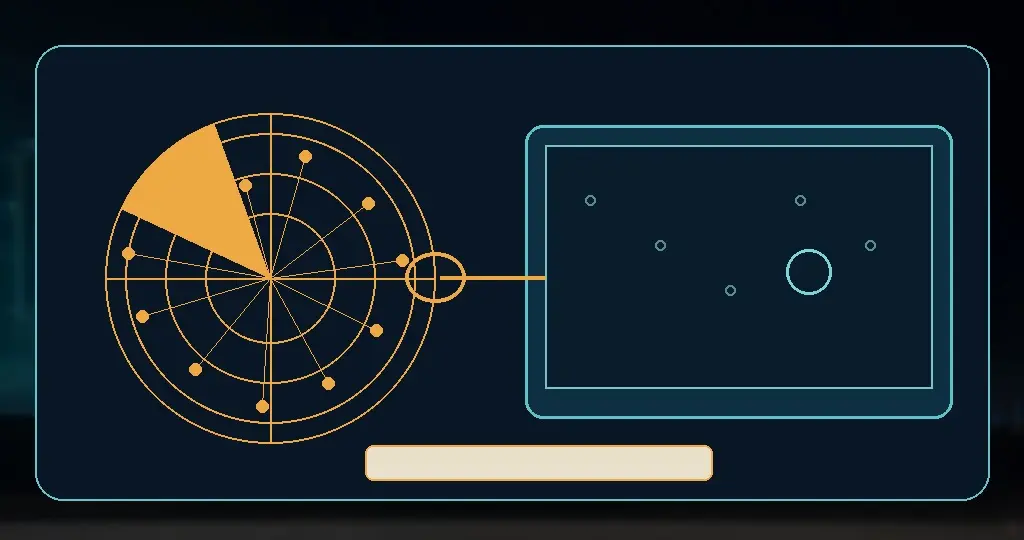
- RIS at 2026-11-25T00:00:00Z sees 0 of 323 IPv4 peers for .136/23, 0 of 323 for .168/23, 0 of 323 for .138/23, and 0 of 313 IPv6 peers for the /48.
One morning, four packet shapes
The first ASN lands at 07:00:00Z. RDAP places AS329850 on Byte Me Connect. The 25 November file gives its token, F368BBFD, no address block. The registry output is a company with an autonomous-system number and no new prefix attached to that token.
At 07:51:00Z, 102.200.168.0/23 appears under F36A7C59. That is ARC International Telecoms’ existing token, already joined to AS329113 and older IPv4 and IPv6 resources. The new /23 expands an established packet; it does not create a four-item bundle from a blank account.
Miraloyd’s records arrive at 08:32 and 08:37. IPv4 102.200.136.0/23 is registered before AS329851, and both use token F3618200. The file gives the Nigerian holder one ASN and one /23.
Abu Dhabi Islamic Bank-Egypt is the only holder with the full set. The /23 registers at 10:39, the /48 at 10:45 and AS329852 at 10:48. All three use F36E4008. In nine minutes, the Egyptian bank moves from no new record in the 24 November file to a three-resource packet in the next.
The elapsed span is three hours forty-eight minutes. The registry has published seven filled resource objects and 1,536 IPv4 addresses. Those numbers are exact. A common application campaign is not: the file contains no request ID, approval timestamp or statement that the four holders are related.
The receipt stops at registry custody
The public file gives status, country, resource value, date and holder token. RDAP gives the organization behind each token and the object registration time. Together they establish who holds what and when AFRINIC’s public objects appeared.
Four different wrappers now share one date in the same delegation file. One holder has an ASN alone. One has an IPv4 addition inside an older ASN record. One has an ASN and IPv4. One has an ASN, IPv4 and IPv6. A CSV row count sees seven successful outputs. A portfolio reader sees four different levels of network inventory.
The missing record is the request-to-resource chain. AFRINIC can describe one application or several without revealing commercial terms: an application ID, the requested object set, the date of approval and the exact resource token assigned. That would separate a coordinated customer packet from unrelated administrative decisions that reached the same daily file.
The route table stayed blank
RIS answered the next question at midnight UTC on 25 November. None of the exact prefixes had an origin visible to the full-table peers in the snapshot. The last of the seven objects had registered thirteen hours earlier. The bank’s IPv6 /48 and three IPv4 /23s were all dark at the exact-prefix level.
The route could be hidden inside a more-specific. RIS found no more-specific in the same snapshot. A holder can also keep the space for a later build. ARC and the bank have existing networks and can expand a known operation. Byte Me has a registry ASN with no new address in this delta. A first route, a more-specific, a holder deployment record or a corrected RDAP object would change the operational reading.
The stakes are not seven interchangeable CSV rows. An operator can use the ASN and prefixes for different parts of a network: peering, customer addressing, VPN, cloud reachability or internal infrastructure. The public receipt stops before any of those services exist.
AFRINIC has published a compact picture of a busy morning. Four holders picked up four shapes of registry inventory; the global route table picked up none of the new address space. The next useful receipt joins each shape to its application and, later, to an observed origin.
Sources: AFRINIC 24 November archive; 25 November file; RDAP objects for AS329850, AS329851, AS329852, AS329113, the three IPv4 /23s and the IPv6 /48; four RIPE RIS exact-prefix snapshots linked above. Official sources: https://ftp.afrinic.net/pub/stats/afrinic/AFRINICPUBKEY.TXT; https://ftp.afrinic.net/pub/stats/afrinic/delegated-afrinic-extended-20261125; https://ftp.afrinic.net/pub/stats/afrinic/delegated-afrinic-extended-20261125.asc; https://ftp.afrinic.net/stats/afrinic/2026/delegated-afrinic-extended-20261124; https://rdap.afrinic.net/rdap/autnum/AS329113; https://rdap.afrinic.net/rdap/autnum/AS329850; https://rdap.afrinic.net/rdap/autnum/AS329851; https://rdap.afrinic.net/rdap/autnum/AS329852; https://rdap.afrinic.net/rdap/ip/102.200.136.0/23; https://rdap.afrinic.net/rdap/ip/102.200.138.0/23; https://rdap.afrinic.net/rdap/ip/102.200.168.0/23; https://rdap.afrinic.net/rdap/ip/2001:43fc:b800::/48; https://stat.ripe.net/data/routing-status/data.json?resource=102.200.136.0%2F23&min_peers_seeing=1; https://stat.ripe.net/data/routing-status/data.json?resource=102.200.138.0%2F23&min_peers_seeing=1; https://stat.ripe.net/data/routing-status/data.json?resource=102.200.168.0%2F23&min_peers_seeing=1; https://stat.ripe.net/data/routing-status/data.json?resource=2001%3A43fc%3Ab800%3A%3A%2F48&min_peers_seeing=1
Member Briefing
Read the full trend briefing
Members read the full briefing with the source notes behind every finding.
Strategic Circle
A daily briefing in your language, built from changes we have verified.
Join for USD 20/monthCancel anytime.
Members also get the full research library, a daily briefing on the networks they follow and the private forum.