
Topic
Security Automation
Within the Topic facet, Security Automation topic intelligence connects articles that share a specific subject, signal focus, or monitoring theme. The page gives readers a richer path through related reporting, source evidence, market actors, and infrastructure implications, with enough context to understand why the topic matters across company movements, governance decisions, regional exposure, and operational risk. Readers can compare recurring signals, affected organisations, public evidence, market context, service continuity, procurement, competition, compliance, and strategic planning questions behind the subject instead of stopping at a thin list of matching articles. It explains what the topic covers, which infrastructure actors or policies are involved, what evidence supports the coverage, and why the subject may matter for operators, customers, investors, and policy readers.

CASE FILE
The Score Starts Before the Stopwatch: RFC 9693 and Stateful NAT Evidence
A stateful NAT benchmark can report zero loss and still be incomparable with the run beside it. The missing variable may not be the offered rate. It may be the population of connections that existed before the measured traffic began—and whether the tester could send a valid…

IETF
The New Name Left of the Slash Was Registered. Nothing Else Was Proven
RFC 9694 turns a rare naming decision into an operating commitment. A new top-level media type can change how software groups unknown formats, chooses handlers and presents content to users. The registry entry is real, but it is only the first receipt in a much longer chain from…

History
The Counter Passed One Receiver’s Window. It Did Not Name the Sender: RFC 2085
RFC 2085 placed a 64-bit replay counter inside one HMAC-MD5 Authentication Header transform, but only when the Security Association selected it. A receiver could admit unseen packets within its own reordering window and reject a repeated value. That was useful freshness evidence…

IETF
The Router Answered for the Exit. The Link Was Still Unproven
RFC 9703 lets MPLS Ping and Traceroute ask whether an EPE-SID reaches the peer association named by its Target FEC Stack. The reply can validate an egress role, and sometimes the observed incoming interface. It cannot make a skipped interface check, an unreconciled controller…

IETF
The Registry Changed. The Old Flow Did Not: RFC 9710
A one-line type correction can travel from IANA into generated collector code, dashboards and incident evidence. RFC 9710 shows why that journey needs a chain of custody: the registry may be normative, but a current row cannot silently upgrade yesterday's parser or rewrite…

History
Dorothy Denning and What the Lattice Actually Permits
A security lattice can prove that a modeled dependency obeys a chosen flow policy. It cannot prove that the policy deserves trust. Dorothy E. Denning’s early work remains valuable precisely because it makes both the assurance and its boundary unusually clear.

IETF
RFC 9806 Corrects the Label, Not the Deployment
The standards record now has a clear name for SIPREC recording metadata: `application/rs-metadata+xml`. That clarity joins an original metadata RFC, a contradictory protocol RFC, an erratum, a later update and an IANA entry. It still leaves operators to prove whether the…

IETF
The Backup Was Valid. The Signature State Was Not: RFC 10033
A stateful hash-based signing key is not merely secret material in storage. It is also a changing account of one-time keys already exposed to the world. RFC 10033 makes that operational distinction unavoidable: restoring an authentic but older copy can recover the right key while…

History
Barbara Liskov and the Argus Commit That Stopped at the Guardian Boundary
Argus made failure a language-level concern: guardians owned recoverable entities, handlers crossed machine boundaries, and actions could commit or abort a distributed change. Its strongest lesson is also its limit. A committed action settled the participating Argus state; it did…

IETF
An AEGIS Codepoint Is Not a Negotiation Receipt
RFC 10032 gives six AEGIS variants stable AEAD identifiers. It does not show that two peers offered the same suite, chose the same tag length, executed the intended implementation path or protected a single live packet with it. The missing record sits between specification…

IETF
A DHCP Lease Is Not a Relay-Topology Receipt
RFC 9928 lets an intermediate relay speak DHCPv4-over-DHCPv6 for a legacy IPv4 client that knows nothing about the conversion. The lease can be valid while the evidence connecting the request to its physical access port is incomplete. The missing entity is not another success…

History
Andrew S. Tanenbaum and the Amoeba Capability That Authorized an Object, Not a Person
Amoeba compressed a service address, an entity name, an operations mask and an anti-forgery check into 128 bits. The resulting capability could travel with user code and carry authority without a central list of holders—but a valid token still said nothing by itself about the…

Global Institutional
RANCID and the enduring value of a one-line network diff
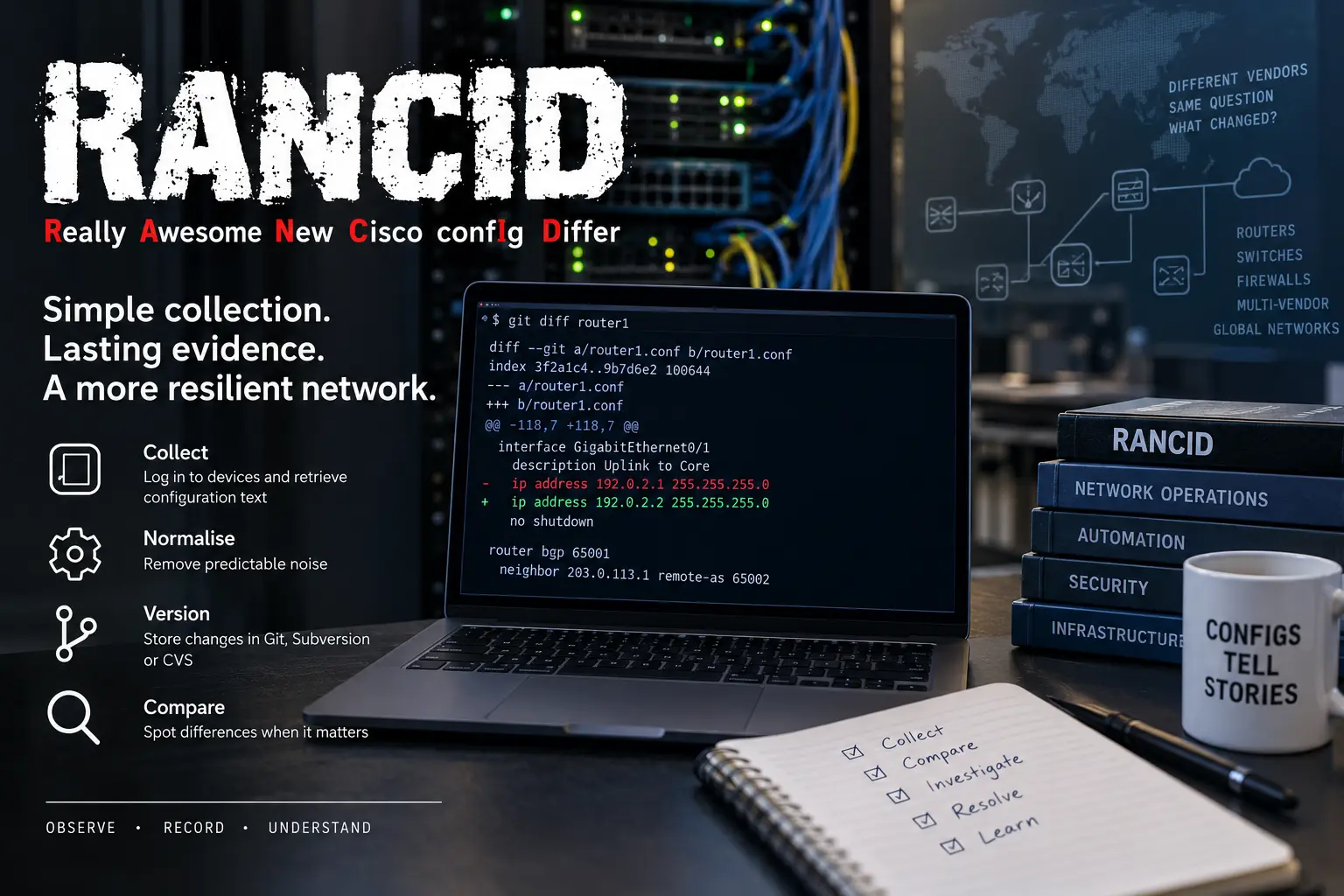
RANCID has endured successive generations of network management because it performs one narrow task: it logs into devices, collects selected configuration text, removes expected noise and commits the result to version control. It does not model intent, approve changes or…

Creators
Jeff Bonwick and the architecture that makes failures visible
Jeff Bonwick's career links two problems usually treated separately: how a kernel allocates small entities quickly, and how a storage system verifies that the bytes read back are the ones the application wrote. From the slab allocator and per-CPU magazines to ZFS, DSSD and…

Creators
Jeff Bonwick and the engineering that makes failures visible
Jeff Bonwick’s career links two problems often treated separately: how an operating system kernel allocates small entities quickly, and how storage verifies that the bytes it reads are those the application wrote. From the slab allocator and per-CPU caches to ZFS, DSSD and…

Global Institutional
LibreNMS and the operating cost of seeing the network clearly
LibreNMS gives operators a transparent, self-hosted way to discover devices, poll counters, build inventory and turn network state into alerts. Its credibility does not come from a promise that open source is automatically safer or cheaper. It comes from an operating bargain: the…
Global Institutional
RANCID and the enduring value of a one-line network diff
RANCID preserves a form of evidence that large management platforms can easily blur: configuration text reported by a device at a particular moment, and the difference from the previous observation. It does not represent the full intent model, every event or causality. That…

Creators
Jeff Bonwick and the architecture of making failure visible
Jeff Bonwick’s career connects two problems that usually appear unrelated: how an operating-system kernel allocates small entities at high speed, and how a storage system decides whether the bytes it reads are still the bytes an application wrote. From the slab allocator and…
Global Institutional
RANCID and the enduring value of a one-line network diff
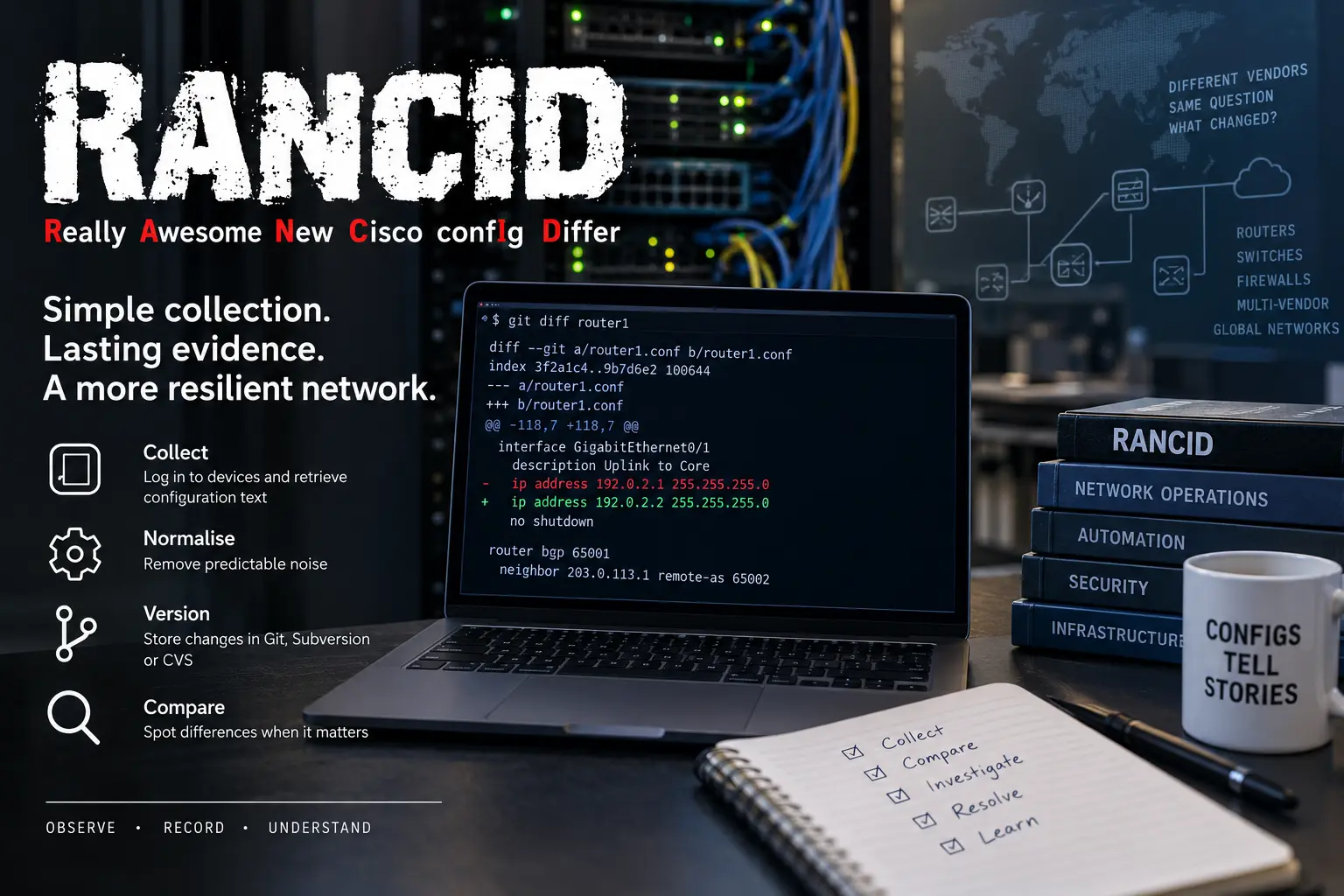
RANCID has survived successive eras of network management by doing one narrow job: logging into devices, collecting selected configuration text, removing predictable noise and committing the result to version control. It does not model intent, approve changes or reconstruct every…

Global Institutional
Cisco patches exploited email-gateway flaw
Cisco has fixed an actively exploited Secure Email Gateway vulnerability, but organisations that were exposed still need to check whether attackers reached the appliance before it was patched.