
Summary
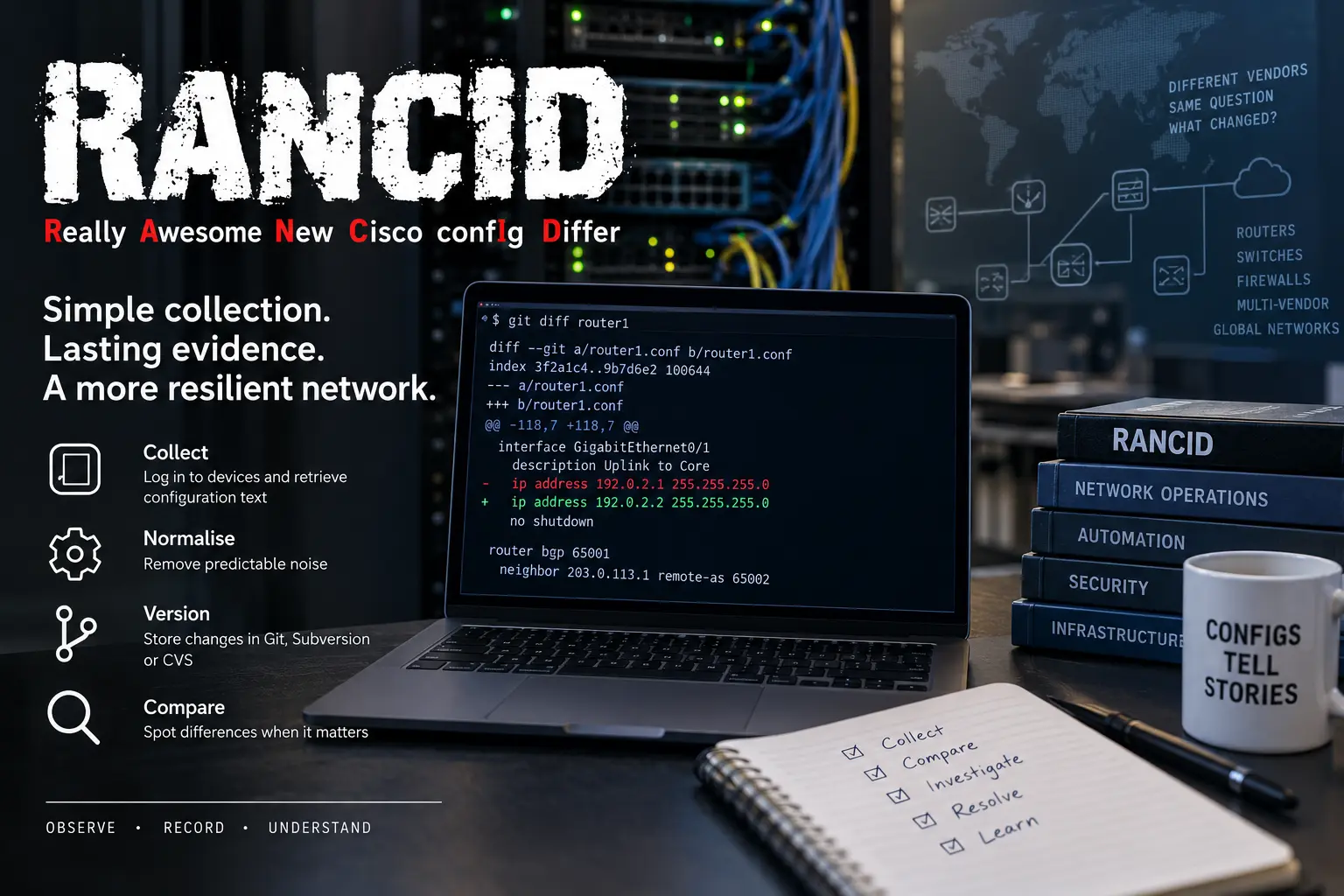
- RANCID—Really Awesome New Cisco confIg Differ—collects periodic device configurations through vendor-specific login and command modules, normalises the output and stores changes in CVS, Subversion or Git.
- Its evidence is observed text, not desired state: a snapshot can reveal drift or an emergency change while still missing intermediate edits, runtime state and the identity of the person who changed the device.
- The same host that improves incident reconstruction can become a high-value security target because it holds management credentials, topology and configuration secrets across a fleet.
- RANCID remains useful beside GitOps, automation and source-of-truth platforms because an independent collector can show what a device reported after the intended workflow was bypassed or only partly applied.
After an outage, the smallest useful question is often “what changed?”
A network can fail through an elaborate interaction among routing policy, interface state, software defects and traffic. The first actionable clue may still be one line of configuration. A neighbour address changed. An access list moved. A route map acquired an extra match. A trunk lost a VLAN. The device accepted the command, and the operational effect appeared later, perhaps far from the point of change.
RANCID was built around the need to preserve that evidence. It connects to routers, switches and other supported devices, runs commands, filters their output and commits the resulting text to version control. When a file changes, the repository provides a diff and can trigger email or another workflow. The system does not need to understand every business intention behind the command to show that the device’s reported configuration is different.
The modesty of this model is a strength. RANCID does not claim to be the complete control plane. It does not schedule an approved change, generate every vendor configuration or guarantee policy compliance. It records periodic observations. That makes it useful in mixed estates where some devices are automated, some are managed manually and some are too old to expose a modern API.
The model is also incomplete by design. A change can be applied and reverted between polls. A failed login can leave an old file looking current. A vendor module can omit the command that matters. Normalisation can remove a changing field that later proves important. A diff shows that the collector observed different text; it does not prove who changed the device, why they changed it or whether the change caused the incident.
Those qualifications do not reduce the value of the evidence. They define it. RANCID gives operators a durable, low-complexity answer to one question at one point in time. During an outage, that answer can be more useful than a broad dashboard that reports symptoms without preserving the configuration context.
The project gave routers an external memory before controllers became fashionable
RANCID emerged when network devices were managed primarily through command-line interfaces. Configuration lived on routers and switches, and operational knowledge often lived in the memories, terminal histories or personal directories of engineers. A device replacement or mistaken edit could reveal that the organisation did not possess a current independent record.
The project’s name began with Cisco, but its scope expanded through vendor-specific modules. The architecture accepted an uncomfortable fact: network operating systems exposed different prompts, login sequences, paging behaviour and commands. Rather than wait for one universal management model, RANCID automated the interfaces that actually existed.
This made the system practical across generations of equipment. A collector could use a login script such as clogin, driven through Expect, to handle prompts and sessions. A vendor module could execute commands that returned the running configuration, hardware inventory or other relevant state. The output could then be normalised and stored as text.
The approach is brittle in exactly the ways command-line automation is brittle. A changed prompt can break a script. A new firmware version can alter command output. Paging, banners, authentication challenges and timing vary. Some devices require legacy ciphers or still expose Telnet. Local modules may diverge from upstream. Every supported platform carries knowledge that must be maintained.
Yet the architecture’s longevity is evidence that interoperability often arrives through adaptation rather than one clean standard. RANCID does not make vendor CLIs consistent. It creates a common workflow around their inconsistency. The repository becomes the stable interface even when collection behind it uses different commands.
That choice also separated memory from the device. A router could fail completely and the organisation would still possess its last collected configuration and change history. The archive could support replacement, audit and incident analysis. The device remained the source of observed text, but no longer the only place where the organisation remembered it.
router.db turns a fleet into a scheduled collection plan
The traditional RANCID workflow begins with router.db, a device inventory that associates hostnames with types and states. Active entries become collection targets. Groups define organisational boundaries, schedules and repositories. The file is simple enough to inspect and version, yet important enough to determine which devices are remembered and which are invisible.
Simplicity makes errors legible. A misspelled hostname, wrong device type or disabled state can be found in text. It also means the inventory is only as complete as the process that maintains it. A router absent from router.db does not become monitored through magic discovery. A decommissioned device can remain in the archive. A hostname can resolve to an unexpected address. The inventory needs reconciliation with the organisation’s actual source of truth.
When rancid-run executes, it selects active devices, invokes the appropriate login and vendor logic, retrieves output, compares it with the previous version and commits meaningful changes. Failures and retries are part of the workflow. A device may be unreachable, authentication may fail or a command may return incomplete data. The result should be treated as a collection event with a status, not merely as the presence of a file.
This distinction matters because stale success can be dangerous. If the latest repository version is months old, it may still look clean and readable. Operators need to know the age of the last successful collection, the number of consecutive failures and whether all expected commands completed. A configuration archive without freshness monitoring can create false confidence.
The group model can limit blast radius and clarify ownership. Different teams or environments can use separate credentials, schedules and repositories. High-consequence devices can be polled more frequently or through isolated collectors. Development and production estates can retain different policies. The architecture provides the possibility; local administrators decide whether to use it.
RANCID’s inventory is not a network source of truth in the modern intent-modelling sense. It is a collection plan. That narrow role is valuable because it can be compared with intended inventory. A device present in NetBox but absent from RANCID may lack historical evidence. A RANCID target absent from the approved inventory may be forgotten infrastructure. The mismatch is often more useful than either list alone.
Expect-based login made automation possible and concentrated credentials
Interactive network CLIs were designed for people, not deterministic software. They display banners, prompt for usernames and passwords, negotiate terminal behaviour, pause output and change prompts when privilege levels or configuration modes change. Expect lets scripts wait for patterns and respond, turning a conversation into an automated sequence.
RANCID’s login tools apply that method to network devices. They can use Telnet or SSH depending on local configuration and device capability, handle prompts, enter privileged modes and run commands. This allowed operators to automate devices long before APIs and model-driven management became common.
The login mechanism creates a severe security concentration. A collector may need read access to hundreds or thousands of devices. Credentials are commonly described in .cloginrc, protected through filesystem permissions and local controls. If the host or file is compromised, an attacker can gain both a map of the fleet and authentication material for its management plane. Where privileged or shared credentials are used, the blast radius grows further.
Read-only access can reduce the ability to change devices, but the practical privilege depends on each platform. Some devices do not separate configuration display cleanly from broader command access. The archive itself may reveal community strings, password hashes, keys, interface descriptions, customer names and internal addressing. Secret filtering helps but is not a complete guarantee.
A secure deployment therefore treats the RANCID host as a privileged control-plane system. It should be segmented, patched, backed up and monitored. Credentials should be scoped, rotated and audited. SSH should replace Telnet where devices support it. Legacy algorithms should be isolated rather than enabled broadly on a general management host. Repository access should follow least privilege.
The use of Expect also creates operational dependencies. A strong authentication change, multifactor requirement or prompt modification can break automation. Operators need a supported non-interactive path that does not weaken security simply to keep collection working. Test devices and staged credential changes can prevent a fleet-wide loss of visibility.
RANCID’s security trade-off is direct: centralising collection improves evidence and recovery while creating a high-value target. The correct response is not to deny the concentration, but to engineer around it.
Vendor modules translate unstable command output into comparable text
A Cisco router, Juniper device and another vendor’s switch do not present the same commands or output. RANCID handles that diversity through device-specific modules and login logic. Each module knows which commands to run and how to process the response. The common output is not a universal data model; it is a set of text files suitable for comparison.
This arrangement permits incremental support. A contributor can add or update one platform without redesigning the whole collector. Long-lived estates benefit because a module can continue serving devices that no longer receive new management APIs. Operators can write local modules for specialised equipment.
The cost is continuous parsing work. Human-readable CLI output is not a stable contract. Vendors add headings, reorder sections and change whitespace. Firmware branches diverge. A prompt or error message can resemble expected output. A module may silently collect only part of the configuration if a command is renamed or permissions change.
Testing is difficult because maintainers do not possess every model and software version. Sample output can support regression tests, but it cannot reproduce timing, authentication or all platform states. Local patches can solve an immediate problem while creating a branch that no longer follows upstream fixes. Device support should therefore be described by exact type, command set and tested release rather than one broad brand claim.
The modules also decide what counts as configuration. Some commands expose hardware inventory, software versions or operational state alongside configuration. Including more data can help incident analysis while producing noisier diffs and larger repositories. Excluding it can make the archive cleaner while hiding a relevant change. There is no context-free correct boundary.
RANCID’s multi-vendor achievement is not that it eliminated proprietary interfaces. It preserved a consistent evidence workflow despite them. That is less elegant than a common schema and often more immediately useful in legacy operations. The repository becomes the comparison point, while the module records the compromises required to reach it.
Normalisation separates meaningful change from output that changes every run
Network-device output contains values that are useless in a configuration diff because they change continuously. Uptime, timestamps, counters, session identifiers and generated cryptographic material can make every collection appear different. RANCID filters or masks selected fields so that the repository records changes an operator can interpret.
Normalisation is what turns raw command output into operational evidence. Without it, a daily email could contain hundreds of lines that changed only because time passed. Engineers would stop reading. By removing volatile fields and standardising output, the system allows a one-line policy change to stand out.
The filtering decision is also a form of editorial power. A field removed as noise cannot help later analysis. A password hash may be masked for security, but a change in the hash may be evidence that credentials rotated. A timestamp may be irrelevant until it reveals a restart. A dynamic identifier may distinguish a routine process from an unexpected one.
The correct filter depends on the purpose of the archive. A compliance repository may prioritise stable policy text and aggressive secret removal. An incident-forensics system may retain more context in a protected location. Some organisations may maintain separate outputs or supplement RANCID with logs and telemetry.
Normalisation can break when vendor syntax changes. A regular expression written for one format may remove too much or fail to remove a secret. Review should therefore include the filtered result and, where safe, testing against representative raw output. A clean diff is not proof that no important data was discarded.
This tension is central to every observability system. Useful evidence is rarely raw. It is selected, transformed and labelled. RANCID makes that transformation visible in code and modules. The responsible operator knows what was removed and does not confuse a quiet repository with a complete account of device state.
Version control gives configuration text a timeline but not a transaction history
RANCID originally used CVS and later supported Subversion and Git. Version control supplies durable history, diffs, timestamps and a familiar mechanism for replication or backup. It turns a directory of current files into a sequence of observed states.
A commit can show that the collector saw one configuration on Monday and another on Tuesday. It can identify the lines that differ and support comparison with an outage window. Branching and distributed copies in Git can improve resilience and integration. Repository tools can enforce access and retention policies.
The commit is not the device transaction. Its author may be the RANCID service account rather than the engineer who made the network change. Its timestamp records collection or commit time, not necessarily command execution. Several device edits may be collapsed into one diff. A change applied and reverted between polls may never appear.
The repository can also preserve sensitive data indefinitely. Removing a secret from the latest file does not remove it from history. Rewriting history is disruptive and may leave copies elsewhere. Secret scanning, access controls and careful module filtering are necessary before a large fleet’s configuration is committed.
Repository integrity matters. An attacker who compromises the collector may alter current files or history, suppress diffs or insert misleading evidence. Remote mirrors, signed commits or immutable backups can improve confidence, but each needs a threat model. Ordinary version control records change; it does not automatically prove that the record is authentic.
Retention should reflect operational and legal requirements. Long history can reveal recurring drift and provide audit evidence. It also increases exposure and storage. A company should decide how much history it needs and how it will protect or dispose of it.
RANCID’s use of version control was strategically durable because it reused a general tool rather than inventing a proprietary archive. The same repository can be inspected with standard commands and integrated with other workflows. Its meaning remains bounded: it is a timeline of collected text, not a guaranteed ledger of every network action.
Periodic collection leaves a gap where the most important change may have happened
RANCID’s central limitation is time. It sees snapshots. If a device is polled every hour, fifty-nine minutes of activity can occur between observations. A harmful change can be introduced, cause disruption and be removed before the collector runs. The repository will show no difference even though the network experienced a real event.
Increasing frequency narrows the gap but adds load. Logging into many devices, running commands and processing output consumes CPU, management bandwidth and device resources. Some platforms handle concurrent sessions poorly. A collector must balance timeliness with stability.
Collection failures widen the gap unpredictably. A routing incident may isolate the management path at the same moment configuration evidence is most valuable. Authentication changes can block access. A slow command can exceed a timeout. A device under stress can return partial output. The absence of a new commit must be distinguished from confirmation that nothing changed.
Event-driven or streaming systems can complement periodic snapshots. Device audit logs may record commands and users. Automation platforms can record intended changes. Telemetry can show runtime state. Controllers may expose transaction results. None of these automatically replaces the independent snapshot. Each sees a different layer and can fail through a different path.
The gap also affects rollback. A previous RANCID file can provide reference text, but pushing it blindly may be unsafe. The device may have changed software, hardware or surrounding dependencies. The snapshot may contain generated values or secrets. The organisation should use it as evidence for a reviewed recovery process, not as an automatic executable truth unless it has built and tested that workflow.
The value of RANCID increases when its blind spots are measured. Operators can record last-success time, poll interval, command completion and repository commit status. They can compare snapshots with change tickets and device audit logs. A missing expected diff becomes a signal that the collection process or change record is incomplete.
Periodic observation is not comprehensive, but it is independent. That independence is why the tool remains useful beside systems that promise real-time control.
The RANCID host can expose an entire management plane
Configuration archives are attractive targets because they combine access and intelligence. The collector knows device names, addresses, types and credentials. Files reveal interfaces, routing relationships, access lists, community strings, hashes, keys and comments. A compromise can accelerate reconnaissance and provide a path to active control.
The host should therefore be placed in a restricted management environment with minimal services. Administrators should separate collection accounts from write-capable operational accounts where platforms allow it. Repository readers should not automatically receive device-login credentials. Backups and mirrors should be encrypted and access-controlled.
Secrets deserve particular attention. Masking in collected output is useful but cannot be assumed complete across every vendor module. New command output may introduce fields the filter does not recognise. Local customisations can bypass upstream protections. Automated secret scanning can help, though it can also produce false positives and does not replace design review.
Credential files such as .cloginrc rely heavily on filesystem protection. Local users, backup agents and support tools may gain unintended access. Moving credentials into a dedicated secret-management system can improve control if integration remains reliable. Whatever mechanism is chosen, the organisation needs rotation, ownership and evidence of use.
Network security can conflict with compatibility. Old devices may support only weak SSH algorithms or Telnet. Enabling those protocols on a general collector broadens risk. Isolated compatibility hosts, jump systems or accelerated device replacement may be safer than weakening one central platform. The business value of historical evidence should be weighed against the cost of preserving insecure management paths.
Repository integrity and availability also belong in the threat model. Ransomware or destructive administration can erase the history needed for recovery. An offline or immutable copy can protect evidence. Audit logs should record access and unusual repository operations. The collector’s own configuration should be versioned and backed up separately from the device data it gathers.
RANCID’s simplicity can make it easier to secure than a large management suite, but simplicity is not isolation. Its narrow service sits at a privileged junction. Treating it like an ordinary utility server ignores the value concentrated inside it.
LibreNMS adds the symptom; RANCID adds the configuration context
LibreNMS and RANCID often appear together because they answer complementary questions. LibreNMS polls counters, state and sensors over time. RANCID collects configuration text and records differences. A monitoring alert can identify when reachability, errors or traffic changed; the configuration repository can show whether device text changed nearby.
The integration does not merge the evidence into one truth. The polling intervals differ. A LibreNMS alert may precede a RANCID collection. RANCID may fail to log in while SNMP continues working, or the reverse. A configuration change can be legitimate and unrelated to the symptom. Correlation narrows investigation; it does not prove causation.
The shared device inventory can also drift. A device may exist in LibreNMS but not in router.db. Names and addresses may differ. Credentials and permissions may be maintained separately. An integration should report missing or stale configuration rather than quietly displaying the last file.
Security boundaries need care. Showing configuration through a monitoring interface can expose sensitive text to users who previously had only graph access. Role design should distinguish operational visibility from configuration access. Links to a repository may be safer than copying every file into another database, depending on the access model.
The combined workflow is strongest after a change. An interface goes down; LibreNMS records the event and history; RANCID shows an altered configuration; a source-of-truth system shows what was intended; a change platform shows approval and actor. No one tool supplies all four records.
This layered model illustrates why specialised open-source tools persist. A broad platform can integrate data, but an independent collector may preserve evidence when the platform’s own change workflow is bypassed. RANCID’s value beside LibreNMS comes from remaining a distinct observation path.
GitOps and source-of-truth systems solve intent; RANCID records the device’s answer
Modern network automation stores intended configuration in version control, models inventory and policy in systems such as NetBox or Nautobot, and uses tools such as Ansible or NAPALM to render, validate and deploy changes. In that world, RANCID can appear redundant. If Git already contains the configuration, why collect it back from the device?
Because intended state and observed state can diverge. An emergency command may bypass automation. A partial deployment may fail on one device. A vendor may normalise or generate configuration differently. A human may make a change during troubleshooting and forget to reconcile it. The source repository can remain perfect while the network is not.
RANCID provides an independent return path. It asks the device what it reports now and records the answer. Comparing that answer with rendered intent can identify drift. The process can expose weaknesses in automation, inventory or change control rather than merely labelling the device non-compliant.
The snapshot still lacks semantics. Text comparison may flag harmless ordering or generated values. It may miss a behavioural difference expressed outside the collected commands. Structured APIs and model-driven data can improve comparison where supported. RANCID remains useful in heterogeneous estates precisely because it accepts text when structure is unavailable.
GitOps also carries its own authority questions. A Git commit records intended change, but production behaviour depends on pipelines, credentials, device responses and human overrides. RANCID’s repository records another stage in that chain. The two histories should not be collapsed or allowed to overwrite one another.
A mature workflow may treat RANCID as a detective control. Approved changes flow from intent to devices. Collected configurations flow back and are compared. Unexpected differences trigger review. The collector does not become the deployment engine, which preserves independence.
The strategic point is that automation increases rather than removes the need for evidence. The faster changes move, the more important it becomes to know what actually reached each device. RANCID’s old text-diff model can still serve that role when its boundaries are understood.
Oxidized and commercial managers modernise the workflow without erasing the original problem
Oxidized is a prominent open-source alternative that also collects network-device configurations through model-specific logic and stores versions, commonly in Git. Its architecture and integrations may fit modern environments differently, and many operators use it with LibreNMS. RANCID remains the historical reference point for the category.
Commercial network-configuration managers add discovery, compliance rules, approval workflows, change automation, vendor support and reporting. They can provide contracts and a more integrated user experience. They also introduce licence cost, proprietary data models and dependence on a vendor’s device coverage and roadmap.
Automation frameworks can retrieve structured state or push changes. Controllers can maintain intended policy. Device-native systems can record command history. These capabilities overlap with parts of RANCID but do not eliminate the core question: is there an independent, durable record of what the device reported over time?
The choice is not binary. An organisation can use a commercial manager for workflow, Git for intended state, streaming telemetry for runtime evidence and RANCID or Oxidized for independent snapshots. The architecture should avoid needless credential duplication and define which record answers which question.
RANCID’s advantages are maturity, transparency, modest resource requirements and compatibility with text and standard version control. Its disadvantages are CLI brittleness, manual inventory, limited formal governance, security concentration and a user experience shaped by scripts rather than a modern product. Those trade-offs are honest and often acceptable in the parts of a network that newer platforms do not cover well.
The project’s continued presence is not evidence that network automation failed. It is evidence that automation systems still need an external memory. The more sophisticated the intended-state pipeline becomes, the more valuable a simple independent observation can be when the pipeline’s own assumptions are in question.
Email diffs turn repository change into a human workflow
RANCID’s traditional operating model does not end with a commit. A change can produce an email containing the diff, placing configuration evidence directly in the workflow of network engineers. The mechanism is simple enough to survive changes in ticketing systems and dashboards. It also exposes the difference between notification and response.
A useful diff is concise, attributable to a device and delivered to people who understand its consequence. Normalisation supports that goal by removing routine noise. Grouping can route changes to the appropriate team. Repository links can provide wider context. A scheduled change can be recognised quickly; an unexpected line can prompt investigation before the next incident.
The same channel can become ineffective through volume. Large planned changes produce long messages. Volatile fields that escaped filtering create repeated noise. An unstable device can send the same variations every cycle. Engineers create mail rules, stop reading and eventually miss the one change the system was meant to expose. Alert fatigue is not limited to monitoring platforms; a diff stream can suffer the same failure.
Notification policy therefore needs design. Planned maintenance can be correlated with expected changes. Very large diffs can be summarised with a link to the repository while preserving the full record. Repeated collection failures should be distinguished from configuration changes. Teams can measure unread or unacknowledged events rather than assuming delivery equals review.
Email also creates data-leak risk. A configuration diff may contain internal addressing, customer references or a secret that filtering failed to remove. Mailing lists and archives may have broader access than the repository. Forwarding can move evidence outside the management environment. Some organisations will prefer ticket or chat integrations with stronger access control, though those systems introduce their own tokens and retention policies.
The important feature is not email itself. It is the translation of a repository event into an accountable operational step. Who is expected to review the diff? How quickly? What makes a change authorised? Where is the decision recorded? RANCID supplies a trigger; the organisation must turn it into a control.
A mature workflow also recognises that no message is evidence of health. If the collector or mail system fails, silence can look like stability. Synthetic changes, test notifications and freshness dashboards can verify the complete path from device to human. The one-line diff matters only if somebody can trust that important lines would arrive.
The looking-glass function shows why read access still needs boundaries
RANCID has historically included a looking-glass capability that allows selected users to run limited diagnostic commands through a web interface. The idea is operationally attractive: support staff or external users can inspect routes and reachability without receiving unrestricted device access. The function turns existing login automation into a controlled diagnostic service.
The security boundary is delicate. A command that appears read-only can reveal routing tables, neighbours, interfaces, addresses and policy. User input must be constrained so that it cannot escape into arbitrary CLI execution. The web application, command whitelist, device credentials and output handling become one chain of trust. A flaw at any point can convert a diagnostic convenience into access to the management plane.
Even correctly restricted output can be sensitive. A public route view is different from internal topology or customer-specific information. Operators need to decide which devices and commands belong in which audience. Rate limits and logging can reduce abuse. Separation from the primary collector may limit the consequence of a web compromise.
The looking glass also illustrates a wider point about RANCID: collection credentials can support services beyond archiving, which increases both utility and risk. Reusing the same privileged path for too many functions makes the collector a larger target. A narrow service account and a separate diagnostic account may be safer, even if they create more administration.
Modern route servers and observability platforms can provide similar views through APIs and purpose-built interfaces. That does not make the historical function irrelevant; it clarifies the design question. Read access is an authority that should be scoped, monitored and justified. The absence of configuration commands does not make the information harmless.
A profile of RANCID should not treat the looking glass as the project’s main identity, but it helps explain the project’s operating culture. The system grew from pragmatic network operations, where engineers needed ways to inspect and preserve device state using the interfaces available. Each convenience carried a management boundary that local operators had to enforce.
Sustainability rests on a small canonical project and many invisible deployments
RANCID is open-source software rather than a conventional company with disclosed revenue, employees and a customer-support organisation. The canonical project is maintained through Shrubbery Networks and contributors. The public record does not provide a complete current maintainer census, budget or succession plan.
This form creates both resilience and fragility. The code can be downloaded, inspected, modified and kept running without a licence renewal. Operators can maintain local modules after a vendor or consultant stops caring about a device. The project is not exposed to one commercial decision to discontinue a subscription product.
At the same time, open availability does not create review capacity. Device modules need updates. Security issues require diagnosis and releases. Documentation and build systems age. A few people may carry knowledge that thousands of installations rely on without those installations being visible or contributing resources upstream.
Downstream packaging can help by adapting RANCID to operating systems and distributing fixes. It can also create delay or divergence. A package version may lag the canonical release. Local patches may never return upstream. An organisation can believe it is “using RANCID” while running a branch with materially different behaviour.
The economics are mostly outside the project. Users pay for collector hosts, storage, backups and engineering time. Consultants may earn revenue from deployment or support. The project creates value through faster investigation and preserved configuration, but that value does not appear as audited project income. A small maintenance burden can support large downstream assets without a matching funding mechanism.
Sustainability should therefore be monitored through releases, security response, contributor activity, documentation and the health of the canonical distribution. Large users can reduce risk by contributing fixes, test output, funding or maintainership rather than treating the project as a static utility. They should also maintain an exit plan: the repository format is portable, but local collection logic and credentials may not be.
The absence of a formal foundation or dominant vendor is not necessarily a defect. It does mean that no central body can guarantee a roadmap. Organisations that depend on RANCID must decide how much responsibility to internalise and which external relationships are reliable enough to support it.
Migration should preserve evidence, not merely replace the collector
When organisations move from RANCID to Oxidized, a commercial manager or a controller-based platform, the obvious task is to collect current configurations in the new system. The harder task is preserving the meaning of the historical archive. Years of diffs may be valuable during audit, litigation, incident review or reconstruction of why an old design exists.
A migration plan should retain repository history, timestamps, device identity and access controls. If filenames or hostnames change, a mapping is needed so that the old and new records can be compared. Secret-retention policy should be reviewed before copying history into a new platform. Data that was protected in a local Git repository may become more widely visible after import into a web application.
Collection parity also needs testing. The new tool may run different commands or normalise output differently. A clean migration can appear to change every line because formatting changed. Conversely, a supposedly equivalent model may omit commands RANCID collected. Parallel runs provide evidence about coverage, freshness and failure behaviour before the old collector is retired.
Credentials should not be copied automatically. The migration is an opportunity to reduce privilege, replace shared secrets, adopt stronger SSH algorithms and segment devices. Legacy equipment that cannot meet the new policy may require an isolated collector or an accelerated retirement plan.
The old repository should not remain online indefinitely without an owner. If it is retained, it needs backups, security updates and access review. If it is archived, the organisation must know how to read and verify it. A compressed directory nobody can interpret is not preserved evidence.
This migration discipline reinforces RANCID’s larger lesson. The durable asset is not the script or interface alone. It is a trustworthy sequence of observations and the knowledge of how those observations were produced. Replacing the collector while discarding provenance can make a modern system less useful than the older one it displaced.
RANCID’s use of ordinary text and version control helps because the data is not locked to one proprietary database. Portability, however, is only potential. It becomes real when the organisation documents modules, filters, schedules, device mappings and the limitations of the record.
Configuration text is not the same thing as network behaviour
A router can have a configuration that looks correct and still behave unexpectedly. Routes depend on neighbour state, received advertisements, timers, hardware resources, software defects and policies applied elsewhere. An access list can exist in text but be attached to the wrong interface. A route map can be correct in isolation while matching data that changed outside the device. RANCID preserves one important layer, not the complete forwarding system.
This boundary matters during diagnosis. A diff near the incident is evidence worth investigating, but temporal proximity does not prove cause. Engineers should compare operational state: routing tables, adjacency status, interface counters, logs and telemetry. They should ask whether the changed command was active, whether it propagated and whether another system produced the same symptom.
The opposite case also occurs. Behaviour can change without a configuration diff. A link fails. A neighbour announces a different route. A certificate expires. A hardware table fills. A process restarts and selects a new path from unchanged policy. A monitoring or telemetry system is required to see those events. RANCID should not be judged for failing to record state it was not designed to collect.
Some vendor modules include operational commands in addition to configuration, which can help. That choice should be documented because it changes the archive’s meaning and noise profile. A route table snapshot may be large and volatile. Storing it periodically can support comparison while consuming space and producing diffs that obscure configuration changes.
Structured state models can improve reasoning, but they also require vendor support and careful semantics. Text remains useful because it is close to what engineers see and can be inspected with ordinary tools. The strongest architecture uses both where possible: structured telemetry for current behaviour, configuration snapshots for device-reported policy and intent systems for approved design.
This separation protects against a common analytical mistake. A configuration archive does not prove compliance merely because files exist, and a live network does not prove configuration quality merely because traffic is moving. Evidence from different layers must be compared. RANCID earns its place by making one layer durable enough to participate in that comparison.
Audit value depends on provenance, retention and the ability to explain the collector
Configuration history can support internal control, external audit and incident review, but a repository is not automatically an audit system. Auditors and investigators need to know which devices were in scope, how often they were collected, which commands were run, what fields were filtered and how access to the archive was controlled.
Provenance begins with the collector configuration. router.db, group definitions, login rules and vendor modules determine the evidence. These files should be versioned and reviewed. A change to a filter can alter every future snapshot. A change to a schedule can widen observation gaps. A change to credentials can silently remove part of the fleet.
Time is another dependency. Repository timestamps, device clocks, ticket records and identity logs must be aligned well enough to reconstruct a sequence. The commit time is not necessarily the time of the network change. Investigators should preserve that distinction rather than creating false precision.
Retention needs an explicit rule. Keeping every configuration forever may expose obsolete secrets and personal or customer information. Deleting history too aggressively can remove the only record needed to explain a long-standing route policy. Different classes of device or data may require different periods. Legal and regulatory obligations vary by organisation and jurisdiction.
Integrity controls can strengthen the record. Remote mirrors, restricted append-only backups, signed commits or external timestamping can make unauthorised alteration harder. None is useful if keys, mirrors and collectors share one compromised administrator or storage system. Independence should match the threat being addressed.
An audit also needs negative evidence. The organisation should report failed collections, missing devices and periods in which the archive was not trustworthy. Hiding those gaps turns a partial record into a misleading one. A clean chain of commits cannot cover a device that the collector could not reach.
The central question is whether another qualified person can reproduce the meaning of the record after the original administrator leaves. If modules, filters and schedules are undocumented, the repository may retain text while losing interpretation. RANCID’s simplicity helps, but governance turns simplicity into dependable evidence.
Legacy devices make narrow compatibility a continuing infrastructure need
Network hardware often remains in service longer than the management fashion under which it was purchased. A switch may still forward reliably after its vendor has moved to another controller, licensing model or API. Replacement can require capital, outage windows and changes to downstream systems. Operators therefore maintain mixed fleets in which new devices support structured telemetry while older equipment offers only a command line and SNMP.
RANCID fits that reality because its core requirement is modest: a reachable management session and a module that can retrieve useful text. It can preserve history for devices that no longer receive attention from newer platforms. That capability is valuable in campuses, utilities, service-provider edges and other environments where infrastructure ages unevenly.
The benefit should not become an excuse for indefinite technical debt. Legacy access may require obsolete ciphers, shared passwords or Telnet. Vendor software may contain unpatched vulnerabilities. Replacement parts and documentation disappear. A collector can make the device manageable enough to postpone retirement while also recording evidence that supports a safer migration.
Organisations should classify compatibility exceptions. A legacy device can be isolated behind a dedicated collector and management path. Credentials can be restricted. The repository can show whether its configuration changes at all. Replacement priority can reflect exposure and business importance rather than age alone.
This approach separates preservation from endorsement. RANCID’s ability to collect an old platform does not mean the platform remains secure or strategically desirable. It means the organisation can retain visibility while deciding how and when to remove it.
The global footprint of RANCID is therefore impossible to measure through one service map. The software runs inside independently controlled networks, often precisely because those networks contain equipment that cannot be handed to a central managed platform. Its reach is encoded in local repositories, package installations and scripts that upstream may never see.
That invisibility complicates sustainability but reinforces the project’s purpose. Network infrastructure is full of assets whose operational life exceeds the commercial life of their management tools. A simple collector can bridge that gap, provided it is used as a temporary control around known limitations rather than as permission to forget them.
A narrow tool can outlive several management fashions
RANCID’s canonical project home is Shrubbery Networks, and the current site at the research cutoff listed version 3.14, with the public release archive dating the 3.14 line to 2025. Mirrors and downstream packages exist, but the canonical site should be used for release and governance claims unless the project states otherwise.
The project does not publish an audited installation count, budget, complete maintainer census or universal device-support matrix. Its scale is therefore difficult to measure. Longevity and package availability show continued relevance but do not establish market share. Many deployments may be old, locally modified or invisible to upstream maintainers.
That opacity is common in small infrastructure projects. The software can be deeply embedded without generating a clear commercial record. Maintainer labour may be volunteer, employer-funded or supported through consulting. Users benefit from avoided incident time and retained evidence, but that value is not captured in project revenue.
Sustainability depends on succession and compatibility work. New device software changes prompts and output. Old devices require legacy support. Security expectations move. Version-control systems and operating-system dependencies evolve. A narrow tool can remain stable, but stability still requires review and release work.
RANCID’s scope protects it from some market pressure. It does not need to become a complete observability platform. It can continue collecting text as long as devices expose text worth collecting. The risk is that the project becomes easy to ignore until a security or compatibility problem appears.
The strongest reason for continued use is not nostalgia. It is the existence of networks that are heterogeneous, long-lived and imperfectly automated. Those conditions are unlikely to disappear quickly. A tool that records evidence across them can remain useful even when its interface looks old.
A text diff matters because it is bounded, inspectable evidence
RANCID’s central idea has survived because configuration text remains close to the operational mechanism of many networks. A diff can be read by an engineer, searched with standard tools and retained without a proprietary database. The evidence is portable and understandable after the original monitoring platform changes.
Its limits should be stated with equal force. The archive is periodic, not continuous. It records selected commands, not the entire device. Normalisation can remove context. A commit identifies collection, not the human actor. Credentials and repositories create a management-plane risk. A file is not desired state, and restoring it blindly can be unsafe.
Those boundaries keep the tool honest. RANCID does not need to claim that snapshots are executable intent. It can complement GitOps because it records the device’s answer after automation. It can complement LibreNMS because it adds configuration context to symptoms. It can complement commercial managers because it preserves an independent repository.
The observable test is whether the archive improves a real investigation. Can the team identify the last successful collection, compare the relevant lines, trace the change to another record and recover without exposing credentials or pushing stale text? Can it prove that the repository itself was not altered? Can it recognise when the absence of a diff is caused by collection failure?
If those answers are yes, RANCID is more than a legacy script. It is a small evidentiary system embedded in network operations. If they are no, version control can provide a convincing history of the wrong thing.
The project’s enduring lesson is that control and evidence should not be assumed to be the same. A controller says what should happen. A device reports what it believes is configured. A monitoring system shows what selected signals did. A text diff preserves one part of that disagreement. Networks become easier to govern when those records can be compared rather than forced into a single story.
The final discipline is to preserve uncertainty in the record. A clean diff can establish that selected text changed between successful collections. It cannot establish the complete command sequence, the operator’s motive or the causal path to an outage. Those conclusions require other logs, interviews and tests. RANCID is most credible when users resist asking it to prove more than it collected.
That restraint is also why the system remains legible after decades. Its files can be opened without a proprietary client, its history can be mirrored and its modules can be examined. The architecture does not make evidence neutral—filters, schedules and access still shape it—but it leaves those choices close enough to the surface for an operator to challenge them. In an infrastructure market attracted to ever larger management platforms, that inspectability is a material form of control.
It also provides an exit path. If the project, package or preferred integration changes, the organisation can retain ordinary text and version history, provided it has documented how the data was gathered. That portability does not remove migration work, but it prevents the evidence from disappearing with one vendor account or database schema. For long-lived networks, the ability to carry yesterday’s record into tomorrow’s tool can be as valuable as any new automation feature.
The archive then becomes institutional memory rather than an attachment to one collector. Its value depends on continued access, interpretable provenance and people who know where its limits begin. Those are governance choices, not software defaults, and they must be tested before an emergency reaches the network in practice.
Member Briefing
Deeper Profile Context
Sign in with the right membership level to unlock the full briefing and source notes.
Only for Strategic Circle
Strategic Circle
Open to all readers. Unlock profile briefings after joining and signing in.
Join Strategic CircleOnly for Leadership Alliance
Leadership Alliance
For qualified IP-asset owners and management; sign in to unlock alliance briefings.
Join Leadership Alliance