
Topic
Security Automation
Within the Topic facet, Security Automation topic intelligence connects articles that share a specific subject, signal focus, or monitoring theme. The page gives readers a richer path through related reporting, source evidence, market actors, and infrastructure implications, with enough context to understand why the topic matters across company movements, governance decisions, regional exposure, and operational risk. Readers can compare recurring signals, affected organisations, public evidence, market context, service continuity, procurement, competition, compliance, and strategic planning questions behind the subject instead of stopping at a thin list of matching articles. It explains what the topic covers, which infrastructure actors or policies are involved, what evidence supports the coverage, and why the subject may matter for operators, customers, investors, and policy readers.

Europe and Middle East National Telecom Trends
Spain starts blocking unregistered SMS sender names
Spain's new SMS sender checks require businesses to register branded sender names and authorise the providers that use them, making provider changes part of delivery continuity.

Global Institutional Trends
GitLab patch deadline passes for exploited flaw
Self-managed GitLab users need an urgent patch that can take single-node installations offline while database migrations complete.
North America Cloud Services Trends
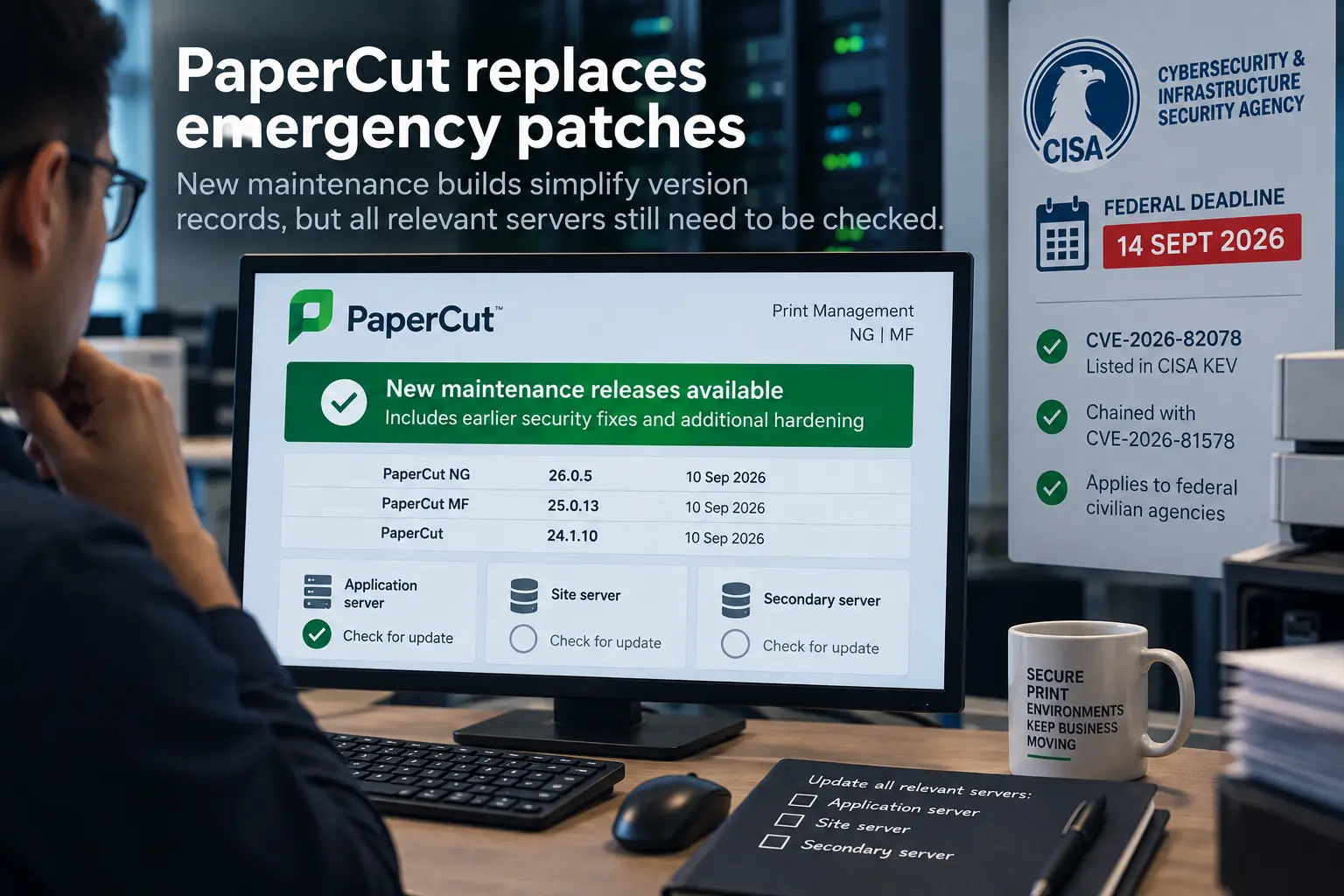
PaperCut replaces emergency patches as CISA deadline passes
PaperCut's new maintenance builds give administrators clearer version records, but site and secondary servers still need to be checked.

North America Cloud Services Trends
CISA deadline passes for exploited ScreenConnect flaw
ConnectWise says the flaw affects ScreenConnect clients, not servers, leaving providers to verify updates across the endpoints they support.

Europe and Middle East National Telecom Trends
ESpanix adds DDoS filtering in Madrid and Barcelona
Nokia Deepfield Defender lets participating networks filter attack traffic inside ESpanix rather than always diverting it to an external scrubbing centre.

Global Institutional Trends
MikroTik patch deadline passes for RouterOS flaw
CISA's deadline has passed for CVE-2026-86060, but patched routers may still need checks for changes made before the update.

CASE FILE
RFC 9919's SHA-1 Count Is Not a Retirement Receipt
RFC 9919 gives OCSP operators a useful migration signal: log the hash algorithm used by clients. It does not turn a falling counter at one responder into proof that every relying party has left SHA-1 behind.

CASE FILE
The Algorithm Label Changed. The Key Refused to Follow: RFC 9709
An attacker can rewrite a cryptographic label without breaking the advertised cipher. RFC 9709 answers that awkward fact by making the complete encoded algorithm identity part of the key itself—and by forcing operators to separate successful processing from evidence they can…

History
One Arrow Was a Mapping. Only the Return Made It Equivalent: RFC 2157
An attachment can cross a gateway, keep its bytes and still arrive under a weaker claim than the word “equivalent” suggests. RFC 2157 made that distinction unusually precise: one transformation was a mapping; equivalence required the outward and return mappings together to…

History
The Password Left the Wire. Its Equivalent Stayed in the File: RFC 2069
“We do not store passwords,” an administrator might have said in 1997. “We store only their digests.” RFC 2069 made the first half of that reassurance meaningful on the network: a client could prove knowledge of a password without sending it in cleartext. It also made the second…

IETF
A DTLS Return-Routability Probe Is Not a Migration Receipt
A protected datagram arrives with the right Connection ID and a new source address. The cryptography can locate an existing DTLS security context, yet the receiver still has a separate decision to make: whether to move that context, release application output to the new address…

History
The Signature Knew Who Spoke. It Could Not Know Whether the Link Was Real: RFC 2154
RFC 2154 let an OSPF advertisement carry its origin evidence through every flooding hop. That was a remarkable change from trusting only the neighbour that handed over the packet. Yet the RFC drew its own harder boundary: a router could sign a false metric, a dead link or a…

History
The Namespace Arrived. Understanding Did Not: RFC 2153
RFC 2153 gave proprietary PPP extensions a shared outer address: Code or Type 0, an OUI, a Kind and vendor-defined values. That prevented private meanings from colliding in the public fields. It did not make those meanings public, prove that a peer understood them, or turn…

History
RFC 2065: The DNS Reply Crossed an Ordinary Server. Its Signature Carried the Trust
In January 1997, RFC 2065 proposed a security upgrade that did not require every machine carrying a DNS answer to become its judge. A security-aware resolver could retrieve signed records through a server that knew little about the new machinery and verify the evidence itself.…

Global Institutional
Akvorado turns sampled flow records into operational network memory
Akvorado gives network operators a self-hosted way to retain, enrich and examine flow records over long periods. Its value lies in exposing the path from router export to operational decision; its central limit is that every chart still inherits the sampling, loss, timing and…

Story
LACNIC’s Election Upload Test Reads Bytes, Not Excel or PDF
A new compatibility test in LACNIC’s open election system carries two reassuring filenames across a disk boundary. The bytes arrive intact. That is valuable evidence—but it is evidence about transport, not about whether a workbook or a result letter is a valid document, whether…

Creators
David S. Miller and the public process behind Linux networking
A networking patch can start as a few lines of code and end up affecting servers, routers, phones, cloud hosts and appliances around the world. David S. Miller has spent decades close to the point where those changes become shared Linux infrastructure, first through the SPARC…

Global Cloud Services Trends
Zscaler’s acquisition-adjusted growth uses three different perimeters
Zscaler reported 25% growth in both revenue and annual recurring revenue for fiscal 2026, then offered a 20% comparison that removed Red Canary. Elsewhere, its accounts valued four acquisitions and its year-end controls report excluded all four from testing. The figures are not…

IETF
The Clock Agreed. Did the Traffic? Auditing RFC 9722 Recovery
RFC 9722 gives recovering EVPN peers a common instant for rerunning Designated Forwarder election. That is a precise control-plane promise—not evidence that clocks, forwarding entries and customer packets all crossed the boundary together.

Global Cloud Services Trends
SentinelOne’s Flex milestone needs a consumption bridge
SentinelOne says its Flex commercial model now accounts for more than 10% of annualised recurring revenue. That is a meaningful threshold inside a business with US$1.218 billion of ARR and US$1.7 billion of remaining performance obligations. Yet the filing also says revenue from…