
Topic
Institutional Legitimacy
Within the Topic facet, Institutional Legitimacy topic intelligence connects articles that share a specific subject, signal focus, or monitoring theme. The page gives readers a richer path through related reporting, source evidence, market actors, and infrastructure implications, with enough context to understand why the topic matters across company movements, governance decisions, regional exposure, and operational risk. Readers can compare recurring signals, affected organisations, public evidence, market context, service continuity, procurement, competition, compliance, and strategic planning questions behind the subject instead of stopping at a thin list of matching articles. It explains what the topic covers, which infrastructure actors or policies are involved, what evidence supports the coverage, and why the subject may matter for operators, customers, investors, and policy readers.

IETF
A Valid ECH Key File Does Not Prove the Right Privacy Boundary
RFC 9934 gives operators a portable way to place an Encrypted ClientHello private key beside the public configuration that uses it. The match is valuable, but it is smaller than the decision a privacy service must make: which names, DNS records, servers, retry paths and time…

CASE FILE
The FTC Withdrew a Health-App Statement, Not the Breach Rule
A one-page withdrawal can produce a dangerously large misunderstanding. On 9 September, the US Federal Trade Commission rescinded a 2021 policy statement about health apps and connected devices. It did not say that the Health Breach Notification Rule had disappeared. The…

Global Institutional
ISC’s operational control ends where deployment evidence begins
ISC’s BIND and Kea projects are widely documented and publicly maintained. The harder accountability question is narrower: which parts of continuity can ISC demonstrate, which parts belong to distributors and operators, and what evidence would show that a repair survived contact…
Global Institutional
INFINITYWIFI and AS210057: Who Can Correct the Record—and Who Can Remedy a Failure?
INFINITYWIFI and AS210057: Who Can Correct the Record—and Who Can Remedy a Failure? intelligence summary explains the development, the public evidence available to readers, the organisations involved, the regional context, market exposure, and the infrastructure consequences that…

IETF
The Route Policy Can Change While Its SR-Algorithm Number Stays the Same
RFC 9933 lets a path request name an SR-Algorithm. For a Flexible Algorithm, however, the number is only a handle: the policy that actually selects a route lives in a winning definition, a metric dictionary, a topology snapshot and an ordered evaluator that can all change…

ICANN
ICANN’s Authority Has Five Separate Links
ICANN’s practical power is easiest to misunderstand when mission, policy, contract, implementation and review are treated as one thing. Its public materials describe a mission centred on Internet unique-identifier coordination, while its agreements and procedures show how…

Story
APNIC's NIR Co-Chair Was Re-elected Without an Online Ballot—By Rule
APNIC 62's linked result sheet contains four polls but no NIR SIG contest. That blank is not a missing tally. It is the visible edge between two procedures: contested positions go to the online system; one confirmed candidate goes to acclamation in the SIG room.

CASE FILE
Ofcom’s NCII Hash Programme Separates Detection From Judgment
The most important word in Ofcom’s new intimate-image-abuse measure is not “hash”. It is “judgment”. A digital fingerprint can tell a service that an uploaded image resembles material represented in a database. It cannot, by itself, establish consent, context or every element of…
Global Institutional
What AS33169 Can Prove About Utherverse Network Operations — and Where Continuity Still Disappears
What AS33169 Can Prove About Utherverse Network Operations — and Where Continuity Still Disappears intelligence summary explains the development, the public evidence available to readers, the organisations involved, the regional context, market exposure, and the infrastructure…

ICANN
How ICANN Turned a .COM Renewal Into an Operative Contract
ICANN’s 2024 renewal of the .COM registry agreement shows where authority in internet governance actually changes form: community input becomes a proposal, the Board authorizes an institutional act, delegated officers complete the transaction, and a contract becomes the operating…

IETF
A Valid Federation Signature Cannot Audit the Decision to Admit a Member
A machine can verify that a federation operator signed today’s member list. It still cannot see who admitted a member, which rule they applied, what evidence they accepted, or whether an exception has expired.

CASE FILE
California’s AI-Audit Laws Separate Registration From Verification
California has enacted two gates for a market that promises to check artificial-intelligence systems. One law will require people selling covered AI audits to enter a public registry and follow conduct rules. The other tells the state to decide which auditors merit the more…

Story
AFRINIC's Arabic Policy Index Returns 404 While English Tracks Seven Live Proposals
A policy register can be authoritative in one language and still become unreliable evidence in another. On 11 September, AFRINIC's English current-proposals index answered normally; the official Arabic route did not answer with an older table, a move notice or an English…

Leaders
Noor Helmi’s Decision Surface: What IX Telecom’s Public Record Can—and Cannot—Attribute
A people-and-leadership investigation of the boundary between Noor Helmi’s observable executive role, IX Telecom’s institutional operating model and the evidence required to show that capability survived beyond the founder.

ICANN
ICANN’s Authority Chain: From Institutional Mandate to Contractual Remedy
ICANN’s power over the domain-name system is easiest to misunderstand when it is treated as a single grant of authority. The public record describes something more layered: institutional powers and accountability rules in the Bylaws, operational obligations in registry and…

CASE FILE
UK AI-Health Blueprint Would Put Device Versions in Patient Records—but Is Not Yet Policy
The most important field in Britain’s new blueprint for governing artificial intelligence in healthcare may be a version number. The National Commission into the Regulation of AI in Healthcare wants the device state used in a patient’s care recorded so that an outcome can later…
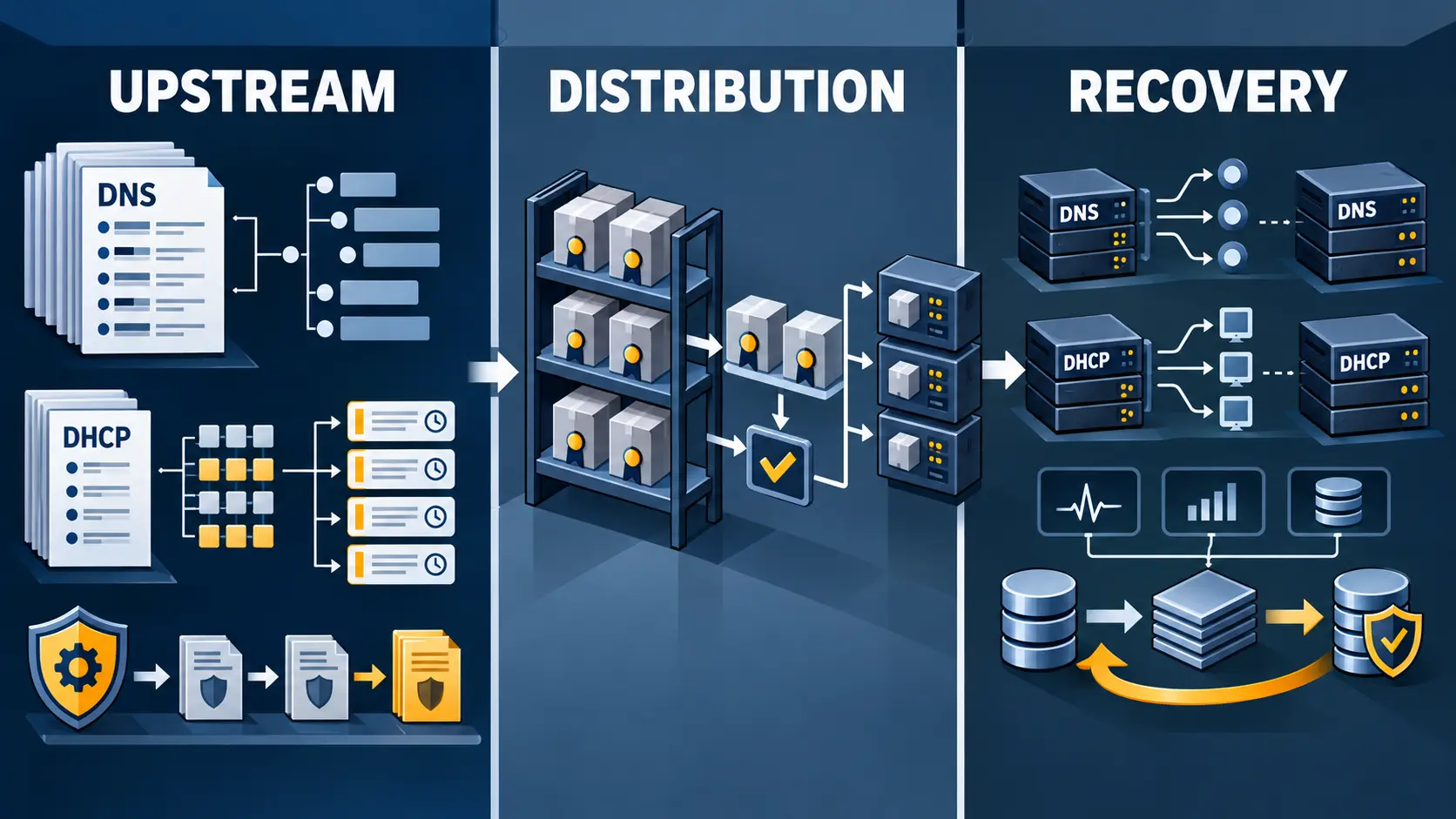
Global Institutional
The Dependency Chain Behind ISC Software
ISC’s BIND and Kea influence network resilience through a chain that runs from upstream release work to distributor packaging and operator-controlled recovery. The public record documents important mechanisms and distribution channels. It does not show how many operators deploy…

History
The List Expired on 16 June: RFC 2000 and the Two Axes of Protocol Status
RFC 2000 was itself an Internet Standard, yet it carried a use-by date. That was not a paradox. The document was authoritative as a dated classification, not a permanent measurement of what the Internet had implemented.
ICANN
ICANN’s Authority Is a Chain, Not a Crown
ICANN can influence the global domain-name system without being a government. Its practical authority is assembled across several instruments: a California nonprofit charter, corporate bylaws, multistakeholder policy procedures, contracts with registries and registrars, technical…

IETF
A Valid YANG Schedule Is Not Evidence That Its Action Is Still Authorized
At 02:00, a controller executes the seventh occurrence of a maintenance schedule created six months earlier. The recurrence is enabled, its version is current, the clock is trusted and no scheduling conflict is reported. Yet the team that approved the action has been reorganized…