
Region
United States
United States regional intelligence explains how companies, people, policy moves, network operations, investment signals, data centre demand, telecom execution, and market constraints shape infrastructure delivery in the same geographic market or governance area. The page connects published coverage with evidence, regional actors, operating dependencies, market context, and customer or regulatory exposure that may otherwise sit across separate topic or company pages. Readers can compare who is active, which signals are backed by public evidence, how local execution risk connects to broader internet infrastructure strategy, and what changes may affect customers, partners, regulators, or capital planning. Readers can understand the geography, the relevant infrastructure sectors, the public evidence base, and the practical questions that make the regional page more useful than a short listing of articles.

CASE FILE
The company wants a faster vote. Its shareholders may need the time
Getting a deal approved sooner is an attractive promise. The SEC's proposed shorter timetable raises a less comfortable question: can the people expected to vote finish their preparations just as quickly?

North America Datacenter
In Hawaii, the internet also needs a way to stay home
Undersea cables connect Hawaii to distant markets. HIX has a less spectacular job: helping nearby institutions reach one another without an unnecessary ocean crossing.

North America National Telecom Trends
Amazon Leo has an Army speed result. The customer story is still taking shape
A laptop connection at Aberdeen Proving Ground gave Amazon a striking number. The more revealing question is what the Army's engineers want from commercial satellite companies after a demonstration ends.

CASE FILE
Five law scholars dispute SEC’s case for rescinding shareholder-proposal rule
A 13 October comment says Rule 14a-8 governs federal proxy disclosure rather than state-law corporate rights; other filings ask for a longer review or support repeal with safeguards.

CASE FILE
SEC’s $173 million cross-trading estimate leaves the distribution question open
The SEC projects sizable annual transaction-cost savings from expanding affiliated fund trades, but its aggregate model cannot show which fund families can capture those savings or how much would reach shareholders.

CASE FILE
SEC proposal would move fund cross-trade checks to compliance officers
The SEC wants to widen the securities that affiliated funds may trade with one another. Its proposal would also shift the quarterly compliance determination from fund boards to chief compliance officers, with annual reviews and reports intended to preserve oversight.

History
Stanford Ran 18 IP Subnets Before the Standard, 1984
In October 1984, RFC 917 described subnetting as a proposal. Stanford had already used IP subnets since early 1982, adapting an older Pup network and routing system rather than waiting for a common Internet procedure.

CASE FILE
SEC would rescind shareholder-proposal rule and widen proxy discretion
The September proposal would move the question of proposal inclusion toward state law and company governing documents, while making it easier for companies to seek discretionary votes on certain items left off their proxy cards. Shareholders would receive a proposed checkbox to…

CASE FILE
SEC staff highlights disclosure and override time for third-party retail voting
An 8 October staff interpretation says federal proxy rules do not require companies to offer retail voting programs or a menu of standing instructions. When a company offers instructions based on outside recommendations, the guidance points to the information shareholders receive…

North America National Telecom Trends
The FCC's E-Rate review puts the limits of school broadband funding on the record
The FCC’s October 13 comment deadline turns E-Rate into a test of both measurement and authority. A school’s Wi-Fi connection may show that a network exists; it does not by itself show that support is no longer needed, or that federal officials may set every rule for how the…

North America National Telecom Trends
Three Carriers Promise Satellite Competition. The Access Rules Will Decide
AT&T, T-Mobile and Verizon have signed a joint venture agreement that promises more satellite-provider competition and common device standards. The harder question is whether new entrants can reach the platform on clear terms and prove that its promised compatibility works.

History
MFS Bought UUNET to Bring Internet Access onto City Fiber
When MFS bought UUNET in 1996, the complement was more than a second Internet company: UUNET reportedly spent heavily to reach customers over local telephone lines, while MFS was building metropolitan fiber. The records show the logic and a later combined offer, but do not prove…

History
MILNET Was Split Logically Before Its Circuits Were Physically Separated
The Defense Department’s separation of research traffic from unclassified military operations was a staged operating change. MILNET service began first, software controls divided the communities in 1983, and the physical network partition followed in 1984. Controlled gateways…
History
The Agreement That Connected Three Commercial Networks: CIX, 1991
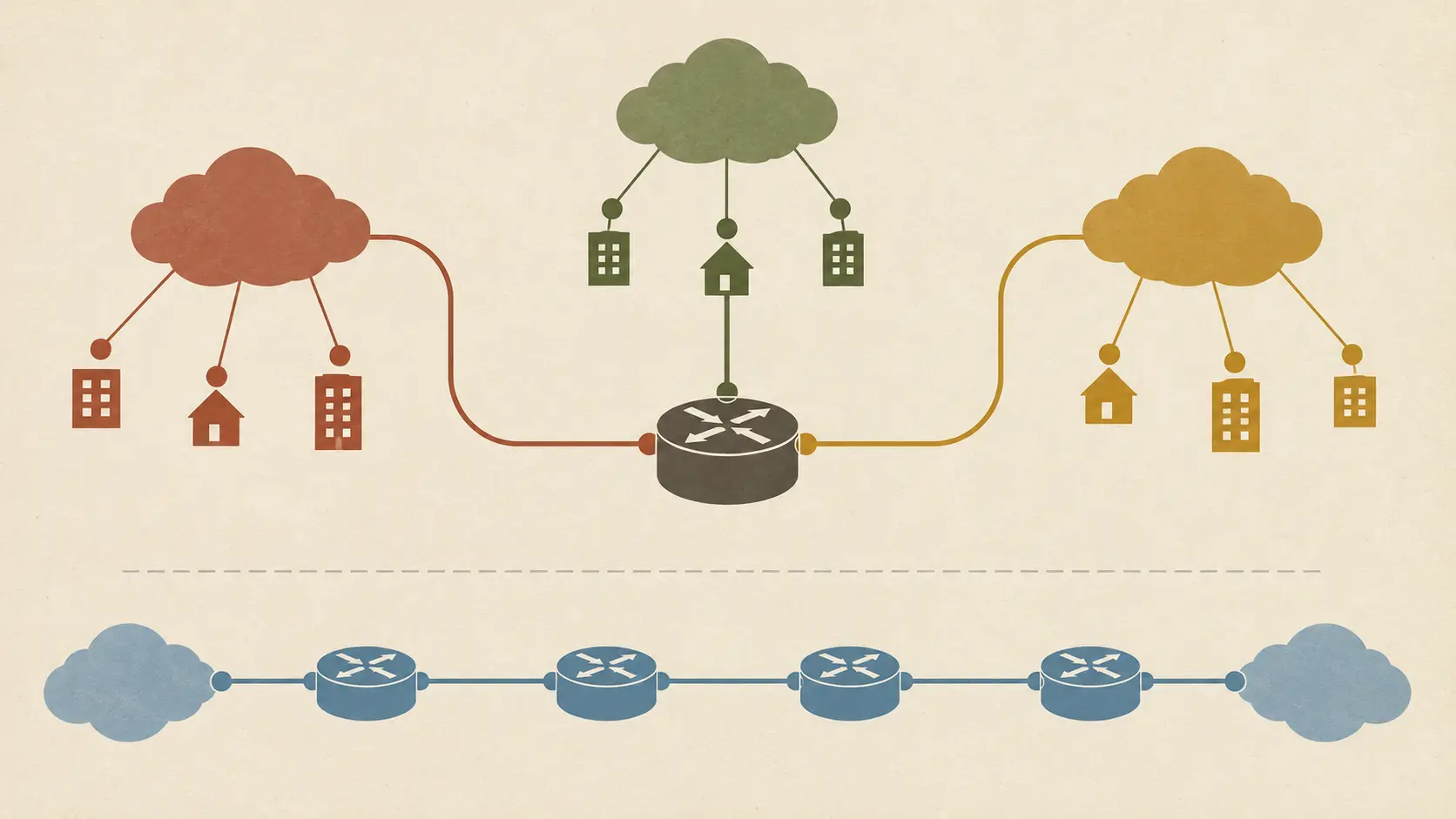
On 25 March 1991, PSINet, UUNET’s AlterNet and CERFnet announced an agreement for customers on their separate networks to exchange traffic directly. CIX mattered because it specified who could exchange what, under which cost rule, and over which path; it did not confer universal…

History
The License Covered the Code, Not the Protocol: Gopher’s 1993 Line
On 11 March 1993, the Minnesota Gopher Team opened a newsgroup post by saying it had heard enough “hysteria” and rumor to set out an official position. The phrase that later stuck was simple: commercial users would need a licence. The policy that followed was not. It divided…

North America National Telecom
AT&T’s Fiber JV: Open Access Depends on the Anchor Tenant
AT&T plans to combine Forged Fiber 37 and Gigapower with GIP and CPP Investments. The ownership split is public; the wholesale rules that will turn “open access” into an orderable service are not. AT&T remains central to the customer relationship and was named as the planned…

North America Regional ISP Trends
Calix says BBT’s small-business ARPU rose 13%; the base is missing
Calix says Big Bend Telephone lifted small-business average revenue per user by 13% in nine months as SmartBiz adoption beat an undisclosed target. The offer is visible; the customer base, starting revenue and margin bridge are not.

North America Regional ISP Trends
FreeU has a $55 price; the value of each ad remains undisclosed
U-wifi presents FreeU as a way to earn internet credits by watching ads, but its public offer still starts at $55 a month. The business case turns on what an ad actually earns, what reaches a customer’s bill, and what remains after wireless access and service costs—not on the…

North America Institutional
Two Companies Named Hughes, One AI Legacy That Got Lost
Before Hughes Network Systems ran self-healing networks on Microsoft's cloud, an earlier Hughes ran one of the defining autonomous-vehicle programs in American AI research. The directory entry that links them is mostly an accident of naming — and the collision tells you something…

North America Institutional Trends
FINRA's Quiet Ledger: What a Year of Sanctions Data Says About Regulator Accountability
The Financial Industry Regulatory Authority filed 625 disciplinary actions in 2025 and ordered $99.6 million in fines and disgorgement, yet the numbers that surround those headline figures raise a harder question than enforcement volume: who audits the auditor, and does the audit…