
Summary
- The FCC’s open E-Rate review asks whether broad school connectivity justifies narrowing or reorienting support; it does not adopt a sunset or new eligibility rule.
- The record needs to distinguish the connection to a school from the network inside it, recurring affordability from headline coverage, and local internet-safety choices from federal funding conditions.
- Public comments can supply evidence and objections, but the final rules still need a statutory basis and a clear account of who has authority to decide.
A connectivity figure is not a closing argument
The Federal Communications Commission set October 13, 2026, for initial comments on its E-Rate review, with replies due November 12. The combined notice asks whether the programme’s connectivity objectives have been met, whether support should be narrowed or potentially sunset, and whether the FCC’s reading of the Children’s Internet Protection Act (CIPA) is the best reading of the law. Those are questions for a rulemaking record, not decisions already in force. The Federal Register notice summarizes the proceeding; FCC 26-41 contains the full questions.
The tempting shortcut is to treat reported school broadband and Wi-Fi access as proof that E-Rate has finished its job. The FCC says some data sources report that virtually all schools have broadband and Wi-Fi, then asks whether the programme’s original access mission has been fulfilled. The qualification matters: the notice does not present a new school-by-school audit, nor does a connection count say what service costs, whether it is reliable, or what support is needed to keep it working.
Congress wrote more than a coverage target into section 254. Under §254(h)(1)(B), carriers provide eligible services to schools and libraries for educational purposes at discounted rates. Section 254(h)(2)(A) directs the FCC to establish competitively neutral rules that enhance access to advanced telecommunications and information services in classrooms and libraries. The statute also describes universal service as an evolving level that the Commission periodically defines. Those provisions leave a real interpretive question, but they do not make the answer self-evident from a map of connected buildings. The current text of 47 U.S.C. §254 puts the discount and access duties in distinct clauses.
“To” and “within” are different network problems
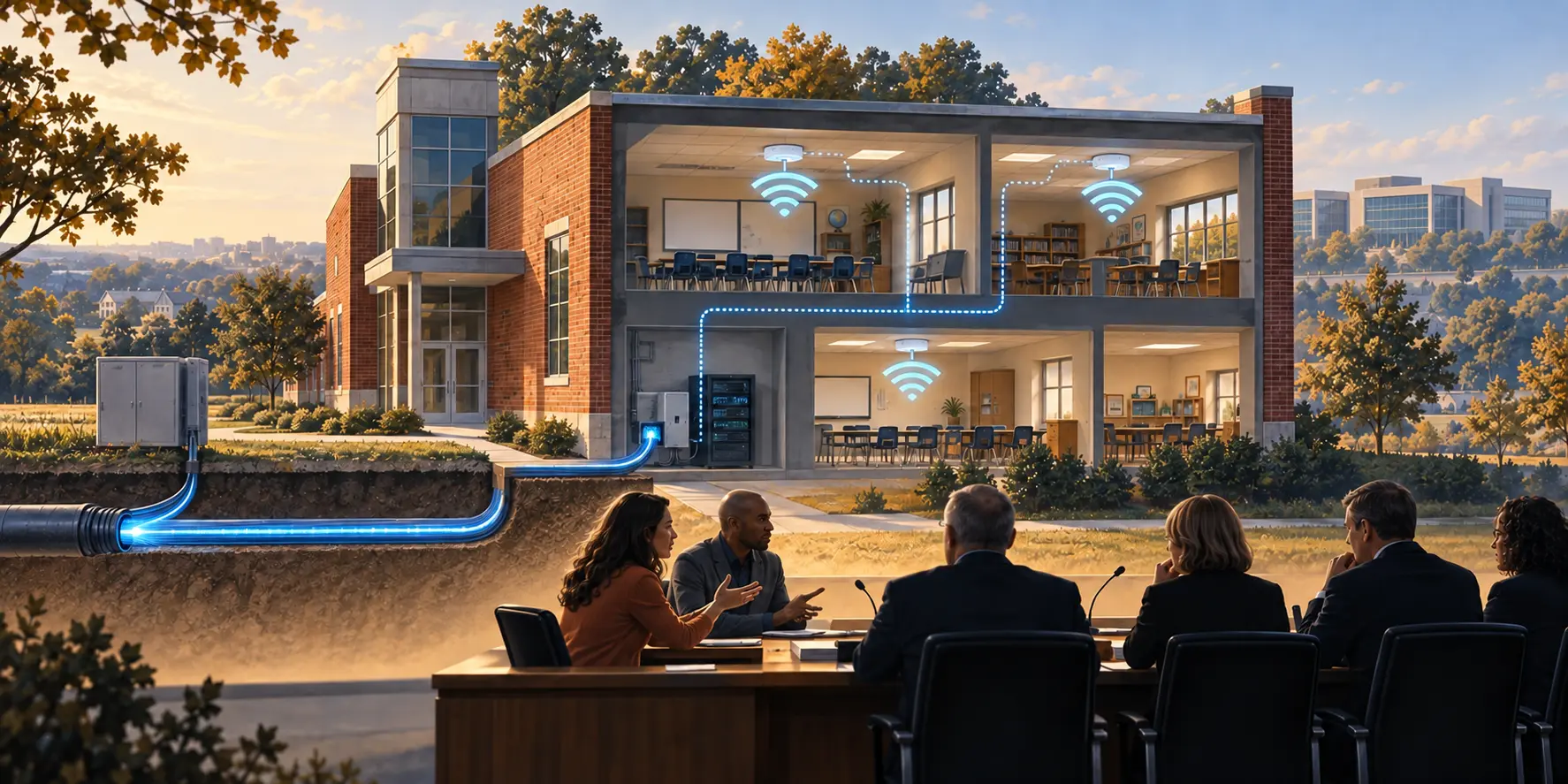
E-Rate supports both a connection to a school or library and internal connections that carry service through the building. The notice says demand has remained below the annual funding cap in recent years, but asks why and whether applicants have needs outside the programme’s current scope. In funding year 2025, applicants requested $1.806 billion for Category One services, described as connections to schools, and $1.418 billion for Category Two services such as internal connections, Wi-Fi, maintenance and managed internal broadband. These are requests, not amounts spent or proof that every request was granted.
The distinction changes what “mission complete” could mean. A provider may reach a campus while the district still needs switches, access points, maintenance or recurring service at an affordable rate. The Commission itself asks what services recipients use repeatedly, what happens if support is limited, and how needs may change over five to ten years. A fair review would compare the network at the boundary with the network inside it, and then compare both with the cost and quality of service. It would not let one aggregate adoption figure answer all three questions.
The FCC also notes that E-Rate discounts range from 20 to 90 percent, with larger discounts for the most disadvantaged schools and libraries. A change to eligibility or discount design therefore reaches beyond programme totals: it can alter the public share paid for an ongoing connection. The docket asks whether the existing discount criteria allocate support fairly and efficiently. It has not yet established that any district or library would lose funding.
Screen time opens a separate authority question
The notice’s second track asks whether E-Rate support should be conditioned on screen-time limits and, if so, who should set them: the FCC, a school board, a local educational agency, a library or another local authority. It also asks what statutory power the Commission has to impose such conditions and how a limit could work across different ages, educational and recreational use, schools and libraries, and devices not owned by the institution.
CIPA already requires covered schools and libraries to adopt an internet-safety policy and use a technology-protection measure in specified circumstances. It also calls for reasonable public notice and at least one public hearing or meeting. That process gives local communities a place to raise evidence and objections. The statute does not itself establish a daily screen-time quota. The FCC is asking whether its existing CIPA interpretation is correct and whether other authority could support further conditions; it has not imposed them.
This is not a semantic difference. Filtering material, deciding when a connection is available, and limiting a child’s total hours online are distinct controls. A condition attached to federal support could prompt new software, staff work and enforcement procedures. The FCC asks commenters to estimate costs and benefits, which is a signal that the operational burden remains to be documented.
The FCC’s notice also revisits past interpretations of section 254 after Loper Bright. The Supreme Court ended Chevron deference in 2024, but that did not automatically erase each earlier FCC rule. The notice asks whether interpretations once sustained under Chevron still fit the statute’s best reading. That is a question for evidence and legal argument, not a presumption that every expansion was unlawful. The Court’s opinion supplies the legal backdrop.
Participation can inform a mandate; it cannot create one
Parents, teachers, districts, libraries, providers and vendors all have relevant evidence. A comment docket can reveal the price of maintaining a campus network, the limits of a filter, or the difference between a classroom and a public library. A local hearing can expose who bears the consequences of a proposed safety policy. Neither participation channel turns attendance, volume of comments or stakeholder status into authority that Congress did not assign.
The decision-ready record should make four things visible: what “connected” means in operational terms; which Category One and Category Two costs recur; how affordability and service differ across schools and libraries; and what statutory clause authorizes each proposed condition. For screen-time policy, it should also distinguish content filtering from time limits and state who would implement and answer for each rule.
That is the test the October deadline opens. The FCC may ultimately narrow support, preserve it, or change its conditions. Whatever it chooses, connection rates alone cannot decide the statutory question, and a list of interested participants cannot substitute for the decision rights written into law.
Sources
Member Briefing
Deeper Profile Context
Sign in with the right membership level to unlock the full briefing and source notes.
Only for Strategic Circle
Strategic Circle
Open to all readers. Unlock profile briefings after joining and signing in.
Join Strategic CircleOnly for Leadership Alliance
Leadership Alliance
For qualified IP-asset owners and management; sign in to unlock alliance briefings.
Join Leadership Alliance