
Summary
- CIX began as a bounded agreement: customers of PSINet, UUNET’s AlterNet and CERFnet could exchange traffic directly, without an added customer charge in the launch announcement.
- A later economic account describes the member arrangement as settlement-free, but physical circuits, ports and network capacity were not costless; CIX did not grant a general right to reach every Internet network.
Analysis
A commercial path inside a mixed network
CIX did not appear before the Internet had commercial services. In November 1990, RFC 1192 described commercial providers such as UUNET and PSI alongside the research network hierarchy. It also recorded a more complicated relationship than “commercial versus public”: some networks used the NSFNET backbone without charge, but their use was in principle limited to research and education. The backbone sat above networks with different funding, customers and operating arrangements.
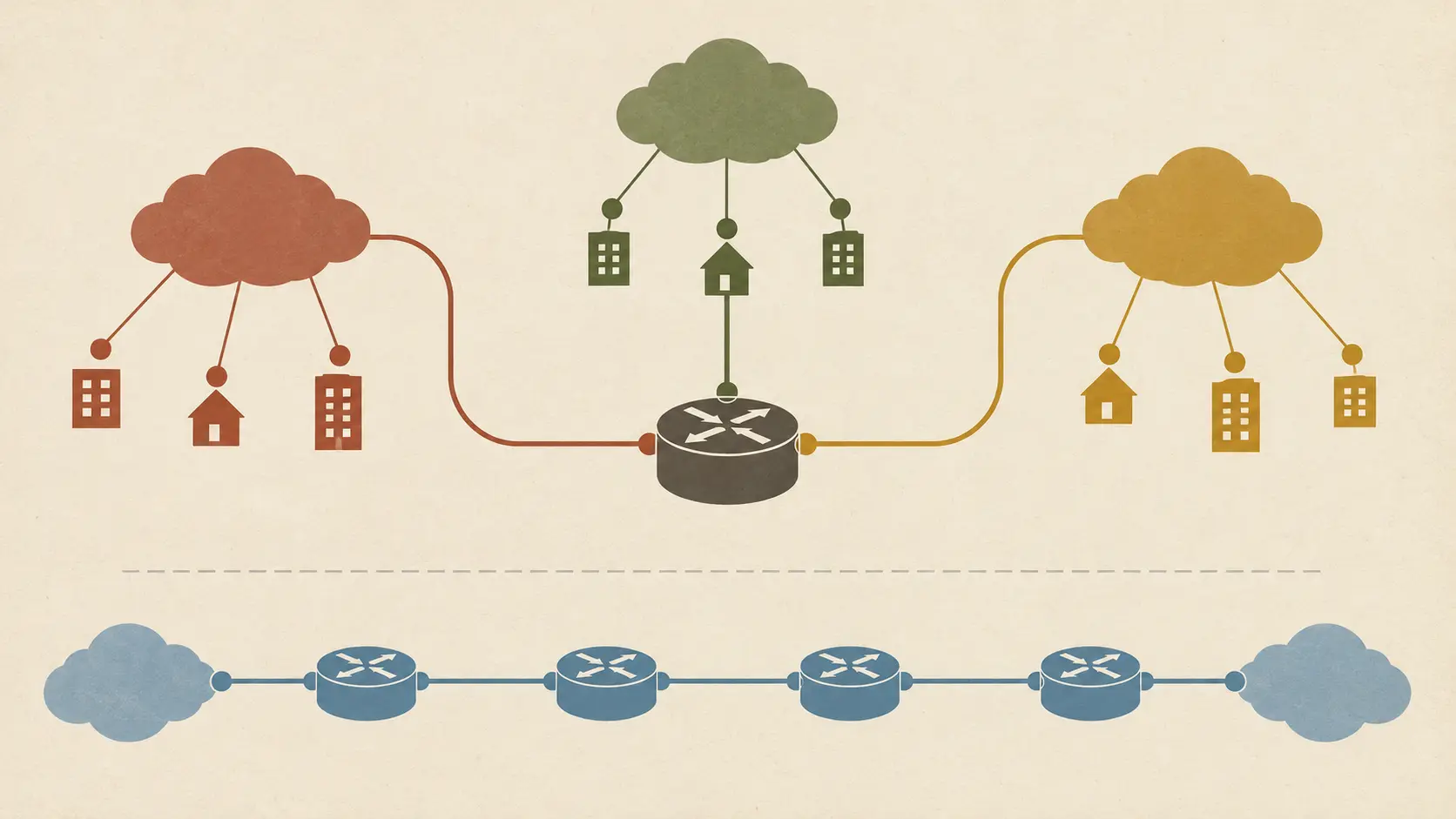
That distinction mattered when a commercial customer on one provider needed to reach a customer on another. The March 25, 1991 announcement said the CIX agreement would let customers of AlterNet, CERFnet and PSINet exchange Internet traffic directly, regardless of which of the three supplied their connection. It said the exchange used the providers’ redundant T1 facilities and was requested by commercial customers, especially firms with sites connected in different places. The release described a path across those providers, not a universal interconnection service.
The date depends on which record is being read. The contemporaneous release says the exchange was established on March 25. A 1995 economic history dates CIX’s formation to August 1991, while RFC 1259, published in September 1991, says it formed that year. These sources do not explain whether they mean the first agreement, public announcement, organized association or operating exchange. The safest chronology preserves the distinction instead of choosing one date as the sole beginning.
“No additional cost” had a boundary
The release promised that customers could exchange traffic “at no additional cost.” It also quoted the founders describing the interconnection as a way to avoid the restrictions that applied when traffic crossed the NSFNET backbone. Those are the signatories’ claims about their agreement. The same announcement called their combined market position “nearly 100%”; that promotional estimate is not an independent census.
A later account by Padmanabhan Srinagesh explains the arrangement between the providers as settlement-free: each network served its own customers and accepted traffic from CIX members without a traffic-based payment to another member. That is not the same as saying transport was free. The providers still needed routers, leased circuits, capacity, staff and customer access. “No settlement” describes one layer of the commercial relationship; it does not erase the cost of building and operating the networks below it.
Srinagesh also identifies the CIX router in Santa Clara, managed by PSI, with the other founding networks connected by private lines. This makes the exchange more concrete and less abstract than a declaration of openness. A commercial agreement defined the participating networks and exchange terms; a particular piece of infrastructure carried the traffic. The announcement’s promise of direct exchange depended on the member networks’ routes and links.
An alternative path was not a new universal rule
The NSFNET policy was not a simple ban on every commercial packet on every part of the Internet. RFC 1359 reproduces the February 1992 Backbone Services Acceptable Use Policy: its general principle supported open research and education, including research arms of for-profit firms when engaged in open scholarly communication and research, while excluding other uses. The scope attached to services and purpose. A private commercial exchange could create a different path for traffic among its members without repealing the NSFNET policy for traffic that still used that backbone.
The CIX announcement said its agreement could be extended to other commercial providers. RFC 1259 later treated CIX as an initial move toward an exchange association with common rules. Both statements point to an ambition beyond three networks; neither proves that every provider joined, that every route was exchanged, or that the whole Internet became commercially reachable through CIX. The association, membership terms, router, transport circuits and actual routing state were separate parts of the arrangement.
The useful historical claim is therefore narrower than “CIX opened the Internet.” CIX showed how providers could define a shared traffic and settlement rule across their own networks while preserving separate operations. It changed the options available to participating customers. It did not replace the rest of the Internet’s funding, routing or policy structure, and the sources reviewed here do not establish that CIX alone caused the later transition away from the NSFNET backbone.
Sources and evidence limits
The launch release is a contemporaneous provider announcement, so its market-share estimate and expected adoption are reported as claims, not measurements. RFC 1192 and RFC 1359 document policy context. Srinagesh’s 1995 account supplies the settlement and router details; it is retrospective. The records use different dates for CIX’s establishment and do not reconcile them.
Sources
- “Establish the First Commercial Internet Exchange (CIX),” provider announcement, 25 March 1991
- RFC 1192, “Commercialization of the Internet,” November 1990
- RFC 1259, “Building The Open Road,” September 1991
- RFC 1359, “Connecting to the Internet,” August 1992
- Padmanabhan Srinagesh, “Internet Cost Structures and Interconnection Agreements,” 1995
- Barbara Dooley, testimony for the Commercial Internet Exchange Association, 30 September 1997
Member Briefing
Deeper Profile Context
Sign in with the right membership level to unlock the full briefing and source notes.
Only for Strategic Circle
Strategic Circle
Open to all readers. Unlock profile briefings after joining and signing in.
Join Strategic CircleOnly for Leadership Alliance
Leadership Alliance
For qualified IP-asset owners and management; sign in to unlock alliance briefings.
Join Leadership Alliance