
Primary Domain
Internet Infrastructure
Within the Primary Domain facet, Internet Infrastructure intelligence groups reporting by primary domain so readers can follow a focused area of internet infrastructure, governance, connectivity markets, or digital capital. The page brings together related articles, public evidence, institutions, companies, people, regional exposure, operating dependencies, and market context that may otherwise sit across separate category pages. It explains the domain, the likely actor class, the market or governance context, and the source material readers should use when comparing signals. Operators, analysts, and governance readers can see how the same domain appears across events, profiles, market shifts, public-source evidence, regional dependencies, and longer-cycle infrastructure decisions over time.

History
At the Router, Membership Became a Route: CIX's 1994 Filter
In 1994, a shared router made it easy for CIX members to exchange traffic without a per-byte bill. Then the association tied route advertisement at that router to a US$7,500 annual membership—and pointed providers toward private links that could carry the exchange elsewhere.

Global National Telecom Trends
A Route Is Not a Jurisdiction: BICS’s SCION Bet Needs a Service Contract
BICS’s move into the SCION Association gives a years-long technical effort a stronger industry platform. The commercial test is whether customers receive verifiable path control and continuity; a selectable route alone cannot decide where data is governed or who remains legally…

History
One Gateway in Suva, Many Permissions Across the Pacific: USPNet’s 1995 Internet Plan
The University of the South Pacific had reached the internet over a 2.4 kbps leased line by November 1994. A year later, its upgrade proposal imagined a faster Suva gateway for campuses scattered across the Pacific, but the local stations and permissions that would make that hub…

History
The Dish Had a Lender; the Circuit Had a Sponsor: Mongolia’s Internet Bargain, 1996
Mongolia’s first permanent Internet route was built with two different kinds of money: a local revolving loan for the satellite equipment and a proposed outside subsidy for the monthly circuit. The distinction explains both how the gateway became possible and why a working…

Story
WorldLink’s APNIC /32 Scaled; DHCPv6 Still Held the Session
WorldLink’s account of more than one million IPv6-enabled IPoE subscribers includes an outage loop in which DHCPv6 lease recovery and a broadband gateway’s binding behavior could affect the shared session. The figures describe different things; none is an independent…

Leaders
Sam Weiler and the DNSSEC Trust Path Outside the Parent Zone
DNSSEC Lookaside Validation gave a signed child zone another way to reach a validating resolver when its parent could not publish a usable DS record. The detour still depended on a second, locally configured trust anchor. Sam Weiler’s RFC 5074 describes that bargain; the later…

History
The Message Was Online by Schedule: Nepal’s Early Internet, 1993–95
Nepal exchanged scientific email through a scheduled cross-border relay before commercial providers established a continuously online international IP link. The dates and early upstream paths do not line up in every account.

History
Uganda’s First Full IP Link Was a Kampala Gateway
Uganda’s 1995 Internet milestone began with an international satellite route, but the first full-IP service still entered users through a Kampala provider. The distinction matters: a new path to the global network was not yet a national access network.

History
The Research Network That Became an ISP: Singapore’s TechNet Handoff, 1995
Singapore’s Internet did not move from campus experiment to household service in one launch. TechNet first connected research institutions; SingNet opened a public-facing commercial service in 1994. A year later, TechNet itself crossed into private operation, carrying an…

Europe and Middle East National Telecom Trends
Arelion's 21% spectrum gain still needs a service test
A live-network trial between Amsterdam and London widened the optical spectrum Arelion can use. The commercial question is how much dependable, priced customer capacity that extra room can carry.

History
The 32 Kbps Link That Challenged Kenya’s Telecom Monopoly
Kenyan organisations had exchanged email for years, but those services were not yet the full Internet connection later histories describe. In October 1995, the African Regional Centre for Computing put a 32 Kbps leased link to the United Kingdom into service. The connection…

History
Two Links to Stockholm, One Missing at Home: Estonia’s 1992 Internet
A 64 kbps satellite link brought TCP/IP from Tallinn to Stockholm in 1992. A second link served Tartu. The striking part of the story is what did not yet connect the two Estonian cities.
History
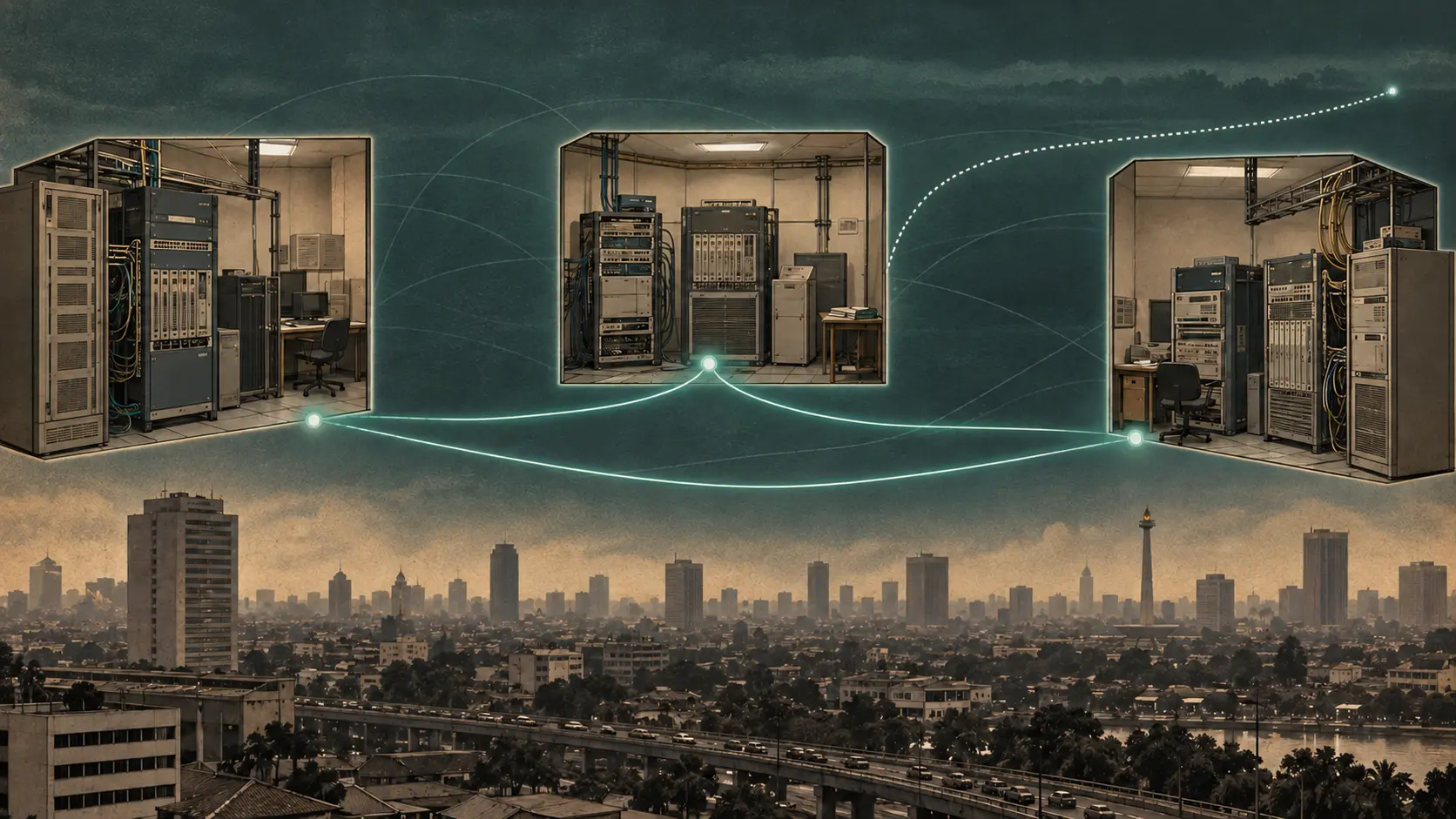
Local Traffic Had to Cross Borders: Indonesia’s 1997 Internet Exchange
In 1997, Indonesian network operators faced an odd routing fact: a message between two users in the same country could depend on international links. APJII’s answer was not one national backbone, but a federation of three carrier-hosted exchange sites where providers could meet…

Asia-Pacific Regional ISP Trends
WorldLink's IPv6 milestone makes traffic the real test
WorldLink reports that about 70% of its traffic uses IPv6. The share says more than an enabled-subscriber count, but no published denominator or observation window makes it a comparable performance score.

History
35 of 124 Municipalities: Buenos Aires Rebuilt Government Links with TCP/IP
A provincial decree made one satellite message service the official route for government communications. The project team’s later account shows how narrow that route was, and how a new IP network grew over the carrier links already in place.

History
The Traffic Meter Was Not the Bill: EARN’s 1990 Funding Vote
In 1989, EARN tested whether countries should contribute according to network traffic. The Board approved a 1990 budget, then sent the traffic formula back for more work.

History
85 Cities, More Than $8 Million in Losses: Telenet’s 1977 Network Bet
When Telenet went to public investors in December 1977, the reported 85-city footprint sounded like national scale: local access was said to be possible for about 80% of the US population. The same account reported more than $8 million in accumulated losses. The gap between reach…

History
One Link for Two Universities, One Bill at First: Mexico’s 1989 NSFNET Connection
A shared satellite channel joined UNAM and ITESM to a US research network. Its agreement spread equipment duties, but the first bill landed with one university.

History
The Call to Amsterdam: How EUnet Carried Europe’s Mail and Usenet
For one Belgian university department, the nearest European Usenet host was in Amsterdam, but the estimated international telephone bill kept the department offline. EUnet’s early history is easiest to see from that distance: a shared network depended on local links that…

History
The Index File Was an Exit Plan: ALIWEB’s Web Search Experiment, 1993–94
ALIWEB let each Web server describe selected resources in a small index file, then gathered those files into one searchable database. Its more durable bet was that the descriptions could move to a better system if the central service stopped being useful.