
Summary
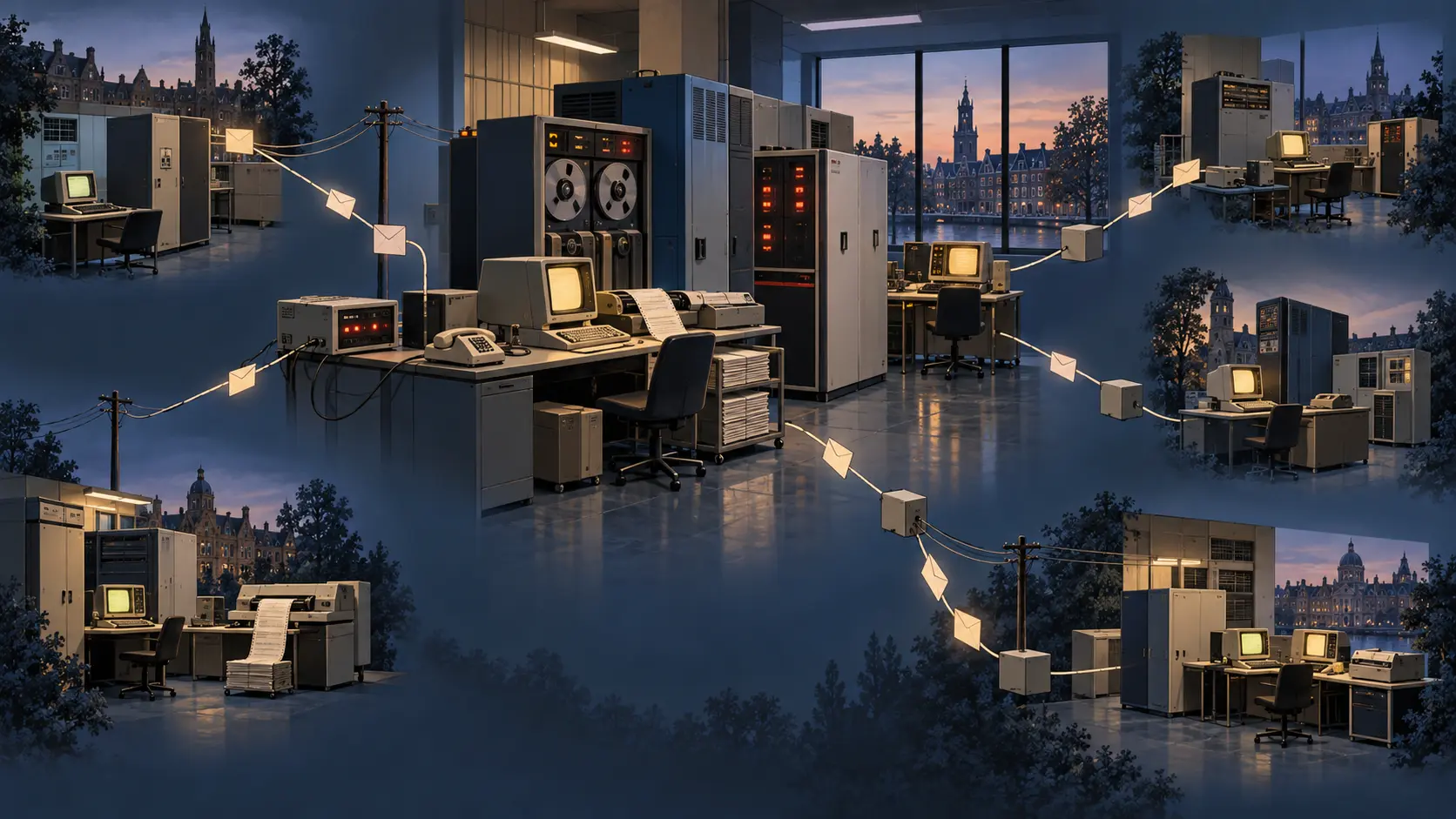
- EUnet began in 1982 as a European UNIX user-group network. Its Amsterdam centre at CWI concentrated UUCP maintenance and experience as national sites joined.
- Mail and Usenet could cross borders through store-and-forward links before every participating site had interactive IP service; national paths, budgets and operating roles still differed.
A nearby host, an expensive call
The KU Leuven Computer Museum records a practical obstacle from Belgium. Around 1980, a department wanted to exchange email, and the closest European computer it identified as connected to Usenet was in Amsterdam. The estimated cost of that international telephone connection delayed its participation. The constraint was not a lack of interest in networked discussion. It was the price of reaching the next machine.
Belgium’s later path shows how local conditions could change the answer. The national RTT began building an X.25 network in 1984. The museum’s account says those connections were cheaper and easier to control financially than the telephone option in this case. Philips Research Lab in Brussels made the first described Belgian connection to the Amsterdam host mcvax and paid for it. A shared European service did not remove the local bill; it gave an institution a useful destination for the link it could arrange.
A network assembled around users and operators
At an EUUG conference in Paris in 1982, Teus Hagen presented what a 1998 NLnet history calls Europe’s first UNIX network. It places the centre at the CWI computing centre in Amsterdam and credits Hagen and Piet Beertema with setting it up. Beertema maintained the UUCP software and infrastructure, becoming a technical reference for network maintainers elsewhere in Europe.
The arrangement joined national and international sites without requiring every pair of computers to maintain a continuously interactive session. UUCP carried queued work between UNIX hosts; a message could move through a sequence of machines. Email and Usenet news were applications carried by that exchange. The design allowed reach to grow through participating sites, but the available histories do not preserve a complete route map or the schedule for every link.
Finland’s timeline illustrates why “the route” is too simple a description. In 1983, Tampere reached EUnet’s email network by dial-up UUCP through Enea Data in Stockholm. In 1984, Helsinki University of Technology connected to mcvax; Usenet news came to Tampere through Enea while Helsinki handled mail through Amsterdam. These were separate paths for different traffic, recorded in one national history. They do not establish that Finland’s users had a single, always-on European connection.
Shared formats, local transport
Two RFCs help explain the boundary. RFC 976, published in 1986, standardised a mail interchange format for the UUCP community. It explicitly left message storage and lower-level transport to other mechanisms, and described routing through next-hop tables. RFC 1036, published in 1987, treated Usenet as messages passed between neighboring systems over any suitable network; its examples include news spooled to rnews across UUCP.
Those documents describe how systems could exchange mail or news. They are not deployment logs for EUnet. The Belgian history makes the service boundary tangible: a 2,400-baud X.25 path in 1986 exchanged mail and news, but the account says interactive services were not available through it. By 1989, a 9,600-baud X.25 link carried email and a news feed to about twenty Belgian sites. Its operator replaced the X.25 connection with a leased line in 1990 because the X.25 cost had become high. The network’s local shape changed as the economics changed.
When volunteer coordination acquired operating risk
The work also acquired an institutional shape. The 1998 NLnet history says the growing financial and operational involvement was an unacceptable risk for NLUUG, a professional association. In 1989, NLUUG founded Stichting NLnet to operate the Dutch network. The Dutch operation was part of the story, not the whole European umbrella. A 1993 NLnet annual report records EUnet becoming independent from EurOpen from January that year, with NLnet taking a share in the new company to support continuity.
These steps mark different things: a user-group service, a national operation, and a European organisation. Treating them as one continuous company would erase who maintained links and who carried the costs at each stage.
EUnet’s historical importance lies in the practical gap it filled. A European UNIX site could join mail and news exchange without first receiving the same interactive IP service as every other site. Local operators chose the medium, paid for the line and kept the system running. The record shows a growing network; it does not provide continent-wide user counts, uptime, delivery times or proof that every node had general Internet access.
Sources
The 1998 NLnet history is a later account by Teus Hagen, Frances Brazier, Wytze van der Raay and Jos Alsters. NLnet’s Teus Hagen biography describes EUnet as the EUUG dial-up service and gives later scale claims. The KU Leuven Computer Museum documents its Belgian network path; the Finnish Internet Society provides a national timeline. The 1993 NLnet annual report, RFC 976 and RFC 1036 support the organisational and protocol details. These sources do not supply a complete EUnet topology or audited network-wide performance figures.
Member Briefing
Deeper Profile Context
Sign in with the right membership level to unlock the full briefing and source notes.
Only for Strategic Circle
Strategic Circle
Open to all readers. Unlock profile briefings after joining and signing in.
Join Strategic CircleOnly for Leadership Alliance
Leadership Alliance
For qualified IP-asset owners and management; sign in to unlock alliance briefings.
Join Leadership Alliance