
Summary
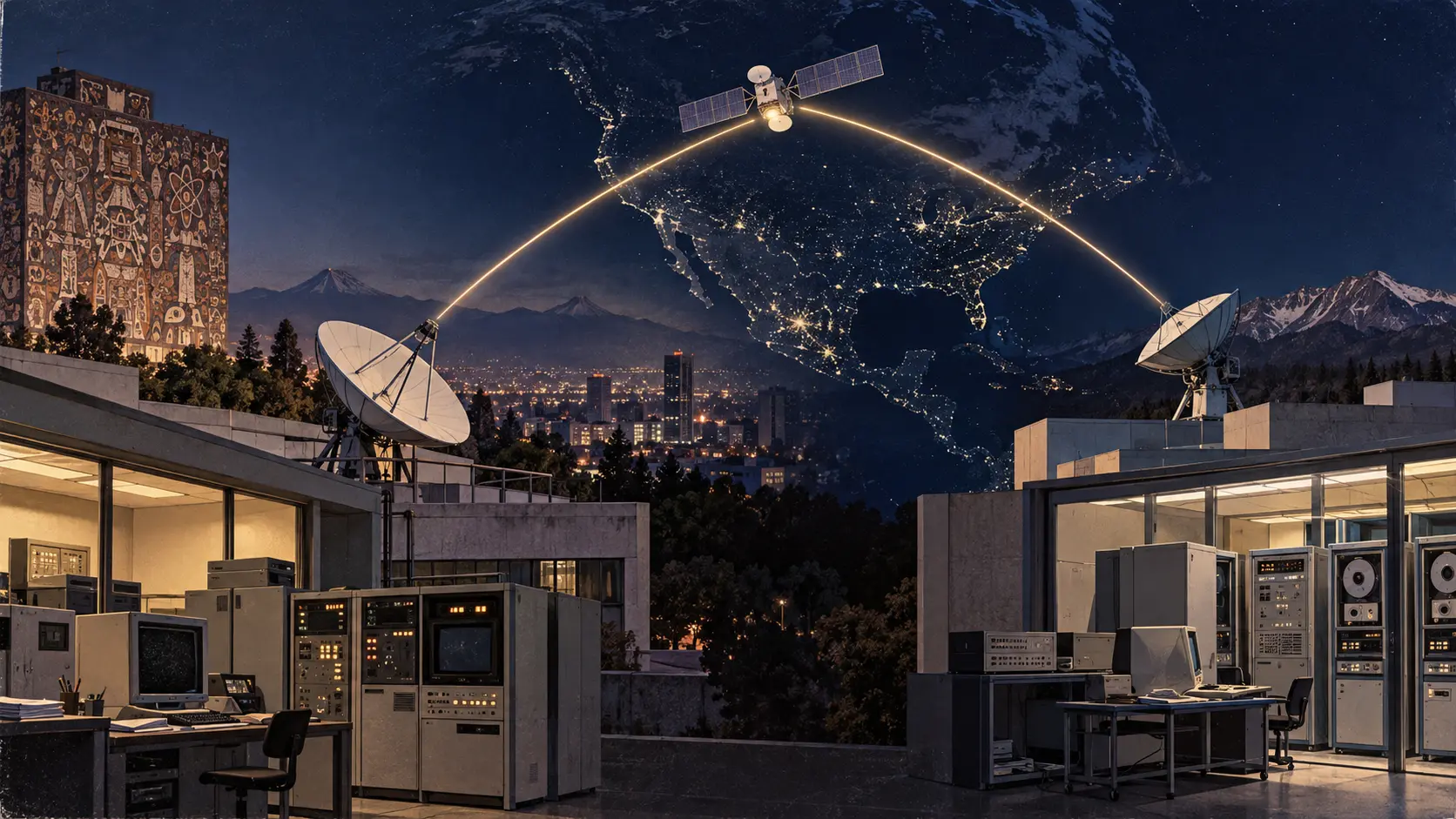
- In 1989, UNAM and ITESM shared a 128-kbps satellite channel through Mexico’s Morelos I satellite to NCAR in Boulder, creating an academic cross-border route with costs divided across institutions.
- The contract and a later billing letter reveal that shared infrastructure and financial responsibility did not initially line up: the channel was billed to UNAM, and a subsequent letter says the account was regularized without disclosing the revised allocation.
The most revealing detail in Mexico’s 1989 international connection is not a launch date. It is a billing mismatch. A later letter reproduced in Gloria Koenigsberger’s institutional history says the 128-kbps Morelos I channel was charged to the Universidad Nacional Autónoma de México (UNAM), although the channel was shared with the Monterrey Institute of Technology (ITESM). A subsequent letter says the account was regularized. The published record does not state the new allocation, so it cannot support a claim that the two universities split the bill equally—or tell us who paid what after the correction.
That small administrative fact changes how the link looks. A satellite connection is often narrated as a national arrival: a spacecraft, a ground station, and a date. The documentary trail instead shows a negotiated service assembled from equipment, institutional commitments, a US research endpoint, and rules about who could use it. The channel connected UNAM’s astronomy institute and the National Center for Atmospheric Research (NCAR) in Boulder through Mexico’s Morelos I satellite. ITESM shared the channel.
Its capacity was 128 kilobits per second, a precise measure of this service rather than a measure of Mexico’s entire international connectivity.
The agreement’s design distributed obligations. Koenigsberger reproduces correspondence from the NSF/NASA discussions and the agreement among the participating institutions. Each institution was to cover equipment purchase, installation, and maintenance on its side. NSF and NASA financed the Boulder-side equipment; ITESM and UNAM were responsible for equipment in Mexico. The stated purposes were academic, and commercial traffic was prohibited. The Mexican institutions also undertook not to deny other universities access to the international link.
Those terms made the channel more than a private cable between two laboratories: they described a shared academic resource, bounded by both purpose and institutional responsibility.
But an agreement about equipment is not automatically an agreement about recurring service charges. The later billing correspondence makes that gap visible. UNAM had signed the 128-kbps channel contract, and the charge initially appeared under its account despite ITESM’s use. Koenigsberger reports that a follow-up letter said the arrangement had been regularized; the reproduced record does not give the revised terms. The defensible conclusion is therefore limited: the original billing did not reflect the shared use, and the parties later addressed the discrepancy. Anything more specific about the ultimate cost split would outrun the evidence.
The link also sits inside a longer institutional chronology. The book documents the work that began years before the 1989 tests: scientific demand, negotiations, equipment planning, training, and the effort to establish a viable connection. UNAM’s link to NCAR was tested in July 1989. The book also describes ITESM’s Internet link in 1989, while noting that the exact date of its Boulder transmission is not publicly established. The Internet Society of Mexico’s history places an earlier ITESM terrestrial NSFNET path in February 1989, before the UNAM satellite link.
These accounts caution against calling the satellite channel Mexico’s first Internet connection. Its significance lies in the particular cross-border research route and the arrangement that made two universities users of one capacity.
The route’s stated academic boundary matters too. It was not an unrestricted consumer service. It joined research institutions under a contract that specified permitted use, counterpart responsibilities, and access commitments. That combination offered a way to move scientific data and communication across a border, but it depended on organizations able to procure equipment, operate terminals, and carry costs. A promise to share the link broadened its institutional reach; it did not make the capacity universal. Nor does the surviving account provide traffic volumes, uptime, or a complete list of universities that actually used it.
Read through the agreement and the bill together, the Morelos I connection appears as a compact governance problem. The technical path could be shared, but the contract, maintenance obligations, access promise, and payer were distinct control points. A shared channel can exist before its costs are shared cleanly. The later correction suggests that administration caught up with use, while the missing allocation leaves an important part of the settlement unresolved. That is a more precise history than a simple “first connection” milestone: a research link whose public value depended on how institutions divided access and responsibility.
Sources
Gloria Koenigsberger, Los inicios de Internet en México (UNAM, 2014), especially the reproduced agreements and later billing correspondence. Context: UNAM Global’s 2019 interview with Koenigsberger and Internet Society México’s history, which records an earlier terrestrial ITESM route. The published book does not disclose the revised billing terms. Additional institutional context: UNAM’s computing history chronology.
Member Briefing
Deeper Profile Context
Sign in with the right membership level to unlock the full briefing and source notes.
Only for Strategic Circle
Strategic Circle
Open to all readers. Unlock profile briefings after joining and signing in.
Join Strategic CircleOnly for Leadership Alliance
Leadership Alliance
For qualified IP-asset owners and management; sign in to unlock alliance briefings.
Join Leadership Alliance