Summary
- Logged-in readers could create reciprocal soft links by following a link or searching from one Everything2 node to another; repeated travel strengthened a connection.
- Early contributors described linking as unpaid cataloguing, useful promotion and sometimes commentary. A finite display meant a stored link could still be hard to see.
In March 2000, an Everything2 contributor called ideath recommended a curious kind of productive procrastination. Find entries without useful links. Connect them to things you know. Improve somebody else’s work without writing an essay of your own. The activity earned no experience points and added nothing to your count of published pieces. The website had found a way to put the reader on library duty without issuing a badge.
The short “Softlink binge” entry captures a task that can disappear behind the word “community”: helping the next person find a way through. Everything2 collected independently written pieces under topic pages called nodes. An author supplied the words; readers could help arrange what someone encountered after finishing them.
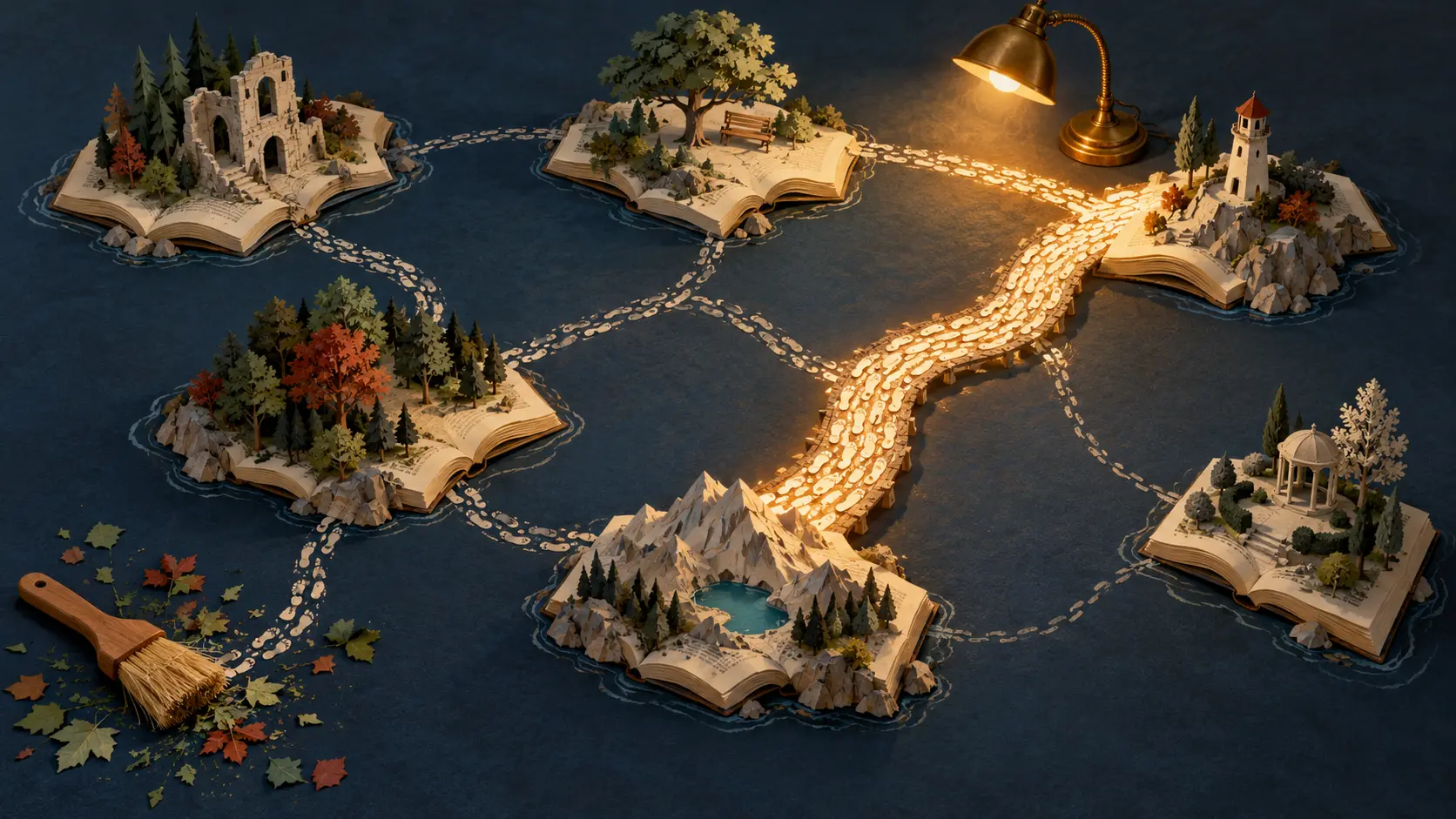
The site’s preserved explanations of soft links, including entries dated 2001 and 2002, describe the mechanism. A logged-in user moved from a whole node to another by following an in-text link or searching for its title and clicking through. The system made a connection at both ends. Beneath the writing, a table offered other places to go. More traversal strengthened a connection and moved it higher in the list.
That return journey mattered. An author’s ordinary link sent readers away from the article. A reciprocal soft link could also put a route back to it beneath another topic. Virgil’s January 2001 explanation cast this as a form of librarianship: people who knew the collection could connect material that a title search might miss. The software recorded the journey; knowledge of where to send somebody remained a human contribution.
The display had limits. A March 2002 question-and-answer entry by passport described 48 visible links for ordinary registered users and 24 for visitors who were not logged in. The database could retain more. If a new connection failed to appear beneath a heavily linked topic, stronger links might already occupy the available space. Storage was generous. The bottom of the page was a much smaller property.
This also made deliberate effort consequential. The same question-and-answer entry explained that repeated traversal could lift a link’s position, and urged contributors to connect older pieces after they fell off the new-writing list. Publication supplied a moment of visibility. Links offered further approaches to the work, provided somebody tended them.
The motives were as mixed as the writing. In an August 2000 contribution, stylee described links as references, promotion of relevant earlier work, wordplay and feedback. A surprising connection might be a useful association or somebody making a point. The table bundled these gestures into the same compact list. A strong route could have an enthusiastic gardener behind it.
The labour left a particularly useful trace on 4 January 2000. In a daylog, pingouin considered visiting old nodes to restore their soft links and asked whether Everything2 would have the convenient two-way linking available in its predecessor. The entry records one user facing maintenance work. Text had endured well enough to be worth revisiting; the paths around it required attention of their own.
The preserved Everything2 Help guide, which carries updates through 2022, lays out the division of work plainly. Authors put hard links inside their writing. Logged-in browsing produces soft links below the node. Editors can place firm links that direct readers toward the appropriate destination. These controls occupy different parts of the same page.
Everything2 made reading productive in a wonderfully untidy way. A person could arrive for an essay, follow a tangent and leave a usable connection for someone else. Another could deliberately cultivate the route. The resulting map carried curiosity, care and ambition in the same ink. Its usefulness depended on people knowing the collection—and on a reader remembering that a well-worn path can have more than one reason for being well worn.
Member Briefing
Deeper Profile Context
Sign in with the right membership level to unlock the full briefing and source notes.
Only for Strategic Circle
Strategic Circle
Open to all readers. Unlock profile briefings after joining and signing in.
Join Strategic CircleOnly for Leadership Alliance
Leadership Alliance
For qualified IP-asset owners and management; sign in to unlock alliance briefings.
Join Leadership Alliance