
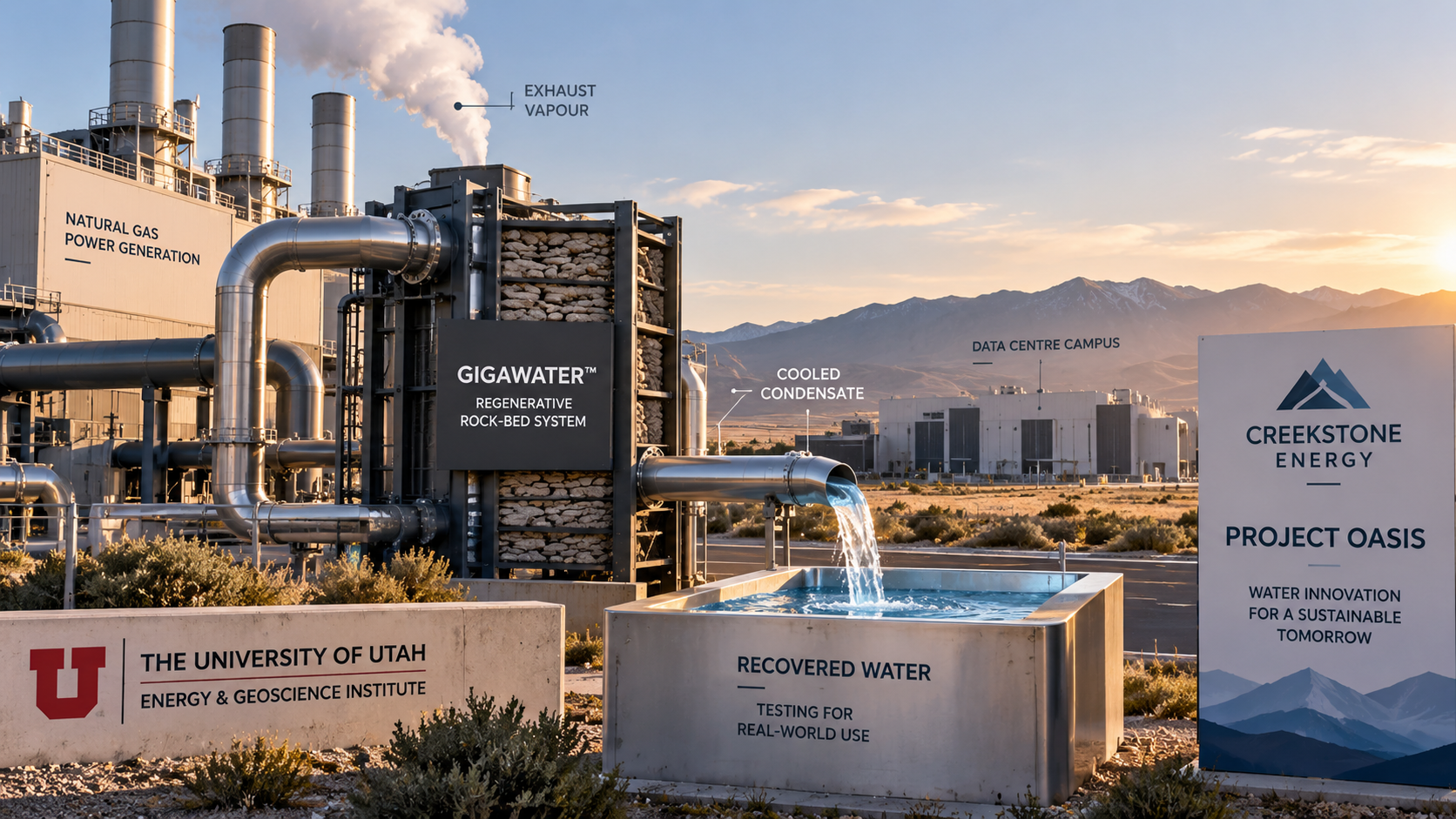
- Creekstone commissioned University of Utah research into recovering water from gas-power exhaust at its Delta data-centre campus
- The company projects about 4,000 acre-feet a year, but the figure has not been demonstrated at operating scale
The fact
Creekstone Energy announced on 9 September that it had signed a research agreement with the University of Utah's Energy & Geoscience Institute to examine a proposed process for recovering water from natural-gas power generation at its Delta Gigasite data-centre campus.
The patent-pending GIGAWATER process is designed to capture water vapour from power-generation exhaust, cool it through a regenerative rock-bed system and collect the resulting condensate. The university's work will test Creekstone's model and assumptions and move towards physical demonstration of the process.
Creekstone projects that the system could recover about 4,000 acre-feet of water a year, equivalent to roughly 1.3 billion US gallons. Founder Ray Conley said that estimate assumes around 2.1GW of gas-fired generation. It is a projection rather than measured output from an operating system.
Conley said university results are expected in summer 2027, while a decision on whether commercial-scale deployment makes sense could take about two years. Further testing is also needed to determine the recovered water's quality, possible uses and any treatment required.
Creekstone separately plans to use dry cooling at the data-centre campus to limit water demand. That cooling design and GIGAWATER are different systems: one reduces water used for cooling, while the other aims to recover moisture from power-generation exhaust.
The assessment
Before the projected water can be treated as a supply, testing has to establish how much can actually be recovered and what condition it is in. Irrigation, industrial use and drinking water can require different treatment, so the gross amount collected would not necessarily equal the amount available for every proposed use.
The projection also depends on the operating conditions behind it. Creekstone's estimate assumes about 2.1GW of gas-fired generation, which means any future water-supply calculation should retain that assumption rather than treat 4,000 acre-feet as a fixed annual output. The university research can test how closely actual recovery follows the model before Creekstone decides whether scaling the system is worthwhile.
For BTW readers, the next meaningful evidence is measured yield and water quality from physical testing. Those results would give Creekstone, potential users and public authorities a firmer basis for deciding whether recovered water can support a dependable supply agreement. Until then, the 4,000 acre-feet figure remains a projected output rather than an available water resource.
What to watch
Watch for the university's expected summer 2027 findings and details of a physical pilot. Measured recovery volume, water quality, treatment requirements and operating conditions will show how much of the projected output could become usable supply and for which applications.
Member Briefing
Deeper Profile Context
Sign in with the right membership level to unlock the full briefing and source notes.
Only for Strategic Circle
Strategic Circle
Open to all readers. Unlock profile briefings after joining and signing in.
Join Strategic CircleOnly for Leadership Alliance
Leadership Alliance
For qualified IP-asset owners and management; sign in to unlock alliance briefings.
Join Leadership Alliance