Summary
- Bangladesh Submarine Cables PLC reports 7,220 Gbps of ultimate-achievable capacity across SEA-ME-WE-4 and SEA-ME-WE-5, 6,850 Gbps lit, 4,320.24 Gbps sold by service class at 30 June 2025, and around 3,563 Gbps of bandwidth used in the country in June 2025 — four quantities for one system, all in the same audited report.
- Domestic IPLC sold rose 45.5% in FY2024-25 to 3,123.4 Gbps while the 863 Gbps IPLC export line reads identically in the FY2022-23, FY2023-24 and FY2024-25 reports.
- No period-matched taka-per-megabit appears in the record I could read: the only price series is a historical BDT-per-Mbps chart whose narrative contradicts its own final point, the live tariff page advertises reductions without a schedule in what was retrievable, and the newest financial filing carries revenue with no gigabit denominator. BTRC's 2011 licensing guideline already requires the tariff chart and the quarterly capacity returns that would close the gap.
Two beaches, one counterparty
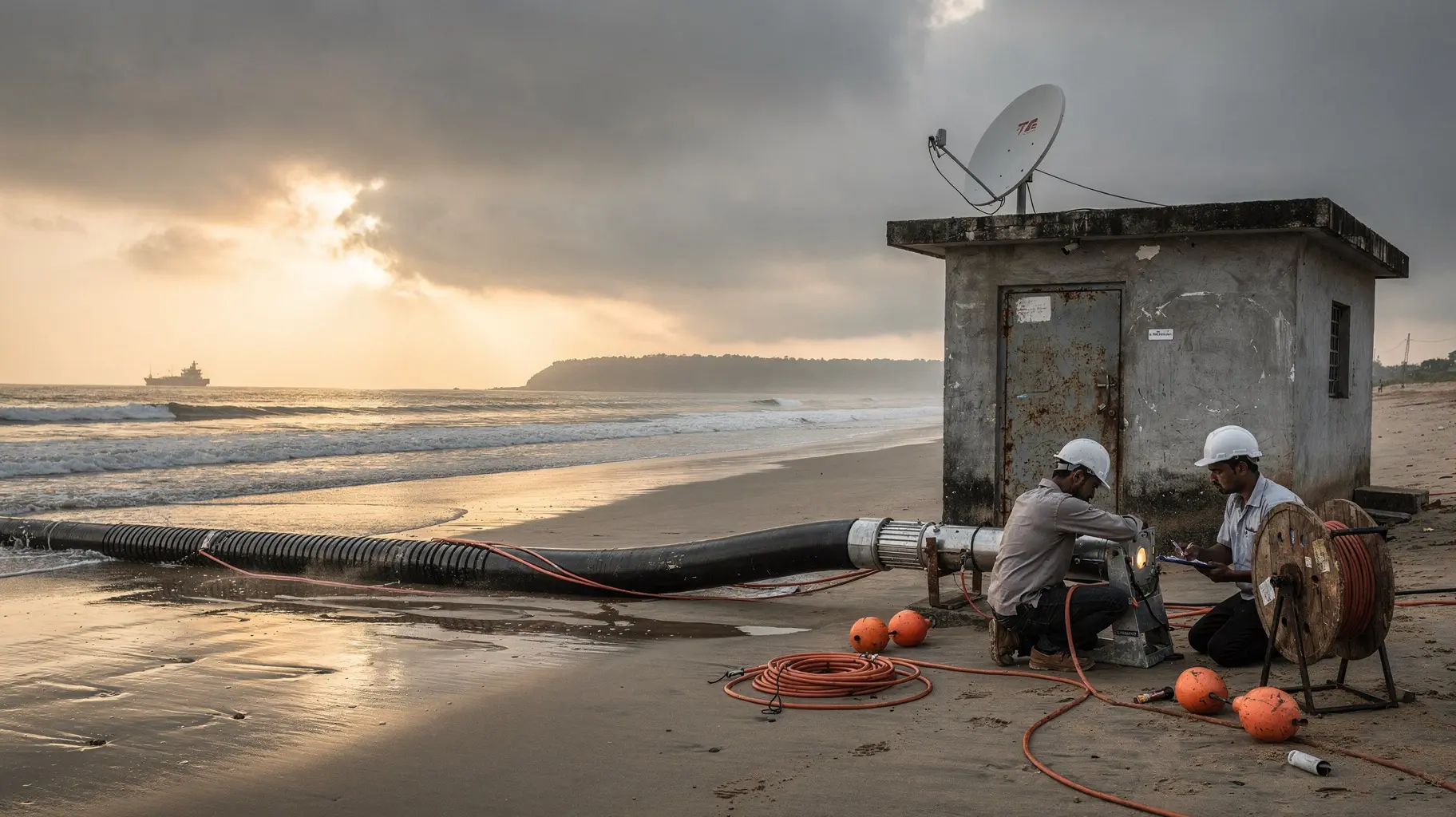
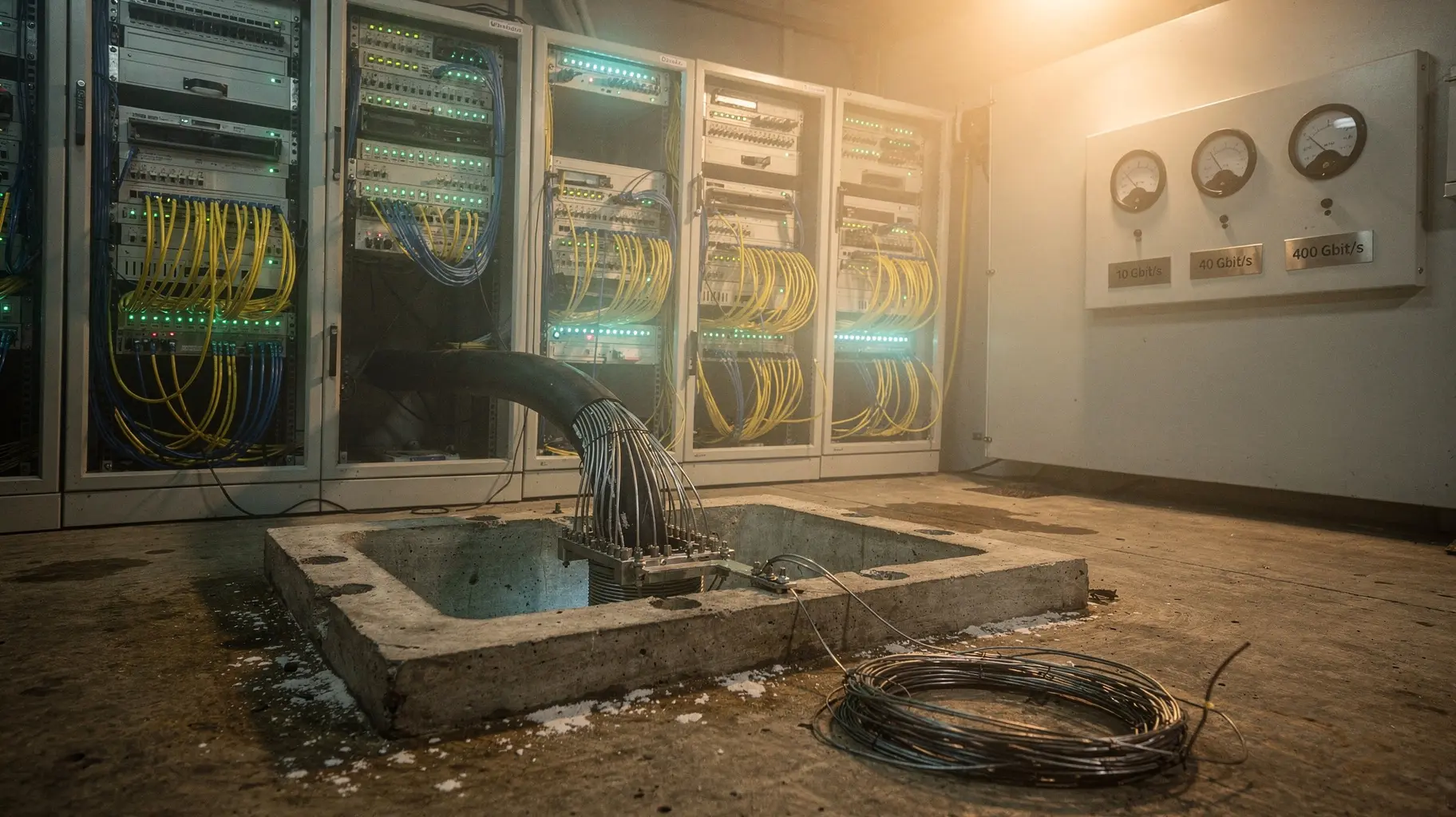
SEA-ME-WE-4 comes ashore at Cox's Bazar. SEA-ME-WE-5 comes ashore at Kuakata. Both are sold by the same company, filed in BTW's directory as Bangladesh Submarine Cable Company Limited, and both are sold from one catalogue: IPLC to international gateway operators at STM-1, STM-4 and STM-16; IPLC to international internet gateway companies at STM-1, STM-4, STM-16, STM-64, 1G, 10G and 100G; dedicated IPLC to BTRC-approved corporate users; and export of unused bandwidth to foreign customers (IPLC service page). Co-location is sold at three sites — Dhaka, the Cox's Bazar landing station and the Kuakata landing station — with rack space, cooling and power (colocation page).
Read that catalogue as a product list and one asymmetry stands out. The finer units, STM-64 through 100G, are listed for IIG buyers. IGW buyers are offered STM-1 through STM-16. The biggest pipe on the public list goes to the wholesale aggregators rather than to the licensed gateway operators.
Two cable systems, two landing stations, one vendor. A buyer can diversify the wet plant. It cannot diversify the seller.
The reports themselves are published under the masthead Bangladesh Submarine Cables PLC, while the directory files the entity as Bangladesh Submarine Cable Company Limited; this piece makes no claim about a renaming.
The four numbers
The FY2024-25 report gives SEA-ME-WE-4 an ultimate-achievable capacity of about 4,650 Gbps and SEA-ME-WE-5 an achievable or design capacity of about 2,570 Gbps, for a combined 7,220 Gbps (Annual Report 2024-2025). The same report puts SEA-ME-WE-5's lit capacity at 2,200 Gbps — 2,100 toward Singapore and 100 toward France — and the combined lit figure at 6,850 Gbps (same). The 370 Gbps between achievable and lit sits entirely on SEA-ME-WE-5; that subtraction is mine.
The third number is a stock at a date. As of 30 June 2025 the company reported capacity sold of 3,123.4 Gbps for IPLC, 863 Gbps for IPLC export, 323.84 Gbps for local IP Transit and 10 Gbps for exported IP Transit (same). Add the four and you get 4,320.24 Gbps — again my arithmetic, not the report's.
The fourth is a flow. "The amount of bandwidth used in the country in June 2025 from BSCCL's Submarine Cable systems was around 3563 Gbps," the report states, with 863 Gbps of IPLC export to STC, Telekom Malaysia and Orange excluded (same).
Put those on top of each other and the answer to "how full is Bangladesh's international capacity?" ranges from half to nearly two-thirds: 3,563/7,220 = 49.3%, 3,563/6,850 = 52.0%, 4,320.24/7,220 = 59.8%, 4,320.24/6,850 = 63.1%. The company publishes no utilisation percentage and no method for one. Those four rates are my divisions of its numbers, and the spread is the finding: one operator, one year, four defensible answers.
The two middle quantities also fail to reconcile exactly. Sold stock at 30 June is 4,320.24 Gbps. June use with the excluded export added back is 3,563 + 863 = 4,426 Gbps. The difference is 105.76 Gbps, about 2.4% of the larger figure. One is a stock on a date and the other a monthly flow, and the report supplies no bridge between them. That is ordinary untidiness in an operator-defined table, and it is exactly why the four numbers must never be quoted as one another.
The step change, and what sat still
The FY2022-23 report gives SEA-ME-WE-4 at 850 Gbps, SEA-ME-WE-5 at about 2,570 Gbps, and a combined capability of about 3,420 Gbps before upgrade 6 (Annual Report 2022-2023). With the additional 3,800 Gbps the arithmetic closes both ways: 850 + 3,800 = 4,650, and 3,420 + 3,800 = 7,220 (Annual Report 2024-2025). The ceiling more than doubled in a single upgrade cycle.
Demand followed on a lag, and unevenly. Domestic IPLC sold went from 2,115.91 Gbps at 30 June 2023 to 2,146 Gbps at 30 June 2024 — a 1.4% move — then to 3,123.4 Gbps at 30 June 2025, up 45.5% (2022-2023, 2023-2024, 2024-2025). Local IP Transit sold fell from 272.10 Gbps to 178 Gbps, down 34.6%, then recovered to 323.84 Gbps, up 81.9% (same three). Bandwidth used in the country went from around 2,556 Gbps in June 2023 to around 2,696 Gbps in June 2024, up 5.5%, then to around 3,563 Gbps in June 2025, up 32.2% (2022-2023, 2023-2024, 2024-2025).
So in the very year the extra 3,800 Gbps became available, domestic IPLC barely moved and local IP transit lost a third of its volume. The growth arrived a year later, and mostly in IPLC. Anyone reading only the FY2023-24 report would have concluded that a doubled ceiling had met a flat market.
The 863 Gbps IPLC export line is identical to the gigabit in all three audited reports. Three years, one number, and no note explaining whether that is a renewed block, a stable set of contracts, or a figure carried forward. The counterparties named beside it do shift: in FY2022-23 the report records 650 Gbps transferred to Saudi Telecom Company, 13 Gbps leased to Orange, 200 Gbps leased to Telekom Malaysia and 20 Gbps exported to BSNL (2022-2023); STC, Orange and Telekom Malaysia appear again in the following two years, alongside 20 Gbps of IP Transit exported to BSNL for Tripura (2023-2024). A line that never moves deserves a footnote it never gets.
The denominator that isn't there
The one official price series on the record is a BDT-per-Mbps chart: 27,000 in 2009, 1,750 in 2012, 240 in 2016, 390 in 2020 and 320 in 2022 (operator publication). Its own narrative says the price has since fallen below BDT 300, which its last labelled point contradicts. The document does not say whether those are monthly or annual charges, which route, which service class, or whether they are list prices or discounts. A series that cannot state its own billing period is not a tariff. It is a shape.
The company does keep a tariff page, indexed as last updated 24 August 2025, carrying a notice that bandwidth prices were reduced and directing buyers to sales contacts (service tariff page). It reached me as a search-index snippet and no numeric schedule appeared in it. That is a limit on what I retrieved on 12 November 2026, not a finding that a schedule does not exist.
The newest financial disclosure I read carries the money and not the denominator: revenue of BDT 3,769.00 million for the nine months from 1 July 2025 to 31 March 2026, unaudited, with turnover mainly from IPLC rent, IP transit service and co-location service (nine-month filing). No gigabit figure, no utilisation, no rate.
I could divide that revenue by one of the four capacities and print a taka-per-megabit. It would be worthless: the revenue is a nine-month flow that includes co-location, the capacity is a stock at one date in a different fiscal year, and the service mix inside the revenue is unstated. So there is no such number here.
The audited FY2025-26 accounts exist as a listing dated 28 October 2026 (report index); the PDF address was not exposed in what I retrieved, so nothing in this piece comes from them.
The regulator already asked for it
BTRC's 2011 submarine cable licensing guideline requires a licensee to submit a tariff chart with proposed maximum and minimum charges and a justification before selling or leasing capacity or providing facilities, and bars changes to approved tariffs without written approval: "The Licensee shall obtain the written approval of the Commission before making any changes to the approved tariffs and charges" (BTRC guideline). The same text requires quarterly returns covering installation capacity, active subscribers, end-user connectivity, quality of service, traffic and transmission links, plus annual reports and audited statements containing plant capacity and client information (same). It applies to the existing BSCCL submarine cable and carries a 3% gross-revenue-sharing obligation (same).
So the disclosure framework that would answer the question is not hypothetical. A tariff chart with a floor and a ceiling, quarterly capacity and traffic returns, audited plant capacity: all of it is already on the licensee's obligation list.
Whether it is still the operative obligation, I cannot tell you. BTRC's index lists three amendments to the submarine cable guideline, dated 15 April 2021, 10 January 2022 and 14 February 2022 (BTRC guidelines index). I did not read them. Nothing above describes the current tariff-approval regime rather than the 2011 text.
What the public record shows is a company that publishes its ceiling, its lit capacity, its sold stock and its monthly use, and a regulator whose rulebook asks for the tariff behind them. The gap sits between a filing and a publication.
What a buyer is left with
Take the seat of anyone sizing a commitment. An IIG weighing more IPLC can see the ceiling and the sold stock, so it knows the country sits somewhere between half and two-thirds committed. It cannot see a rate per megabit for a stated term and class. It cannot see which domestic gateway holds what, because no operator-by-operator allocation appears in the reports. And whichever cable it buys on, it faces one counterparty.
That leaves the ceiling to do the talking. 7,220 Gbps is the figure that travels, because it is the flattering one; 3,563 Gbps is the figure that constrains, because it is what the country used. When the seller publishes the first and not a rate, the buyer's only benchmarks are a fourteen-year-old taka chart with a contradictory last point and whatever the sales desk says next.
BTW's Bangladesh coverage has so far sat at retail ISP level: small network-resource holders, upstream dependency, thin margins. This is the layer above them, and it is where their costs begin.
Bangladesh's capacity figures are unusually good for a market with a single landing party. Its price record is not. Until a period-stamped taka-per-megabit sits beside one of those four gigabit numbers, every negotiation in the country's international market starts at the seller's ceiling and ends at the buyer's guess.
Member Briefing
Deeper Trend Context
Sign in with the right membership level to unlock the full briefing and source notes.
Strategic Circle
A daily briefing in your language, built from changes we have verified.
Join for USD 20/monthCancel anytime.
Public reporting stays free. Member research, the daily briefing and the forum need a membership.