
Summary
- IANA’s WHOIS record dates the
.btobject to 16 July 1997, almost two years before Bhutan announced Internet service for citizens on 2 June 1999. - A Bhutan Telecom presenter’s 2015 history says
.btmoved from an earlier tour-operator arrangement to the Department of Telecommunications and Ministry of Communications, then to ITU operation and BTNIC by 2006.
The country code was on the Internet’s map before most Bhutanese could reach the Internet. That difference matters. A country-code top-level domain is a branch in the naming hierarchy. It lets organizations place names beneath .bt; it does not supply an international circuit, a dial-up line, a computer or an Internet subscription.
The IANA WHOIS record gives .bt a creation date of 16 July 1997. That is a date in the registry record, not evidence that a Bhutanese website appeared that day or that the country had public service. A Bhutan Telecom retrospective places the public announcement and DrukNet inauguration on 2 June 1999. Bhutan’s national statistical yearbook and an ITU country report also place Internet service in 1999. The two dates describe different layers: root-zone naming and user access.
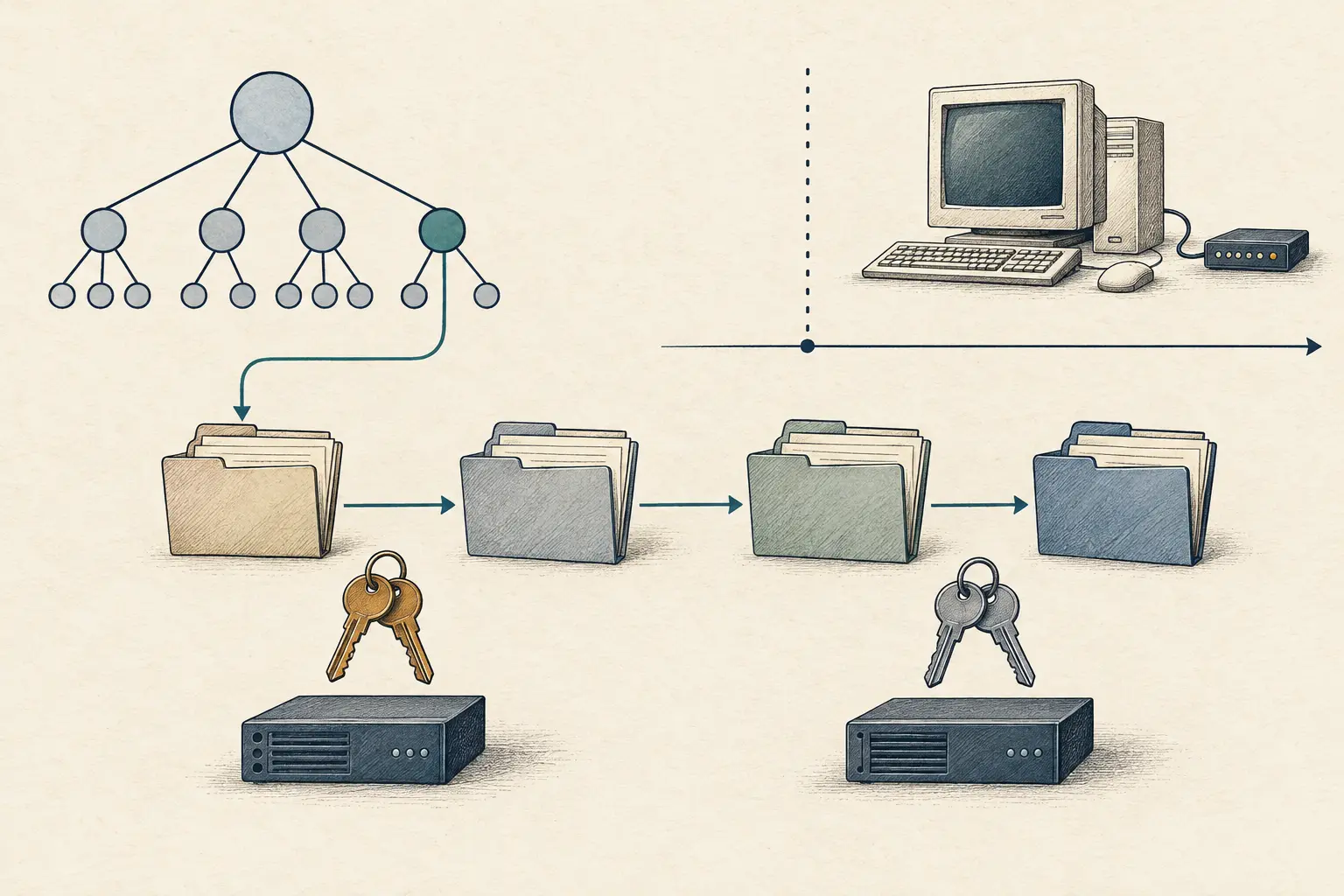
The most revealing part of the chronology comes from a presentation by Jichen Thinley, then associated with Bhutan Telecom, at APRICOT 2015. He recalled that when Bhutan applied to IANA for .bt, the label had already been assigned to a Bhutanese tour operator and was operated by a firm in the United Kingdom. The slides do not name either party, explain how the first arrangement came about, or reproduce an application file. The prudent conclusion is limited: the official retrospective describes an existing arrangement that Bhutan’s telecom officials then sought to change.
Thinley’s account dates a legal transfer to the Department of Telecommunications and Ministry of Communications to 20 May 1999—less than two weeks before the public Internet launch. It then says the Ministry chose to have the International Telecommunication Union operate .bt instead of BTNIC, the domain name information centre run by the Department. In 2006, the slides say, .bt transferred to BTNIC, then associated with Bhutan Telecom. This was a sequence of reported decisions, not one uninterrupted national takeover.
The record does not show the transaction instruments, who approved each step, whether the name-server set changed on the same day, or how registrations were handled during the transitions. Thinley’s presentation is valuable first-party institutional memory, but it is not the underlying IANA correspondence or a DNS operations log. The 2006 year is reported without a day or a detailed cutover account.
RFC 1591, published in 1994, helps explain why naming stewardship was framed as a service role. It described country-domain managers as trustees for the local and global Internet communities, and said a manager transfer should be communicated by both outgoing and incoming organizations to IANA. That text gives the period’s declared principles. It cannot prove whether every step in Bhutan followed a particular process, and it should not be used as a verdict on the parties.
Today’s IANA record lists the Ministry of Information and Communications as manager and Bhutan Telecom officials as administrative and technical contacts. It also lists nameservers at ITU and DrukNet, among other operators. That current record is not a snapshot of the 1999 arrangement. It shows why “who manages the domain” and “who operates each server” are separate questions even now.
The historical point is not that Bhutan had Internet access in 1997. It did not follow from a root-zone date. Rather, the domain’s administrative life began before the public service it would help name. Separating the two timelines makes the handovers legible without turning a registry date into a claim about connectivity.
Sources
- IANA WHOIS record for
.bt - IANA root-zone record for
.bt - Jichen Thinley, “History of Internet in Bhutan,” APRICOT 2015
- Bhutan National Statistics Bureau, Statistical Yearbook 2019
- ITU, Bhutan national telecommunications report, 2003
- RFC 1591, Domain Name System Structure and Delegation
- IANA’s current ccTLD delegation guide
Member Briefing
Deeper Profile Context
Sign in with the right membership level to unlock the full briefing and source notes.
Only for Strategic Circle
Strategic Circle
Open to all readers. Unlock profile briefings after joining and signing in.
Join Strategic CircleOnly for Leadership Alliance
Leadership Alliance
For qualified IP-asset owners and management; sign in to unlock alliance briefings.
Join Leadership Alliance