Summary
- ARIN's published transfer log records 3,727 transfers moving 52,449,536 IPv4 addresses in 2026 to 25 November, against 4,336 transfers moving 132,783,360 addresses in all of 2025: volume down about 60 percent, deals down 14 percent, mean deal size down from 30,623 addresses to 14,073.
- Concentration fell with it. The five largest 2026 transfers carried 18.0 percent of the year's volume against 33.2 percent for 2025, and cross-border flow ran one way: 992 transfers left the ARIN region and 56 arrived, with 806 of the departures going to RIPE NCC.
One file, two different years
| Measure | 2025 | 2026 to 25 November |
|---|---|---|
| Transfers | 4,336 | 3,727 |
| IPv4 addresses moved | 132,783,360 | 52,449,536 |
| Mean addresses per transfer | 30,623 | 14,073 |
| Five largest transfers, share of volume | 33.2 percent | 18.0 percent |
The 2025 number was a big-block year. Two sellers carried February and June of 2026 — T-Mobile USA moved three blocks of 2,097,152 addresses plus a further 1,048,576 to Amazon.com on 11 February, and Prudential moved 2,097,152 to CoreWeave on 17 June — and even with those, the five largest 2026 transfers are worth little more than half the share their 2025 equivalents held.
That is what a flatter market looks like. Fewer addresses change hands per signature, more signatures are needed to move the same tonnage, and the price-setting mega-deal becomes rarer and more visible when it happens. Monthly volume in 2026 swung from 1,017,088 addresses in January to 12,395,776 in June and back to 1,371,648 in a November that is not finished. Monthly counts never fell below 194 and never rose above 458.
The conveyor belt runs west to east
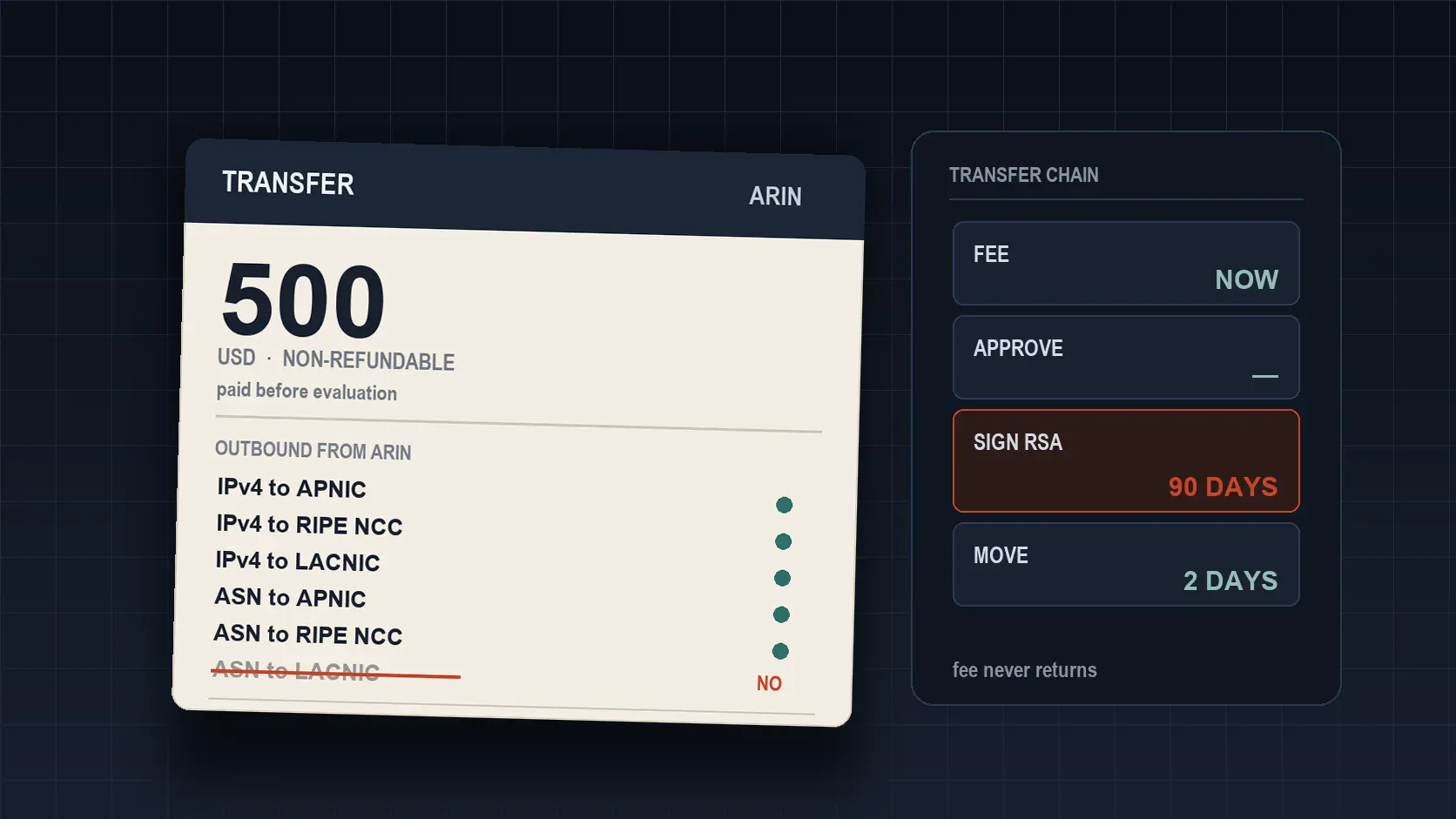
Of 1,048 inter-RIR transfers in 2026, 992 left the ARIN region carrying 9,201,920 addresses and 56 arrived carrying 1,580,032. The destination list is not subtle: 806 departures went to RIPE NCC, 179 to APNIC, seven to LACNIC. Arrivals came from RIPE NCC (39), APNIC (14) and LACNIC (3).
A reader can treat that as arbitrage and stop there. The log supports a more useful reading: the ARIN region is now a net supplier of address space to the rest of the world at a rate of roughly 7.6 million addresses a year, and most of it lands in the region whose members pay the highest per-account membership fee and run the longest waiting list. Space that is expensive to hold in one registry is being sold to operators who need it in another.
Why the halving is not a collapse
Three readings fit the same table. Demand fell, because the buyers with big balance sheets finished their build-outs. Supply tightened, because holders who wanted to sell already did. Or the definition of a big deal moved, because the buyers now prefer leases, provider-aggregated arrangements and cloud-provider bring-your-own-address deals that never appear as a transfer of registration.
The log can separate the first two from the third only by continuing. If 2027 runs at 2026's pace with a similar 14,000-address average, the market has settled into a steady small-deal regime and the 2025 spike was an artefact of a few transactions. If the average climbs back toward 30,000, the big-block buyer has returned and the flatter year was a pause.
What the log does not say
Price. The format records blocks, registry pairs, organisations and dates, and no money changes hands inside it, so every claim about value has to come from somewhere else. It also records only transfers where ARIN is a party; a sale inside the RIPE region never appears here, which is why the 806 departures matter more than the 52 million total.
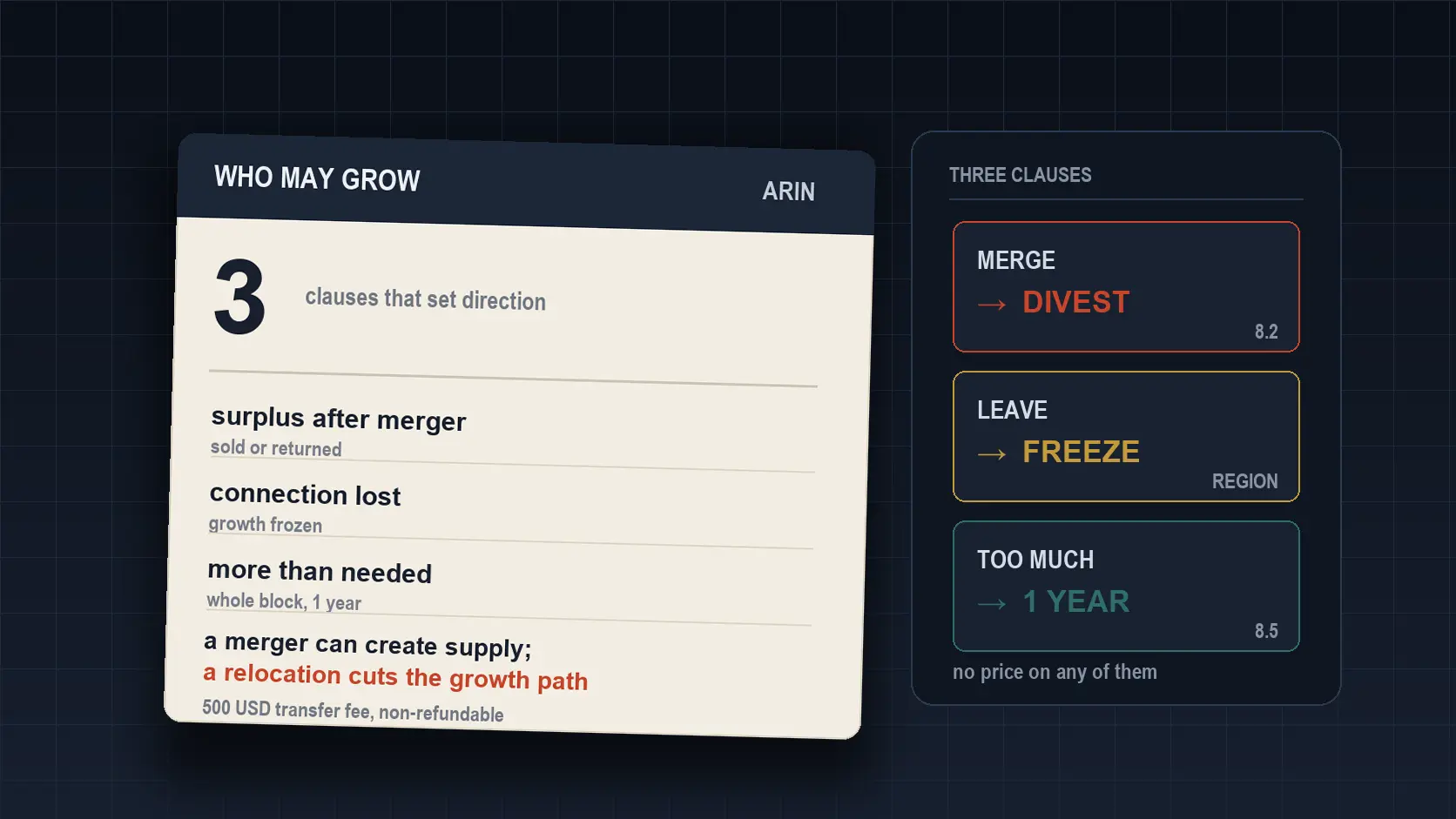
The window used here begins on 12 June 2024, although ARIN's log itself starts in 2012, so the year-on-year comparison is between two complete calendar years inside a partial file and not a statement about the market's whole history. Records include mergers and acquisitions filed under NRPM 8.2 alongside specified-recipient transfers under 8.3 and inter-RIR transfers under 8.4, and this count does not split them.
Sources
Member Briefing
Read the full trend briefing
Members read the full briefing with the source notes behind every finding.
Strategic Circle
A daily briefing in your language, built from changes we have verified.
Join for USD 20/monthCancel anytime.
Members also get the full research library, a daily briefing on the networks they follow and the private forum.