Summary
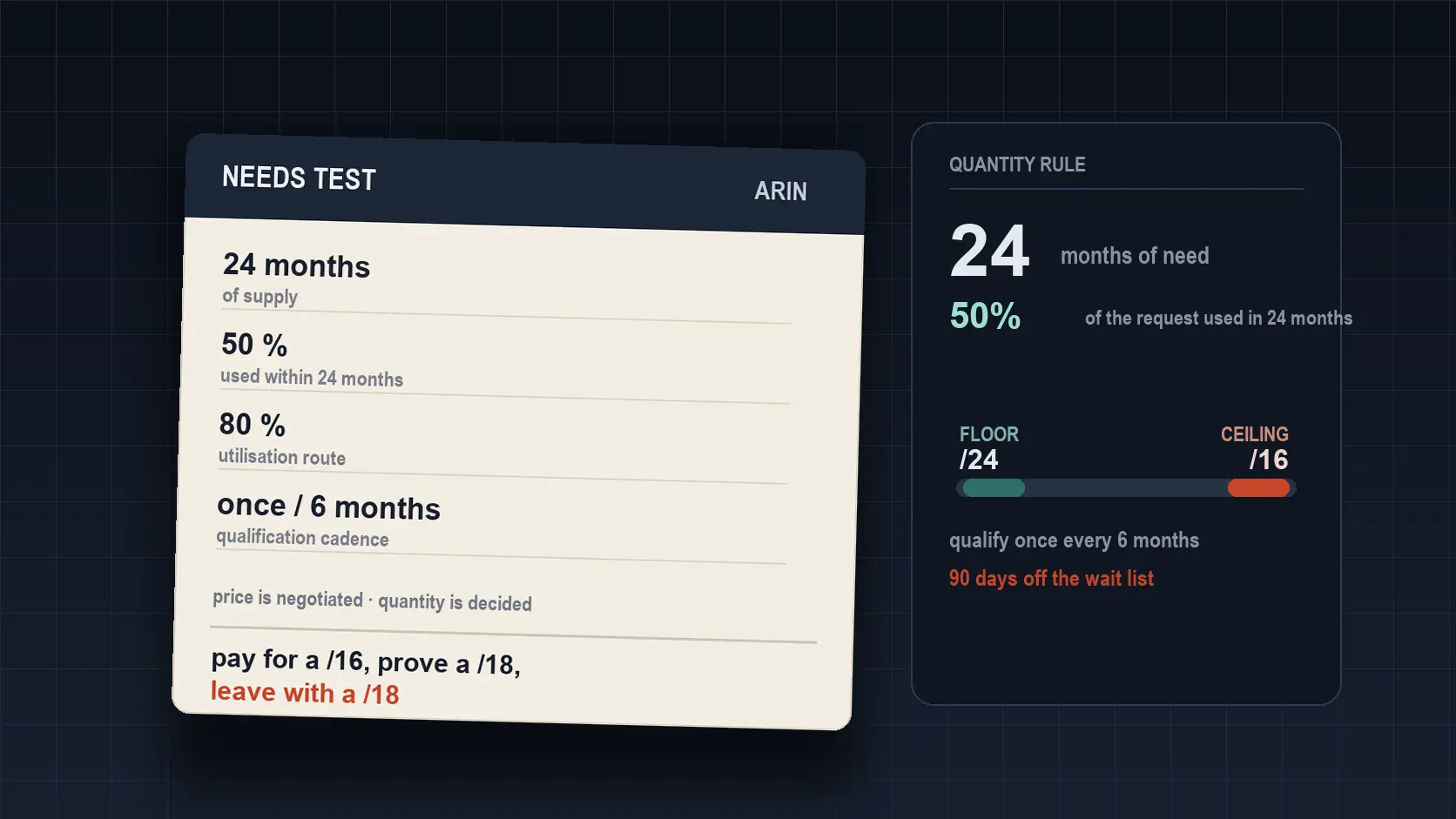
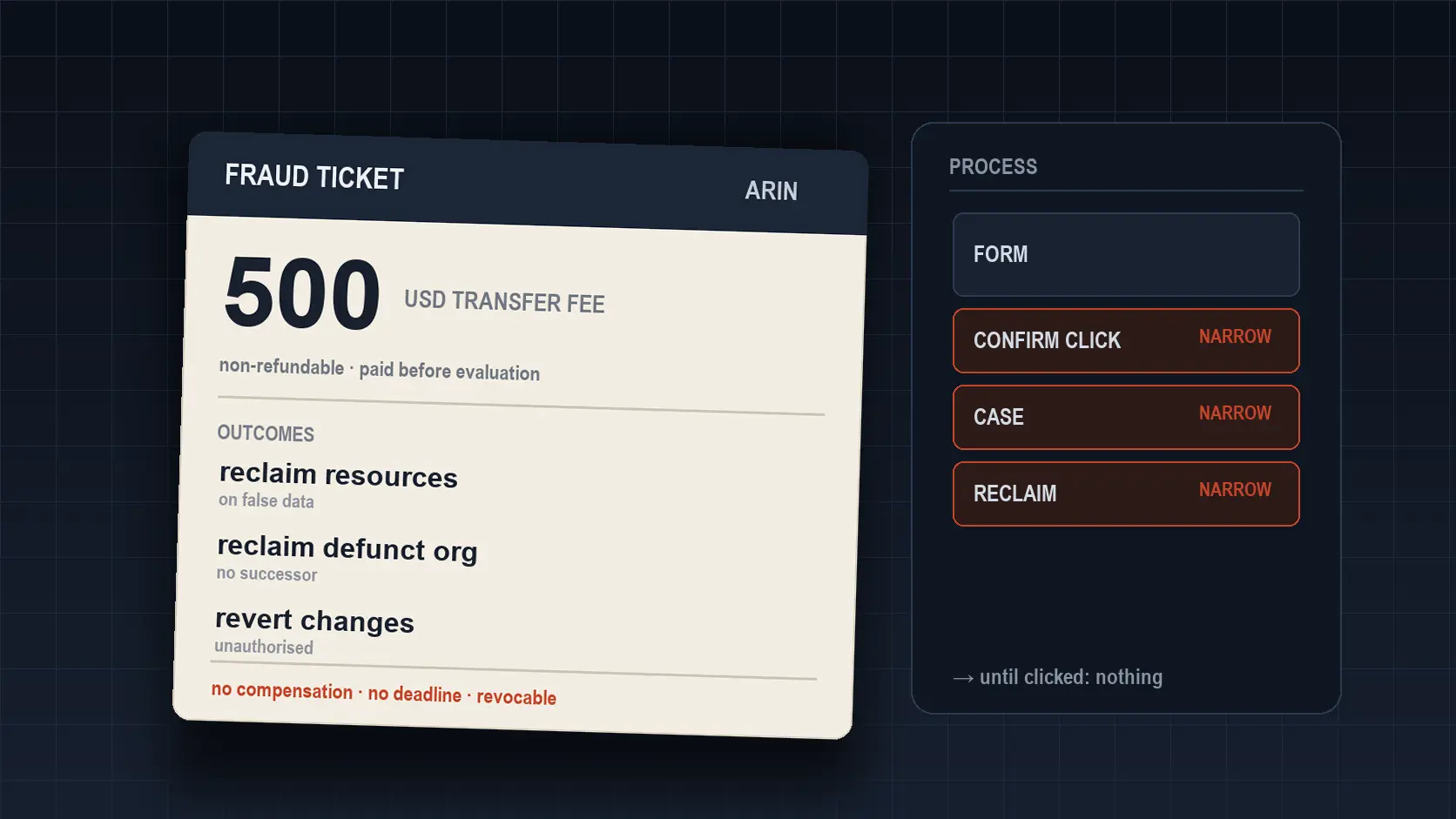
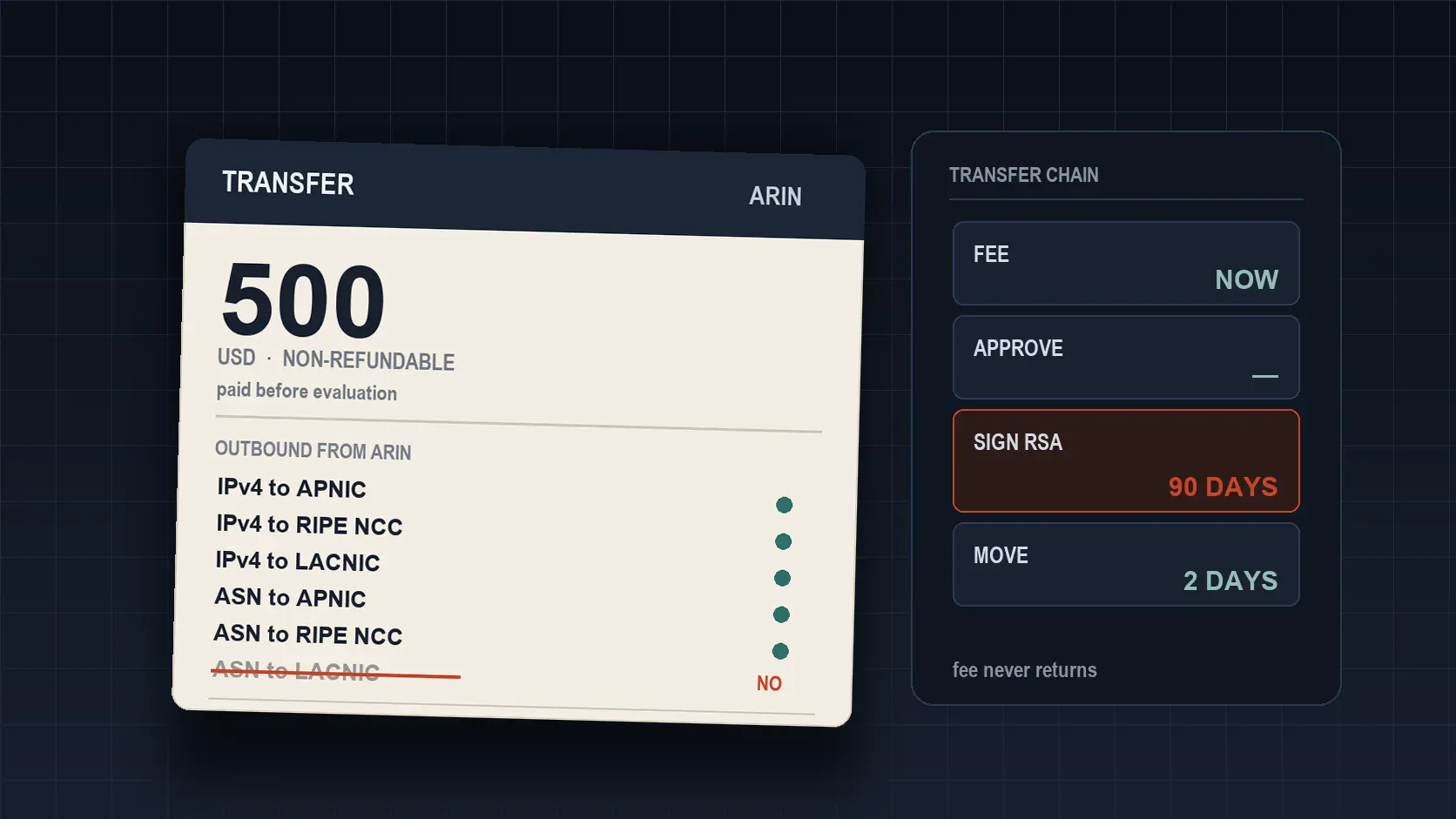
- ARIN's transfer procedure requires the non-refundable processing fee before evaluation, then, upon approval, any other applicable fees and a signed Registration Services Agreement within 90 days; once the signed agreement and fees are in, the resources transfer within two business days.
- The same page states that APNIC and RIPE NCC accept IPv4 addresses and ASNs while LACNIC currently accepts IPv4 addresses only, so the outbound inter-RIR route has a narrower set of assets than the inbound one.
One process, four dates, one of them refundable
The published steps read like a settlement instruction. Log in, select Transfer Resources, follow the instructions, pay the non-refundable processing fee if required, pay any other applicable fees on approval, and sign the Registration Services Agreement within 90 days. Then the closing rule: once ARIN receives a signed RSA and all applicable fees, resources transfer within two business days.
In the 2027 fee table that first payment is $500 for a source transfer request under NRPM 8.3 or 8.4, charged before evaluation and non-refundable, plus a separate recipient processing fee after approval. Nothing in the process promises the fee back if the signature never arrives.
The 90 days is an option, and it expires
A transfer approval is worth something only if the counterparty signs. The 90-day window is the period in which that signature can be obtained, and the party holding it controls a decision the buyer has already paid to reach. For a buyer, that is a 90-day option on a block whose price may move, written by the seller's own paperwork department.
The two-business-day completion is the mirror image: after signature and payment, ARIN is fast. The registry has therefore built a process where the slow part is a private contract and the fast part is a public record. Whatever goes wrong, goes wrong inside the 90 days, not inside the two.
What lapses
The page does not say what happens to an approval whose 90 days expire. It also does not say how often that occurs, how many approvals are re-opened, or how the non-refundable source fee interacts with a lapsed approval. Those are the only facts that would size the risk, and they are unpublished.
The fee structure already answers part of it. The source pays before evaluation, the recipient pays after approval, and the transfer completes two business days after the paperwork is clean. An organisation that has paid both fees and is waiting on a signature is exposed for up to 90 days with no asset in hand, which is a longer credit exposure than most operators would accept from a peering partner.
The inter-RIR route is not symmetric
ARIN's note on the outbound direction is easy to skim past and hard to improve on: "APNIC and RIPE NCC accept IPv4 addresses and ASNs. LACNIC currently accepts IPv4 addresses only." An ASN held in the ARIN region can therefore cross to two of the other four registries, and an IPv4 block can cross to three.
That asymmetry is a market fact with a price attached, because an ASN's portability is part of what a buyer assumes. A network that needs its number to move to Latin America has to test the route, not assume it, and the registry's own transfer page is where the answer sits in one sentence.
Sources
Member Briefing
Read the full trend briefing
Members read the full briefing with the source notes behind every finding.
Strategic Circle
A daily briefing in your language, built from changes we have verified.
Join for USD 20/monthCancel anytime.
Members also get the full research library, a daily briefing on the networks they follow and the private forum.