Summary
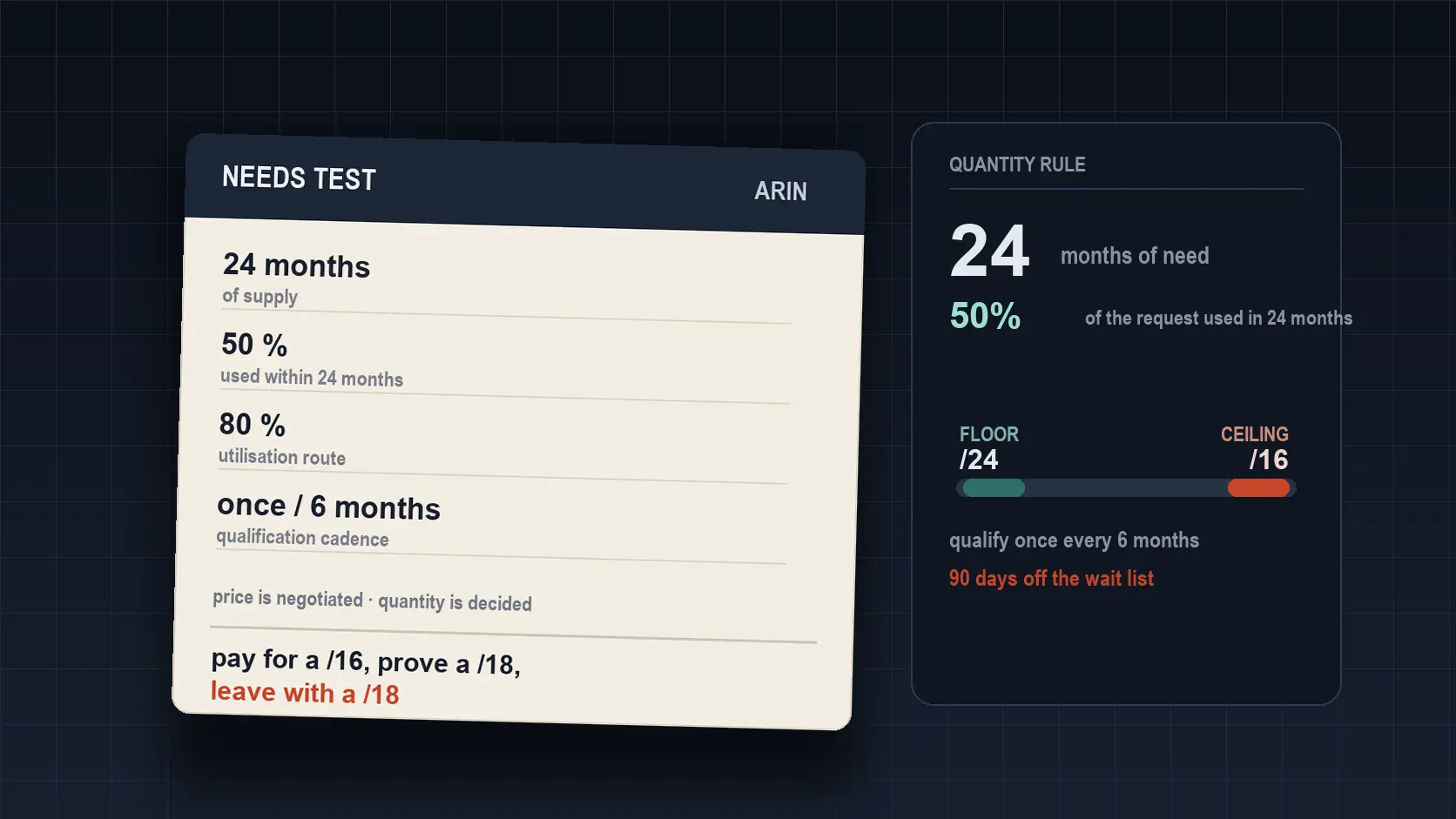
- ARIN's transfer requirements set a /24 minimum, an initial /24 for recipients with no allocations, and a needs test above that: 50% of the requested addresses used within 24 months, efficient use of prior allocations, or 80% utilisation of everything previously held, up to a /16.
- Organisations may qualify under the larger-block route only once every six months, a recipient that takes a transfer is removed from the ARIN waiting list and cannot reapply for 90 days, and the recipient must hold an updated signed Registration Services Agreement and pay applicable fees.
The market has a quantity rule, and it is not price
Buying address space in the ARIN region is not a purchase of a commodity. It is an application to hold a quantity the registry judges necessary. The recipient's documented need caps the transfer; the /24 floor restricts the granularity; the six-month cadence limits how often the cap can be raised.
That structure explains a fact that puzzles sellers: a block's price is negotiated privately, but its quantity is decided publicly. A buyer prepared to pay for a /16 and able to prove need for a /18 ends up with a /18, and the difference is a business plan the registry accepted rather than money the seller accepted.
The three thresholds in the published test
ARIN's page sets out the arithmetic in plain text. A recipient without allocations gets an initial /24. A larger initial block requires documentation detailing that "50 percent of the requested IPv4 addresses will be used within 24 months" and demonstrating that "50 percent of the sum of all previous IPv4 allocations is efficiently used". Recipients that already hold allocations may alternatively demonstrate 80% efficient utilisation of all previous allocations and qualify for a transfer equal to their current holdings, up to a /16.
The same section closes the door on repeating it: organisations may only qualify under that policy once every six months.
Above all of it sits the general rule that recipients within the ARIN region must demonstrate need for up to a 24-month supply. That is a forecast obligation attached to a scarce asset. A network that guesses its growth wrong does not pay a penalty; it simply qualifies for less next time, and the constraint binds at the moment of purchase.
Taking a transfer costs your place in the queue
One sentence on the same page is the strangest and most useful. If applicable, a recipient that takes a transfer "will be removed from the ARIN Waiting List and will not be allowed to reapply under section 4.1.8 ARIN Waiting List for a period of 90 days."
The two channels therefore interact. A transfer and a waiting-list position are not cumulative rights; accepting the faster route costs the slower one for a quarter. For a buyer inside the region, that is a real trade: pay a private seller now and lose the free queue position, or stay in the queue and keep the option.
What is not published
Nothing in the published rules says how many larger-block applications are refused, how often the 80% route is used, or how many recipients choose a transfer over a waiting-list place and lose it for 90 days. Those counts are what would tell whether the needs test is a formality or the binding constraint on the ARIN market. Without them, the only evidence that it bites is the fact that the registry wrote three thresholds instead of one.
Sources
Member Briefing
Read the full trend briefing
Members read the full briefing with the source notes behind every finding.
Strategic Circle
A daily briefing in your language, built from changes we have verified.
Join for USD 20/monthCancel anytime.
Members also get the full research library, a daily briefing on the networks they follow and the private forum.