Summary
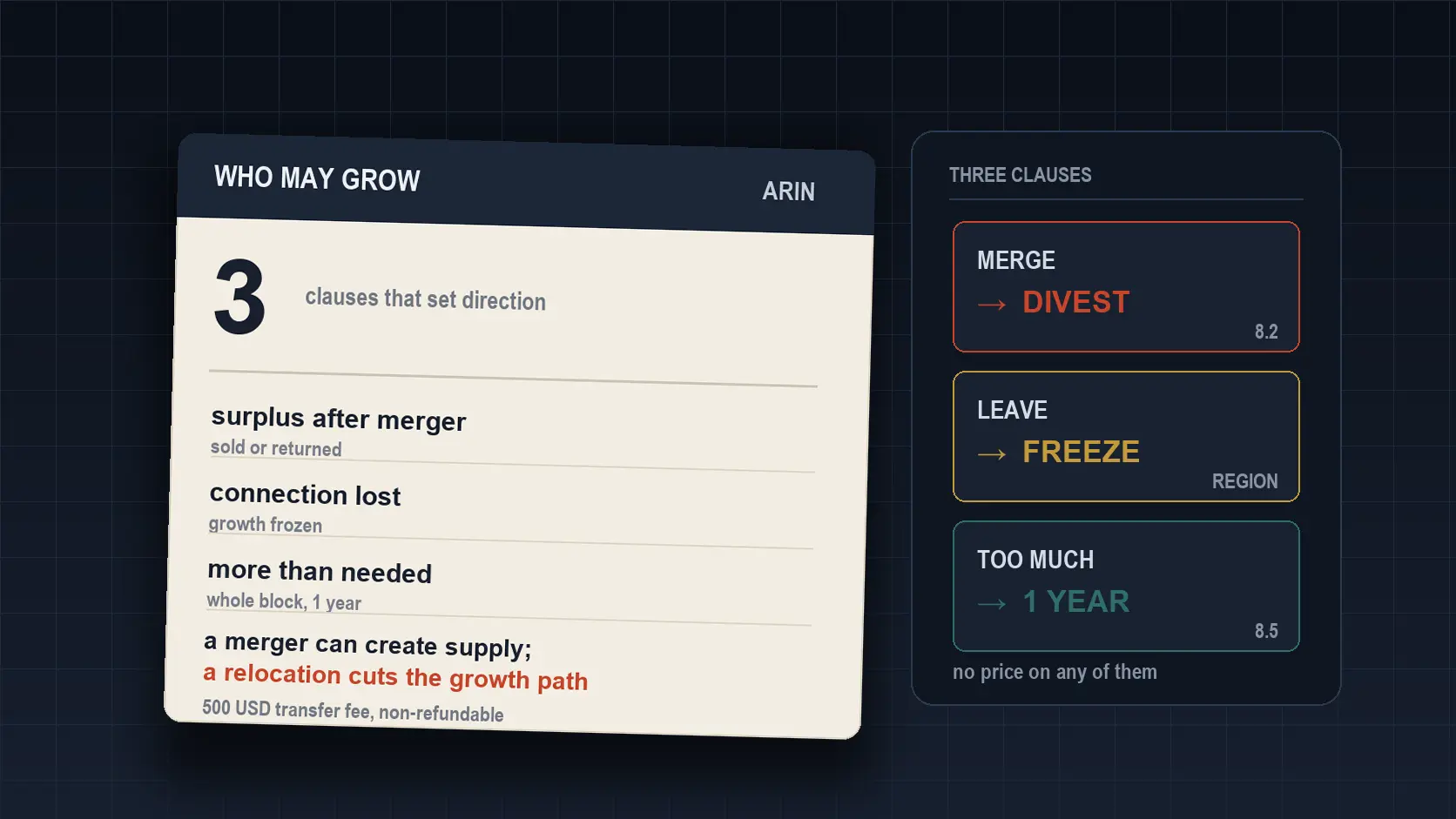
- Under NRPM 8.2, ARIN processes merger and acquisition transfers even where the combined holdings exceed what policy justifies, and then works with the holder to transfer the extra resources to other organisations or to accept a voluntary return.
- A surviving entity that loses its real and substantial connection with the ARIN region keeps the resources issued before the transaction but qualifies for no additional resources until the connection returns, and a holder with more space than it needs can take a smaller block only by handing the entire larger block to a qualified recipient within one year.
A merger is rewarded with a divestment
The merger clause is the least sentimental text in the document. ARIN does not refuse a request because two networks together hold more than either could justify alone; it processes the transfer and then deals with the surplus. "In that event, ARIN will work with the resource holder(s) to transfer the extra number resources to other organization(s) or accept a voluntary return of the extra number resources to ARIN."
For the parties, that turns consolidation into a two-part transaction: buy the network, then sell or surrender whatever the arithmetic no longer supports. The registry has effectively decided that combined need, measured under NRPM 8.5, is the ceiling on a merged holding, and that the market absorbs the difference. It also means a merger creates supply: every acquisition that overshoots the test pushes blocks back into circulation.
Leaving the region freezes the ceiling, not the holdings
The connection clause is the quietest piece of geography in the number registry. A merger, acquisition or reorganisation that leaves the surviving entity without "a real and substantial connection with the ARIN region" may continue holding everything issued before, "but shall not qualify for any additional numbering resources (directly or indirectly) from ARIN, unless and until it once again has a real and substantial connection with the ARIN region".
Read it as an asset rule. The blocks are not confiscated and the registrations do not lapse; the option to acquire more does. An operator relocating its headquarters keeps a portfolio and loses a growth path, and the only way to restore it is to re-establish the connection the policy requires. For a buyer, that is a diligence question nobody asks: where will the surviving entity actually sit?
Downsizing has a deadline nobody advertises
The third clause covers the holder with more space than it needs. It "may receive transfer of a smaller block for the purpose of renumbering onto the smaller block if they transfer the entire larger block to a qualified recipient under section 8 within one year of receipt of transfer of the smaller block."
The words that matter are "entire" and "within one year". The route is not a partial sale of the excess; it is an exchange of a whole block for a smaller one, with a twelve-month clock running from the smaller transfer. A holder that misses the year has bought a smaller block, renumbered onto it, and kept the larger one without satisfying the condition the policy attached.
What the page does not say
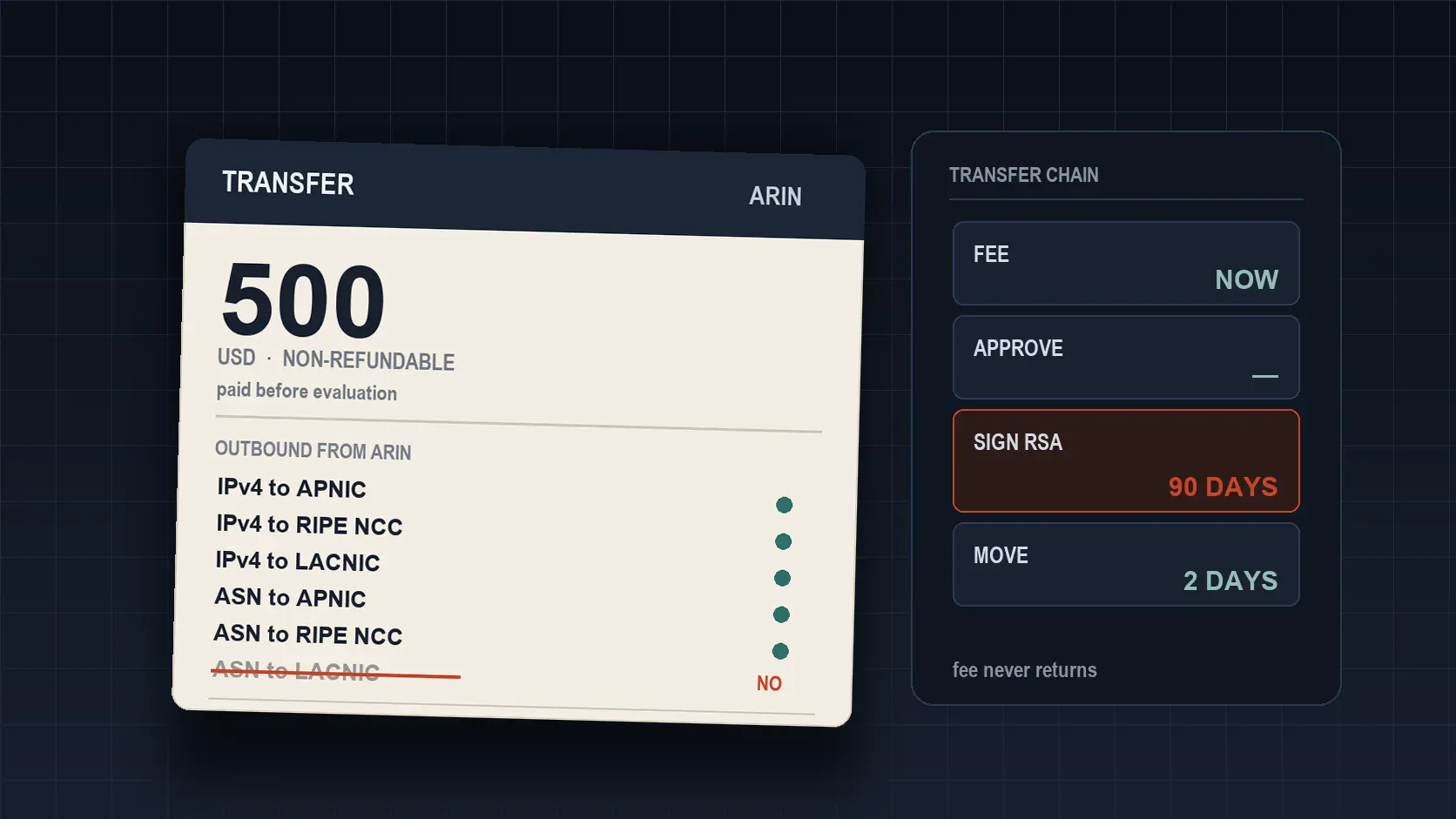
The document does not say how often a merger surplus is surrendered rather than sold, how many holders sit frozen under the connection rule, or how many one-year renumbering deadlines are missed. Those counts are the only way to know whether these clauses shape behaviour or merely describe it. The one number that is published is the fee: $500 for a source transfer request before evaluation, non-refundable, in the 2027 schedule.
Sources
Member Briefing
Read the full trend briefing
Members read the full briefing with the source notes behind every finding.
Strategic Circle
A daily briefing in your language, built from changes we have verified.
Join for USD 20/monthCancel anytime.
Members also get the full research library, a daily briefing on the networks they follow and the private forum.