Summary
- ARIN's Qualified Facilitator Program approves organisations to help others acquire or transfer IPv4 and ASNs, publishes the approved list, and says plainly that using a facilitator is not required. The 2027 fee schedule sets the annual Qualified Facilitator fee at $10,000.
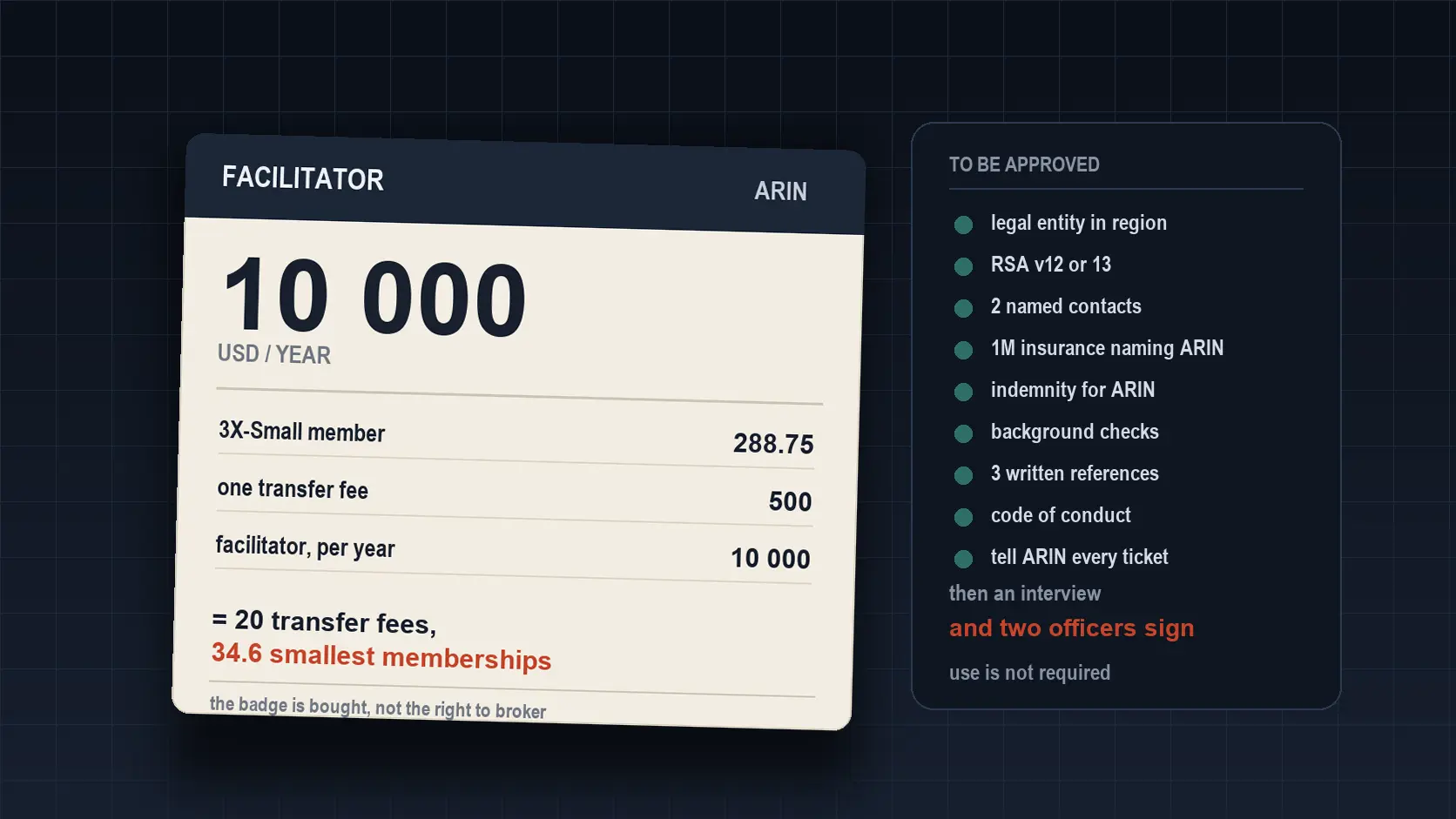
- Requirements include operating inside the ARIN region under RSA version 12 or 13, at least two named contacts who are employees, officers, directors or shareholders, $1M general liability insurance naming ARIN, indemnity for ARIN, third-party background checks, three written customer references, a code of conduct, and notification to ARIN whenever the facilitator assists on a ticket.
What the licence costs relative to everything else
In the same 2027 schedule a 3X-Small member pays $288.75 a year and a source transfer request costs $500. The facilitator fee is therefore 34.6 times the smallest annual membership and exactly 20 transfer fees. A business that helps other people move address space pays, each year, the price of twenty of the transactions it exists to produce.
That is the number that makes the programme interesting. ARIN does not sell the right to broker — anyone may negotiate — it sells approval, a listing and a documented process. On ARIN's own pricing, that approval is worth more than the fee income from three dozen small networks, or the transfer revenue from twenty transfers.
The registry takes insurance, indemnity and a roll-call
The requirements read like a counterparty file rather than a certification. A facilitator must carry general liability insurance "naming ARIN, with minimum coverage limits of $1M", furnish "indemnification protection for ARIN", supply "third-party background checks for key employees" and provide "at least three written customer references, to include contact information for verification". It must also notify ARIN "whenever they are assisting with a transfer ticket on behalf of a customer".
Two things follow. The registry has moved the risk of the intermediation layer onto the intermediaries: if a facilitator's customer is unhappy, ARIN holds an insurance certificate and an indemnity, not a complaint log. And the roll-call means ARIN can see which approved facilitator is in which ticket, which is precisely the data a regulator of the market would want and precisely the data a broker would rather not supply.
A gate with two keys and no obligation to walk through it
Approval is decided by an interview and "subsequent approval from both the Chief Legal Officer and the Chief Experience Officer". Two executives sign, which is a serious process and a narrow one: a discretionary decision at two desks, with no published criteria for what the interview has to establish beyond the checklist.
All this is for a service nobody must use. ARIN states that organisations "are not required to use a Qualified Facilitator when transferring IPv4 or ASN resources", and that using one "may streamline the transfer process". So the $10,000 buys a listing, a faster conversation and a badge, and a broker without the badge can still do the same work without paying or filing references.
What is not published
ARIN publishes the list of approved facilitators but not how many applied, how many were approved, how many laps or is removed for a code-of-conduct breach. Those counts are the only way to tell whether the programme is a quality filter or a small club, and the code of conduct is the only document that could show what a facilitator is actually forbidden to do.
Sources
Member Briefing
Read the full trend briefing
Members read the full briefing with the source notes behind every finding.
Strategic Circle
A daily briefing in your language, built from changes we have verified.
Join for USD 20/monthCancel anytime.
Members also get the full research library, a daily briefing on the networks they follow and the private forum.