Summary
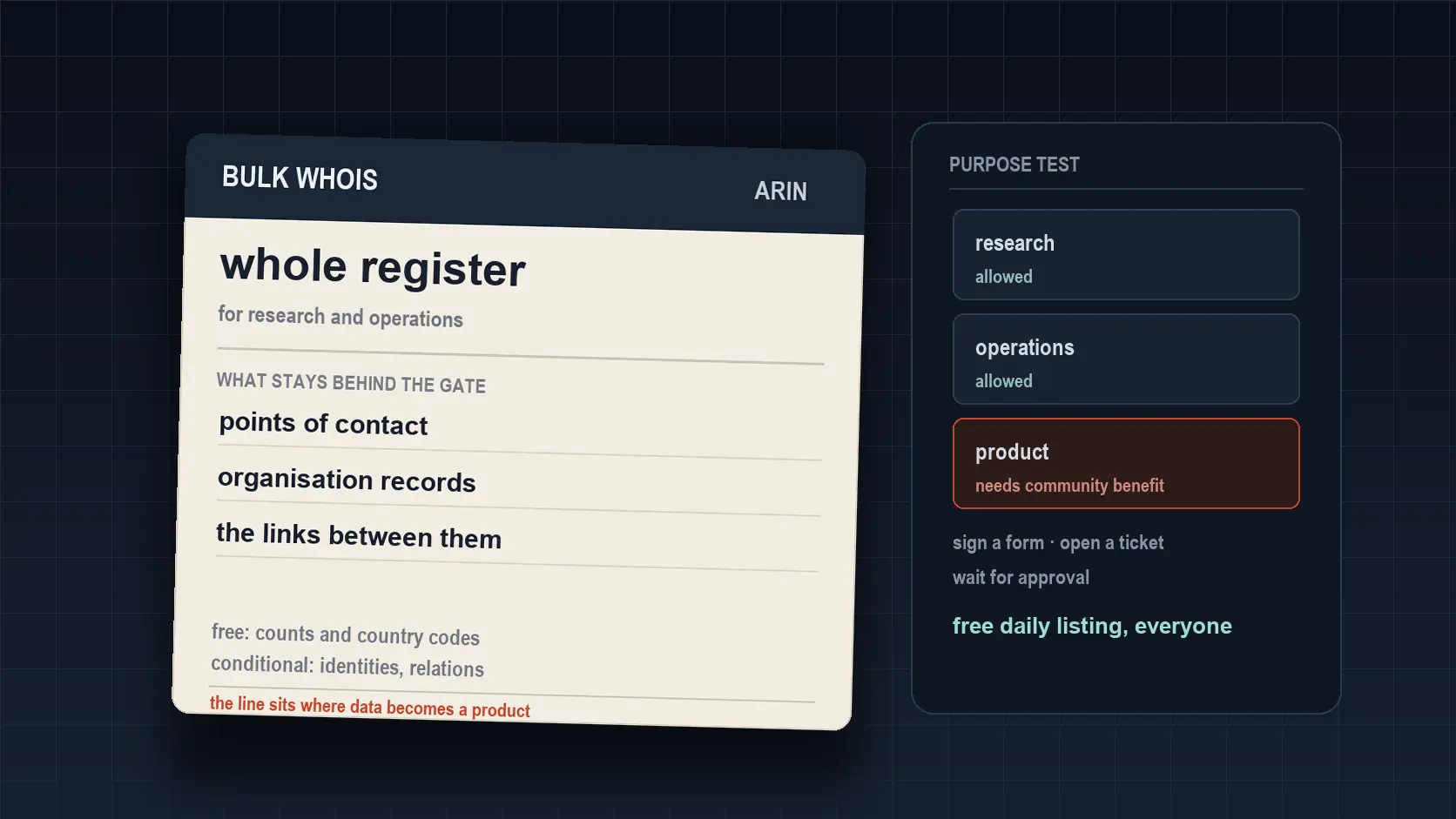
- ARIN's Bulk Whois service provides a bulk copy of all objects in the public Whois directory to organisations using the data for internet operational or technical research, and states that it does not provide bulk copies to operators who want to incorporate the data into products, services or internal systems "with no clear benefit to the broader community".
- Access requires an ARIN Online account, a signed Bulk Whois Terms of Use and Data Request Form, an Ask ARIN ticket naming Bulk Whois Request with a description of intended use, and a review and approval step. ARIN also publishes a free daily listing of all active IPv4, IPv6 and ASN registrations with country code data.
The register grants the data by reason, not by licence
Most data providers sell access and let the buyer decide what to build. ARIN does the opposite: it gives the complete register away, and then decides whether the reason is good enough. Research and operations qualify. A product qualifies only if someone inside a registry judges that it carries a clear benefit to the broader community.
That is a purpose test, and every purpose test contains a judgement. A compliance team at a buyer that wants to screen counterparties is doing operational work. A vendor that wants to sell the same screen is doing a product. The dataset is identical and the answer differs, and the deciding sentence has no published criteria behind it.
The paperwork is small and the point is not
The stated mechanics are modest: sign the terms of use, open a ticket under Resource and Reporting Inquiries with the subject Bulk Whois Request, describe the intended use, attach the scan, wait for review and approval. Once approved, the whole set is available as a zip, or in parts as zip, text or XML, and there is API-key access.
The modest mechanics hide the interesting part. A signed form converts a public-registry courtesy into a contractual relationship, and the ticket leaves a record of who asked for what and why. ARIN ends up holding a file on data use that no other publication of the same data creates.
The free listing is the compromise nobody advertises
One note on the same page matters more than the service it decorates: ARIN publishes a daily listing of all active IPv4, IPv6 and ASN registrations, complete with country code data, as a free report on its website.
So the useful, machine-friendly, aggregate view is public and daily. What remains behind the purpose test is the object-level detail: points of contact, organisation records, and the links between them. The registry has drawn a line at exactly the place where the data becomes a product: counts and country codes are free, identities and relationships are conditional.
Why this matters more than it looks
The usage terms on public directory data already restrict use so that the data may not be republished, resold or made publicly available. The bulk service adds a second gate in front of the same corpus: even a user who would comply with the republication rule needs a purpose that ARIN approves.
For anyone building market infrastructure on registry data, the practical consequence is that the richest input is discretionary. A model that depends on object-level history should assume the tap can slow, because the grant is a decision by a person, not an entitlement in a licence.
What is not published
ARIN does not publish how many bulk requests it receives, how many are approved, how many are declined for want of community benefit, or how long review takes. Those four numbers are the only way to know whether the purpose test is a formality or the real gate on registry-derived products, and the page that imposes the test does not report on it.
Sources
Member Briefing
Read the full trend briefing
Members read the full briefing with the source notes behind every finding.
Strategic Circle
A daily briefing in your language, built from changes we have verified.
Join for USD 20/monthCancel anytime.
Members also get the full research library, a daily briefing on the networks they follow and the private forum.