Summary
- Under NRPM 8.2, resources transferred as part of a merger, acquisition or reorganisation "will not be subject to a needs-based assessment", while the specified-recipient route under NRPM 8.3 requires demonstrated need for up to a 24-month supply.
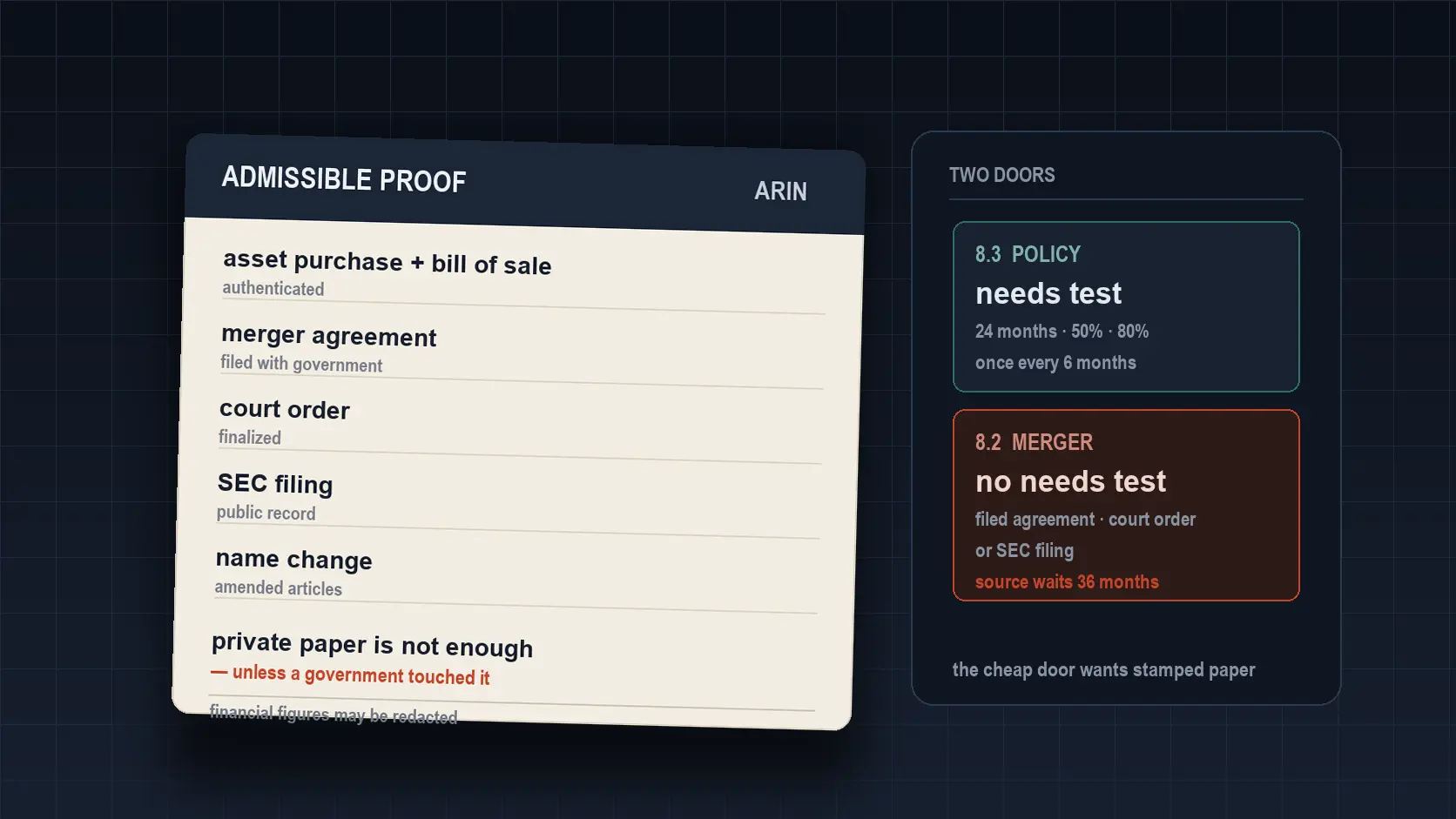
- The 8.2 door requires an authenticated instrument of transfer: an asset purchase agreement and bill of sale, a merger or amalgamation agreement filed with a province, state or federal government, a finalized court order, or SEC or other public filings. A source of an 8.2 IPv4 transfer may not apply for IPv4 space from the waiting list for 36 months unless the recipient stays a subsidiary, parent or under common ownership.
Two doors, two currencies
The same address space can change hands on one of two legal theories, and they are paid for in different things. Under 8.3 the buyer spends evidence of need: a 24-month supply argument, a 50% use forecast, an 80% utilisation showing, and the right to try again only every six months. Under 8.2 the buyer spends evidence of a transaction: documents that a government clerk, a court or a securities regulator has already touched.
ARIN's page says the difference plainly. An 8.2 transfer is not subject to a needs-based assessment. That single sentence makes the merger route the cheapest way to move a large block, and it explains everything that follows.
What counts as proof
The accepted instruments are listed and the list is narrow in a useful way. An "authenticated copy" of the asset purchase agreement and bill of sale; a "finalized merger or amalgamation agreement filed with a province/state/federal government"; a "finalized court order"; or "SEC or other public filings that document the transfer of assets". A pure name change needs amended articles of incorporation or a government verification of the change.
Read the adjectives: authenticated, finalized, filed. Private paper is not enough on its own; what ARIN accepts is paper that has entered a public register or been completed by a court. A private contract between two companies counts only as an authenticated copy, and the registry reserves the right to want the authentication.
The 36-month clause admits the arbitrage
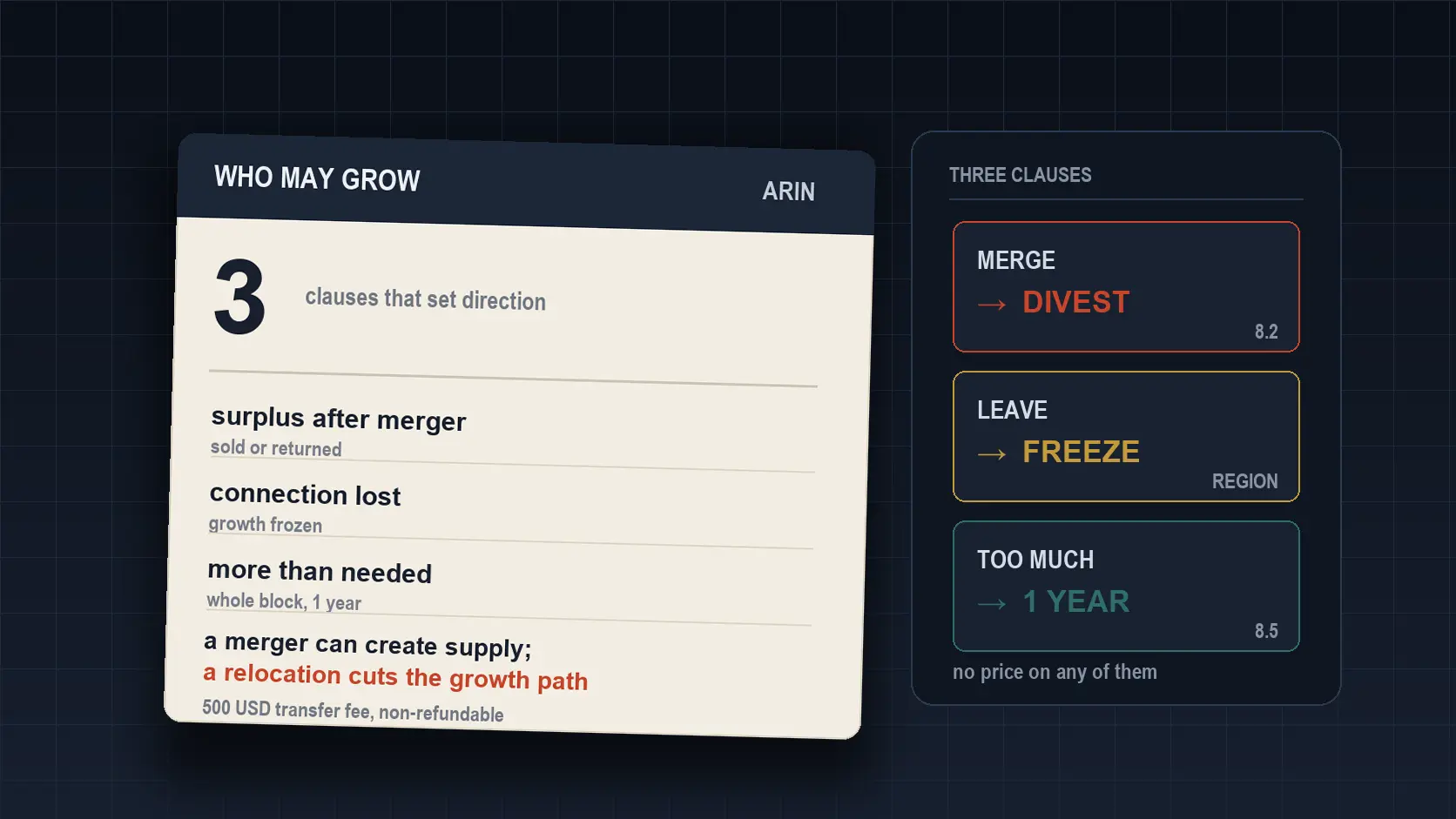
If 8.2 is the cheap door, it would be an obvious way to acquire space and then re-enter the queue. ARIN closes that with a sentence: an organisation serving as the source of an 8.2 IPv4 transfer may not apply for IPv4 space under the waitlist for 36 months afterwards, "unless the recipient organization remains a subsidiary, parent company, or under common ownership with the source organization".
The exception is the interesting half. Same group, no penalty; genuine sale, three-year wait. The rule is not about the block, it is about whether the corporate relationship persists, and it tells anyone reading carefully that 8.2 is a route for reorganising a group, not for trading space between strangers.
Practical notes the page gives away
Two details are unusually generous and both are about friction. If multiple transactions connect the old and new organisations, documentation is required for each. And parties may "redact any financial or otherwise sensitive information", with a standard non-disclosure agreement available.
That is a registry that cares about chain of title and not about price. It will read the agreement, insist that every step in a multi-stage deal is documented, and then let the numbers come out of the copy. For a market where the price is the contested quantity, the document that settles ownership is deliberately silent about value.
Sources
Member Briefing
Read the full trend briefing
Members read the full briefing with the source notes behind every finding.
Strategic Circle
A daily briefing in your language, built from changes we have verified.
Join for USD 20/monthCancel anytime.
Members also get the full research library, a daily briefing on the networks they follow and the private forum.