
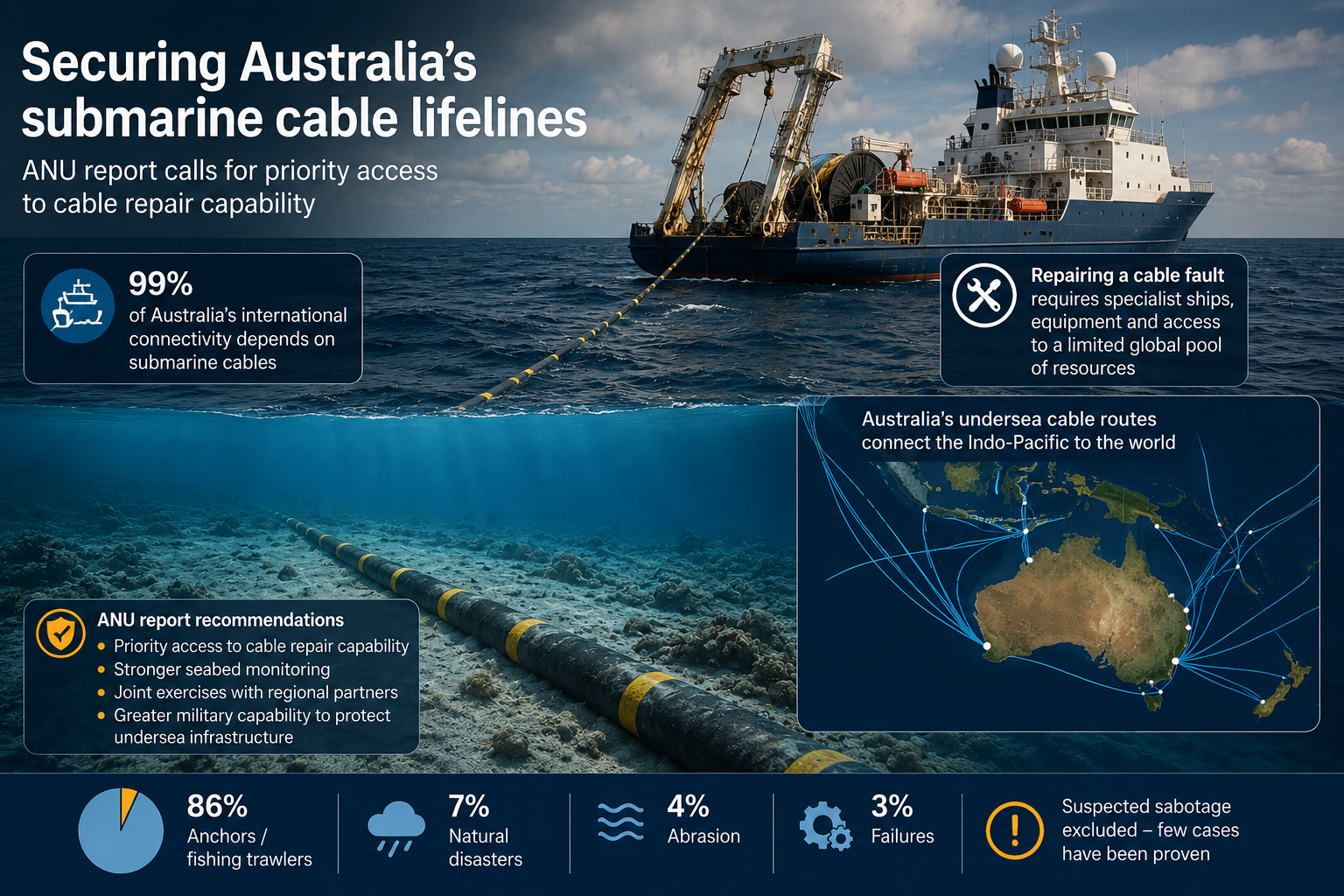
- About 99% of Australia’s international connectivity depends on submarine cables, while most disruptions are still caused by anchors or fishing trawlers
- The report also calls for stronger seabed monitoring, regional exercises and greater military capability to protect cables
The fact
The National Security College at the Australian National University released a report on 10 August calling for stronger protection of Australia’s submarine cable network. The study, partly funded by the Department of Defence, says about 99% of Australia’s international connectivity depends on submarine cables. It recommends priority access to cable repair services, stronger seabed monitoring and joint exercises with ASEAN and other regional partners.
The report cites suspected attacks in European waters and around Taiwan, while noting that most cable damage is still accidental. It attributes 86% of disruptions to anchors or fishing trawlers, 7% to natural disasters, 4% to abrasion and 3% to failures. Suspected sabotage is excluded from that breakdown because few cases have been proven. The report also urges the Australian military to improve seabed surveillance and other capabilities used to protect underwater infrastructure.
The assessment
Australia can improve surveillance of its submarine cables, but a damaged system still has to be physically repaired. With specialist ships and crews available from a limited pool, restoration depends on whether that capability can be mobilised when a fault occurs.
Priority access would address that practical constraint. It would not prevent sabotage or create additional repair vessels. Instead, it would give Australia pre-arranged access to existing repair capacity, reducing the need to negotiate for ships and crews after an outage has already happened.
For BTW readers, the report puts recovery planning alongside cable protection. The operational question is not only whether Australia can detect damage, but whether it can secure the people and equipment needed to restore the connection quickly enough when a cable fails.
What to watch
After the report’s formal launch on 11 August, watch for any Australian government response on priority access to repair ships and crews. Funding for naval repair capability, agreements with commercial repair providers or joint exercises with ASEAN partners would be concrete follow-up. The proposed cable-operator association is another item to watch if the government takes it forward.