Summary
- Amazon confirmed it bought Pacifico Energy's GW Ranch site in Pecos County, Texas, and plans a data-centre campus across more than 8,000 acres.
- Three Texas construction filings describe three data-centre buildings and an expected immediate start — filings, not foundations.
- A preliminary TCEQ determination describes a nominal 5,000 MW simple-cycle gas plant with 35 turbines serving an on-site AI data centre.
- The record's 33,204,964.44 tons per year of allowable CO2-equivalent is a proposed ceiling, not measured pollution.
- Pacifico markets a future design of up to 7.65 GW of dispatchable generation, 1.8 GW of storage and 750 MWac of solar.
- First power in Q1 2027, 1 GW in 2028 and more than 5 GW by 2031 are targets; Amazon says grid connection stays an option as interconnection permits.
What Amazon actually bought in Pecos County
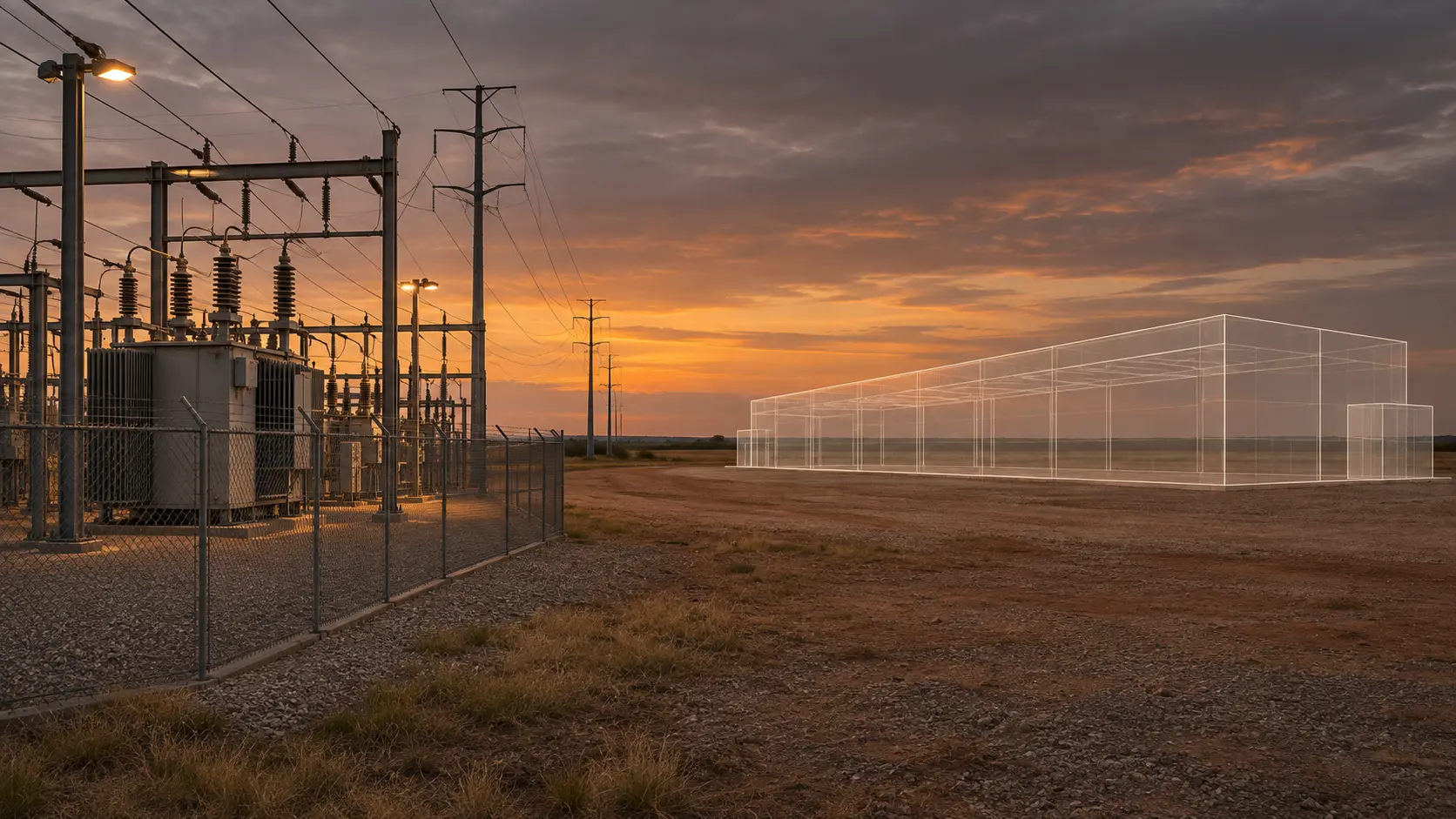
Out in Pecos County, Texas, acreage is cheap, sunlight is merciless, and the transmission system is a long way from generous. That is precisely why a ranch the size of a small city became a power project before it became a data centre.
GW Ranch had already been pitched as an enormous power-led campus hunting for a hyperscaler to fill it. Amazon's confirmation puts a name on the other side of the table: a buyer with the balance sheet to build, and a stated plan to plant a data-centre campus on the land.
What it does not put on the table is delivery. A deed can be signed years before a switchgear lineup is ever energised. Land, financing, procurement, construction and occupancy are five different calendars, and only the first one just got stamped.
Three building filings are a starting gun, not a finish line
Data Center Dynamics reports three state filings covering three data-centre buildings, with work expected to begin immediately. Filings are genuinely useful: they name the packages, sketch the scope and put a date on intent.
They are also paper. A filed value is not a poured foundation. An expected start is not a crane on site. Until contractors mobilise, permits issue, steel rises and commissioning records appear, the honest description of those three buildings is "scheduled."
Keep that date separate from the acquisition date. They measure different things, and blurring them is how a press release becomes a phantom campus.
7.65 GW and 5,000 MW are two envelopes, not one plant
Pacifico advertises up to 7.65 GW of dispatchable generation across the eventual campus. The preliminary TCEQ determination describes a nominal 5,000 MW simple-cycle gas installation built around 35 turbines.
Those two numbers do not add up to anything, because they are not supposed to. One is a developer's marketed maximum for a design that may be built in stages. The other is the plant configuration currently sitting in front of a regulator. Neither is a megawatt flowing into a GPU.
No turbine has been installed, no fuel arrangement is demonstrated in this record, and no electron has reached compute equipment. The gap between a nameplate and a workload is where most infrastructure stories quietly die.
33,204,964.44 tons is a ceiling, not a smokestack reading
TCEQ lists proposed allowable annual greenhouse-gas emissions of 33,204,964.44 tons of CO2 equivalent. The decimal places are the tell: that precision belongs to a regulatory model, not to a sensor.
It is a permitted envelope — the most the plant may emit under the terms proposed. Actual emissions will depend on which equipment is installed, how hard it runs, how efficient it is, what fuel it burns, how many hours it operates and what control conditions get attached later.
Quoting the allowance as pollution skips every one of those variables. Quoting it as a forecast does the same thing with more confidence and less excuse.
Behind the meter is a phase, not a religion
The TCEQ material describes an on-site AI data centre whose plant neither sells to nor draws from the local utility distribution system. That is the classic behind-the-meter bargain: your turbines, your busbar, your problem.
Amazon, though, says the campus is designed to move to grid-connected service as interconnection timelines allow. So "off grid" is not a description of the project's life. It is a description of its opening chapter.
Sequencing is the real story. On-site generation buys an earlier start. A later grid connection rewrites cost allocation, reliability, dispatch and emissions accounting. Regulators and the eventual grid operator hold switches that a purchase agreement cannot flip.
Batteries, solar and water are still drawings
Pacifico pairs its gas case with 1.8 GW of battery storage and up to 750 MWac of solar. Amazon says it is exploring solar and batteries, and plans non-potable water with custom cooling.
Every one of those is intent or design. None is delivered capacity, and none is measured water use. The same discipline applies to the promised thousands of jobs: headcount, duration and local hiring only become facts after work begins.
The only proof that counts arrives after first power
Pacifico targets first power in the first quarter of 2027, 1 GW online during 2028 and more than 5 GW by 2031. Hit all three and you still have electricity, not occupancy.
Buildings must close, equipment must land, workloads must be commissioned and customers must actually pay to run there. Electrical availability and occupied IT load are different numbers, and only the second one pays the bills.
So follow GW Ranch on separate ledgers: land, buildings, generation, storage, solar, interconnection, compute occupancy, water and emissions. Amazon's name makes the project more believable. It does not make the clocks strike at once.
Sources
Member Briefing
Read the full trend briefing
Members read the full briefing with the source notes behind every finding.
Strategic Circle
A daily briefing in your language, built from changes we have verified.
Join for USD 20/monthCancel anytime.
Members also get the full research library, a daily briefing on the networks they follow and the private forum.