Summary
- Xavier Marjou, Lucas Tamic and Ilan Jaffeux-Cheniout built PCAP-LM, a lossy text representation for packet captures. Their mean test capture took 18.7 million tokens as
tshark -Voutput and 22.1 million as JSON. - PCAP-LM reduced the mean to 23,091 estimated tokens, an 812-times cut against
tshark -V. A frontier model answered 297 of 300 forensic questions correctly from the compact document, compared with 51% from a token-budget-matched text prefix. - The same result carries a 24% false-negative rate for TCP retransmissions when an upstream proxy changes sequence numbers. Operators get a strong first-reading tool, provided its flow summaries lead back to exact raw frames.
Marjou’s problem begins with an ordinary network investigation. A customer reports a slow download. A security analyst suspects a reset. An engineer wants to know why a flow collapsed. Wireshark or tshark shows the evidence, but the text expands packet by packet. A mean 3.4 MB capture produced 18,738,238 tokens under tshark -V and 22,050,813 tokens in JSON. Neither document fits in a model context window.
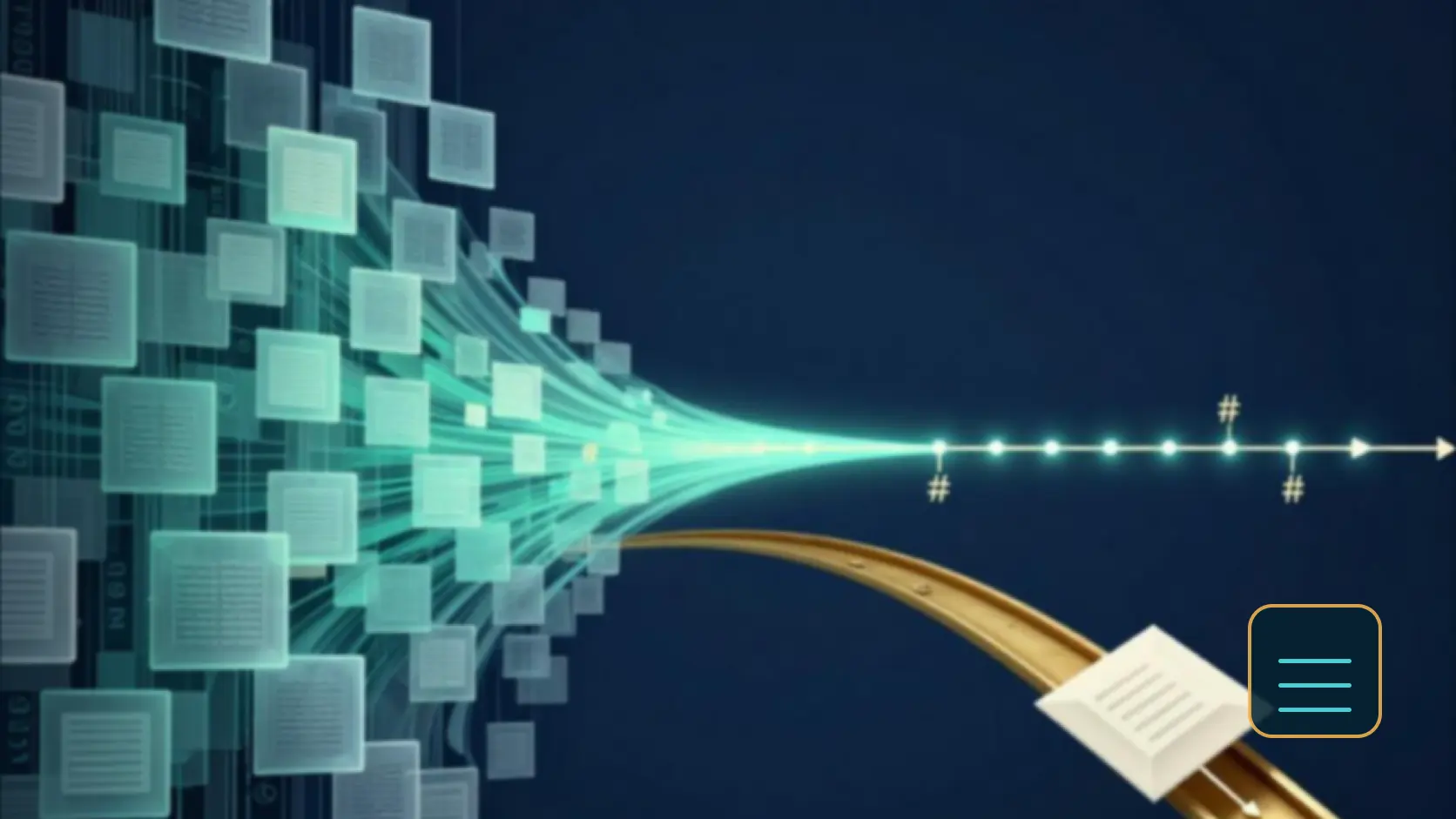
The Orange team changes what the model sees. PCAP-LM stores session metadata, flow summaries, an event stream and an anomaly annex. PacketGlyphs encode direction, TCP/TLS state, a size bucket and a delay bucket in a few characters. Repeated patterns become run-length expressions. The model receives a story about conversations rather than a heap of frame fields.
The compression is real and easy to measure. On 60 held-out files, PCAP-LM after BPE and run-length encoding averaged 23,091 estimated tokens. The paper reports 812-times fewer tokens than tshark -V, 955-times fewer than tshark -T json and 37-times fewer than its raw-byte estimate. Large captures fit inside one context window.
The question-answer test looks even more dramatic. The team asked ten questions of each of 30 held-out server-side files: 300 answers. Claude Sonnet 4.6 answered 297 correctly from PCAP-LM, or 99.3%. The token-budget-matched tshark -V prefix answered 51%. That prefix usually exposed only the first 1–3% of packets. Packet totals, duration and late retransmissions disappeared before the model even started reasoning.
The authors make that baseline limitation explicit. PCAP-LM wins because it summarizes the whole capture; the comparison gives the model a detailed view of a tiny opening slice. A 51% score says little about the best tshark-based agent loop. It shows that a long, exact text export cannot serve as a single-context overview.
The useful result becomes clearer when the same paper exposes its loss. Exact sequence numbers, sub-millisecond timings and payload bytes are absent from the main document. A @REFS side index maps summarized flows back to original frame numbers, allowing a later tool to fetch the raw packet.
Retransmission detection shows why that path matters. The detector had precision 1.000 and recall 0.761 against tshark ground truth. Eleven misses came from one node class where an upstream TCP proxy modified sequence numbers. The glyph representation retained packet direction and state; it lost the sequence detail needed by its simplified duplicate detector.
That is a 24% false-negative rate for this test. A cloud portal can read the whole flow and still miss the recovery event an operator is trying to prove. The right response is not to throw away the summary. It is to send every consequential anomaly through the raw-frame path.
The evaluated corpus also stays narrow. It contains HTTPS bulk downloads between fixed endpoints on a 5G/4G production network. The learned vocabulary saturated at 159 tokens. The paper estimates 2,000–4,000 composite tokens might be needed for mixed enterprise traffic, QUIC boundaries, SMTP phases or HTTP/2 frame types. A low token bill on a homogeneous test does not predict a production enterprise capture.
There were two other errors in the 300 answers. The model misread session-level dominant direction in the two largest two-flow captures. The proposed fix is a session byte-direction aggregate. Asymmetric-traffic detection was tested on synthetic captures; the real corpus contained no such case. Those are concrete gaps, not reasons to pretend the representation proved more than its test proved.
For an operator, PCAP-LM works as a first reader. It can expose conversation count, duration, ports, TLS metadata, repeated motifs and candidate anomalies before anyone loads the raw trace. A linked tool should then expand a suspicious flow to frames and return the evidence to a human or deterministic check.
The paper says payloads are discarded and addresses, hostnames and filenames are pseudonymised locally before cloud processing. A production pilot must prove that statement at the field boundary, not accept it from the diagram. Keep the original capture, the pseudonymisation map, the generated PCAP-LM file, frame references and their hashes under one custody record.
Marjou’s best contribution is the attention model for packet evidence: summarize the whole conversation, then zoom into the packet that decides the case. The 297 correct answers show the format can preserve enough context for forensic reasoning. The eleven missed retransmissions show why the green answer still needs a frame number beneath it.
Sources: APNIC article; Xavier Marjou profile; arXiv abstract; arXiv paper.
Member Briefing
Read the full trend briefing
Members read the full briefing with the source notes behind every finding.
Strategic Circle
A daily briefing in your language, built from changes we have verified.
Join for USD 20/monthCancel anytime.
Members also get the full research library, a daily briefing on the networks they follow and the private forum.